This is definitely the most attainable idea so far.
Biggest downside is the need for 221 distinct loci per palace. For speed in encoding it could be a chore to zoom to the correct value loci / suit sub-loci. Some kind of intuitive marker system or lots of drilling will be needed to get to a point of instantaneous location finding via that first card. But, palaces are unchanging and can be learned to fluency fairly quickly. It will be a challenge to craft each loci in a way that there are four distinct encoding zones for those suits, but again, this will be a predetermined layout that once set, is set. Usually for card practice its good to have several palaces so that you can practice multiple deck memorizing attempts per day. It will take a while to prep and practice multiple palaces with this extensive loci set-up, but it may be worth it for the benefits that can be extracted.
The idea of using spatial features to actually encode details is really great and I think is head and shoulders above category modifiers that affect the imagery. Combining this with the agent-observer idea to determine the 2-block suit designation is really smart. The images stay as learned, while the position and interaction encodes the critical additional details.
If you have a 2704 card system of any kind, you could even just use those combined with loci encoding to get you to 3 cards in one image, with agent-observer technique not needed. The animation and interaction can be whatever you want. I may explore this as a phase-two expansion once I get my 2704-PO locked in.
Just to make sure I’m grasping it correctly, and as a practical demo for others, here’s an example for how I’d encode a 3-card image for [A  ] [2 ] [3 ] if it was my first set in the deck.
I’d see that triple set and quickly recognize that “at palace zone 1, loci 1 / sub-loci 1 (for [A ]), I will observe my image for [2 ] [3 ].”
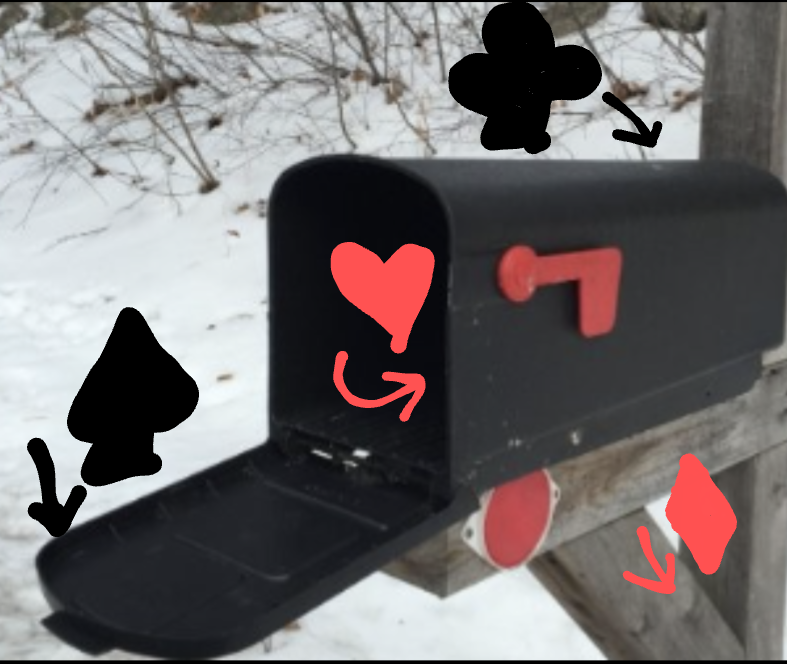
Since it’s the first set, the image will go into my first palace zone, lets say this is my house. The first card is an Ace so it will live at my first loci. Lets say this is my mailbox. I need to determine 4 sub-loci zones to represent the first card suit. This is where it can get a little tricky as some loci may not have ideal “front left / front right / back left / back right” features.
I’m going to say that the front flap of the box will be Spade zone, inside the box at the back will be the Heart zone, sitting on top of the mailbox will be for Clubs, and hanging onto the post underneath the box will be for diamonds.
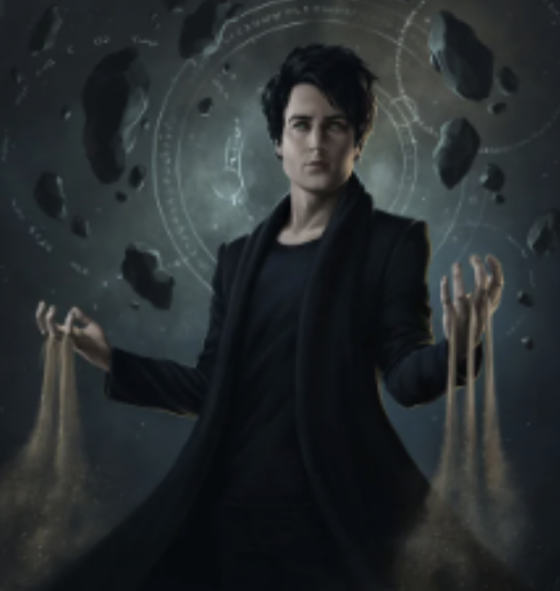
So, my image will live at on the front flap of the mailbox because the first card suit is a Spade. Now I just need to retrieve my image for the pair that’s created by card 2 and 3… [2 ] [3 ]. This pair is represented by the Sandman for me. (Lets assume this is a 2-block image that could also represent [2  ] [3 ])
So we’ve got the front of the mailbox where the Sandman lives… This tells us we have the Ace of Spades as the first card and either the 2 and 3 of Spades or 2 and 3 of Hearts. To lock in that second pair, we apply the agent-observer method. If the pair was red-first we would imagine ourselves interacting with the Sandman in some way. It’s not, it’s black-first, so we take the perspective of an observer watching the Sandman do something on his own.
So I picture the mailbox sitting open, the Sandman is using the front flap as springboard, he’s bouncing up and down on it, all the while flinging fistfuls of sand everywhere.
That encodes the first three cards.
For the second set, say [3 ] [4 ] [5 ] I think “in palace zone 2, at loci 3, sub-loci 2 (for [3 ]), I will interact with my image for [4 ] [5 ].”
I’d use the second pre-determined palace zone, maybe its my old school classroom. I’d go to the 3rd loci (maybe my desk) and the Hearts sub-loci (inside the desk) and there, I’d have a bowl of cereal (my image for [4 ] [5 ] and [4 ] [5 ]) In order to encode that its the red-first version. I actually interact with this scene. I’d imagine myself pouring a bowl of cereal all over the inside of the desk, completely soaking its contents.
So theres the first 6 cards, encoded by just Sandman and Cereal and their locations and interactions!
Now if I apply my Person/Object 2704-Card system images to this, I don’t even have to worry about encoding via agent/observer. I can place the exact image for the card pair and make it animate however I want. Having this approach could be awesome as it would really force the focus of the scene animation to be the image memorably interacting with the specific sub-loci. It would lean more heavily on the spacial recall to parse which loci was used in each palace area, but that may actually be a strength of this system. Only 17 total images for a full deck is amazing. (Technically this gets you 51 cards, but you’d just grab the final card or not even worry about it because it would be the only one left at the end!)
It will be a heavy lift to craft multiple palaces with all the loci needed, but it could be worth it. Even if you can get 4 palaces so that you can practice a couple times per day, it could be enough to build up to competition speed in a reasonable timeframe.
Well done, @Mike4 !!!
 : front left sublocus
 : front right sublocus
 : back left sublocus
 : back right sublocus