3-Card System (64-block card system)

After developing a 4-digit system, I was wondering if it would be possible to create a 3-card system to accompany it. I’m not talking about a “fake” 3-card system where there are actually 2 images (one for ranks and another for suits). I mean a “true” 3-card system. More precisely, I’m talking about a block system, like the shadow or the Double-2-Block system, because having 140,608 images would be impossible.

The following is what may make 4-digit systems common in the future:

First, we need to create something that I named “Formation Code.” This number is a 1- or 2-digit number that encodes what, if any, cards in the triple are picture cards (P) and what cards are number cards (#).

FORMATION CODE
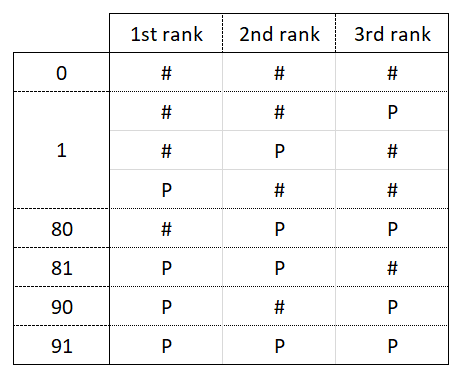
In other words:
0: there is no picture card;
1: there is one picture card;
80: there are two picture cards together in the end;
81: there are two picture cards together in the beginning;
90: there are two picture cards separated;
91: there are three picture cards.

We need a simple way of representing the ranks of number cards using digits:

NUMBER CARDS CODES
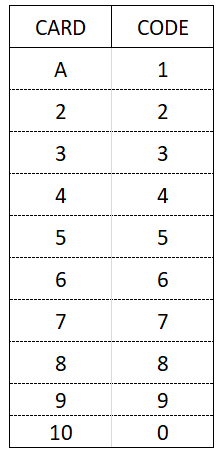
To represent picture cards, we are going to encode by pairs:

PICTURE CARDS CODES
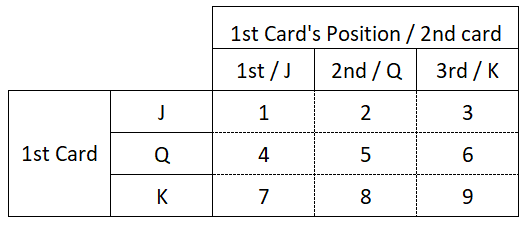
The columns may represent either the position of the picture card in the triple or the second picture card’s rank. For instance:

the pair “JQ” is 8
the triple “K49” has 7 as K’s number

That means that, if we don’t have a pair of cards, we can still use this table to encode both the picture card’s rank and its position in the triple. Notice that, if there are two picture cards, we can’t know where the pair is located based on the code alone; in these cases, the formation code is essential.

Moreover, it doesn’t matter if there is a number card between the picture cards. “1st Card” means “1st picture card in the triple” while “2nd card” means “2nd picture card in the triple.”

Example:
The picture cards in the triple Q2K are represented by 6

Now I’m going to explain how each triple of ranks can be encoded using a 4-digit number. One of the most important things is the following:

PRIORITY OF CODES:

  1. Formation code;
  2. Picture card’s code;
  3. Number card’s code (in order).

Examples:
786 is 0786 (Formation code: 0)
6Q2 is 1562 (Formation code=1 and Q=5 in this case)
10JK is 8030 (Formation code=80 and JK=3)
QJ3 is 8143 (Formation code=81 and QJ=4)
KAJ is 9071 (Formation code=90 and KJ=7)

For triples made exclusively of picture cards, the first one will be represented as if it were alone while the other two will be encoded as a pair:
KQJ is 9174 (Formation code=91, K in the 1st position = 7, and QJ=4)

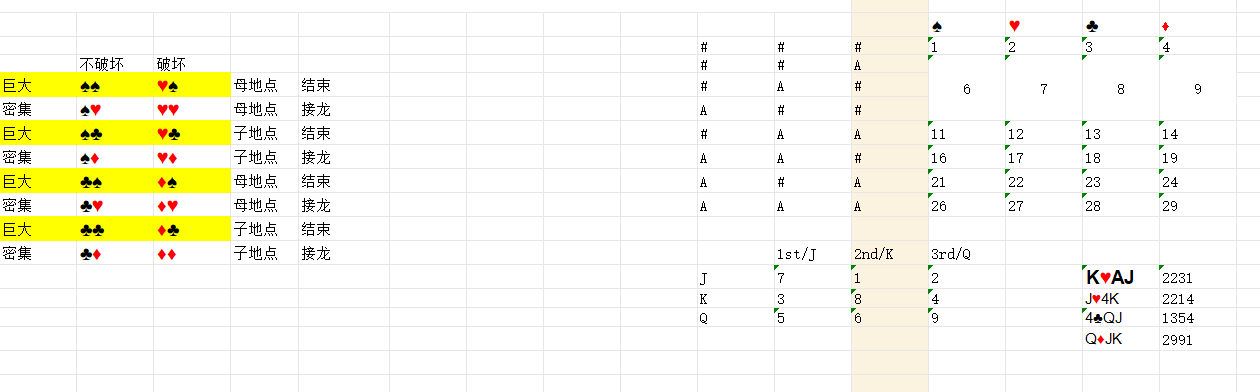
Now we can encode the ranks. What about the suits? Here is where I needed to create multiple blocks to encode information. Only the first suit has blocks that modify the final number. The other suits have blocks that change how the image will be stored in the memory palace.

For the first card’s suit, we are going to modify the formation code. The following is the conversion table:

FORMATION CODE CONVERSION
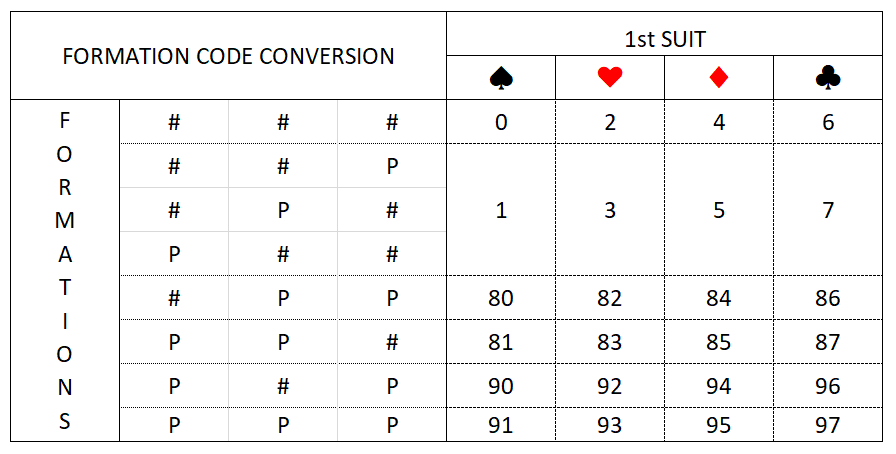
The table of formation codes that I showed in the beginning was incomplete, sorry. That one only contained the codes for when the first suit is :spades:. Don’t worry, the other codes aren’t difficult to memorize. They are just the left code plus 2. Also, notice that for the codes that have 2 digits, only the units change.

You can also give each suit a value (:spades:=0, :hearts:=1, :diamonds:=2, and :clubs:=3) and apply the following formula for the formation code:

Formation code = :spades:'s formation code + 2*Suit value

Now we can convert each triple of ranks (and the first suit) into a 4-digit number.

Examples:
J :hearts:4K is 9234 (Formation code is 90 + 2 * 1 = 92 and JK=3)
4 :clubs:QJ is 8644 (Formation code is 80 + 2 * 3 = 86 and QJ=4)
Q :diamonds: JK is 9543 (Formation code is 91 + 2 * 2 = 95, Q=4, JK=3)

The truly difficult part comes now: how to encode the remaining 16 suit combinations? I’m going to propose a standard solution, but I’m going to propose alternative strategies as well. You may pick the one that you prefer.

First, let’s name the strategies:

Sublocus Strategy: this strategy consists of dividing every locus of the memory palace into 2 (2-sublocus strategy) or 4 subloci (4-sublocus strategy). For instance, you may divide each locus into wall and floor, into right and left sides, or left side of the wall, right side of the wall, left side of the floor, and right side of the floor. This requires prior planning of the memory palace, especially if you want to divide it into 4 parts. In the 2-sublocus strategy, put the image inside the first sublocus if the second suit is :spades: or :hearts:; put the image inside the second sublocus if the second suit is :diamonds: or :clubs:. In 4-sublocus strategy, put the image inside the first sublocus if the second suit is :spades:, inside the second sublocus if it’s :hearts:, inside the third sublocus if it’s :diamonds:, and inside the fourth sublocus if it’s :clubs:.

Agent-Observer Strategy: we mostly imagine ourselves as observers instead of agents when memorizing. However, we can also imagine ourselves interacting with the images inside the locus. This strategy can be applied in two ways: Current-Agent-Observer or Next-Agent-Observer. In the former, we do the following: if the second suit is red, then I’m an agent interacting with the current image; if the second suit is black, then I’m an observer (I don’t interact with the current image). In the latter, we do differently: if the third suit is red, then I’m going to be an agent, interacting with the next image; if the third suit is black, then I’m going to be an observer, not interacting with the next image.

Variable Image Stacking: this is the only strategy not invented by me. It was invented by Johannes Mallow. In our context, It consists of putting the image in the current locus and going to the next one if the third suit is red; otherwise, keep putting images in the same locus;

Variable Story Stacking: most of us memorize by creating stories with our images in the memory palace. Some people create continuous stories (like legendary Ben Pridmore/ @Zoomy, who has commented on this forum that the loci work just as backgrounds for him). Others may cut the story at the end of locus. Some may even cut the story at the middle of the locus. Since the end of the story is independent of the end of the locus, we can use it to encode information: if the third suit is :spades: or :hearts:, then stop the story; if the third suit is :diamonds: or :clubs:, then keep the story going.

Now that you understand each strategy, you can choose them according to your preferences to encode the remaining 16 suit combinations. I would recommend three possible combinations. The orders were chosen to make visualization as fast as possible.

16 SUIT BLOCKS
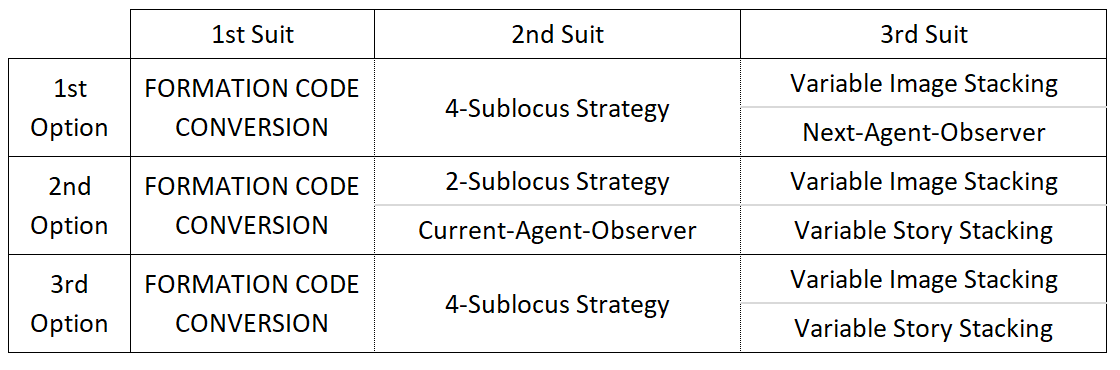
In my opinion, the second option is the best one because it isn’t too rigid and wouldn’t require me to divide my loci into too small spaces, but other people may disagree.

ENCODING
For any of the options, you should start by spotting the first suit. It will determine the list of formation codes to use. After that, read the ranks of the cards and convert them into a 4-digit number/image. Afterward, you need to apply the chosen strategy(ies) to encode the second suit. Finally, the strategies for the third suit tell you how to behave in the next locus, like “stay in the same locus” or “keep the story going.”

DECODING
Decode the image into a triple of ranks and the first suit. Later, try to recover the second suit by applying the opposite reasoning to your chosen strategy(ies). Finally, analyze the next locus to decode the third suit.

In conclusion, this system requires 8,788 images (3.25 times as many as the Ben System’s and 6.5 times as many as the Shadow System). On average, this method needs just 8.67 loci while 2-card systems usually need 13. In other words, there is a 50% improvement in card per image and a 33% decrease in number of loci.

I would love to know what you think about this system. Do you think it is possible to apply it? Would it be slower or faster? Could this system make 4-digit systems worth it?
2 Likes

Theoretically speaking, brilliant!

Definitely possible.

I think much slower at first than a single card PAO, 2-block, or true 2-card. Not sure if the time it would take to catch up to the speed attainable by those systems would be worth it or better spent investing in building instant fluency with one of them (probably the latter.)

Maybe. But likely in a limited set of circumstances. The challenge is obviously learning the card rules you’ve outlined and then having to convert the resulting number into an image. 4-digit systems are much more realistically attainable for certain language constructions that allow for direct reading. I’m not sure how viable actually drilling and learning associations to fluency would be for that many images, but if you use a language and number system that is easily read in 4 digits, you wouldn’t have to drill everything as much. If you are good at making words or phrases on the fly with number systems, this card application may work to a degree, but I doubt it would ever beat a well-drilled fluent smaller scale system simply due to the delay when having to create those images and then having to apply the observer or loci stacking rules needed. If you can just go “imageA interacts with imageB” at each loci, your focus and mental energy can be fully dedicated to vivid encoding and it can happen really really fast. Speed is sacrificed with each additional step that needs to be actively considered and calculated. If you encounter a number that you haven’t prepped or is just particularly challenging to convert on the fly, any previous speed advantage will take a huge hit. You kind of need to hope that all 17 numbers needed for a deck are very quick to visualize after figuring out their phrasing. I think theres just a bit too much extra here to make it practical in a competitive sense.

Alllll of that said, the idea is really clever and original. A true 3-card system is kind of the final frontier. Not sure if it’s beyond any kind of real practicality due to the exponential increase in elements. My feeling is that it probably isn’t going to be realistic. I love theorizing about it though. This was a fun read!

4 Likes

Thank you so much, Tim!

I think the same, and this idea of a 4-digit system + 3-card system is making me feel unsatisfied with the 3-digit system that I haven’t even finished learning yet. I had thought 3-digit + 2-card would be something I’d create once and then never ever change, focusing exclusively on getting better with it. Greed is a strong thing man, haha

Btw, I noticed that it actually doesn’t need to get as fast as a 2-card system. For example, let’s suppose three people (PAO, 2-card, and 3-card) memorize a deck in 52 seconds.

PAO: 1 deck in 52 sec means that they spent 1 sec/image
2-Card: 2 sec/image
3-card: 3 sec/image

This means you could take 50% longer per image and still be as good as someone using a 2-card system. In my opinion, the rules I outlined are actually easier than the Shadow’s since there aren’t exceptions, so maybe you’d have even longer than 50% extra time.

I’m also not sure. I look at it and feel like “that’s too much work,” but I always remember how crazy the Ben System is compared with a simple PAO (17.3 times bigger while a 3-card system is 3.25 times bigger than Ben’s). How revolutionary was it? I think of how complex the Shadow System is, to the point no one gets it at first. If this thing works, it may be the last major improvement. Isn’t being part of it exciting? If this becomes a thing in the future, not undertaking it would make me regretful, haha.

Hmm, I was thinking about what you said on my 4-digit system post. You’re right. If I ever build that list, I’d try as much as possible to pick CCVC or CVCC words. They’re the easiest because they often have one syllable only. Sometimes it would be impossible to find anything following this pattern, so I’d pick a CVCV word. VCVC or VCCV would be hellish combinations to learn since they both have two syllables and start with a vowel, so I’d try my best never to use them. Do you think having these priorities would solve the problem?

I abandoned my aversion to competitions some months ago. Since I now wanna become really fast, I’m gonna go with my 3-digit system. However, if I build a 4-digit list throughout many years, I may manage to dilute the immense workload to make it doable. What do you think?

2 Likes

Wow, this is incredible, this idea is completely feasible.

The image of the shadow system is one image representing 2 card suits at the same time, but this 64-block card system has 1 image representing 16 suits.
This process of judging images from a 16 card suit I think may affect memory and recall speed.
At least 3 strategies are needed to tell which card suit an image belongs to.
It takes a long time to create 8788 images and become fully familiar with them.

Anyway, the idea is very wonderful. thank you for your work

3 Likes

Thank you, Honje!

I’m glad you like it.

You’re already building a 4-digit system, right? This 3-card system will have almost no cost for you, so I think it’s quite worth a try in your case. If, when you finish learning your list, you decide to apply this 3-card system, I’d love to see how it goes.

1 Like

I think I still choose to use the Ben system
The reason is
If the Ben system is used to its extreme
It’s enough for me to memorize the speed card to within 10 seconds.
No offense intended, but there is a strong possibility that the advantages of the 3 cards system will be difficult to exploit.
Whether it is an electronic competition or a traditional competition.
I deduce that the best speed of the 3 cards system will hardly exceed the potential best record of the Ben system.
The reason is that the time cost is too high.

It can be inferred from the 4 digit system.
Although the potential for breaking world records in the future is huge
But there are definitely only a few people who can persevere

I know the Chinese memory athletes very well
In order to achieve quick results, they only use the 1-card system and the 2 digit system or the PAO system.
This system only takes 3 months to reach the top level. It even takes just 3 months to break a world record.

I asked them repeatedly if they would like to use the 3-digit system and the 2-cards system.
they can only
shrink back at the sight of something difficult

2 Likes

No offense taken! I’m also skeptical that this system could work in a realistic time frame. I believe it may work if someone takes it as their lifelong system/project, though. Now you wanna break that speed card record, and I hope to become a grandmaster in future years, so this 3-card system isn’t worth it to any of us, at least at the moment.

So I guess you’re gonna use the Simon System only to memorize numbers, right?

Indeed. That is the cool thing about a 2-digit system. It’s so small that the brain gets used to the conversion very quickly compared with a 3-digit one.

2 Likes

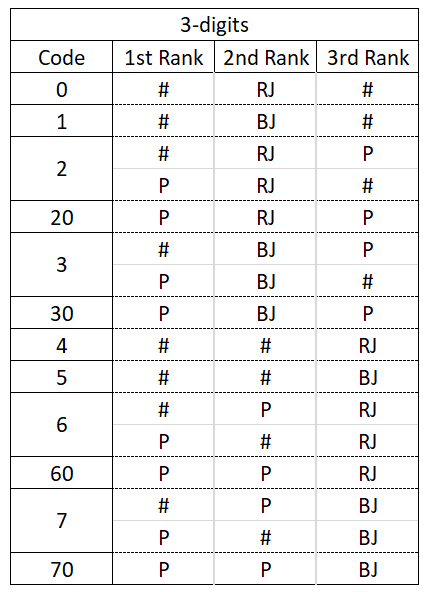
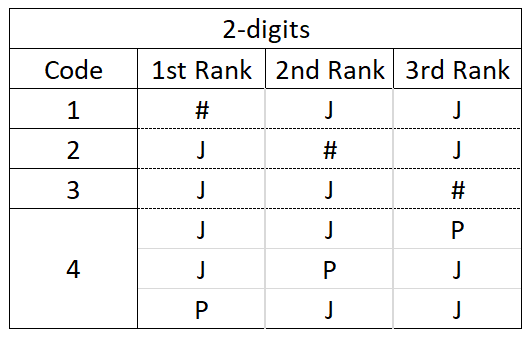
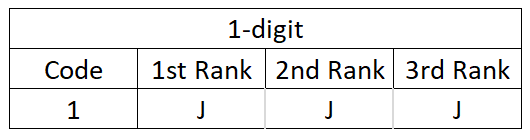
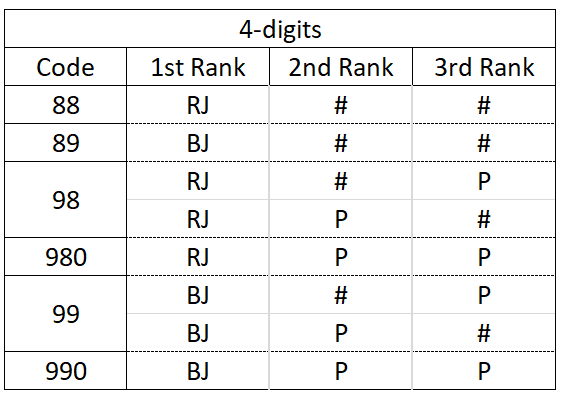
For completeness, I was thinking if it would be possible to encode jokers as well, just like I did to Double-2-block system. In order to do so, we need 3-, 2-, and 1-digit lists. The following are the tables with the formation codes for jokers (red joker=RJ & black joker=BJ):


When there is just one joker, the formation code determines both the sequence and the suit of the joker. When there are two jokers (2-digits), their suits are determined by 4-subloci strategy while the suit of the normal card is determined by variable image stacking + next-agent-observer strategy. When there are three jokers, you need to apply 2-sublocus strategy to encode the suit of the first one and variable image stacking + next-agent-observer to encode the last two.

Admittedly, these rules are confusing, and they are just a thought experiment. Memorizing jokers makes this system harder than it already is.

(Btw, I changed my mind on what group of strategies for encoding suits would work better. Variable Story stacking is bad. I’d pick the first option instead)

2 Likes

I used Python code to generate 140,608 total combinations of 3 cards

1 Like

That’s an insanely long list for sure.

May I ask you how you plan to use it?

I don’t know, and I’m not sure yet what I will do. All that remains is to match the numbers to the cards.

1 Like

I just noticed that there are obviously 4 suits, why do the rules you set only have 3 options? Shouldn’t there be 4 options each for 1st Suit, 2nd Suit, and 3rd Suit?

If there are only 3 options, it should be impossible to distinguish between 4 suits.

It has to be at least like the second three-card system.

There is a big problem here, Variable Image Stacking and Variable Story Stacking, in my opinion, they are the same strategy. Just the name is different.

1 Like

Each option is a different set of strategies that you may use to encode the three suits. The idea is to pick one, and only one, option and practice it.

Some of these strategies, like the formation code conversion can encode the four suits. The 4-subloci strategy can encode four suits as well. Variable image stacking can only encode two pairs of suits, so you need another strategy to combine and find out the exact suit, like the agent-observer strategy.

There is a subtle difference, but it’s too small to be effective, indeed. So I’d choose the first option if I were to use this system.

1 Like