A few days ago, I made a post showing the first 3-card system. It may work if someone devotes years to master it since it requires really many images, 8,788 more precisely. Later, @Honje (Jedidiah Benedict) made a post showing another block strategy to decrease the number of images needed. Using it together with the strategies I created, a 3-card system with just 2,197 images is possible.
The only requirement is having 2 groups of 3- and 2-digit lists; in my case, it’s a group of people and a group of objects.
First, we need a way to represent the ranks. For number cards, it’s simply the rank’s number (A=1 and 10=0). For picture cards, we are going to encode them in pairs:
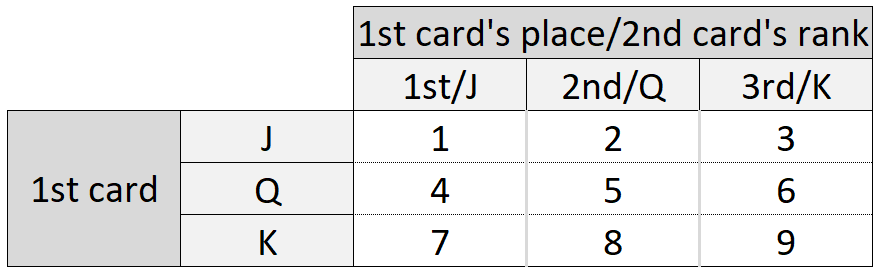
The columns represent either the position of the first picture card or the value of the second one.
To know whether or not there are picture cards and where they are in the triple, we need something called formation code, which is a 1- or 2-digit number. Not all combinations have this code, though. The following table shows how this works:
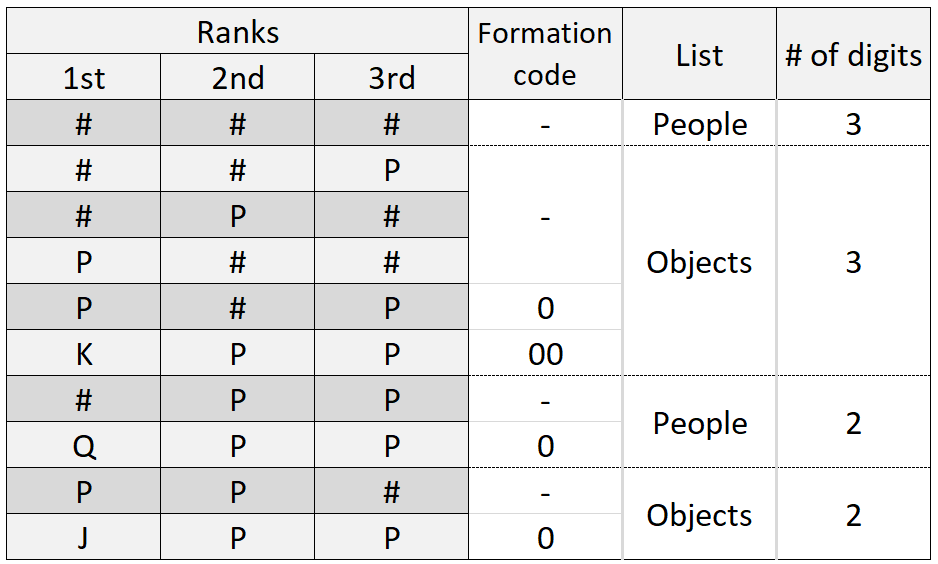
(# means number card, P means picture card, J means jacks, Q means queen, and K means king)
To form the triple’s number, we are going to use this order:
Formation code
Picture cards code
Number cards code
After all this, a number for the ranks triple is made. In order to encode the suits, we are going to use the block strategies displayed in the following table:
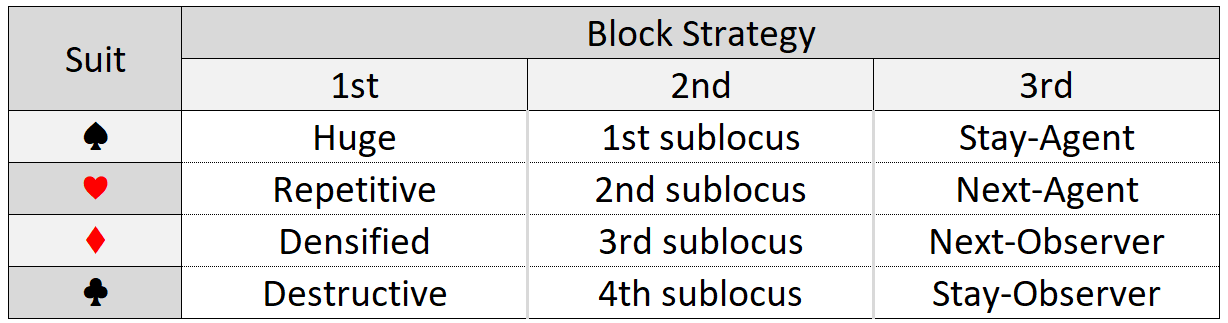
The third suit would be encoded using both Joahannes’s Variable Image Stacking and Agent-Observer Strategy.
(If you want to understand all these strategies better, read the post on the first 3-card system and Honje’s post)
What do you think of this system? Would it be better than the Double-2-Block System? I really need advice here because I’m gonna finish learning my 3-digit list this week, but I don’t know what system to apply.
this is an extremely compressed system, so each block would slow me down significantly. However, since there are also fewer images per deck (17 instead of 26), this system could be 33% slower than a 2-card system in card-image conversion and still achieve the same results. What do you think?