Introduction:
This is a complete description of a system for memorizing 2 cards per image. It is an alternative to those who find the Ben System too big or the Shadow System (SS) too complex. The former requires 2704 images while the latter requires only 1352, but has multiple rules and can’t be implemented with any 3-digit list.
The Double-2-Block System (D2B) converts any pair of cards into a 3-digit number, which can be memorized using the system of your preference. It could be a list following the Dominic System, the Major System, the Ben System, or any other.
Instructions:
To apply D2B, you will need two 3-digit lists, but only 676 images of each will be used, so there will be only 1352 in total. I’d recommend having a list containing only people and another containing only objects to ensure they are distinguishable enough.
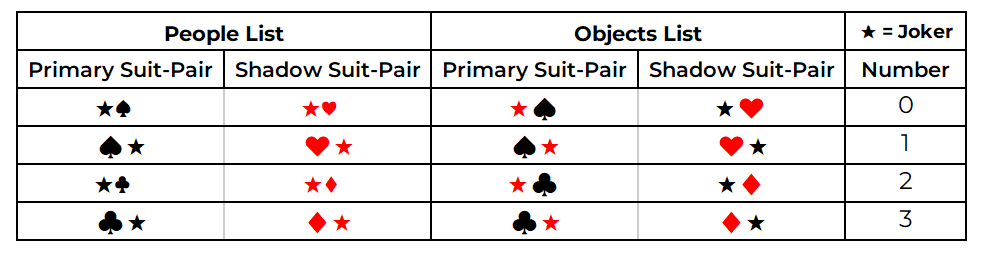
First, the 16 suit-pairs are divided into two blocks of 8 suit-pairs. People are used to representing pairs of cards of the same color; otherwise, objects are used. Second, each block is divided into two groups of 4, based on whether it starts with red or not. Just like in SS, those combinations will be differentiated using the variable-locus strategy created by Johannes Mallow. Finally, A number between 0 and 3 is chosen to represent each quadruple of suit-pairs. The following image summarizes these ideas:
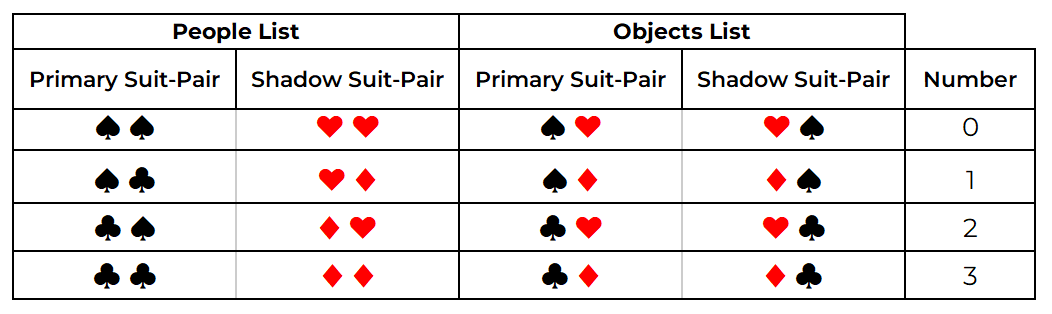
To encode the ranks, a different strategy is implemented, depending on whether or not the card is a picture card (PC). If it is a number card, then the number of the rank represents the card (A = 1 and 10 = 0). If it is a PC, then the card has a primary and secondary number:
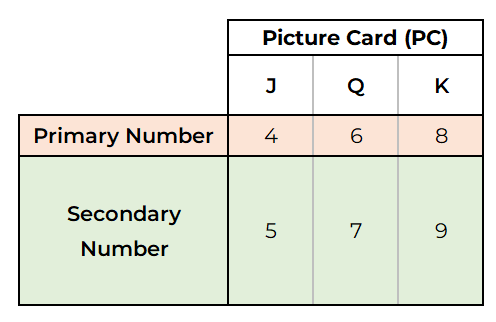
Whether the primary or secondary number will be used depends on where the PC is in the pair. If there is a number card followed by a PC, then the primary number will be used to represent the PC. If either the first card or both are PC, then only secondary numbers will be used. (Edit: didn’t you find this intuitive? Me neither. I later changed the system to make it even more didactic. You can find the post containing the new version here)
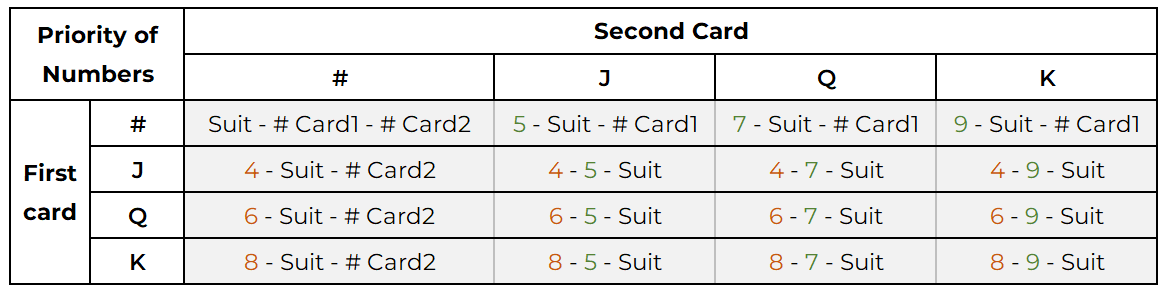
To determine the order of the digits, you only need to follow two rules:
- PC has priority over suit-pair;
- Suit-pair has priority over number card.
The following is an image exemplifying all possible combinations:
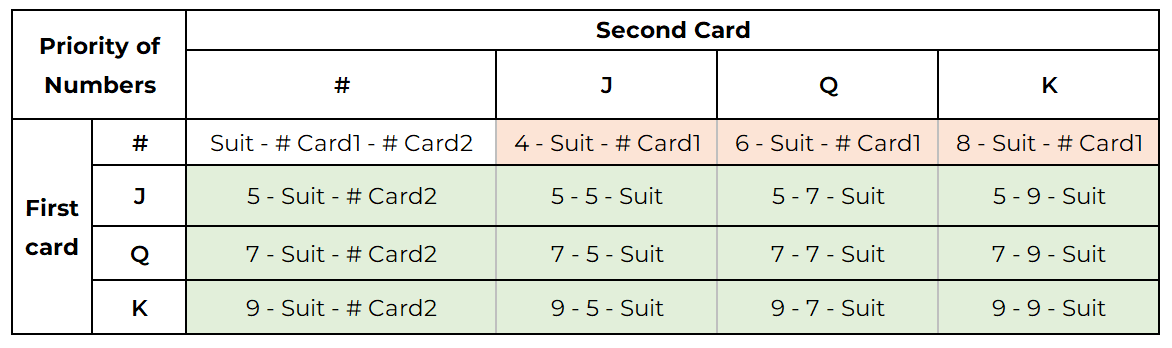
(“#” means number; “# Card1” and “# Card2” mean the number of the first card and number of card 2, respectively; “Suit” refers to the number of the suit-pair; the orange and green colors represent whether the primary or the secondary number was used, respectively)
Examples:
Q  - 3
- 3  would be represented by an object of number 723 (Q-Suit-3)
8  - 8 would be represented by a person of number 388 (Suit-8-8)
J - K would be represented by an object of number 592 (J-K-Suit)
4  - 7 would be represented by a person of number 147 (Suit-4-7)
5 - Q would be represented by an object of number 615 (Q-Suit-5)
10 - 6 would be represented by a person of number 206 (Suit-10-6)
J - J would be represented by a person of number 550 (J-J-Suit)
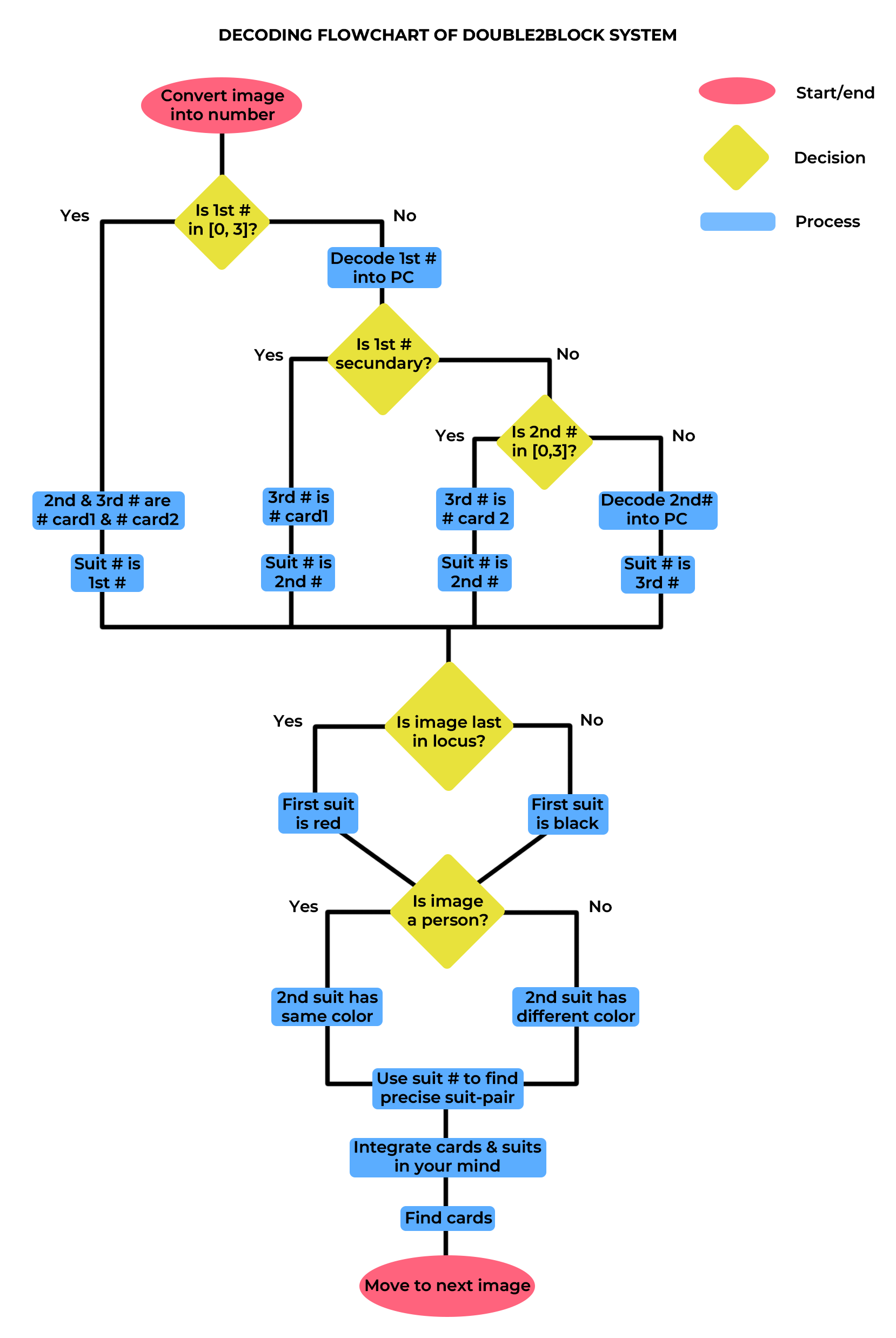
After creating your image, you need to put it in your memory palace. To do this, the variable-locus strategy is implemented. In brief, if the first card of the pair is red, you should put the image in the current locus and move to the next one; otherwise, you should put the image in the current locus and stay.
During recall of the suit-pair, follow the reasoning in the opposite direction: if it is the last image of the locus, then the suit-pair starts with a red suit; otherwise, it starts with a black one. If the image is a person, then both suits have the same color; otherwise, they have opposite colors. Afterward, decode the suit number into the precise suit-pair.
The variable-locus strategy has a downside: sometimes loci will get crowded or almost empty. To understand why this is not such a big problem, I recommend you to read Alex Mullen’s post. He uses SS, but his arguments apply to D2B as well.
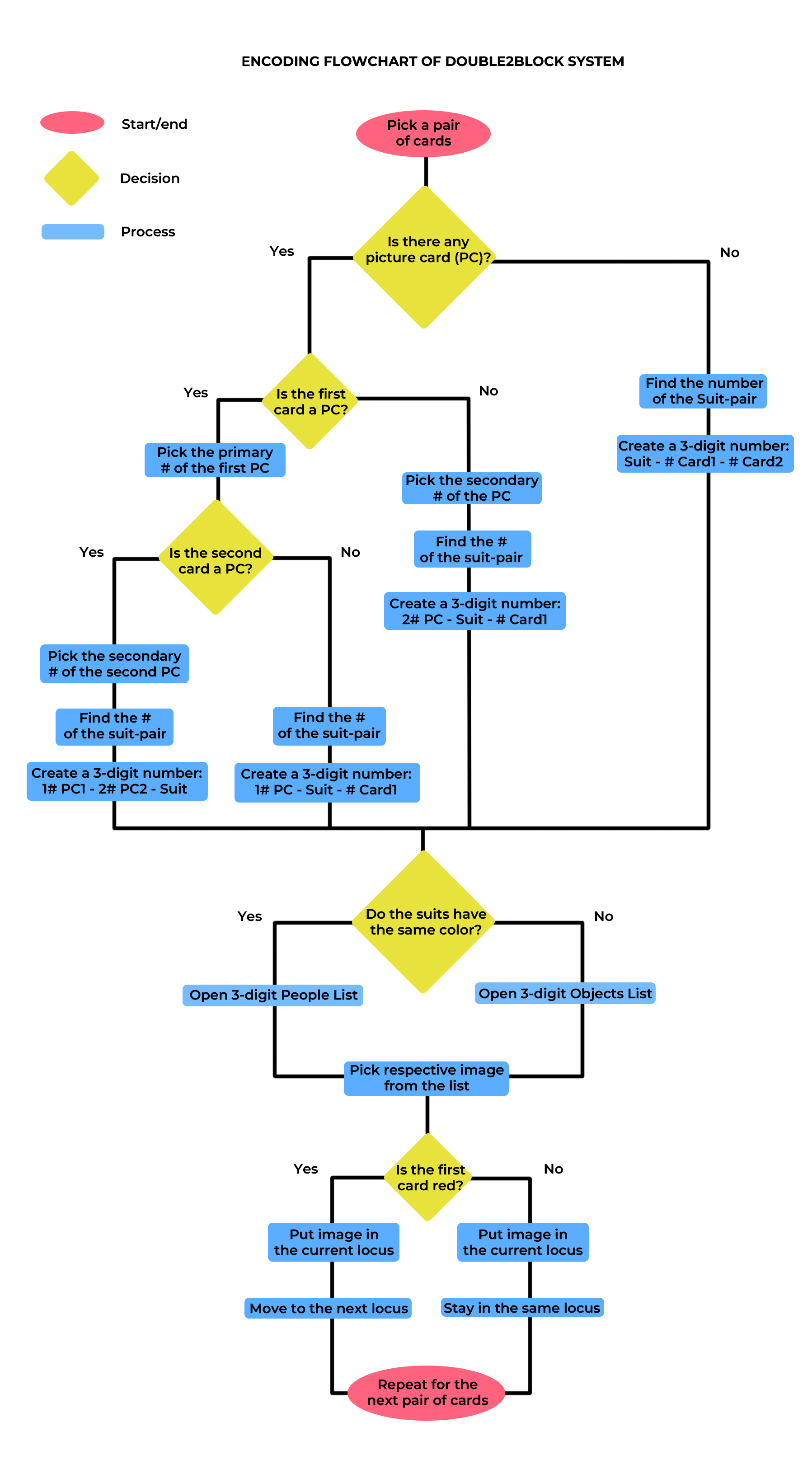
To illustrate the system even better, the following are flowcharts/decision trees describing the encoding and decoding processes of cards.
Encoding: transforming pairs of cards into images

Decoding: transforming images into pairs of cards

(“1st #,” “2nd #,” and “3rd #” mean first digit, second digit, and third digit, respectively; “Suit #” means the number of suit-pair; “[0,3]” means the interval of numbers between 0 and 3, including 0 and 3)
Advantages:
- It has only 1352 images, making it smaller than the Ben System and equal in size to SS;
- It has far fewer rules to learn than SS, so it will likely be learned very quickly;
- It is not restricted to any particular number system, like Major, Dominic, or Ben. In fact, I created D2B because my Major System is inconsistent with SS;
- It is not necessary to create extra images for it if you already have a 3-digit system;
- It is not exclusive to the English language, like the Ben System, so, for example, you can take words from any tongue without worrying about the vowels.
Disadvantages:
- I haven’t used it yet, so I don’t know if it truly works.
The reason why I’m posting D2B now before even applying it is twofold:
- To possibly receive feedback before I start practicing intensively;
- Since it will take a long time for me to finish my 3-digit objects list, I wanted to write down all instructions, for I’ll have probably forgotten most details of D2B until then.
This system was developed after discussing a previous idea with @TheHumanTim in another post on the forum. His help was essential, and he coined the name Double-2-Block System.
If you have any question or criticism, please don’t hesitate to share it here!
 - J
- J  - 8
- 8  - A
- A 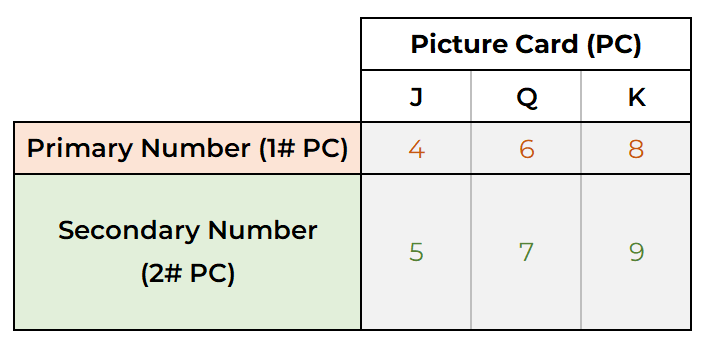
 would be represented by an object of number 00