Study: Synesthesia Can Be Learned

Scientists Think Synaesthesia Is Something You Can Learn

A recent experiment by conducted by the University of Sussex suggests it may be possible to learn to experience synesthesia, a rare condition that mixes up brain signals and leads people to hear colors or taste words. Researcher David Bor had volunteers read ebooks with 13 letters consistently written in a specific color. In addition, the volunteers spent 30 minutes every day associating the letters and colors, working on increasingly difficult tasks.

Adults Can Be Trained to Acquire Synesthetic Experiences

Synesthesia is a condition where presentation of one perceptual class consistently evokes additional experiences in different perceptual categories. Synesthesia is widely considered a congenital condition, although an alternative view is that it is underpinned by repeated exposure to combined perceptual features at key developmental stages. Here we explore the potential for repeated associative learning to shape and engender synesthetic experiences. Non-synesthetic adult participants engaged in an extensive training regime that involved adaptive memory and reading tasks, designed to reinforce 13 specific letter-color associations. Following training, subjects exhibited a range of standard behavioral and physiological markers for grapheme-color synesthesia; crucially, most also described perceiving color experiences for achromatic letters, inside and outside the lab, where such experiences are usually considered the hallmark of genuine synesthetes. Collectively our results are consistent with developmental accounts of synesthesia and illuminate a previously unsuspected potential for new learning to shape perceptual experience, even in adulthood.

Another article:
People taught synaesthesia learn to read in colour

See also:

Edit: you can create colorized ebooks with the synesthesia ebook colorizer tool.

Update: Colorize ebooks and other text for synesthesia training
5 Likes

Continuing from another discussion:

I found a paper on synesthesia from 2014 from the ideasthesia Wikipedia page. I only read part of if so far, but it looks interesting.

Currently, little is known about how synesthesia develops and which aspects of synesthesia can be acquired through a learning process.

https://www.ncbi.nlm.nih.gov/pmc/articles/PMC4137691/

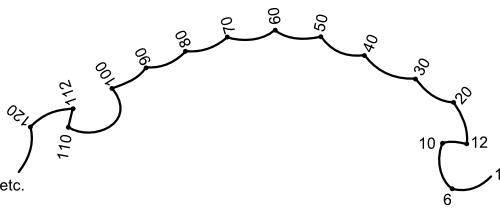
Just a side note: in addition to the colored magnets study , number-form synesthesia can be based on clock faces like this (1-12):

That doesn’t mean that there isn’t a narrow window of time where synesthesia has to be developed, but it seems to happen after birth.

2 Likes

What is the reason for wanting to develop synesthesia?

Is there any evidence that developing it (assuming that to be possible) would confer any benefits?

Or is it synesthesia for its own sake?

2 Likes

Fascinating! Thank you for posting.
Mark

“Training consisted of ~30 minute sessions including 4–5 tasks per day, 5 days per week, for 9 weeks, with one or two new tasks each week replacing older tasks (Table s3). In addition, “homework” was assigned on each training day, which involved reading an e-book at home, with colored letters to match the training tasks”

Look at how much effort was required to sort of experience it. Not to mention that they only focused on 13 letters.

And as all the other studies, they don’t say the result was permanent. Probably because it never is.

Intense training for all that.

I appreciate the effort but it hasn’t convinced me that genuine synesthesia is achievable by sheer training. It’s only shown me how difficult it is to obtain a very small portion of a presumably synesthetic experience, let alone the real deal.

3 Likes

Continuing the conversation.

And as all the other studies, they don’t say the result was permanent. Probably because it never is.

user_7e said spaced repetition is the answer.
Does this not mean that it would look like this:

1 day 7 days 16 days 35 days 90 days 1 year 3 years 10 years 30 years 90 years?

90 years for most people is permanent. It is only 10 repetitions?

I am not really confident about all of this.

From what I understand now.
Synaesthesia is possible to acquire. Including as an adult with training.
Results do not last. Therefore it is imperfect.
It is time consuming and difficult.

You are saying results will never last.
user_7e is saying results will last with spaced repetition.

There are no studies on increasing the duration of results.

But it is true that if you train forever you do not lose results?
If you train for 10 years you will lose results in 3 months?

It all sounds unlikely.
Maybe it has not been enough time. This study was in 2014. It is now 2021.

I thought about your potential theory. It still does not make sense.

the thing with brain plasticity is that the brain is also inclined to go back to the way it was.

Your brain developed the potential for synesthesia before you actually experience synesthesia

Because it’s about the way the brain is formed that allows for synesthesia this means that synesthesia can also be formed by brain damage

What I don’t understand is this.

If the brain goes back to the way it was.
Then why does brain damage not repair itself?

If brain damage is too much for the brain to go back.
Does that not mean that training for longer will make results permanent?

First; it’s not my theory.

I guess there is a limit as to how far you can push your own brain to change through training.

We have limits in other areas as well like working memory.

Right now nobody ever developed a savant-like working memory through training and memory techniques don’t have a significant effect on working memory, if at all.

The difference with brain damage is that the brain is physically changed from an outside force.

You can’t train your left hemisphere to become a savant but if you hit it really hard with a baseball your brain has no choice but to physically change. A change we can’t create with training

This is actually what happened to Orlando Serrel, a special case of acquired savant syndrome.

https://youtu.be/iG8ZarX1Kp0

There are many examples of people who did something for years but have lost most of their skills after they stopped investing their time into it.

A great example is Rudiger Gamm. He used to be able to calculate an 8x8 digit multiplication in his head in less than 30 seconds but now he struggles with a much easier 3x3 multiplication as was visible in his appearence on the show “Super Brain” in China, which took him more than a minute to calculate.

Once you stop training, practising or learning, you would be suprised at how good the brain is in forgetting all those skills.

That’s why doctors have to keep themselves up to date, same for lawyers, judges and many other professions. Otherwise, they will forget most things, even if they have been doing it for decades.

No, this is not how it would go down.

That way would only work for a short period of time.

After a while you would need to do training with a consistent time interval.

It would most likely go like this:

1 day, 7 days, 16 days, 35 days, 90 days, 90 days, 35 days, 90 days, 90 days, 35 days, etc. If you are lucky.

If you had a job for 10 years and took a break for 10 years, you would forget a lot things. You would have to almost restart completely.

Here is a great example of a man who memorized 111,000 digits of pi.

https://www.google.nl/amp/s/amp.theguardian.com/science/alexs-adventures-in-numberland/2015/mar/13/pi-day-2015-memory-memorisation-world-record-japanese-akira-haraguchi

“I have been reciting more than 15,000 digits per day (since 2006). That takes up about an hour every day.
To me, reciting pi’s digits has the same meaning as chanting the Buddhist mantra and meditating. I’m actually trying to do more these days, making it a daily goal to recite more than 25,000 digits, which takes me about three hours.”

Spaced repetition reaches a plateau at one point.

1 Like

Everyone is saying different things.
I will try and process everything.

comeon

is different and incomplete to synesthesia given by definition

What is the precise definition?

Adult has already his basis of perception (more precisely, cognitive filters) set by the language constraints

Adults learn a different synaesthesia. Because they have cognitive filters that change it?

So because you have the word “happy”.
If you associate it. You will associate it in a language way.
Therefore it will not be similar to synaesthesia individuals.

This makes a lot of sense.
Does that mean that language causes a lot of subconscious effects?
Is there a book I can learn more from?

albinoblanke

The difference with brain damage is that the brain is physically changed from an outside force.

If you hit someone with a baseball bat.
Momentum moves brain connections?
What is the damage?
If it is just movement. Then it is not much different from training? Unless it is like comeon said.

physically changed

Plasticity is not physical change?

Rudiger Gamm…Orlando Serrel…

Savant.
Synaesthesia.
Calculation.

Are all the same??

for lawyers, judges and many other professions

I do not know about this.

A lot of people say memory works with spaced repetition.
I have found memory work with spaced repetition too.
Studies say it does too.
Also lawyers need memory?

1 day, 7 days, 16 days, 35 days, 90 days, 90 days, 35 days, 90 days, 90 days, 35 days

Why does it go up then down then up ??
Is this for all spaced repetition or only for skills?

Spaced repetition also reaches a plateau at one point.

Is that for memory? That would mean I cannot speak english anymore?
Where does it plateau? That does not make much sense. Unless it is at 70 years.
You said it goes up and down. Therefore it will never get to 1 year?

user_7e

In some cases you need more precise windows early on. It is also important to keep awareness of sort of chaos systems. Which I am just terming to imply unordered and more random or general associations. Compared to more direct associations these are more difficult to manage.

Sorry. I do not understand.

Unordered. Random. Do you mean patterns in data?
General associations. Do you mean seeing color as shapes?
Direct association. Do you mean E = yellow?

I wanted to ask this.
Spaced repetition works on non memory. Is that what you are saying?

While some memories will last a very long time in absence of interference

Is that why you do not need spaced repetition sometimes?
Sometimes you just remember things.

Reading your answer.
It sounds complicated. I do not know what to say.

It also does not need to take a long time. There are various tricks and important points that can speed things up.

It sounds like you spend a lot of time.
Is this all your own theory?

Me

This is a really long message.
According to comeon.
True synaesthesia is not acquired because language created cognitive filters.
According to albinoblanke.
Your body has a limit. so it is impossible to keep training results for long. Because this limit is not long.
According to user_7e.
Training needs spaced repetition too in order to keep it for long.
It is complicated.

I am a bit more confused now. But I also know more now.

From what I understand albinoblanke contradicts with user_7e.
user_7e says spaced repetition extends results.
Albinoblanke says it plateaus. Also behaves erratic after a point.

Albinoblanke also contradicts with comeon.
Comeon says it is cognitive filters due to language constraints.
Albinoblanke says it is the brain returning.

user_7e and Comeon do not contradict eachother?
user_7e says spaced repetition maintains results.
Also complicated factors are involved.
Comeon says more about acquiring synaesthesia.

user_7e can you explain it simpler?

Albinoblanke what is the theory source?

Also anyone. How do I quote with the name attached?

It looks like there is some evidence that it has benefits in certain situations.

https://www.sciencedirect.com/science/article/pii/S0042698918302001

My interest in it is probably because I’m a chronic experimenter (mental exercise, food, sleep, etc.). There might not be any benefit, but experimentation can lead to new ideas. Not having the exact result as a person with grapheme-color synesthesia from birth doesn’t mean that the experiment failed. :slight_smile:

Also, it might be possible for people with sensory crossover to increase or manage that sensory crossover.

Highlight some text on the page, and a “quote” button will pop up. Click that. It works even if you’ve already started writing your post.

There are more tips here: How to format text in the forum

3 Likes

Fascinating study. It makes some sense to me since we’ve seen interesting results in perceptual learning before, like how people can learn to operate with their vision flipped upside down.

Incidentally I’m taking part in a somewhat related study into whether adults can learn perfect pitch, or at least some degree of it. Stands to reason that if you can create an automatic link between colours and numbers, then maybe you can create an automatic link between note pitches and labels.

2 Likes

I’d be interested to hear how it goes. There are some related discussions about perfect pitch here:

1 Like

Everyone’s vision is in fact “flipped upside down” because of the way our eyes work… of course you can wear special goggles to flip it once more and then your brain will simply adapt after a couple of days… not sure what that has to do with synesthesia though.

They’re also not learning how to operate things upside down… it’s pretty much bumping into things until your brain flips the image again… so it’s not “that” kind of learning.

1 Like

Cheers! I’ve actually been doing the training for a year now, and kept a record of my performance over time. When I graphed the average error magnitude in semitones, I noticed a sort of logarithmic curve similar to what’s seen in motor learning – a huge improvement at the beginning, then the rate slows down over time. I’m down to around 0.5-1 semitones off on average per session now, reducing at about 0.01 semitones per day. I’m hopeful that I’ll actually reach a consistent 0 rather than plateau out where I am.

I might write up the experience when I’m finished the training. Unlike some of the linked discussions, this approach tries to avoid use of relative pitch as much as possible, so it feels like having 12 competing voters in my head when I hear a note. In the beginning, they were all quite dim and indistinguishable, but now there’s mostly one or two giving a more confident signal.

2 Likes

That sounds interesting. I’m sure that people here would be interested in the method, if you have time to write it up at some point. :slight_smile:

1 Like

Just adding personal experiences.
I have the more common synesthesia where I have colors associated with numbers, words, sounds associated with them, but I don’t see them in reality, they’re just associations that are very natural and automatic when I imagine them. Also it seems that I can (sort of) change those associations just through regular mnemonic training. So naturally E, energy, money – these are all green words for me, but if I were to try to imagine them as a different color, I’m pretty sure it would change, because I generally associate colors with every new word.

Another thing is if you think about it, almost anything can remind you of a color. Like soft calm sounds could be a grey-blue hue, reminding me of a morning pond. I mean, it’s all just senses reminding you of other senses that fit together in the same experience. So basketball clearly reminds me of oranges and yellows and browns – that’s sort of what most of the basketballs/court are colored. It really depends on what the life experiences are.

I don’t notice synesthesia much if I don’t pay attention to it. But if you were to ask me, what’s the color of this song, I’d surely have some answers. Or what’s the color of a feather touch – well white for me, because I think of white feathers. So I feel we might all have varying levels of synesthesia, we just have to ask that question – what color does this word remind me of? King is yellow because of the gold crowns they wear. A is red because I think of a red Apple. There are some things that are pretty interesting, like the letter Q – that’s like, a dark grey purple white black blue, hard to explain. I’m just ranting. But I think it’s pretty cool how the senses are interconnected.

Now what was really amazing for me is when I made a fantasy memory palace (e.g., a memory palace made in blank, empty imaginary space on a grid) – part of the palace has each location targeting a different sense. So, alright, Loc#1 we got something colorful, Loc#2 I put breathing – now breathing is fascinating because it’s almost a sense on its own in terms of physiological activity, I imagine that slot for inhale/exhale to calm my nerves down, then at Loc#3 I put sound – actually these locations are probably moreso reminders for me to turn my attention to mindfulness of sounds of the present moment, but I could hear like trumpets or violins there – then at Loc#4 I put emotions, like excited/relaxed, then Loc#5 we got movement, like I’m moving around with the body, all sorts of dance, then Loc#6 I put all sorts of touch feedback like splashing hot/cold water on the body, maybe feeling pressure on the finger tips, then Loc#7 put mathematical or logical contemplation like, TRUE FALSE NEXT IF THEN, sizes angles numbers calculations and work, then Loc#8 put smelling some mint or lemon, then Loc#9 put appreciating sipping on some water. There are more senses that can be had, but that 3x3 grid of all sorts of mental awareness really blows my mind, and when I try to access those nodes quickly, I feel pretty happy to notice all these senses and how remarkable they are. I mean, if you’re always paying attention to vision you might be forgetting how sweet it is to hear sounds. So switching between those locations in memory is just fascinating. Also reminds me to breathe, relax, appreciate, which is quite nice.

2 Likes

Your post is interesting.

The book Synesthesia by Richard Cytowic mentions that it’s a spectrum that all people experience to some degree. At one end there are “warm” and “cool” colors and metaphors, all the way up to experiencing colors for numbers and things like that.

(I haven’t finished the book yet.)