Double-2-Block System for Memorizing Cards (2x676 images)

Two lists of elements are needed for D2B. We’ve suggested people and objects as these are probably the most commonly used elements, but the two categories could be anything as long as they are easily distinguishable.

You could use all people and have one list be all male and the other all female.

You could use cartoon characters for one list and living humans for the other.

Foods and weapons.

People and pokemon.

Whatever you can associate with the numbers!

4 Likes

Nelson and I were just talking about the Shadow and perhaps learning it together.

People I’ve talked to tell me I understand the concept, but I don’t feel like I do. And I know I won’t until I actually set up for it and start using it.

If we do it, or I learn it on my own, I’ll definitely share whatever I learn along the way.

1 Like

I’m not quite sure what the issue is. The block conversions can be performed mentally and at the end you’ll arrive at the final correct pair. Just speak that pair.

Am I missing something? What point in the decoding process is tripping you up?

2 Likes

I also didn’t understand your question.

Se for mais fácil explicar sua dúvida em português, pode ser também.

1 Like

Sooooo, after much discussion with @Mike4 in the new 3-Card System Thread, we came across the idea to use “Variable Spacial Encoding” (VSE) to represent information about suit-pairs. By doing this, you can use a single list of 676 three-digit number images with no specific phonetic structural requirements and no need for a double list like a person/object setup. You can just use a single image and let the VSE be your guide to identifying the suits.

How does VSE work?

Good question.

To make this awesome technique happen, you’ll need to first create a memory palace with 26 areas. Each of those areas should have 2 distinct loci in them. Each of those loci should have 2 sub-loci (areas in or on the loci that are easily distinguishable.) This means you’ll need to drill down to 104 discreet potential areas where images can be placed and interact with.

Lets make a couple as examples.

  • Area 1 - Living Room
    *Loci 1.1 - Chair
    **Sub-loci 1.1.1 - On the chair cushion
    **Sub-Loci 1.1.2 - Under the chair
    *Loci 1.2 - Coffee Table
    **Sub-loci 1.2.1 - On top of the table
    **Sub-loci 12.2 - Under the table

  • Area 2 - Kitchen
    *Loci 2.1 - Stove
    **Sub-loci 2.1.1 - On top of the stove surface
    **Sub-Loci 2.1.2 - Inside the oven
    *Loci 2.2 - Refrigerator
    **Sub-loci 2.2.1 - Standing on the water / ice dispenser shelf
    **Sub-loci 2.2.2 - Inside the fridge

Ok, so now that we’ve defined our first two VSE zones, lets see how to get imagery placed so that those areas can encode information.

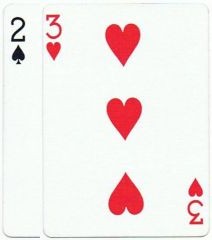
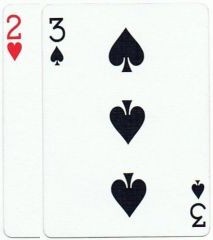
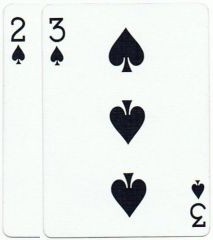
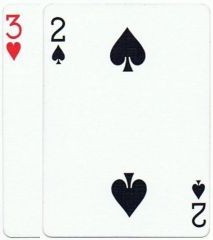
Lets take a look at the following card pairs as our first four cards to memorize:

and

They are both number/number pairs, so the priority rule tells us the numeric structure will be “Suit + Card1# + Card2#”

The first pair is “spade/spade”, which translates to a 0. When we include the card values in order we get 023 as the three digit equivilent of

You recall your 3-digit list and visualize your image for 023, maybe it’s the SaN’Man if you’re using the Major System like me:

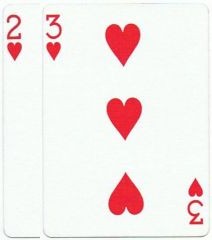
Now, the challenge (which is solved by VSE) is that in this card system this image actually represents four different card pairs:

and and and

So how do we know which one is correct when we try to recall the deck?

We use the loci and sub-loci to indicate aspects of the suit colors. If the suit combination that you’re placing is black-first, use the first loci in the area (in our example this would be the chair.) If the suit combo is red-first, use the second loci (the coffee table.)

The pair we placed was :spades: :spades: . This is a black first pair, so the loci we’ll use is the Chair (the designated black-first loci.)

This has narrowed down the possible suit combos that the number represents to either :spades: :spades: or :spades: :hearts: (the two black-first suit combos represented by the number 0 in the card-pair to number translation.)

To lock in the exact suit combination, we use the sub-loci of the chair. If the image contains two suits of the same color, we place it on top of the chair. If the suits are two different colors, we place it underneath the chair. (We pre-determine which sub-loci gets which suit combo and practice recognizing those translations as part of training the system.)

Because the pair is :spades: :spades:, two of the same color, we’ll use the top of the chair. So our final formulation of the image will have Mr. San’man interacting with the top of the chair. Maybe he’s jumping on it, or sitting on it and picking the cushion apart, or maybe he’s pouring sand all over the seat.

This way when we recall, we go to our first area, the living room. Our two loci options are the chair and the coffee table. We remember activity at the chair, not the coffee table, so we know that the suit combo is going to start with a black card. We further recall the scene and that it involves the San’Man (023) doing something on top of the chair. This tells us that the suit combo is black/black. The 0 in the number tells us the exact suit, the black black option of the four available “0” suit pairs, which is :spades: :spades: . Recalling the San’man tells us that the values are 2 and 3. Putting this information together we can determine that the card pair was:

Lets applying the strategy to the second card pair with a more abridged explanation:

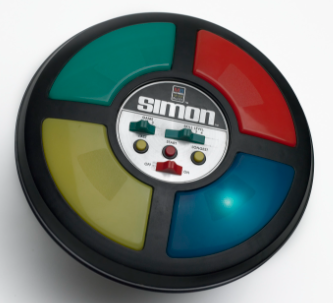
Second card pair means area 2, our kitchen. The pair starts with a red card, which means Loci 2.2, the Fridge. Because the suits are two DIFFERENT colors, we use the second sub-loci which is Inside The Fridge. The number that the card pair translates to is 032 (0 for the suit combo, 32 for the values.) In my system 032 is:

I imagine opening the fridge and the inside is dark except for the flashing lights of this Simon game, its distinctive tones startling me and making me jump back.

On recall, when trying to recall and decode my second pair, I look at my second palace area, my kitchen, I consider if there was anything happening at my stove… there wasn’t. What was happening at my fridge? Oh right, there was a Simon game inside it. Simon = 032. 0 plus the sub-loci gives me :hearts: :spades: and the 3 and 2 give me the values. So I’ve correctly recalled my second pair:

In order to take advantage of this technique, you’ll need to do some fairly intensive prep work to build some detailed palaces, but due to the strength of the method of loci, there is considerable advantage to be had in doing so. The biggest upside in this approach is that it makes a 2-card system available to those who have a single 3-digit list. There is no requirement for a specific phonetic structure and there is no need to have multiple lists (no person/object or any other categorical designation is needed.) If you can come up with the 676 images needed to fill in the corresponding 3-digit numbers, you can use this technique to get yourself a usable 2-card system!
6 Likes

Hi @Mike4! I read your post carefully and I really find your idea awesome! I’m actually using a PAO system for cards (with a personal best in 24.50s) and I recently created a 3 digits system with 1000 characters and 1000 objects. I intend to switch to a 2-Block-System for cards to get better scores. However, I don’t want to use a too complicated system or to create extra images (probably because I’m too lazy for that). I’m not really familiar with a 2-Block System for cards and I think I will make some changes according to my preferences (especially about the variable-locus strategy) but I really like your idea and the Double-2-Block System looks perfect for me.

I was wondering, did you invent it by yourself? Do you know anyone who uses it (maybe yourself)? Do you think it’s possible to reach a very high speed like sub 20s with this system?

Thanks a lot for sharing this with us!

3 Likes

24 seconds for a deck is VERY fast. It sounds like your current PAO system is fairly automatic. If you feel like you’ve truly plateaued with it and are willing to put in the time to get the 2-card system to that same recognition speed, I bet you can match or better that time or at the very least be more consistently accurate as it will cut the total elements needed to memorize and recall in half.

I’m glad you like it!

Awesome speed! Congrats!

Man, you already built 3-digit PO lists, so you can be called anything but lazy, haha.

You can use other blocking strategies, like Variable Spatial Encoding or Agent-observer Strategy. You can find them in my first 3-card systems post.

I’d say I did invent it by myself, but this was only because there were other people to helpfully criticize my previous ideas.

I don’t practice speed cards yet, but I intend to use “another” system, which is kind of an extension to D2B. The only person who said to have applied the Double-2-Block system itself was @anon69297051 , but he gave it up for a 1-card system.

Since there are people getting below 20s with the Shadow System, I think there’s no reason to think it wouldn’t be possible for the D2B. In fact, it’s probably going to be easier since it has fewer rules. Moreover, I remember asking @AlexM for feedback when I built it, and he said he did’t find any problem with the method, so I’m confident.

2 Likes

Thanks! Yeah, I’ve been training a lot on cards for a year. I think I can still improve with my PAO but it’ll definitely take a lot of time and I think in the long term I could reach better scores with a more complex system (at least I hope so). Besides, it’s really exciting and challenging to try a new system haha

1 Like

Thanks a lot! I’m not satisfied with my speed to be honest but I’m ready to put a lot of effort in a more complex system to achieve a better speed

Haha, I meant I’ve already build 2000 images, and now I want to have fun with them instead of keep creating new images

Thanks for sharing all your different ideas in your post. All of them are truly interesting and worth to be taken into consideration. But the variable-locus strategy looks more intuitive and fun for me. What I meant by making some changes, I was talking about the rule of moving from one loci to another. I couldn’t explain why but it’s more natural for me to switch from one loci to another if the last card of the pair is black. But it’s just a small detail actually

I see. It emerged from different ideas but you’re the only one to write about how it works exactly in details as far as I know. I will keep in mind you’re the creator of this system then

Wow, I’m glad I could be one of the first to use it! I could tell you my progress if you’re interested. My goal is to reach sub 20s, so I’m not going to give up until I can reach this speed anyway (whether it’s with D2B or another system)

2 Likes

I understand. I guess most athletes won’t ever be satisfied since the fun is in pushing the boundaries.

Yes, I get it. Building images is by far the least fun part.

Oh, I see. I thought you meant you disliked the variable locus strategy itself.

Yes, I’m the creator of D2B.

It will be my pleasure to have you as one of the first users of my system. You’re gonna be an excellent guinea pig, haha. I would love it if you shared your progress, please!

1 Like

Nice! I don’t mind to be the guiena pig for your system haha. I’ll give you some news of my progress once or twice a month then. It’s going to be a long and exciting journey! :grin:

1 Like

They do, of course. There is a layer of impromptu processing. Whether that disadvantage is more detrimental to speed than the best 2704 mappings so far, that part is dubious.

1 Like

I mean, if we analyze the system objectively, then yes, a true 2-card systems would be faster because of fewer processes. However, in practice, it may take significantly longer to build one, so maybe dedicating more time to practice when using a block system instead would allow one to get the same PR in a shorter time frame. But idk, that’s just a possibility.

Don’t you think that the system you just built could be turned into a true 2-card system? Maybe this change could make it even better.

I think it’s not double 2 card system, it’s just 2 card block system + person
if you have 2 objects for every 4 pair, 676 x 2 = 1352, it’s just another approach of 2 card block system not doubling