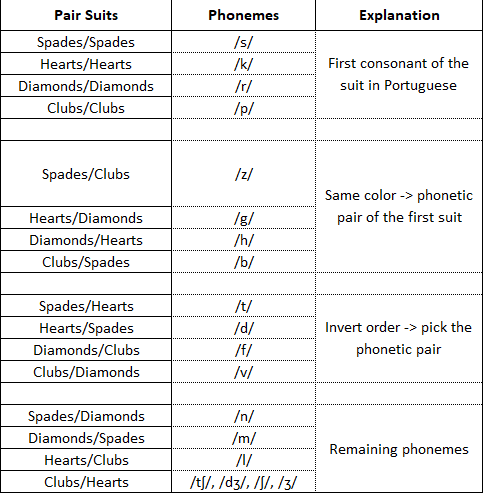
What do you think of this new 2-card system?

I need help with this system. It will be a huge commitment, so I’d like to start well. Any feedback is welcome!

I’m looking for a 2-card system. The ones I’ve found are the Ben System and the Shadow System. On the one hand, the former is highly based on English, and I think it won’t be worth it for me as a Portuguese native speaker since vowels change too much. On the other hand, the Shadow System is based on the Major System, so it wouldn’t have the same problem since consonant sounds are much more similar across languages. However, I don’t like the decision-making necessary during memorization. Moving to the next locus depending on the color of the card seems to open the possibility for crowded loci, loci that are almost empty, and mistakenly skipping images during recall. I know it works well for some of the best mind athletes, but it seems too complicated for me.

My idea was to discard the vowels in the Ben System. Moreover, since I’ve used only fictional characters to fill my major system list, I still have an infinitude of famous real people to use to encode cards, using their names and surnames. In this way, the first consonant of the name represents the number of the first card, the second consonant of the name represents the pair of suits, and the first consonant of the surname represents the number of the second card.

The following is the system and explanations:

The phonemes for the first four pairs were chosen based on how the Portuguese words for the suits sound. By phonetic pairs, I mean voiced and unvoiced, like t/d, f/v, or p/b. The h sound was added to 4 because that works better in Portuguese or if you’re going to take words from manga and animes.

Examples:

Q :heart: - 3 :club_suit: could be represented by Paul McCartney
J :club_suit: - K :heart: could be represented by Doja Cat
10 :spade_suit: - 6 :heart: could be represented by Steve Jobs
4 :spade_suit: - 7 :diamond_suit: could be represented by Ariana Grande
5 :diamond_suit: - 10 :diamond_suit: could be represented by Willard Smith (Will Smith)

Advantages:

  1. It is very close to the Major System, so it won’t take much additional time to learn; in fact, I developed it today and already remember what suit pairs each phoneme refers to.

  2. Because it does not use vowels, you can pick words from multiple languages more easily because consonants are much more stable across languages. You could choose names from Hollywood stars, Japanese animes, Spanish singers, or Korean k-dramas without any difficulty.

  3. I believe finding names following this system would be much easier than in Ben’s. Having three exact phonemes in sequence for each of the 2704 pairs of cards seems almost impossible. However, given two consonant sounds for the first name, I’m quite sure we can find someone with a surname that contains any consonant sound that we need.

  4. I chose the order Card1 - Suit Pair - Card2 because I believe it matches better the order we pronounce the cards: the number of the first card, the first suit, the number of the second card, and the second suit. This would theoretically make decoding faster because you would spot the first consonant and immediately know the number of the card, so you would then need to find your first card among four possible suits. If you put the suit pair first, your first card would still have 13 possibilities before you analyzed the second consonant. Furthermore, in this system, after you decode the suit pair, you don’t need to hold the second suit for as long as in Ben System or Shadow System. These things would matter only for a beginner/intermediate level, though.

Possible disadvantages:

  1. Advantage number 4 is totally speculative, and I suspect that Ben Pridmore and Lance Tschirhart had a very good reason for putting the suit pair first; if you know what it is, please let me know.
  2. You still need 2704 images, which will take a long time both for construction and for memorization.
  3. There may not be 2704 names following this pattern. Looking for names in multiple languages may help, but I’m not sure if that’s enough.
  4. I got zero experience in card memorization, so there is a good chance that I’m missing some very big shortcomings.
4 Likes

Some great ideas here.

On the topic of order of reading the pair (value1 - suitpair - value2, or various combinations) I think its a purely visual decision that kind of depends on your instinctual eye sweep across the cards and what you notice first.

If you glance a card pair and your eye kind of takes a U shaped path with the first value as your anchor point, down to the suits, back up to value2, this way makes total sense.

If one’s native language reads right to left… The inverse may apply better.

If the first thing that pops in there is the combination of the two suits, it may make sense to go suitpair - value1 - value2.

I think its totally a preference thing.

If you put the suit pair first, you’ll have more variety of starting letters for names. 16 vs 13. Less total names needed that start with each. Don’t know if thats a factor for you. I don’t believe Ben System actually puts the suit pair first. From what I recall, its used to generate the center vowel sound of the CVC phonetic thats used to build the word. Shadow has multiple phonetic structures depending on the presence of face cards amd their location in the pair, so the suit pair phonetic can live in different places within the “word.”

The tough part of a true 2-card 2704 image system as opposed to a 2-block like shadow is that you need a distinct encode/decode rule for all 16 suit combos. As you’ve developed here, this usually means splitting up shared letter/sound numbers like S and Z, B and P, etc. This is fine, but it will limit you for choices when you have to stick to those letters. It may be tough to find the necessary number of Z names especially when you are requiring the second consonant of the first name to be strictly followed as well.

I’m interested to see what you and others think of using all people as your images. My Shadow list is fairly evenly split, maybe slightly more objects than people. I’ve found objects to be a little easier to work with. If I get a few loci in a row with just people populating them it can get a little muddled. The people need to be very distinct and unique to be able to be recognized on recall. With objects, its a bit easier to tell apart and create unique actions and interactions.

2704 images will take a long time to get fluent with. For 1352 Shadow images, I’m just now feeling “fast” (just over 1 second to recognize and visualize a pair on sight) after 300+ straight days of drilling them for recognition speed. You can absolutely do it, but be aware of the realistic time commitment needed.

One last thing when it comes to speed in recognition, an advantage that Ben has is that by taking a consonant - vowel - consonant structure, when you “read” the card pair, you only really vocalize a single syllable. This syllable is then associated through practice to the image. So B-Ah-R may be drilled to associate to Bart Simpson as thats the starting sound of the word Bart. Over time the conversion steps of [“reading/hearing B-Ah-R” → finishing that sound into “Bart Simpson” → conjuring mental image of Bart Simpson…] will just become [see/hear “B-Ah-R” → mental image of Bart Simpson appears.]

By using 3 consonants, you will be initially reading/hearing/saying/subvocalizing three syllables, like “Puh Luh Muh” for PauL Mccartney. This may seem like a minor thing, and it is for 99% of people, but if you eventually want to try to take your time to the bleeding edge of speed, reading single syllables will be faster than multi.

I know this was kinda rambling, but I hope you keep working on this and let us know what you find out along the way!

4 Likes

These are great ideas!

Ok, I was struggling to get this part because I couldn’t understand what you meant by a U path if the symbols appear at the bottom right upside down, but after googling I found out people hold decks with their left hand, not right one as I do :man_facepalming:. I could push cards from the bottom, but that feels so awkward.
Since most people hold the deck with their left hand, do they move their eyes from right to left while they encode images? This feels a little bit counterintuitive since we usually memorize numbers and read texts from left to right.

According to the description on Art of Memory, it seems that he uses the first consonant to encode the suit pair.

Yes, this would be tough indeed.

Great point. Maybe it would be a good idea to add objects. I just don’t know if I’m going to find enough many of them for both my 3-digit major system and this system. Would repeating images in both lists be bad?

One alternative to solve this problem and the one about the 16 suit combos could be to use 2 sets of 8 combinations, like in the shadow system, but using images of people to encode the first set and objects to encode the second set. The system would become more similar to SS than to Ben System, but it would still have 2704 images. What do you think about it? Do you think this works better?

For sure. I expect to take a year to know all images, but 2 or 3 to get fast. I also gotta learn my 3-digit system, so maybe it’ll take even a little bit longer.

I thought that after enough practice the sight of the cards would make one remember the image without the need for subvocalizing. Btw, this would be a problem for the Shadow System as well, right? How can people who use it reach the bleeding edge of speed then?

It was full of great ideas. Thanks a lot, man.

1 Like

I’m a lefty and hold the deck in my right, so normally I’d push with my thumb and be looking at the indexes like you do, bottom right, upside down. I still do this a lot when playing card games, but I’ve forcibly trained myself to push cards the opposite way, with my index/middle/ring fingers from below for memorizing purposes to make it readable normally.

If you use any kind of online training app or website, you’ll have the cards rightside up. You could also hold the deck in the right hand and just flip pairs of cards over as you go with the left, viewing them in the correct orientation instead of pushing them like a conveyor belt.

1 Like

Thats the goal. The process seems to be a gradual chopping down of what gets subvocalized. For me it went from “full pronunciation of the whole word/phrase” to “dropping some trailing uncoded sounds/syllables” to “just the first syllable or two” to sometime having the instant visual (still working on it!)

I think maybe by just starting with less syllables to subvocalize theres a headstart advantage to the process that can save time upfront.

As you said, Shadow can lend itself to multi syllables which isn’t perfect efficiency. But with tons of practice, bleeding edge times happen, see Braden Adams and his 15 second or less decks! I think at that speed, people are looking to shave tenths of seconds off personal bests and the difference between one syllable recognition and multi could do just that. But for most “normal” speed folks, it wouldnt make too much of a difference.

I don’t think so, since you could differentiate cards and numbers. But this was maybe the biggest reason I went for Shadow. The phonetics of 992 of the card images match those of a 3 digit major list, so one reinforced the other, or if you’re like me and didn’t have a 3-digit list built yet, it was getting two for the price of one.

This is actually exactly what I just worked on and may try to implement next year! All black-first pairs get People, all red-first get Objects. 1352 of each. This way you can eliminate the variable image stacking at loci and just build scenes with two or three elements each. The biggest hurdle for me with Shadow is still the unpredictability of how many elements I’m going to have to build scenes with each time.

My lists are complete, but in order to switch to this, I’m gonna have to unlearn half of my existing associations and basically learn 1352 new ones again. I know I can learn new ones, but am dreading unlearning the old ones that have become nearly instant. Not sure I want to commit to that at the moment. If I had thought of it at the start of the process, I’m pretty sure I would have gone that way from the beginning though.

Good catch. I havent looked it up in a while. Maybe I confused it with stuff I read about Josh’s C-V-C layout recently. It all blends together haha

1 Like

This seems to be the best option. I’m gonna practice this.

Could you explain how you structured the cards? I got 1110 people and will have 1110 objects, but I don’t know how I could organize the remaining 484 cards. In fact, I don’t know even how I’d use the 220 images that have less with 1 or 2 digits.

That sounds like a lot of hard work, but I’m quite sure you’re gonna get this.

I think I’m gonna follow this idea of using my two lists at the start. It seems better than disrupting the Major System I’m already used to.

It all has to do with the way Shadow phonetics are mapped.

All of the “Number/Number,” “Jack/Number,” and “Queen/Number” pairs will generate 3 digit numbers with traditional major system mapping to 000-999 (with the exclusion of 444, 448, 484, 488, 844, 848, 884, and 888.)

Pairs that end in Kings only generate two phonetics, so images from a 2-digit list can be used.

1-digit images aren’t used in Shadow.

Pairs that have face cards in the second position follow different phonetics and involve finding new images that contain S-blend phonetics to start, so like SWiFT, SNiCKeR, SPaCeR, etc. These really are the equivalent of almost 4-digit numbers, so entirely mew words will meed to be found for those.

King first pairs start with the H sound, which isn’t used in major, so new words need to be found here. Along with avoiding using words that start with H in all the other lists so theres no confusion.

1 Like

Oh, so you use standard shadow system. I’ve got a problem then because the way I use the Major System is by taking h and r to encode 4. Besides, I’m quite sure there are words beginning with an s followed by another consonant in my list. It seems that one’s Major System must be created with these things in mind if they want to use the shadow system in the future. I’m going to come up with another way to associate digits and cards that will allow me to use my existing major system, maybe by dividing the suit pairs in three sets instead of two.

1 Like

After a few hours, I gave up on devising a system without blocks because all my ideas involved creating multiple lists that needed to be highly distinguishable. Moreover, since I already have a non-standard Major System, I couldn’t use Lance Tschirhart’s strategies: S at the beginning of the word, H means king, etc. Although I didn’t like the idea of moving next only if the first card was red, I relented. It is too smart and efficient to ignore it. Besides, Alex Mullen has great arguments for why crowded loci aren’t such a big problem for the Shadow System.

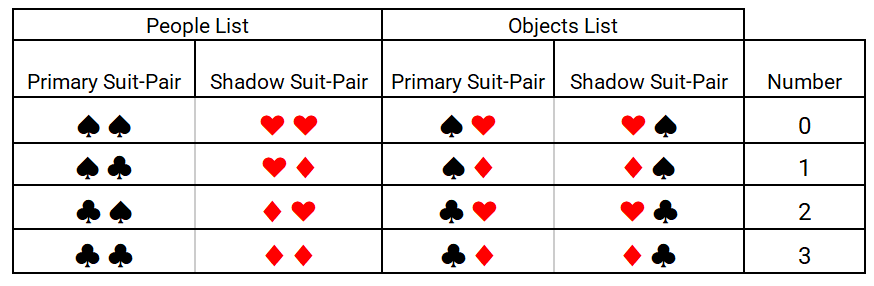
To make the Shadow System work with any 3-digit Major System, even the messed up ones like mine, I divided the suits into 4 groups of 4. Since most people who use a 3-digit system have at least two lists, we can use one to encode pairs of suits of the same color and the other to encode pairs of suits of different colors. The relationship between the primary suit pair and the shadow suit pair is the same:

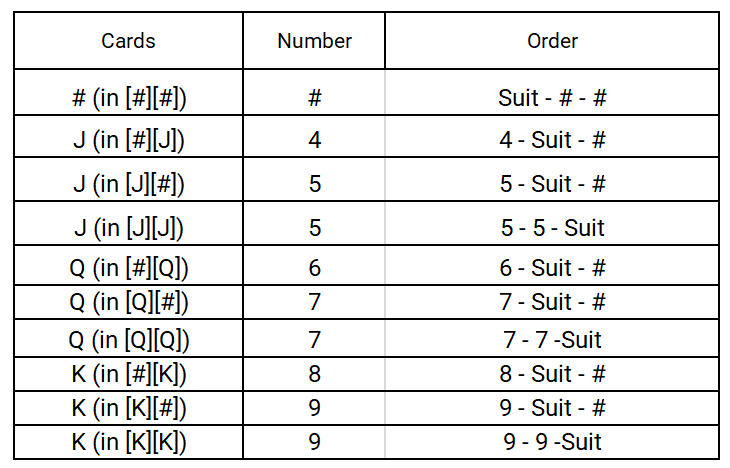
Instead of using new strategies to encode kings or pairs of numbers followed by face cards, we can do the following:

In this way, any 3-digit system easily fits in with the Shadow System.

Examples:

Q :heart: - 3 :clubs: would be represented by an object of number 723 (Q-Suit-3)
10 :diamonds: - 6 :heart: would be represented by a person of number 206 (Suit-10-6)
J :clubs: - K :heart: would be represented by an object of number 592 (J-K-Suit)
4 :spades: - 7 :clubs: would be represented by a person of number 147 (Suit-4-7)
5 :diamonds: - Q :spades: would be represented by an object of number 615 (Q-Suit-5)

I feel like I’m bothering to ask your opinion again, but you always have some wise and useful advice to give, so I couldn’t lose the chance. Do you think this works better?

1 Like

No bother! I’ll take a look! Will check this out tomorrow and hit you back.

1 Like

So I kinda like the idea of taking the suit combos in four groups. This becomes a sort of double-2-block system.

My approach was to split people and objects along black-first or red-first lines in order to eliminate the block approach all together. You added another layer to block encoding. We’ll see how it works.

Let me see if I’m understanding this idea…

Each 3-digit number now represents 4 possible card pairs. The indicator for whether the number encodes a person word or an object word is if the pair has suits of the same color or of different colors. You will still need to use variable image stacking during memorizing to indicate when you hit the “shadow suit” pair (a “red-first” pair), but whether you visualize a person or an object depends on the actual suits involved. I think I get it, and kinda like it!

With a “double2block” approach, if you use the suit pair as the first number, you’ll only fill in the 000’s thru 399’s for standard “number/number” pairs, right?

Then 400 - 439 would be Number/Jack pairs (440-499 unused?)

500-539 would be your Jack/Number pairs.

550 would be J/J of either :spades: :spades: / :hearts: :hearts: / :spades: :hearts: / :hearts: :spades: (with 551, 552, and 553 representing the J/J pairs of the other suit combos?)

570 would be J/Q of either :spades: :spades: / :hearts: :hearts: / :spades: :hearts: / :hearts: :spades: (with 571, 572, and 573 representing the J/Q pairs of the other suit combos?)

590 would be J/K of either :spades: :spades: / :hearts: :hearts: / :spades: :hearts: / :hearts: :spades: (with 591, 592, and 593 representing the J/K pairs of the other suit combos?)

600-639 would be Queen/Number pairs… Etc.

I think this DOES allow for every card to be associated unambiguously to a single 3-digit number, using standard major phonetics without splitting letter/sound associations to account for values over 10. You still need 1532 total images, but its really a double set of 676 phonetics. 656 people and 656 objects.

Only a couple downsides I see. One, which I think is pretty minor, is the extra steps of having the suits and suit colors performing double duty of informing whether the image is a person or an object AND where the suit phonetic lives in the word structure.

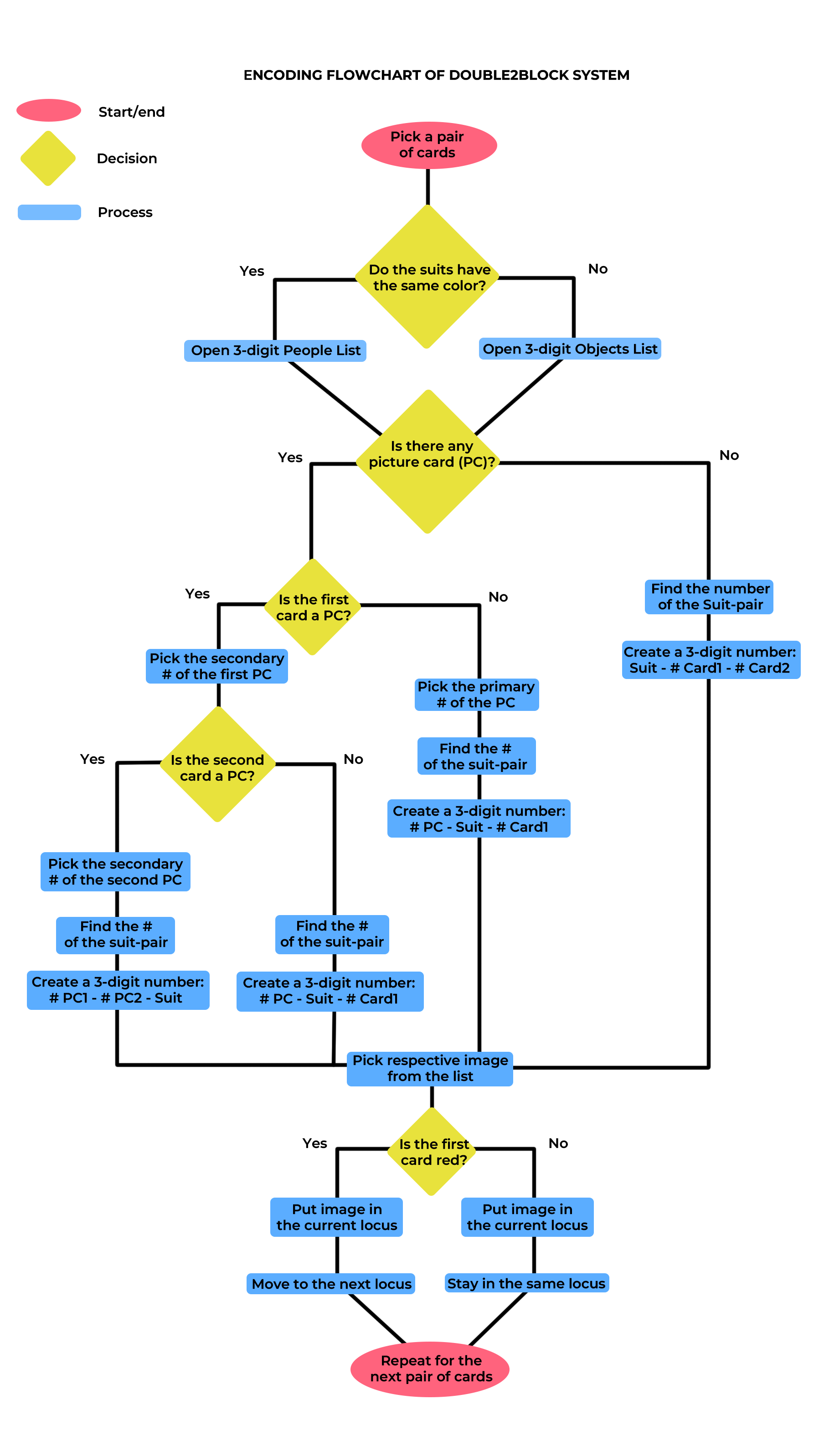
I would love to see a decision tree / flow chart of what the thought process for determining the word from the card pair…

Something like:
If the card suits are the same color, then access the “Person” list.

If the values are both numbers (A=1), then use suits to determine group 0xx-3xx, use value1 to determine subgroup x0x-x9x, and use value2 to determine sub-sub-group xx0-xx9.

If there is a picture card in the first position, then use its value to determine… Etc.

The other downside is when you get to your pairs that include picture cards, there are quite a few structural combinations to remember. Each picture card has a primary and secondary sound depending on if it appears first or second in the pair. This is really not much different than with Shadow and will just be one of those things that need to brute force learned via practice. In terms of a “perfect rules” system this is a mark slightly against, but I think the benefit of keeping everything to a 3-digit structure may outweight it. Shadow has the same problem and it’s still able to be learned and used well.

Overall though, I think this has really good potential. The challenge as always will be to find words/images that fit those phonetics, but my keeping yourself in major mode, you can employ all of the “alternate” phonetics for the numbers to give you more options.

Nice job, I like it.

2 Likes

I like this name. Double2block System sounds nice haha

Yes, exactly!

Yes, this is true, but this won’t cause any troble. In fact, I predict that after a lot of practice the contrast of colors will be translated into a sense of “objectness” while the similarity of colors will be felt as a sense of personhood, taking virtually no time.

Your wish is my command:

I’m not sure if this is the optimal decision tree. As I said before, I’ve never memorized a deck of cards, so there are good chances you’re gonna spot a better order. What do you think of it?

I think this double2block approach actually has an advantage over the Shadow System when it comes to learning it. The latter uses multiple exceptions and rules. For instance, Jacks and Kings have each two possible sounds that are unrelated (J: F/V and T/D while K: H and Silent); each picture card has their own specific set of instructions; when numbers are before picture cards, you gotta take care to put an S at the beginning of the word, but, depending on the combination, you will need to change the sound of the suit as well, like in #:spade_suit:Q​:spade_suit: / #:spade_suit:J​:spade_suit: (suit-pair changes from S/Z to W) and #:spade_suit:Q​:club_suit: / #:spade_suit:J​:club_suit: (suit-pair changes from J/CH to TR); and, finally, you need to start creating your Major System with the Shadow System’s rules in mind, or else it won’t work.

I’m going to have no trouble finding images actually. I’m just going to pick the ones from my 3-digit Major System. Btw, I don’t know if you noticed this, but this double2block system actually doesn’t have any “phonetics.” While the Shadow System is based on the Major System, this version only requires two 3-digit lists, which could follow absolutely any logic. If someone devised a 3-digit Dominic System, it would work, or maybe someone uses Ben System but doesn’t have the time for 2704 images, so they could use this double2block approach as well.

2 Likes

Yeah this is definitely a big plus! And its not even two 1000 image 3-digit lists… Its two 676 image lists, so even a lighter lift if you’re starting with this without previously filling in a full 000-999 grid.

I like this idea a lot. Especially for someone who doesnt want to learn or covert to major. The learning curve of recognizing those suit differences will be fine, comparable to the phonetic exceptions, replacements, and reordering of Shadow’s picture card rules.

With enough practice any “arbitrary” rules can become fluent and second nature, (see reading and writing the english language as an example haha) but this does a nice job of justifying those decisions to at least help you think through the “why” of how to read the pairs.

Well done.

Now, learn it and see how it works!!!

(P.S. the flowchart is great and really helps with understanding the structure and decision process as you “read” the pair!)

2 Likes

Thanks Tim!

Thank you!

I just changed the flowchart because it makes more sense to analyze whether the colors are the same or not only before picking the image. No need to analyze that in the beginning:

Sure! I’m just gonna finish my Major System for objects first.

Also, thank you so much for answering my questions and giving advice. Your help was crucial.

2 Likes