I thought of making a few changes. The idea of primary and secondary numbers for picture cards is essential to D2B; however, the criteria for using each was not very good (primary number if the first card is a number & secondary number if the first or both are picture cards). These two rules were mostly inspired by the Shadow System, but there is no reason why D2B should follow them. In fact, I wish to make it a little bit more intuitive and didactic.
The two rules could be changed into one: use the primary number if the picture card is in the first place and the secondary number if it is in the second place. Isn’t it much more intuitive and easier to grasp at first?
Here’s the table of primary and secondary numbers:
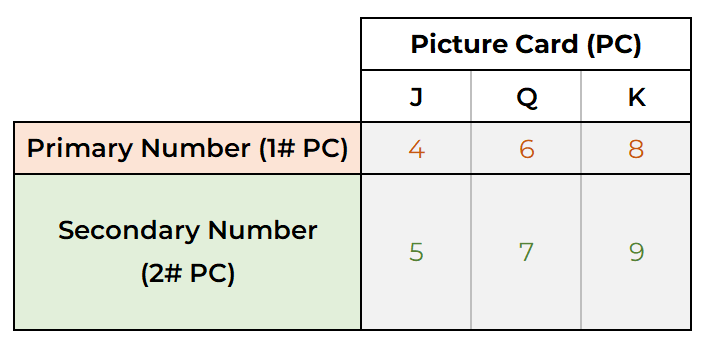
To determine the order of the digits, you now need to follow three rules, instead of two as before (but don’t worry, the additional rule is very straightforward):
- PC has priority over suit-pair;
- Suit-pair has priority over number card;
- If there are two PCs, the primary number has priority over the secondary.
The following is a table exemplifying all possible combinations:
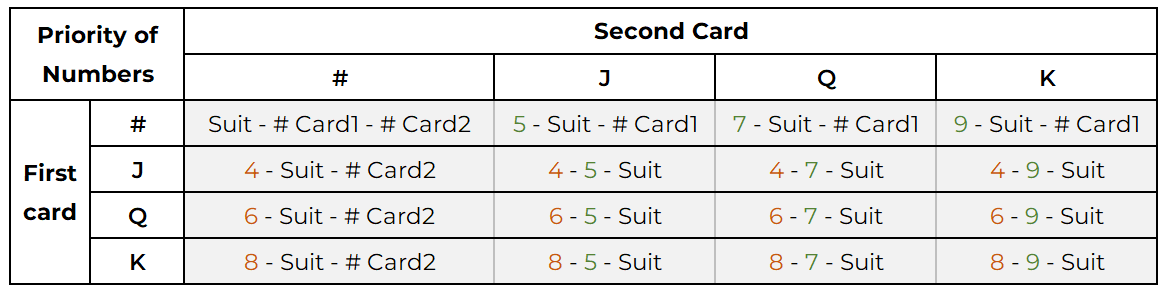
(“#” means number; “# Card1” and “# Card2” mean the number of the first card and number of card 2, respectively; “Suit” refers to the number of the suit-pair; the orange and green colors represent whether the primary or the secondary number was used, respectively)
If you compare this new table with the old one, you’ll see that now the primary and secondary digits are equally common. This makes the system easier to learn, not only by its intuitiveness but also by practicing both types of numbers often.
Old examples after change:
Q  - 3
- 3  would be represented by an object of number 623 (1#Q-Suit-3)
8  - 8 would be represented by a person of number 388 (Suit-8-8)
J - K would be represented by an object of number 492 (1#J-2#K-Suit)
4  - 7 would be represented by a person of number 147 (Suit-4-7)
5 - Q would be represented by an object of number 715 (2#Q-Suit-5)
10 - 6 would be represented by a person of number 206 (Suit-10-6)
J - J would be represented by a person of number 450 (1#J-2#J-Suit)
The encoding and decoding flowcharts changed a little bit as well:
Encoding: transforming pairs of cards into images
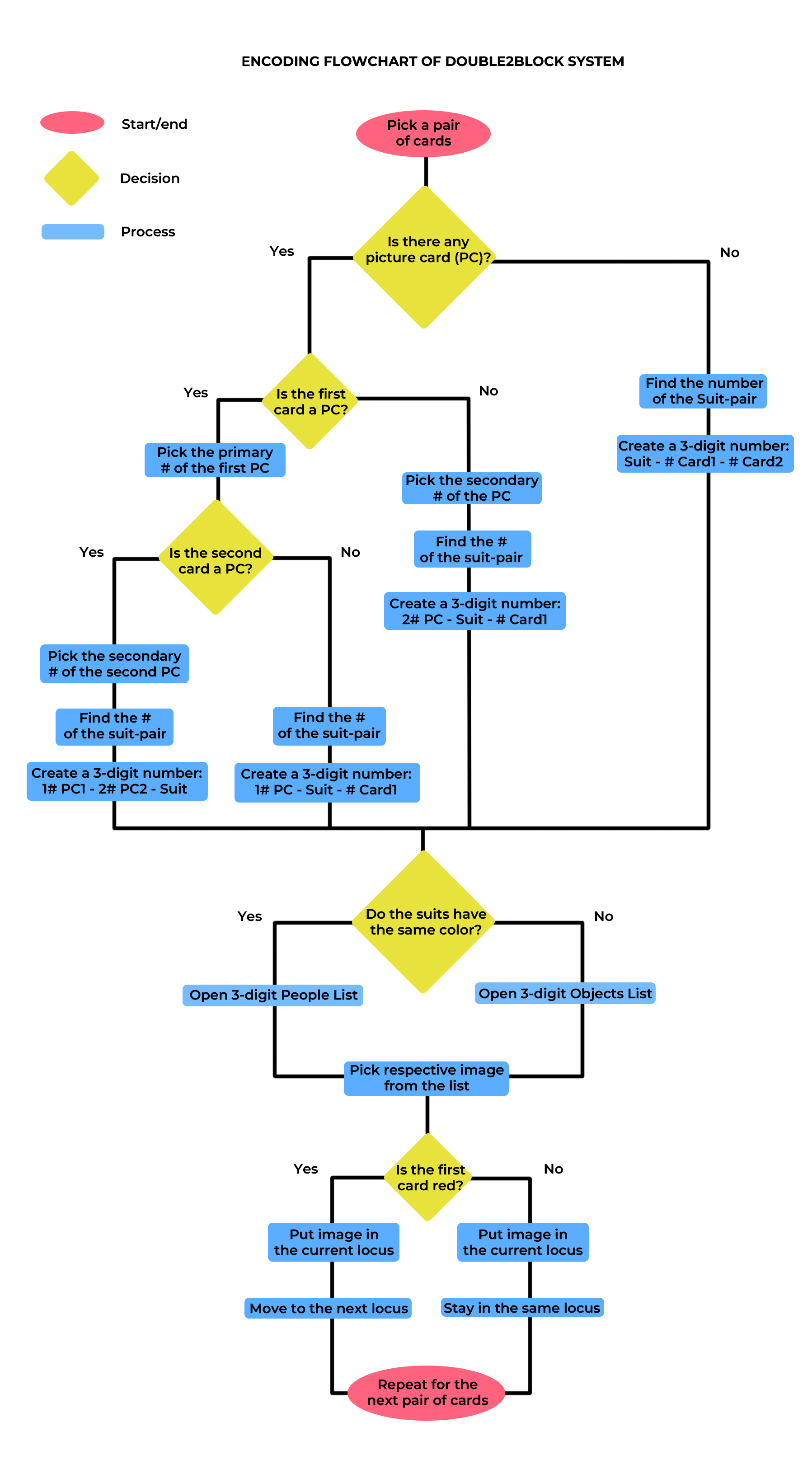
(“1# PC” and “2# PC” mean primary number and secondary number of picture card, respectively)
Decoding: transforming images into pairs of cards
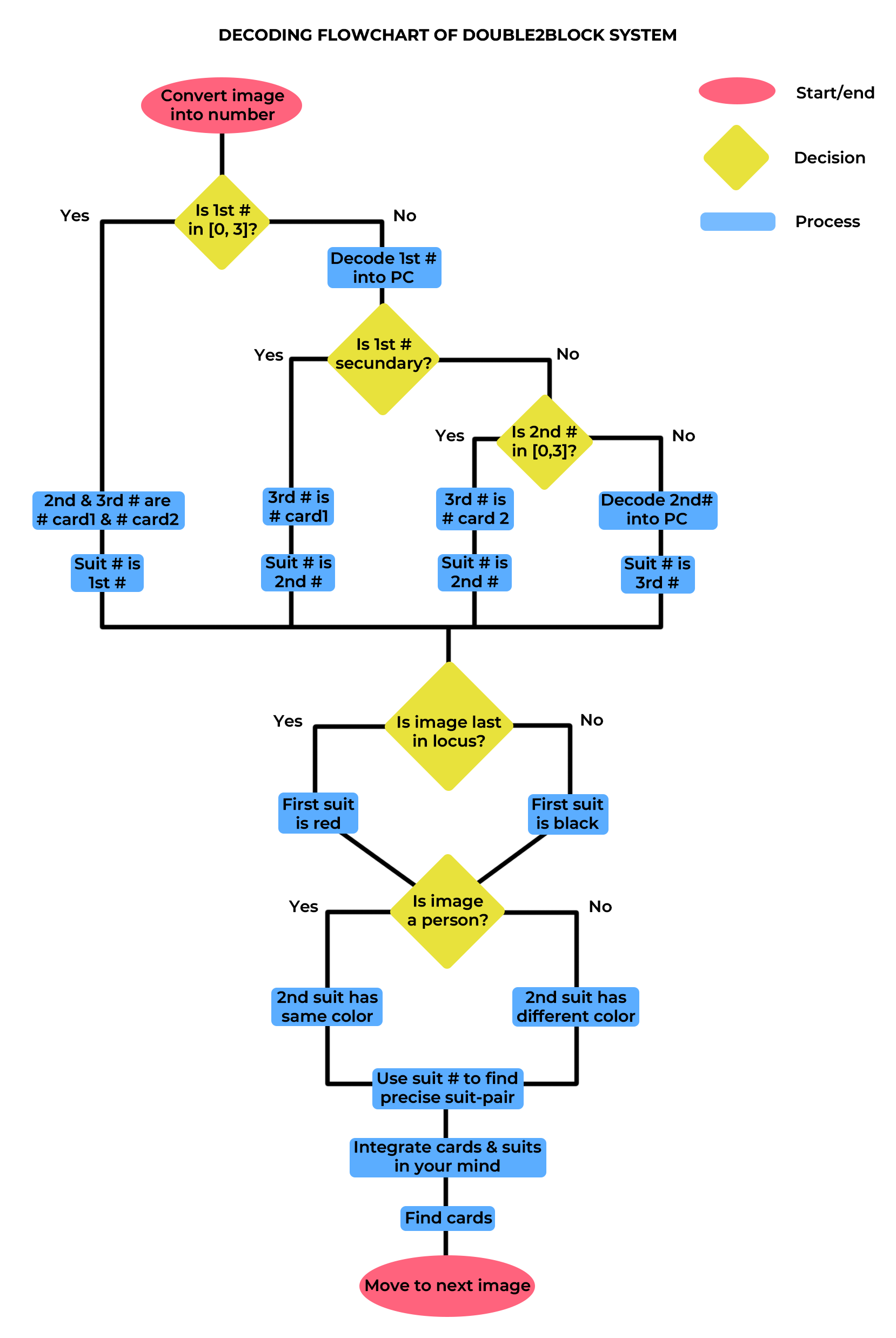
(“1st #,” “2nd #,” and “3rd #” mean first digit, second digit, and third digit, respectively; “Suit #” means the number of suit-pair; “[0,3]” means the interval of numbers between 0 and 3, including 0 and 3)
Please, let me know if you didn’t find this to be more intuitive.