After a recent thread discussion between @Mike4, @fred2, and myself about a new double2block card system idea, I’ve been thinking about the different structures of large card systems, namely the Ben System (by @Zoomy) and the Shadow System (by @LociInTheSky)… with the goal of simplifying conversion/construction rules.
I recently reached my goal of learning Shadow and using it to memorize a deck in under one minute and as I reflected on that process the thing that stood out to me as one of the biggest hurdles for onboarding Shadow was getting used to the different phonetic structures required depending on card values.
In the last week or so I’ve started looking at the Ben system more closely and really liked the consistency of the rules for constructing phonetics and reading the cards that it uses. The thing I’m not as big of a fan of is the use of vowels and how values can stand for consonants or vowels. Also the scope of a full 2704 pair system is still a bit daunting.
I wanted a way to have a card value represent one and only one value so that when you looked at the pair, there was no conditional translating needed. I also wanted to use only the standard Major System sounds and keep them as closely linked to their original number associations as possible.
I’ve come up with a way to make this happen via a two-block system that allows for simple construction with “only” 1352 elements to learn. (I’ll assume for the purposes of this thread that you’re familiar with the concept behind 2-block systems.)
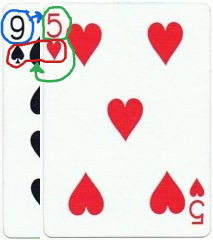
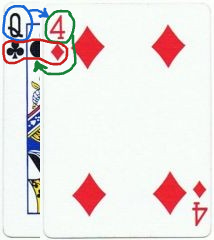
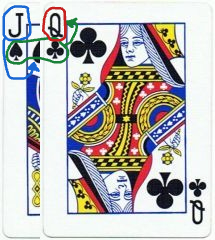
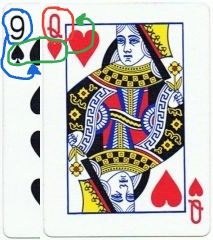
Here’s the basic rules for construction. They’ll be quite familiar to those who know Major or who are familiar with Shadow:
| SuitPair,BlackFirst | SuitPair,Redfirst | SuitPairSound |
|---|---|---|
 |
 |
S/Z |
|
|
T/D/TH |
 |
♢ |
N |
| ♢ |
♢ |
M |
|
|
L |
|
♢ |
J/SH/CH |
|
♢♢ | K/G |
| ♢ |
♢ |
P/B |
| Card1Value | Card1Sound |
|---|---|
| 10 | S/Z |
| Ace | T/D/TH |
| 2 | N |
| 3 | M |
| 4 | R |
| 5 | L |
| 6 | ch/sh |
| 7 | K |
| 8 | F |
| 9 | P/B |
| Jack | juh |
| Queen | V |
| King | guh |
| Card2Value | Card2Sound |
|---|---|
| 10 | S/Z |
| Ace | T/D/TH |
| 2 | N |
| 3 | M |
| 4 | R |
| 5 | L |
| 6 | ch/sh |
| 7 | K |
| 8 | F |
| 9 | P/B |
| Jack | juh |
| Queen | V |
| King | guh |
In order to account for the 3 picture cards expanding the phonetics needed to 13, I split three of the “multi-phonetic” numbers and assigned one sound exclusively to those picture cards. So for example, 7 is typically the K or the hard G (“guh”) sound in standard Major. In this card system, 7 is now ONLY generating the K sound. The King now generates the G guh sound exclusively. Similarly the 8 now ONLY gives you F while the Queen picks up the V, and the 6 keeps the CH and SH, while Jacks are assigned the J or soft G “juh” sound.
In this way every single card pair can be read by first looking at the suit combo, then value 1, then value 2, just like the Ben system, but using almost all traditional Major mapping.
This is a “cards first” approach. The goal was not to create an “all in one” system, so it doesn’t give you a full direct conversion to all 1000 3-digit numbers, and I doubt a binary system could be easily pulled from this, but if you have a 3-digit major list, you can directly import 800 words into this system.
This idea is literally like 2 days old right now, so there are probably a bunch of things I’m not considering in the design. It may not even be original, if there are other threads where this has been done already, please let me know. Either way, I’d welcome anyone’s constructive thoughts or questions on it!
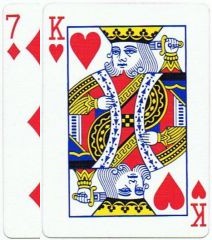
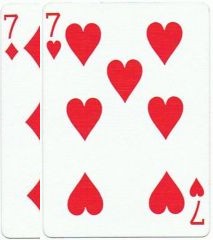
 I’m probably not going to use this system since I’ve already made so much progress with Shadow, but I’m viewing it as a potential Shadow alternative for someone who doesn’t want to deal with the extra rules or who doesn’t care about a single integrated card/number/binary system.
 , make both R and L represent