EDIT: I think I’ve settled on a name… The “Translated Index Method,” or “TIM” System. Kinda rolls nicely off the tongue, eh?
I’ve created a document in google sheets listing the complete method and instructions, along with a tab that lists every possible card pair along with their phonetic assignments and associated numbers. This can be used to fill in your own list if you wish to use this system. At some point, I’ll upload an Anki deck for this as well, similar to my other projects so that you can use it as a template and fill it in with your entries.
The link to the google folder is here: TIM System - Google Drive
UPDATE: 11/19/24, I’ve scrapped the “first-person action” and the “starting vowel” sets completely and assigned those suit combinations to the V and F sounds respectively! I THINK this is now the final form. Every suit combination now has a specific single starting consonant sound and all entries evoke “noun” images! The google doc has been updated. (The “first-person action” method is still there in a hidden “old method” tab, if anyone wants to play around with it, but I think this singular consonant approach is cleaner.)
OLD POST: Please scroll down to THIS POST for an update on the phonetic and structural assignments that I’ve settled on! If you want to see how the process of creating and updating the system went, feel free to read the earlier posts, but there will be some key details that differ from the final form. I’m hiding details on old posts so as to avoid confusion for people looking to understand the system.
Old Details
Been marinating on card stuff recently (what else is new haha), and I started messing around with building a structure to accommodate a “true” 2-card system where all 2704 pairs have unique images and phonetic structures associated with them.
In the past, I built out a “pseudo” 2-card system where there were 2704 unique images, but there were shared phonetics, so only 1352 phonetic structures. Now, normally it’s a positive thing to be able to reduce the requirements for learning a system, but as I worked with this structure, I realized a drawback with it. Having shared phonetics but different images caused a delay when reading each pair. I’d have to discern which “type” of pair it was, and then lock into the correct translation before the right image would spring to mind. This was enough to prevent instantaneous fluent recognition and was what ultimately caused me to abandon it in favor of my custom 2-block system.
I’ve always had a motivation to return to the challenge of figuring out a “true” 2-card system and have occasionally revisited the structure of Ben and others, but they all either required a fairly big departure from Major or had more complex structural rules than I wanted. My goal was to find a system that was sound-based, used as much traditional Major encoding as possible, had a singular reading structure so that every pair was read in the same way, and that remained consistent in terms of values always mapping to the same sounds.
Nothing that I could find hit all of these points.
So, I decided to try to come up with my own. This is a work in progress so I’m not sure if it ultimately will be able to be completed, but I’m optimistic so far. I think it’s a fairly original idea, but if it has been thought of already, apologies, no plagiarism intended. Here’s what I have at the moment.
Phonetic Structure:
- Read the suit-combo phonetic
- Read the card1 value phonetic
- Read the card2 value phonetic
SUIT-COMBO PHONETICS
The eight combos that start with Black Suits, and the two “double red” combos ( and
and  ) are mapped to Major System numbers (with ONE split exception, the number 1 which is traditionally phonetically represented as T/TH/D. I split these associations and picked one Black-First suit combo to associate with T/TH, and one Red-Black suit combo to associate with D.) Which combo gets which number sound is arbitrary. I used mappings that I’m familiar with from my time with the Shadow System, but you can pick any number to associate with any suit combo.
The remaining Red-Black suit combos get mapped to Vowel sounds, A - E - I - O - U/Y. These include long and short sounds. I’ll provide examples below. By including vowels as representational “first” sounds this imposes a small limitation on word construction. It now matters if your word starts with a vowel. So while previously you might be able to use something like “icy road” to represent 041 and disregard the i sound, now that i matters. Only start words with vowels when you mean to, for words in those suit combo lists.
Suit-combo phonetic list:
 - S/Z (0)
- T/Th (1) (note that this does not include the D sound typically mapped to 1 via major. The D is used for another suit combo.)
 - N (2)
- M (3)
- R (4)
- L (5)
- J/CH/SH (6)
- K/G (7)
- F/V (8)
- P/B (9)
- A (as in “Ace”, or “At”)
- E (as in “Eel” or “Ed”)
- I (as in “Ice” or “Ick”)
- O (as in “Oh” or “Odd”)
- U/Y (as in “You” or “Uh” or “OOf”)
- D (here is the only starting phonetic split from traditional major sounds.)
VALUE PHONETICS:
There are 13 values for playing cards. Ace through 10 can easily and logically map to numerical values, but the big hurdle is always what to do with the picture cards (Jack, Queen, and King.) In this system, I add one additional phonetic that Major doesn’t typically use, and I split phonetics from two numerical major associations to account for the others. Here’s how it works:
(Note: Value-sound mapping is the same whether the value is for the first or second card.)
Ace - T/TH/D
2 - N
3 - M
4 - R
5 - L
6 - CH/SH (typically this mapping includes the J "Juh"sound, but I’ve split this off so that J maps to Jack)
7 - G (typically this mapping includes the “K” or “CK” sound, but I’ve split this off so that K maps to King)
8 - F/V
9 - P/B
10 - S/Z (when looking at the ten, disregard the 1 and focus on the 0.)
Jack - J
Queen - W (here is the non-traditional non-major sound. By including this sound, we impose a limitation… W’s are no longer “free sounds” so be careful in your word construction!)
King - K
I chose to split J and K for Jack and King simply because those are literally the letters that appear on the cards, making it (hopefully) as simple as possible to translate and read in real-time when memorizing. This may come at a cost of more challenging word construction, but I think that it’s worth it.
Here are a couple examples for how a pair is read:

Suit combo is first,
is read as “T/Th”Then the first card value: 6 = “CH/SH”
Then the second card value: Jack = “J”
so T/Th-CH/SH-J… maybe “TouCH Juggler” shortened to two syllables as “TouCH Jug.” Mental image can be something like this:

Here’s a second example:
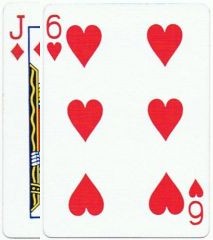 = D
= DJack = J
6 = SH/CH
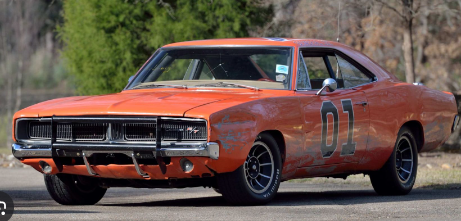
so D-J-SH/CH maybe something like “DodGe CHarger” or “DodGe Char” for it’s two-syllable truncation… a classic muscle car:
One last example:
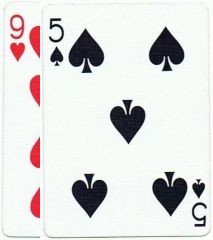 = A
= A9 = P/B
5 = L
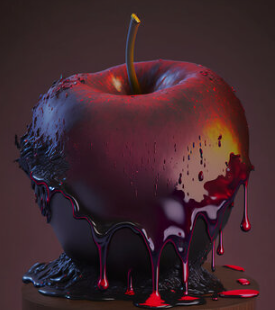
This is an easy one… “APPLe” (maybe make it a poison apple to boost its memorability!)
I’m aware that this system is less syllabally efficient than a CVC like @Zoomy’s Ben System or like @LociInTheSky’s Trochee System, but for me personally, I can accept the occasionally slightly longer sub-vocalization as a trade-off for this structural consistency. As I’ve found with my other systems, the more familiar the words and images become, the easier it is to truncate that active sub-vocalization and trigger the visual after just the first sound or so.
I haven’t worked yet on filling in the complete word list, so I’m not sure how the new vowel-first entries will go. Based on my last three large system builds though, I’m pretty confident that I can come up with associations.
One last note… Because this structure uses all 10 major assignments as starting values across suit combos, it contains a complete 3-digit major list. This means that if you already have a 3-digit major list, you can directly import all 1000 associations and if you have been wanting to learn a 3-digit major number system, you can kill two birds with one stone with this system. (The vowel-first entries provide multiple options for every number in a 2-digit major list as well!)
So… there it is! Hopefully that explains things. Feedback is welcome!
 ][2
][2 ][2
][2
 Well explained.
 - M (3)