Happy Holidays, all!
Though I may have only recently made an account, I’ve been using the site for a few years. You all have been invaluable to my journey as a memory sage! Specific special thanks to @Bateman and @Josh.
So, recently, I came upon the post made about Gary Lanier’s technique. I’ve read the paste bin file(Lanier Verbatim Memory System - Pastebin.com), but I’m afraid I’m having trouble understanding just exactly where everything needs to be. Is there a possibility anyone would be willing to draw a diagram or two in order to help me(and any others curious) understand the function and structure of the system?
EDIT REASON: forgot the “b” in “pastebin” and added a link to the post.
I HAVE seen the videos, but I was NOT aware of those posts. About to do some binge reading. But I know I’ll still need those diagrams. I suppose I’m mainly a visual learner?
Gary Lanier is a follower of Christ who composes music. He developed a specialized system for memorizing Holy Bible scriptures, and this technique can be used for effectively memorizing any passages of text word-for-word.
I don’t THINK that it’s very complicated, but I’m having trouble wrapping my head around it at the moment.
Here is something Gary Lanier said that I found particularly helpful as far as examples and explanations go.
garylanier
Aug '13
“ Aazib:
Hi, Let’s say you want to memorize this:
The Wright brothers, Orville (August 19, 1871 – January 30, 1948) and Wilbur (April 16, 1867 – May 30, 1912), were two American brothers, inventors, and aviation pioneers who were credited with inventing and building the world’s first successful airplane and making the first controlled, powered and sustained heavier-than-air human flight, on December 17, 1903. From 1905 to 1907, the brothers developed their flying machine into the first practical fixed-wing aircraft. Although not the first to build and fly experimental aircraft, the Wright brothers were the first to invent aircraft controls that made fixed-wing powered flight possible.(Wikipedia).
How would YOU?”
Hi Aazib… here’s my take that I posted a few weeks ago on my blog:
Verbatim Approach to Memorizing Sentences & Paragraphs
MEMORY ENVIRONMENT
By using what I call a Memory Environment, that is basically a picture backdrop, that represents the overall subject matter, I can mnemonically memorize word sequences by the use of image pegs or hooks.
ALPHA CHARACTERS
Though using the peg system is common, a unique addition that has been very helpful to me, is the use of Alpha Characters. They work like mini-journeys (4 locations each). Their sequence is derived from the first word or two of each sentence, which I call the Sentence TITLE.
Example: If the sentence begins with the WORD “AND,” the Alpha Characters used are 3 familiar Ladies whose names start with A, N, & D. Each Lady holds 4 words, 12 words all together. If the sentence is longer, add the MEN whose names start with A, N, & D. That gives 12 more words…and so on. If that’s not enough, simply add a word to the TITLE.
One other thing, every word in each sentence has a SUBSTITUTE or SYMBOL. That’s what gives the verbatim possibility.
THE FOLLOWING IS A GRID ON HOW I DID IT!
Subject: THE WRIGHT BROTHERS
Memory Environment Image: Wright Brothers Airplane in grassy, sandy lot
Sentence Number 1 of 3:The Wright brothers, Orville (August 19, 1871 – January 30, 1948) and Wilbur (April 16, 1867 – May 30, 1912), were two American brothers, inventors, and aviation pioneers who were credited with inventing and building the world’s first successful airplane and making the first controlled, powered and sustained heavier-than-air human flight, on December 17, 1903.
Sentence Title (usually first word or two): THE WRIGHT
wright_brothers_1_of_4.png
wright_brothers_2_of_4.png
Sentence Number 2 of 3: From 1905 to 1907, the brothers developed their flying machine into the first practical fixed-wing aircraft.
Sentence Title: FROM
wright_brothers_3_of_4.png
Sentence Number 3 of 3: Although not the first to build and fly experimental aircraft, the Wright brothers were the first to invent aircraft controls that made fixed-wing powered flight possible.
Sentence Title: ALTHOUGH
wright_brothers_4_of_4.png
To me, building a SUBSTITUTE WORD vocabulary, is like learning another language. After a little practice, things begin to fall in place.
I haven’t used the system, and I don’t remember all the details of how it works. Have you seen his videos? I think he gave some examples there, but I haven’t watched them since they were originally posted. (I’ll try to take a look again later tonight.)
Yeah, I’ve watched the videos, but they don’t do much for that the written form doesn’t do. I need a straight up diagrammatic drawing with all of the components of the method in view and labeled. That being said, I’m not trying to pressure you into it or anything. I might make a post somewhere if I can find the right place and ask anyone if they’re familiar with the method enough to do such a thing. Although, I wonder if Gary himself is available?
I took a closer look, and the system has some very interesting ideas in it. I don’t know if this alternate explanation will help, but I think it works something like this:
Street-Sidewalk-Structure
From what I can understand it uses an S.S.S. technique where each chapter is memorized using a Street, Sidewalk, and Structure. That part is described in section 2-2 of the pastebin starting on line 133.
The street is a location (see memory palaces) that holds information about the book and chapter numbers (see the Major System).
The sidewalk is a location that holds the number of the verse and the “title” of the verse, which appears to often be the first word of the verse.
On the structure, choose four locations, like in his image here:
(I love the formatting and illustrations in that text document. )
Alpha Characters
You then take the title of the verse (usually the first word) and create “alpha characters” (people and objects) from them using the letters of the title.
To create alpha characters, create three people/objects for each letter of the alphabet: one male, one female, and one object. You will have 78 alpha characters in your system.
If I’m understanding it correctly, it might look like this:
Letter
Male
Female
Object
A
Abe
Amy
Apple
B
Bob
Beth
Box
C
Charles
Cindy
Cantaloupe
D
Dave
Debbie
Door
etc.
He uses the images of women for odd sentences and men for even sentences. If the title word is too short to use for the sentence (each letter of the title holds just 4 words), then you can use multiple alpha characters for that single letter. For example, if the first word of the sentence is “A”, then you could memorize 12 words on that letter by using all three alpha characters for that letter: Abe, Amy, and Apple. Alternatively, you could use the first two words of the sentence as the title for the sentence.
Each character acts out four words from the sentence or verse, moving through the four locations in a clockwise direction, and interacting with one word per location. The first alpha character moves through four locations, then the second, then the third, etc.
F-A-C-E
F-A-C-E looks like a way to strengthen the associations or add more locations for each alpha character. It stands for Feature, Abode, Career, and Event.
A. Feature – physical feature that stands out – Position 1
B. Abode - Where they live – Position 2
C. Career - What they do (Doctor, Wife, Student) – Position 3
D. Event - Some memorable event in their life – Position 4
There are two ways that F-A-C-E seems to be used:
to strengthen associations by adding a prop to each location:
Pos 1 + AC Feature
___I_
/\-_--\
/ \_-__\
Pos 4 + AC Event |[]| [] | Pos 2 + AC Abode
Pos 3 + AC Career
to add four extra pegs per location, giving each alpha character a capacity of 16 items instead of just four:
There are some interesting ideas starting on line 463. If you’re going to the bank and need to remember your to-do list there, the word “bank” becomes your title word. Convert the first letters into alpha characters: Bob, Abe, and Nathan (or whatever your images are). Then those alpha characters could walk around your structure (the bank itself), interacting with the mnemonic images that represent your to-do items.
Line 469 describes how to memorize the US Presidents by using the first six letters of the word “President” and two alpha characters per letter.
It’s a bit more complex than the plain method of loci, but I think there are some great ideas for new types of memory systems there.
Full Description
Here’s the original explanation for reference:
╔════════════════════════════════════╗
║LANIER VERBATIM MEMORY SYSTEM v. 0.2║
╚════════════════════════════════════╝
This complex mnemonic system will allow you to memorize texts verbatim. It was designed by composer, worship leader, and “Art Of Memory” forum member Gary Lanier (garylanier.com). Mr. Lanier uses it to memorize Bible verses but, with minor modifications, it can be used to memorize any type of text. Further modification is necessary to memorize special punctuation, line breaks, and capitalization. This system presumes knowledge of the Major system, substitute words, linking, loci, and the journey method.
The Lanier Verbatim Memory System may be the only mnemonic machine invented in modern times. It effectively reuses a limited number of loci to store vast amounts of detailed information, making it superior to peg system variations like PAO.
┌═════════════════┐
│TABLE OF CONTENTS│
└═════════════════┘
PART I: INTRODUCTION
An introduction of the basic techniques that will be used in
this system, how they might differ from standard usage, and
a basic description of the system's function.
1-1. BASIC ELEMENTS
The significant implementation of the primary mnemonic devices
used in this method.
A. Journey Method
B. Substitute Words
C. “Clock Face” Journey
1-2. FUNCTION
A short description of the Lanier system including a simple
sketch of the entire process.
PART II: DEFINITION OF TERMS AND METHODS
A definition of terms and detailed description of how the
system functions.
2-1. MEMORY ENVIRONMENT (LOCATION)
This refers to the environment and all its associated loci
2-2. S-S-S SYSTEM
Used to construct your Memory Environment. The STREET contains
title information for the text in question; the SIDEWALK
contains sentence, paragraph, or verse number information as
well as a special TITLE index; the STRUCTURE uses Alpha
Characters generated by the TITLE to store sentence words.
A. STREET
B. SIDEWALK
C. STRUCTURE
2-3. SENTENCE TITLE
An index based on the first sentence of the paragraph from
which Alpha Characters are generated
2-4. ALPHA CHARACTERS
A detailed description of Alpha Characters and how to use and
generate their three forms
2-5. FACE HELPER
A system to strengthen weak loci or add four additional loci to
store additional or nested information
A. Feature
B. Abode
C. Career
E. Event
D. Example: strengthening a weak position
F. Example: adding depth to your structure
2-6. CONTENT: SUBSTITUTION OR SYMBOL
All non tangible noun words must be translated into tangible
substitutes.
2-7. REVIEW
Or, how to use your fingers to review
2-8. PREPARATION
Planning, or an outline of the steps to take prior to beginning
A. Planning
B. Memory Environment Construction
C. Alpha Character Placement
PART III: Examples
One simple and one more complex text
3-1. PSALMS 118:17
3-2. Complex Titles And Text Division
PART IV: Extensions And Modifications
Several suggestions on how the system can be modified or used
for other types of memorization.
4-1. TITLE variations
4-2. Clock Face Journey card memorization
4-3. Clock Face Journey Mini Palaces
4-4. A Few Suggestions From Mr. Lanier
A. On Mixing Real And Unreal Environments
B. Using The Clock Face Journey For Shopping Lists
C. Using The Clock Face To Remember Historical Facts
D. A Few Final Words
┌═══════════════┐
│I: INTRODUCTION│
└═══════════════┘
┌───┬──────────────┐
│1-1│BASIC ELEMENTS│
└───┴──────────────┘
The Lanier Verbatim Memory System uses three primary mnemonic devices to create its memory machines: 1. Journey Method 2. Substitute Words 3. “Clock Face” Journeys
A. Journey Method: The Journey Method is used to create the structural framework of the Memory Environment;
B. Substitute Words: Substitute Words become powerful in the Lanier system by becoming mini-journeys to store additional information by using spatial positions. For example, a single word “and” is transformed into the image “hand.” This concrete image can then have additional information stored spatially above, beside, in front, and behind the image.
C. “Clock Face” Journey: This simple method defines the number of elements and direction of the journey. It places four objects around a substitute word image and leads you through them clockwise.
┌───┬────────┐
│1-2│FUNCTION│
└───┴────────┘
This system helps you create a logical mental journey to memorize text verbatim. It uses an imaginary street to indicate book title and chapter number; the sidewalk marks paragraph, sentence, or verse numbers. A house next to the sidewalk provides one area where multiple persons each act out four words from the sentence using the “Clock Face” Journey. The person names are based on the letters of the sentence's first word.
sidewalks introducing sentence
| | |
V V V
===+===+===+=== <- road containing meta narrative
| | |
| | |
S S S <- structures containing complete sentences
(|) (|) (|) “Clock Face” Journeys take place here
(|) (|) (|)
F F F <- optional strengthening/depth through added detail
secondary “Clock Face” Journeys can be used here
Greater data density can be achieved, or positions reinforced, by adding specific details from persons used in the structure locus. The additional details can act as secondary “Clock Face” Journeys to encode more information into the image.
┌═══════════════════════════════════┐
│II: DEFINITION OF TERMS AND METHODS│
└═══════════════════════════════════┘
┌───┬─────────────────────────────┐
│2-1│MEMORY ENVIRONMENT (LOCATION)│
└───┴─────────────────────────────┘
The location where the text is acted out. The size and scope depend on the content, and locations can be reused. The memory environment is built using the S-S-S Principle.
┌───┬───────────────┐
│2-2│S-S-S PRINCIPLE│
└───┴───────────────┘
Used to break text into visual chunks, from the general to the specific.
A. STREET:
The locus that holds the book and chapter number. In books with complex or nested titles, use it to add necessary details. Here, little action takes place: the street sets the general scene for your memory environment, and changes only when moving to another book or chapter.
B. SIDEWALK:
The locus that holds the sentence, paragraph, or verse number and the sentence TITLE. It provides a visual break than leads from the street to a specific STRUCTURE.
C. STRUCTURE:
A detailed locus used to store words from the sentence. The location should have four positions such as Top, Right, Bottom, Left, or Roof, Side, Front, Back where actions take place. ALPHA CHARACTERS, discussed later, are the actors in this locus.
         Pos 1

          ___I_
         /\-_--\
        /  \_-__\
Pos 4   |[]| [] |   Pos 2

         Pos 3
The STREET is the narrative thread for your journey; the SIDEWALK holds the SENTENCE TITLE that will define your ALPHA CHARACTERS; the STRUCTURE is a location where actions representing or involving the words are carried out by ALPHA CHARACERS.
┌───┬──────────────┐
│2-3│SENTENCE TITLE│
└───┴──────────────┘
Usually the first word or two of the sentence. In “See Spot run,” “See” is the sentence title. The letters in the sentence title are used to create ALPHA CHARACTERS.
┌───┬────────────────┐
│2-4│ALPHA CHARACTERS│
└───┴────────────────┘
Persons based on the letters of the SENTENCE TITLE. If “See” is the sentence title, possible alpha characters are Susan, Emily, Emily. Each character is used to act-out up to four words from the sentence.
It is effective to choose three Alpha Characters for every letter of the alphabet: one male set, one female set, and one “object” set. Mr. Lanier uses women Alpha Characters for odd sentences and male Characters for even sentences. This avoids repetition and image confusion.
If the sentence title is short and there are too few characters to link with sentence words, you may lengthen it or repeat the title using different persons. For example: “I shall not die but live and declare the works of the Lord.” There are 13 words in the sentence. Since “I” is used as the TITLE, 12 words remain. “I” gives us one Alpha Character that is used to act-out four sentence words. Since eight words remain, you must either use two words for your TITLE, or repeat the TITLE by switching to your second (male) or third (object) set.
Alpha Characters take turns acting on the STRUCTURE. Since a STRUCTURE has four numbered positions (eg. Top, Right, Bottom, Left), “start at the top and read like a clock.” Have your first Alpha Character act first on the roof (Top), then continue the story at the side of the house, etc.
┌───┬──────────────┐
│2-5│F-A-C-E HELPER│
└───┴──────────────┘
If you are having difficulty remembering a person-word-position association, you can strengthen it by using Mr. Lanier's F-A-C-E helper to add detail. The helper adds a unique Alpha Character detail to each Structure position:
A. Feature – physical feature that stands out – Position 1
B. Abode - Where they live – Position 2
C. Career - What they do (Doctor, Wife, Student) – Position 3
D. Event - Some memorable event in their life – Position 4
                 Pos 1 + AC Feature

                     ___I_
                    /\-_--\
                   /  \_-__\
Pos 4 + AC Event   |[]| [] |   Pos 2 + AC Abode

                 Pos 3 + AC Career
E. Example: strengthening a weak position
For example, if our Alpha Character is Ivanhoe, and the word in position two is “and” visualized as a hand, you could strengthen the association by adding an “abode” detail to position 2. In Ivanhoe's case, this could be a tent getting crushed by a hand:
Pos 1
___I_ Pos 2
/\-_--\ ____
/ \_-__\ /|\ \
Pos 4 |[]| [] | / | \ \
Pos 3
F. Example: adding depth to your structure
F-A-C-E can also be used to add details (sub words, numbers, binary numbers, etc) or depth to the locus. In the simple system without FACE to add depth, each Alpha Character represents four words; using FACE, you can store four words in each FACE element, for a total of sixteen words per Alpha Character. As always, “start at the top and read like a clock:
                            Pos 1-1
                               |
                               |
                   Pos 1-4--FEATURE--Pos 1-2
                               |
                               |
                            Pos 1-3
                               |
                            Pos 1

      Pos 4-1                ___I_                 Pos 2-1
         |                  /\-_--\                   |
         |                 /  \_-__\                  |
Pos 4-4-EVNT-Pos 4-2-Pos 4 |[]| [] | Pos 2-Pos 2-4--ABODE--Pos 2-2
         |                                            |
         |                  Pos 3                     |
      Pos 4-3                  |                   Pos 2-3
                            Pos 3-1
                               |
                               |
                   Pos 3-4--CAREER--Pos 3-2
                               |
                               |
                            Pos 3-3
┌───┬───────────────────────────────┐
│2-6│CONTENT: SUBSTITUTION OR SYMBOL│
└───┴───────────────────────────────┘
Every word in each sentence has a SUBSTITUTE or SYMBOL to allow visualization.
SUGGESTED IMAGES FOR SHORT WORDS (possibly to be expanded):
A = Hay
The = Tea
Come = Comb
Or = Oar
And = Hand
┌───┬──────┐
│2-7│REVIEW│
└───┴──────┘
Use your thumb and four fingers to guide recollection. The THUMB cues the TITLE and appropriate ALPHA CHARACTERS, and each finger represents a position on the structure.
┌───┬───────────┐
│2-8│BASIC STEPS│
└───┴───────────┘
The efficient use of the Lanier Verbatim Memory System uses these steps:
A. Preparation
Consider the text you wish to memorize and begin to break it up into its parts. How is the text divided? Will you use these natural divisions, or will you create your own? It's possible to prepare without paper and pencil but many will find it useful.
Once you've decided on text division, begin to write out or split things into S-S-S categories. A detailed plan will include what visualizations you will use for each.
Identify your sentence TITLEs and identify how many Alpha Characters are needed for each sentence. Consider whether you will use FACE for added depth.
Identify problem words in each sentence that don't have easy substitutions. If the text is digital, you can use the find and replace feature to change words into their tangible forms; alternatively, translation software like Trados can be taught to automatically “translate” texts into its substitute form. If you're not using FACE for added depth, consider what positions might need strengthening in advance.
Identify the STRUCTURE you plan to use. Will it be a generic structure, or one somehow related to the topic? Will it change according to the division of the text, or will the same structure be used throughout?
B. Memory Environment Construction
Once the preparation is complete, begin to visualize your Memory Environment. How many details will go in the STREET locus? Does your street continue on to other environments, or will you reuse the same location? Do you prefer a SIDEWALK running parallel to the street, or a path running directly to the house?
C. Alpha Character Placement
Place your Alpha Characters onto or around your STRUCTURE. Will you use individual instances of each character in each position, or will they journey through positions one-to-four? How will they change when another Alpha Character enters the scene? Have you remembered to alternate the gender of the Alpha Characters depending on whether the sentence is even or odd?
┌═════════════┐
│III: EXAMPLES│
└═════════════┘
┌───┬─────────────────────────┐
│3-1│EXAMPLE 1 - PSALMS 118:17│
└───┴─────────────────────────┘
“I shall not die but live and declare the works of the Lord”
Begin by using S-S-S to create your memory environment.
STREET - PSALMS 118 - This locus contains the book name and chapter number. Substitute “palm” for the book title “psalm” and place it in your street. Use the Major system to transform 118 = t/d t/d f/v, TDF, TeeD oFF. Imagine a golfer that has just teed off next to the palm tree in the street.
SIDEWALK – 17, “I” - This locus contains the verse, paragraph, or sentence number and TITLE. In the example verse 17 = TK, TaCK, so you can imagine tacks on the sidewalk. The TITLE is the first word of the verse, “I,” so you imagine an eyeball skewered by tacks.
ALPHA CHARACTERS - “I” is our TITLE, with 12 sentence words remaining. Since each Alpha Character can only have 4 words, we know that we will need 3 Alpha characters (3 AC's x 4 = 12 words). However, our title is one letter, so we will need to use either 3 AC's based on the letter “I,” or we need to add another word to the title to extend our range of characters. For this example we will use 3 characters based on the letter “I.”
Since the verse is an odd number, 17, ladies go first, and the TITLE begins with “I,” we will use “Irene.” Our second AC will be “Ivanhoe,” and our third AC will be “Igloo.”
STRUCTURE: - The structure should be familiar and must have four locations, for example: Top, Right, Bottom, Left or Roof, Side, Front, and Back. Remember “Start from the top, read like a clock.” Each Alpha Character will make a four-stop journey through these points, interacting with one sentence word at each stop. Once the first character completes their journey, the second Character begins at position 1, and so on.
Pos 1
___I_
/\-_--\
/ \_-__\
Pos 4 |[]| [] | Pos 2
Pos 3
It can be helpful to carry out this process on paper to keep track of your ideas:
┌────────────────────────────────────────────────────────────────┐
│PSALMS 118:17 │
├────────────────────────────────────────────────────────────────┤
│STREET: │
│ Book: Psalms = Palms │
│ Chapter: 118 = TTF = TeeD Off │
├────────────────────────────────────────────────────────────────┤
│SIDEWALK: │
│ Verse: 17 = TD = Tack │
│ Title: “I” │
│ # of words minus TITLE = 12, # of needed Alpha Character = 3 │
│ (number or words just a reminder for next part) │
├────────────────────────────────────────────────────────────────┤
│STRUCTURE: │
│ TITLE: “I” = Irene, Ivanhoe, Igloo │
├──────┬─────────────┬──────────────┬──────────────┬─────────────┤
│ │ POS1 │ POS 2 │ POS 3 │ POS 4 │
├──────┼─────────────┼──────────────┼──────────────┼─────────────┤
│IRENE │shall = shell│ not = knot │ die = dye │ but = butt │
├──────┼─────────────┼──────────────┼──────────────┼─────────────┤
Complete the table for the rest of the Alpha Characters
IRENE – Shall = shell - pos 1 - throwing shells off the roof
IRENE – not = knot – pos 2 - knots in vines in the garden
IRENE – die = dye - pos 3 - dying her hair on the front
IRENE – but = butt - pos 4 - hit riffle butt on the ground
IVANHOE – live = leaf – pos 1 – fanning himself with a leaf
IVANHOE – and = hands – pos 2 - horse with hands
IVANHOE – declare = decals – pos 3 – with decals all over armor
IVANHOE – the = tea – pos 4 – tail swishing tea
IGLOO – works = workers – pos 1 - workers working on igloo on roof
IGLOO – of = off (bug spray) – post 2 spraying bugs in garden
IGLOO – the = tea – pos 3 - melting down into cup of tea
IGLOO – lord = lord – pos 4 - lord walking into igloo
Once you have your words written out, you can begin to place the images into position and to create your narrative:
“You walk down the street and see a big palm tree (psalms) with a golfer standing next to it that just teed-off (ch. 118). Tacks (verse 17) are scattered all over the sidewalk next to the road, and an eye (Title “I,” first sentence word) bounces on the tacks and rolls towards a recognizable house. You hear the sound of something hitting the walk leading up to the house, and see Irene throwing shells (shall) off the roof. She begins to climb down into the garden at the side of the house using a vine that gets tangled into a huge knot (not). Irene keeps walk to the front of the house where there's a hair-salon chair. She gets in and begins to dye (die) her hair. When she's finished, Irene goes to the back of the house where she finds a rifle that she takes, hitting the butt (but) into the ground and making a loud noise. Something jumps on the roof, and you see Ivanhoe leaning against the chimney and fanning himself with a leaf...”
When you're done the first verse, walk back to the sidewalk where you might see “A dove (18) sipping tea (Title “The”). Looking back to the house (you can either go back to the same house or create a new one for each verse), you see Tom Cruise's face being carved out of the chimney (here we use the FACE system to make a better image, where F is Feature) by the Lord (no substitute word)...and so on.
To move on to another chapter, simply walk to the street. In the distance, you'll see another palm tree (Psalms), but instead of a golfer that's TeeD oFF (118), you might see DaTa with a Bee (119).
┌───┬────────────────────────────────────────────┐
│3-2│EXAMPLE 2 – Complex Titles And Text Division│
└───┴────────────────────────────────────────────┘
Complex titles and nested lists can be encoded either in the STREET or SIDEWALK locus in your Memory Environment. Consider the following text:
SECTION I: RIGHTS AND FREEDOMS
ARTICLE 2: Right to life
1. Everyone’s right to life shall be protected by law. No one
shall be deprived of his life intentionally save in the execution of a sentence of a court following his conviction of a crime for which this penalty is provided by law.
2. Deprivation of life shall not be regarded as inflicted in
contravention of this Article when it results from the use of force which is no more than absolutely necessary:
(a) in defence of any person from unlawful violence;
(b) in order to effect a lawful arrest or to prevent the escape
of a person lawfully detained;
(c) in action lawfully taken for the purpose of quelling a riot
or insurrection.
Begin to break this text down following the S-S-S Principle.
STREET:
SECTION I = S (section), I = t, d (major system) = SoDa
RIGHTS = Rice, AND = Hand, FREEDOMS = Free Drums
The first part of the image will be a large soda glass in the middle of your street.
Now use a Clock Face Journey to add the second part of the text title to the first by placing the substitute words in positions 1 to 3:
At the top (pos 1) of the SODA, you see RICE (maybe Rice Krispies) being poured into it. At the right (pos 2), you see a giant HAND slapping the SODA. At the bottom (pos 3), you see FREE DRUMS beating at the bottom of the SODA glass. The word FREE may be painted on the DRUMS (plural).
ARTICLE 2 = AwNing. A presents “Article” and 2 = N
RIGHT = Write, TO = Toe, LIFE = Leaf
Beyond the SoDa, you now see AwNing in the middle of the street, facing the sidewalk.
On top (pos 1) of the AWNING there's a TYPEWRITER clacking away; to the left (pos 2) there's a large TOE holding the awning up; underneath the awning (pos 3) there's a big pile of LEAVES.
Alternatively, if you know you won't forget the proper order, you can make one image: a typewriter under the awning being typed by toes, that are part of a foot being tickled by a leaf.
SIDEWALK (1st & 2nd Part Titles)
1 = Tie (major system)
TITLE = Everyone's = AVIARY WANDS
You now stand under the AWNING, looking at the familiar SIDEWALK that runs in front of the familiar STRUCTURE (building).
On the SIDEWALK, there is a very long TIE rapped around an AVIARY with WANDS sticking out all over. This image is located left-center of the building. The TIE is the substitute for the number, “1.” The AVIARY with the WANDS is the SUBSTITUTE for the word, EVERYONE'S.
ALPHA CHARACTERS
Select the Alpha Characters, beginning with the Ladies since the sentence is an odd one, according to the letters, E-V-E-R-Y-O-N-E-S. If I need more Alpha Characters, which you will in this case, simply continue where the Ladies ended but with Male Alpha Characters
├────────────────────────────────────────────────────────────────┤
│STRUCTURE: │
│ TITLE: “AVIARY WANDS” = Elizabeth, Vickie, Evelyn.... │
├──────┬─────────────┬──────────────┬──────────────┬─────────────┤
│ │ POS1 │ POS 2 │ POS 3 │ POS 4 │
├──────┼─────────────┼──────────────┼──────────────┼─────────────┤
│Eliz. │right = write│ to = toe │ life = leaf │shall = shell│
├──────┼─────────────┼──────────────┼──────────────┼─────────────┤
...
├──────┼─────────────┼──────────────┼──────────────┼─────────────┤
│Earl │penalty = pen│is = hiss │provide = pro │by = bye │
│ │ tree│ (ice) │ hide │ (wave) │
├──────┼─────────────┼──────────────┼──────────────┼─────────────┤
For Part 2 of ARTICLE 2, place Noah (Major System) on the SIDEWALK at the right center-side of the building. Then, place Deborah (Kerr) on the ark having a VACATION. Deborah linked to Vacation gives you a substitute for DEPRIVATION. The whole substitute image reads, “2. DEPRIVATION.”
After this apply the ALPHA CHARACTERS technique for the TITLE, and start the substitution linking process again.
This system really works well for non-verbatim use also. I just stick a key word in here and there, just enough to trigger the thought.
┌════════════════════════════════┐
│IV: Extensions And Modifications│
└════════════════════════════════┘
┌───┬────────────────┐
│4-1│TITLE variations│
└───┴────────────────┘
The merit of the Lanier sentence TITLE index is that it is also a functioning part of the sentence. It effectively avoids the problem of forgetting the first step in a journey. However, some may prefer to use a title based on a sentence's main idea instead, thereby creating a meaningful index of topics instead of just sentence triggers. The problem of forgetting the first word of the sentence can be avoided by adding it back into the SIDEWALK locus. Instead of number and sentence title, you might use number, topic title, first word imagery.
┌───┬────────────────────────────────────┐
│4-2│Clock Face Journey card memorization│
└───┴────────────────────────────────────┘
Mr. Lanier uses the first 13 words of John 3:16 to memorize a deck of cards. He does this by using each substitute word to hold 4 cards, one in each Clock Face Journey position. Mr. Lanier's substitute words are:
For (fur) - God (cot)- So (sewing machine) - Loved (heart shaped box of candy) - The (tea) - World (globe) - That (dad) – He (heater) - Gave (cave) - His (hissing snake) - Only (on a leaf) - Begotten (peacock) - Son (son)
┌───┬───────────────────────────────┐
│4-3│Clock Face Journey Mini Palaces│
└───┴───────────────────────────────┘
Almost any sentence you have memorized can be coded into substitute words. Then, that sentence has the potential of becoming another powerful Memory Journey.
Nursery rhymes, song lyrics, and slogans can all be appropriated. Just convert the words into tangible nouns and place the images you need to remember
┌───┬────────────────────────────────┐
│4-4│A Few Suggestions For Mr. Lanier│
└───┴────────────────────────────────┘
A. On Mixing Real And Unreal Environments
“For most of my scripture memorizing I use real Streets and real Structures and even reuse them for unrelated things like grocery lists and cards. However, I have placed an imaginary Structure on a real Street in an open lot. Very effective.”
B. Using The Clock Face Journey For Shopping Lists
“Shopping lists in different stores: When I go to WalMart, Wanda, Anna and Leah help me remember my list. At the bank, Bob, Andrea, and Neil are there to help.”
C. Using The Clock Face To Remember Historical Facts
“If I want to remember the presidents, I get a little help from Paul, Robert, Earl, Steve, Ivan, and David. Between them and the Lady ACs, all is well. You may have noticed, I stopped after the letter "d." The next letter would have been "e" which is a repeat. So, rather than loading up on Earl or using another AC with an "e," I just invited the Lady ACs to join in.”
D. A Few Final Words
“A lot of the times the Memory Environment is automatically created. WalMart is its own clock. When I think of presidents, I see the White House and there it is, staring in my face. Just start at the top and read like a clock.”
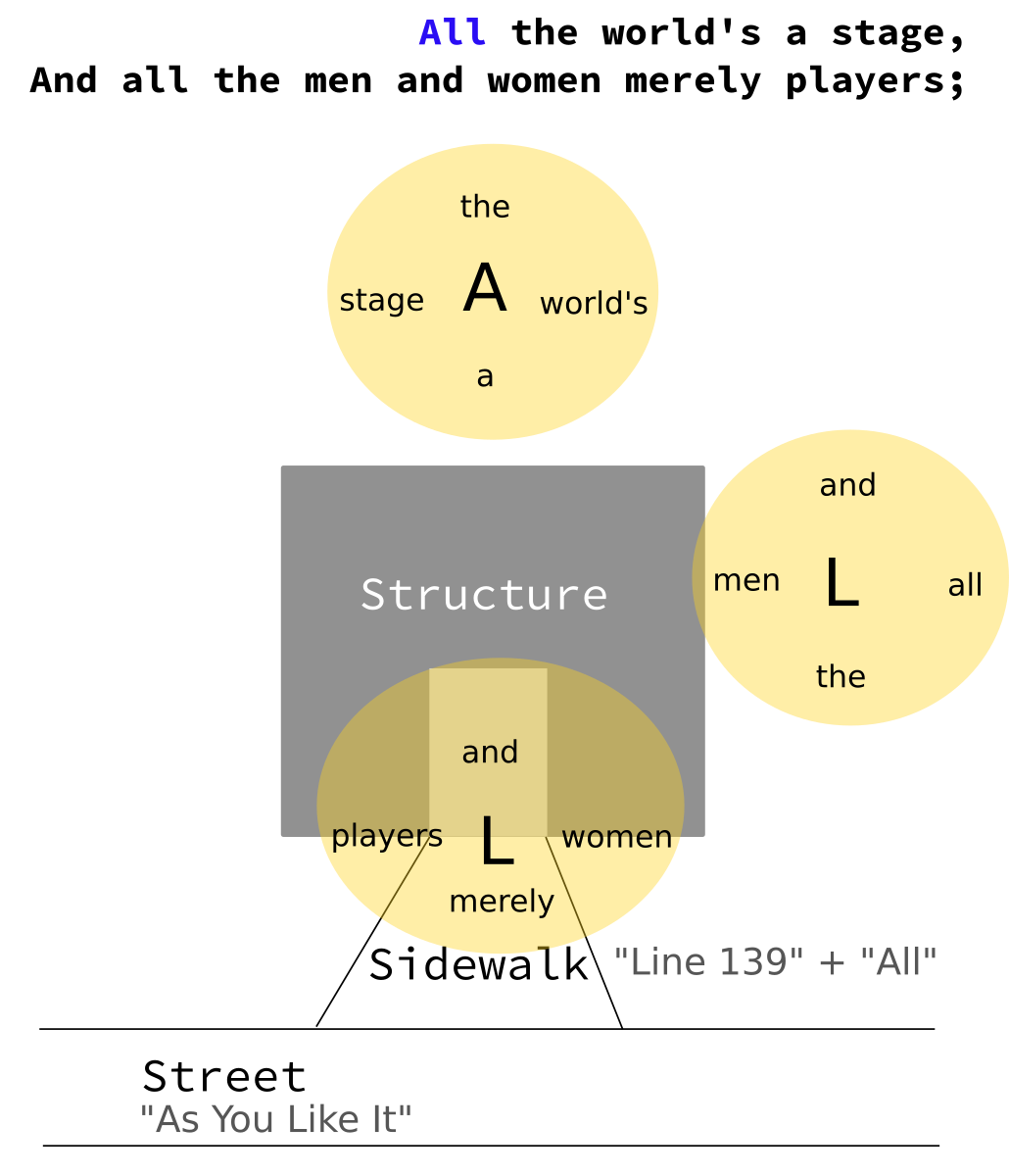
The quote is from line 139 (I think) of As You Like It by Shakespeare.
Extract the title word – which is “All” in this case.
Find your S-S-S: Street, Sidewalk, and Structure.
Encode the name of the book on the street.
Encode the line/verse number along with the title on the sidewalk.
Convert the letters of your title into alpha[bet] characters. The “A” might be “Alice”, the first “L” could be “Lucy” and the third could be “Lemon” (an alternate alpha character for “L”).
Then encode four words per alpha character, going clockwise. The words get encoded by using substitute words. For example, the word “a” might become “hay”, the word “and” might become “hand”, and the word “the” might get the “t” dropped to make “he”, which could become He-Man. The purpose of changing the words is to convert abstract information into something that can be imagined clearly (usually visual images). So in the first locations (around “Alice”), the images might be He-Man, the world (or a globe), hay, and a stage.
If you have touble making the images stick, you could add the F-A-C-E images to reinforce the associations. The image of He-Man could be linked to a Feature of Alice. the image of the world/globe could be linked to Alice’s Abode. the image of hay could be linked to Alice’s Career. The image of the stage could be linked to some Event in Alice’s life.
There are some more possibilities for it that are listed in the pastebin, but I think that’s the basic idea.
(Edit: the choice of quote was arbitrary. That line is relatively easy to remember due to the iambic meter, so I think it would be slower to create a mnemonic image for every word than to just memorize it with a little repetition.)
Hii, I m still not able to grab this idea.Is there anyone who can tell me in more clear terms with more easy and daily life examples?I will be thankful.Thanx alot.
ما نژدې نږدې نظر وکړ، او دا سیستم په دې کې ځینې خورا زړه پورې نظرونه لري. زه نه پوهیږم چې دا بدیل وضاحت به مرسته وکړي، مګر زما په اند دا یو څه کار کوي:
د سړک سړک - جوړښت
له هغه څه چې زه پوهیږم دا د S.S.S. تخنیک چېرې په هر فصل کې د سړک، Sidewalk او جوړښت څخه کار اخیستل کیږي. دا برخه د تیرې ربعې په 2-2 برخه کې په 133 لیکه کې بیان شوې.
واټ یو ځای دی (د یادولو محلات وګوري) چې د کتاب او سورت شمیرې په اړه معلومات لري (لوی میجر سیستم وګورئ).


 )