Does anyone else use hand gestures while encoding in a memory palace? Is this okay for competitions?

I’ve noticed something interesting when I’m working with my memory palace. If I start moving my hands and making gestures that correspond to the mental images and loci I’m placing, it really helps me out. Not only does it make me feel more comfortable, but it also seems to boost my speed quite a bit.

For example, if I’m placing an image of a giant banana in a certain spot, I might mime the action of placing it there with my hands, almost like I’m physically interacting with the image. It sounds a bit silly, but it really seems to make the process smoother for me.

Honestly, if someone saw me doing this, they’d probably think I’m a bit nuts! But it works for me!

I’m curious though. Has anyone else experienced this? Do you find that physical movement or gestures help with your memory techniques too? And is this kind of thing okay in memory competitions? I’m wondering if it would be allowed, or if I’d have to tone it down.

Would love to hear your thoughts!

8 Likes

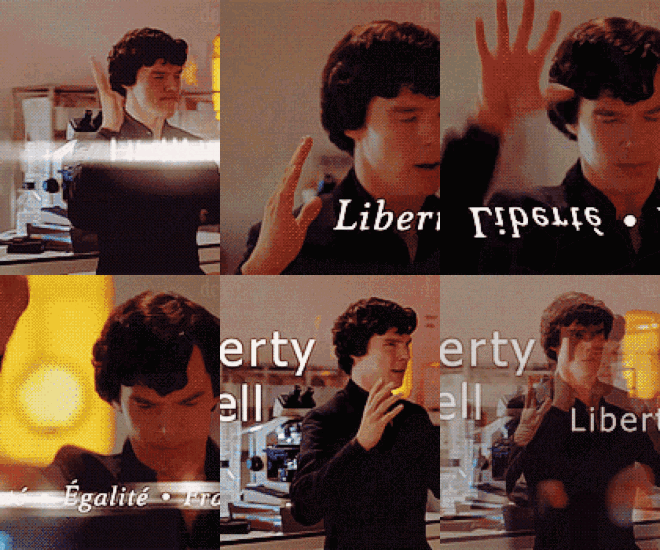
Not to be cliché but this really does remind me of the ‘mind palace’ scene from Sherlock.

bebetwenty

Anyway, I sort of do this too, though less consciously.

6 Likes

@turducken Yes! I actually picked up hand gestures from this scene in Sherlock Holmes (I haven’t watched the entire series, just a few clips). When I’m trying to encode information, I mimic Sherlock’s movements exactly. It seems like he uses more dramatic hand movements when he’s decoding or retrieving information. Either way, whether you’re encoding or decoding, I’ve found that these gestures really help. I think it’s because they enhance spatial awareness and probably engage different parts of the brain, like the motor cortex, which helps the information stick better.

3 Likes

It is the use of procedural memory, it is preferable to try to touch the images and places.

4 Likes

@Magno Yes, exactly. When you try to ‘touch’ the images and places in your mind, it really helps the memories stick better. This way, we’re not just using visual and spatial memory; we’re also adding in procedural memory, which is a strong way we remember stuff. Like how you can ride a bike or type on a keyboard even after years. Doing this makes the memories in our Memory Palace even stronger.

5 Likes

I wonder if it really is procedural memory, or if it’s just because you’re more fully engaging with it. Procedural memory takes quite a while to build.

3 Likes

@Noan You’re right that procedural memory usually takes time to develop, so what I’m doing might not exactly be that. I’m not sure if it’s true procedural memory, like when you’re riding a bike or typing, but the gestures help make the images feel more real and stick better. I hadn’t thought about it that way, so I appreciate the insight.

2 Likes

Dancing, rhythm, movement. All potent techniques for encoding and recall.

I think of gestures like tiny dances (cue Elton).

One technique I specifically use this for is creating impromptu memory palaces. If I don’t have a palace ready at the top of my mind for some new information, I’ll create an interesting gesture or body movement as the “starting locus.”

Then I chain information from there and later I can consolidate and re-encode into a more adequate palace. :slight_smile:

8 Likes

Before I lost my eyesight I used to walk back and forth while I went through my flashcards. I found that engaging the ‘doing’ sense really helped, especially as I grew up using German Sign Language as a child

6 Likes

E.g. you feel the wrinkled face of an old man, the texture of his clothes, etc., the same for any other shapes.

Procedural memory becomes automatic with practice and adds another layer of encoding.

It is as if you were a sculptor of a work.

5 Likes

It helps. It’s like a ritual. Like reminding my brain to change my mindset from whatever I was doing to pure memorization, creativity, and visualization of everything. Not just the use of fingers, but I play a song in my head, imagine a fire starting to concentrate at the center of my brain (weirdly I do feel something in my head, placebo effect much? Is it positive/negative?)

More now than ever before, after reading a lot of fantasy about cultivation and meditation, the idea became attractive, although I can only conclude to be brain processes and nothing more if something calms my brain or makes it concentrate and deepen its prowess: I want that, however ridiculous.

Of course, you could become dependant on the rituals, needing to use them before you or while you do anything related with the concept of imagination or memorization. So be aware of the cognitive biases and maladaptive schemas at play.

For example, I invented a group of fictional characters including: Ayumi, Ayiko, Ferdinang, Alena, Elizabeth, and 9-10 versions of myself (as alternate personalities/characters, say one version of me is pure anger, another pure love, another pure correct, another pure chaos, others are about equilibrium). Although these characters were intended for thinking and exploring strategies of thinking, and even pseudo multitasking thinking (as a means to consciously trigger unwanted thoughts that would be wanted at that point by using the method of loci to hold ideas in a back and forth).

The ritual for activating memorization focus would be to invoke Ayumi and Ayiko (I tend to vary how I see Ayumi: she’s an omnipotent being aware of being a concept that exists in the realm of all my paracosms, she’s the manifestation of the idea, if God exists, how does he explain his existence? does she ask why I exist? how I am here?). Just as such, wherever I am, I visualize this seemingly Japanese/Chinese/Han-looking woman (Ayumi) and the Red vixen/fox (Ayiko), while Ayumi doesn’t always look the same, Ayiko is always a fox that only varies in size, the more chaotic is my mind the less as a fox is Ayiko, and the more at ease I feel, the more divine is Ayumi (a giant even). They can interact with me, but I can’t with them, as they are my thoughts. (I don’t play pretend, it’s more like the dialogues of Platon than anything else).

Back to the fingers, do they help YOU? I don’t know. But consider this, all religions aid people to fit into behaviors via repetitions, the rituals serve as triggers to mindsets, thoughts, feelings, and more complexities. Having your rituals can be positive or negative, as long as you remain aware (of what you’re seeking) while also letting go (the point of the ritual). For example, when I was in the Pentecostal Church, I used to speak in tongues, even today I know how to trigger what makes me do so, and when I do (active the ritual behavior) it follows other behaviors, suddenly I want to shake my head, and jump and dance letting go of my control by just keeping the pattern and expecting something (this was the awareness part, when in that time I thought there was something divine making me do it). But consider another ritual, this time involving getting focused on memorization or imagination, define the want and strategize the trigger: when I snap my fingers three times, I will focus on X. Do it, and try focusing on X after you snap the fingers three times (DO TRY to focus), repeat this at different times, multiple times. Create the association, and just like memories are made, create that habit. However, this want I chose is too vague (what is to focus in memorization?). If it were just concentrate then, every time whenever you’re do the ritual, focus on whatever task you have in front.

The ritual of the example:

  • Want/goal: to focus on task X
  • Trigger: snap the middle fingers of each hand at the same time three times in a row and at the end try focusing on the task

You can use this one I just invented, try it and see. It’s just about memory and habit-making. Realize the similarities between the habits of emotional attachments and memorization. If every day you hear the name and see the face of a person there’s always a joke or laughter, don’t get surprised if that person becomes a joke or a comedian to you.

This is all my opinion and it can be revised later.

I still think there’s a conscious relationship between the things we think, memorize, and associate, our emotions, habits, and mind complexes.
4 Likes

This has come up briefly in an earlier thread:

3 Likes

This reminds me a lot of this blogpost:
https://vasilishynkarenka.com/fingers/

Not by a mnemonist, but he’s reinvented a lot if the basics.

What is particularly interesting are his observations about how the consolidation of ideas happen.

3 Likes

I’m nodding and smiling after reading that. Good share.

I’ve used the fingers for various memory applications over the years but my favorite so far is doing binary (and subnetting) on my fingers.

Which also reminds me of the video someone shared that shows how Ninja used touching different body parts to do math and quickly memorize numbers when tasked with reconnaissance.

4 Likes

Using placeholders to convert working memory into (temporary) long term memory is something I’ve reinvented over and over again. Anything from setting a few coins on the desk to hold thoughts on what I want to say, or note what someone else said, to just taking notes with a couple key words, to making marks so I can remember items I want to draw.

This is as much a thinking device as it is a memory tool. I’ve been mulling over the topic lately, considering making a post about it, and here you are posting an auspicious article.

5 Likes

I like how the author uses the method for both memory and problem-solving. Bending fingers to remember key thoughts sounds handy, especially when you have a lot going on. I’m thinking of trying it out, maybe when I’m brainstorming or stuck on something. The part about switching from focused thinking to a more relaxed state also makes a lot of sense. I have noticed that too, sometimes the best ideas come when you just let your mind wander.

1 Like

I’ve noticed that if you focus intently on a problem consciously, filling your mind with the detail.
Sort of like “loading it up for processing”.
And you then “get out of the way” and do something else that leaves the mind free.
After a while some solution or synthesis pops out.

It looks like some subconscious background process continues and consolidates what you’ve absorbed.

You see it often in historical accounts:

Like Archimedes seeing how to mass the crown in the bath.
Like Kekule falling asleep and seeing the benzene ring in a snake eating its tail.

When I used to smoke it was specifically noticeable. I’d program or have some design discussion and then stop with some unsolved minor conundrum, only to come back from a smoke with a key insight.

Often these insights seem to have have a quality similar to mnemonic imagery.

So I’ve been pondering what this means for using the mind and what can be done to enhance the process or to master the aspects of it.

3 Likes

For children and simple songs
(think Baby shark or camping kind of songs) I see it’s pretty standard practice to use mimed actions to teach them.

It works well.

3 Likes

It wasn’t for memory palaces, but when I was learning my system I created hand positions for my vowels. (I use consonant-vowel for 2-digit numbers and consonant-vowel-consonant for 3-digit numbers, like a modified Ben System.)

I would recite the numbers and move my hands into the position for the vowels. It created interesting mental associations between vowel sounds and space.

Related to hand gestures:

4 Likes

I didnt know it. Seems very interesting. Like Tom cruise in minority report :sweat_smile:. It could use other inteligences. Not only visual spatial. You are using kinestesic inteligence. It could be motivational and fun. And help to memorize more. I always thought si ce I saw that movie that it could ve useful. I use it to imagine when I lost something at home.

2 Likes