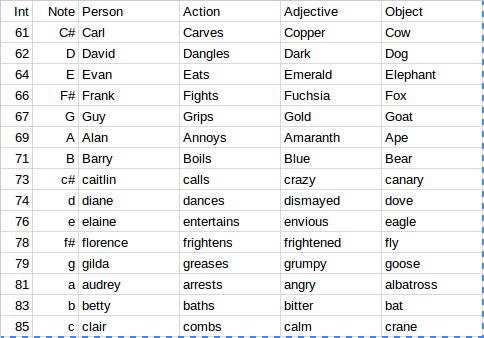
I’ve been thinking about ideas for developing a mnemonic system for music.
Images for Notes
I'm thinking that each node will get a sound based on solfege. My guitar teacher once told me to use a "fixed do" system. The only problem with the traditional "fixed do" system is that it doesn't distinguish the accidentals. C is "do" and so is "C♯".One workaround would be to use one of the chromatic variants or the syllables from “movable do”.
One other interesting idea that I would like to incorporate is hand signs (kinesthetic memory). In the beginning stages of learning the Ben System, I was using hand signs in my number system, where a certain hand movement indicated a vowel sound. I just came across this interesting concept from Curwen/Kodály:
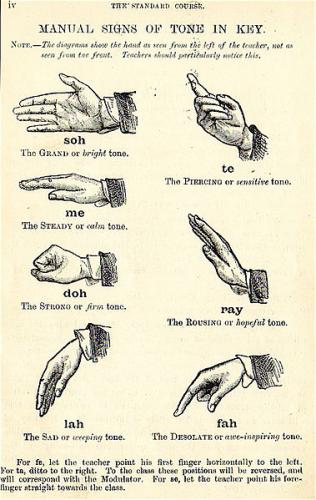
Hand signs, also borrowed from the teachings of Curwen, are performed during singing exercises to provide a visual aid. This technique assigns to each scale degree a hand sign that shows its particular tonal function. For example, do, mi, and so are stable in appearance, whereas fa and ti point in the direction of mi and do, respectively. Likewise, the hand sign for re suggests motion to do, and that of la to so. Kodály added to Curwen’s hand signs upward/downward movement, allowing children to actually see the height or depth of the pitch (Wheeler 1985:15). The signs are made in front of the body, with do falling about at waist level and la at eye level. Their distance in space corresponds with the size of the interval they represent (Choksy 1999:14).
Here are some other explanations of the method:
https://web.archive.org/web/20110708163653/https://www.classicsforkids.com/teachers/training/handsigns.asp
http://web.ku.edu/~cmed/acdapres/curwendiatonic.html
Images for Rhythm
Kodály also had rhythm solmization:The Kodály Method incorporates rhythm syllables similar to those created by nineteenth-century French theoretician Emile-Joseph Chêvé (Choksy 1999:16). In this system, note values are assigned specific syllables that express their durations (12). For example, quarter notes are expressed by the syllable ta while eighth note pairs are expressed using the syllables ti-ti. Larger note values are expressed by extending ta to become ta-a or "ta-o" (half note), ta-a-a or "ta-o-o" (dotted half note), and ta-a-a-a or "ta-o-o-o" (whole note) (Wheeler 1985:13). These syllables are then used when sight-reading or otherwise performing rhythms.
Here are some examples:
I think that giving names to unknown concepts helps to increase understanding of them. I was going to apply my Ben System syllables to rhythmic notation, but I might just use Kodály’s method.
Images for Intervals and Chords
I’m thinking of making images for each interval. Chords may be more complicated. I’m not sure whether images based in figured bass would work.
These are a few of the ideas I’ve been thinking about, but the system hasn’t been built yet. If anyone has any ideas, please leave a comment… 
 A lot of things