1.000.000-loci memory palace
Okay, I might be taking the definition of a 1.000.000 loci memory palace a bit loosely, it is rather a collection of multiple memory palace… multiple = thousands. I have explained this system of my Memory City briefly in some other topics already, but I decided to make a topic of my own, where I can also post updates further down the road.
I am a real visual thinker, I need to have an image of something to make sure my mind keeps track of it. That’s why I decided to not just have a collection of Memory Palaces, but to give them a spot in an even bigger Memory Palace. This thought gave birth to my Memory City, a categorization system for my Memory Palaces.
City
Let’s start with a little layout for the city. This one is mine so far, with 9 sections. My sectios so far are Physical Science, Life Science, Formal Science, Social Science, Language, Law-History-Society (grouped them as each on its own would be small, and they are quite closely related), Sports and Philosophy in the pieces of the circle, and Applied Sciences in the middle (Applied Sciences covers all kinds of topics, so I put it in the middle).
Sidenote: I have a lot of things that are a science, as I would like to use the Memory Palace to memorize facts, things that are true rather than things that are said to be so. I do have ‘Religion’ as a category in it too, which holds a spot under Law-History-Society. While Religion in general isn’t known for the facts, I view the things which I will put there as ‘facts on the religion’. My Memory City has to become as objective as it can get, while still containing as much kinds of information as possible.
District
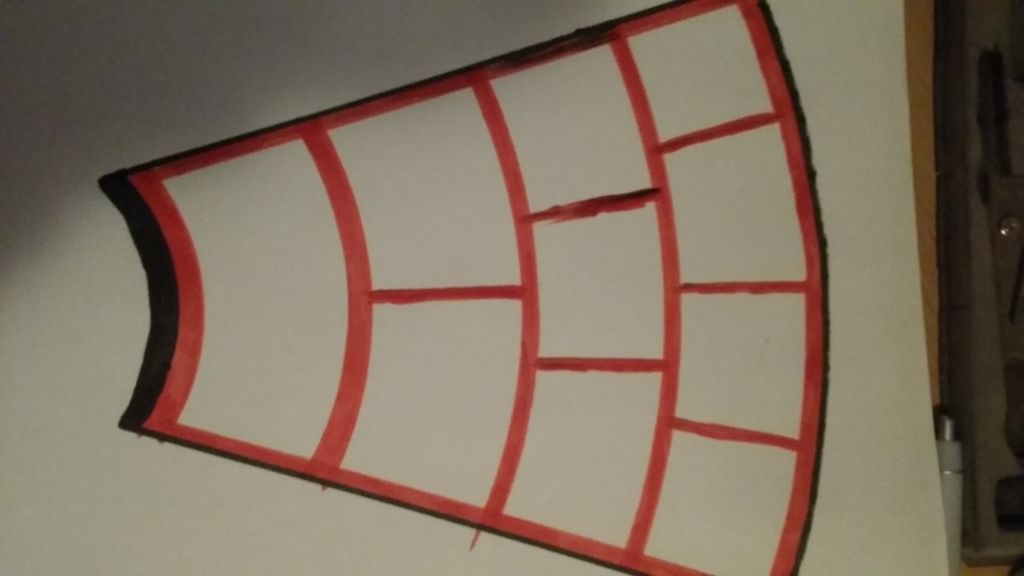
Next up is a focus on one of the pieces that makes up the City. This contains categories, you could see the categories as a district within the city. Now, while a real life city would be bound to material boundaries, this one does not. All the pieces together make the city, but the city is just a collective, it doesn’t do much itself. As shown in the image, there are mulptiple layers from the center to the outer ring, I have drawn four layers for representation purposes. Each Layer also has some extra lines dividing it into two, three or four pieces. In the image, I have drawn the lines in red. All the white squares you see there are the actual categories, the “neighbourhoods”.
The layers represent different groupings of categories. If you would imagine the district on the image to be the Physical Science District, the layers would represent a separation of Physics, Chemisty, Earth Sciences and Space Sciences. This is also where actual city planning goes out of the window. If Physics would be the most left and Space Sciences the most right, you’d think that Space Sciences has more categories and information, while in reality Physics might have way more. The circle is not an exact representation, but it was the best I could do. This might be confusing, but it makes sense to me. It is not an important aspect of the system though, in the end you have to use what makes sense to you.
Blocks
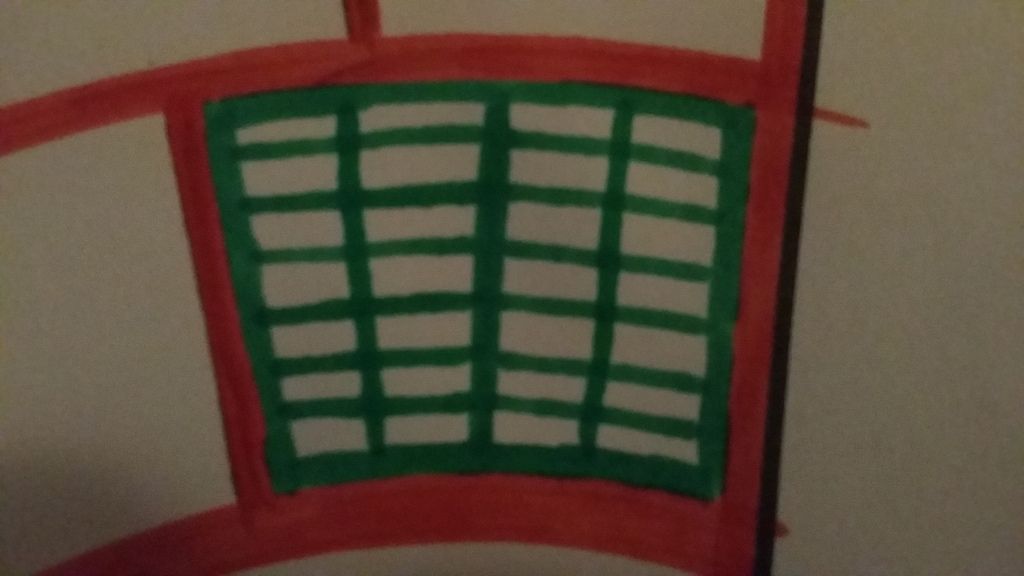
The last image shows the blocks, outlined with green. Every white block is a different city block, a different subcategory. If we’d take ‘Astronomy’ as an example, that is where you would find the Planet-block, the Star-Block, the Comet-block, the NASA-block, you name it. All these blocks contain the actual Memory Palaces. Some blocks are devided in 2 or four more subsubcategories (streets).
Finding information
Now, the categorization is nice, but information needs to be easy to find. That is where I let the designer in me out of her cage. Lets say you ask me about autism, you want to know about famous people who have autism. So I go to my city, I head to the Social Sciences District, which can be easily recognized as it is a chaos of different shapes and colors, to represent the fact that almost everything in social sciences is a spectrum, it is almost never exact. So we’re in the Social Sciences district, then it is time to find the Psychology layer, which is the middle layer, as to me psychology is the core of who we are, which is just a little mnemonic aid. In that, I have to find the Neightbourhood of Clinical Psychology, which is placed on top of a huge, red couch, like the one that is seen in the stereotypical images of psychoanalasys. In there, I have to find the Disorder-block, which on it’s own isn’t distinctive, but the actual Memory Palaces all look different and chaotic, you can see the chaos. One of the four streets of the block is the Childhood Disorder Street, where autism is. Finally, we head to the building which is a perfect cube shape, the exterior is layered with a chessboard pattern in all kinds of colors, and there are no windows. There I have all my information on autism, including a list of 20 famous people with a form of autism in the backyard.
Please ask if you have questions!

 Yes I have, and it actually works surprisingly well. It would be near impossible to catagorize all information, but I just started out with a few bits, and then I found out how much I actually knew about other stuff. Also, for example when I was doing the part on the solar system, I searched a lot of information. Distances of the sun from all planets, elements found in the atmospheres (the majority of the elements at least), surface temperatures, sizes. All kinds of information I didn’t know before, but which I did add to the palace.