Down to only 9 entries left! They all have their middle sound as J.
T-J-T
T-J-N
T-J-J
T-J-K
T-J-P
T-J-D
J-J-T
J-J-N
J-J-K
Down to only 9 entries left! They all have their middle sound as J.
T-J-T
T-J-N
T-J-J
T-J-K
T-J-P
T-J-D
J-J-T
J-J-N
J-J-K
Nice time you got there! What’s your rating?
Thanks! My best time for a deck is 58 seconds (with my previous system). I’m working on getting to a final build with this one and getting faster than that time with it. I don’t do any official competing so I don’t have a “ranking” in terms of IAM or Memory League or anything like that. Maybe at some point I’ll give that a go, but its more for the fun and personal challenge at the moment!
Got em all!! Now my system is fully optimized!
Every value and suit combination has been restricted to a single sound. All 2704 entries are unique and follow the phonetics exactly. Nearly all of them can be reduced to either one or two syllables when subvocalizing. There is a great ratio (for my preference) of about 2/3 objects and 1/3 people.
I am EXTREMELY happy with how this design and build phase has gone. I think I landed on what I hope to be the last card and number system I’ll ever need. Now all there is to do is learn it fluently and see how fast I can get it!
With this adjustment to the J’s and S’s, I have 363 replacement entries to re-learn. Meaning 13.4% of my system has changed due to this new restriction.
This is fine.
I’m happy to sacrifice short-term progress of some recognition fluency for the benefit of long-term optimization. I figure it will take me a few weeks to build these new ones up to the speed of the old ones… BUT many of the old ones were challenging due to their variable phonetic nature. It will actually be interesting to see if these new ones lock in significantly faster now that there is just the single phonetic structure. It will require less brute force combination cycling as I’m learning them, so I think it may go quicker than I expect.
If you’ve followed along with my development of this system, or of my previous ones, you know that I actually enjoy this stage a lot. The journey to the goal and the refinement of the process almost as rewarding to me as actually getting to my target usage speed.
I’ve said all along that I’m not going to set a hard deadline goal for training this system under 58 seconds (which would be a new personal best for a deck), but I feel like I can achieve that before the start of spring, mid-March. Lets see how it goes!
I think it will be cleaner to create a separate thread in the general chat section with the guide to the system and link to the google doc. This thread can be maintained as a development and training journal. This way if anyone has questions or comments about the system itself, those can go in the general chat section thread and if there are questions about my actual training and development process, they can go here.
Yeah true I think the world record is like 10 seconds or close to from memory of YouTube. Your pretty close!
Quick update, took most of the last 3 weeks off for the Christmas holidays. Back to it this week. Happy to say that even after the break, most pairs that I’ve reviewed are still sharp!
I’m starting to reflexively identify 6’s as ONLY the J sound as well, which is REALLY REALLY nice. Even though I have to overwrite quite a few existing associations, I’m glad I took the time to make this adjustment! I’m going to work on exporting an Anki deck template today and making it available in the other thread along with the guide.
After a lengthy break from actively practicing, I’m coming out of winter hibernation mode and picking back up this week. Let’s see if I can stick with it now that spring is almost here!
About a week and a half into my practice restart and something has clicked with reading/recognition.
Up until now, I’d been hovering around 2.5 - 3 seconds for my pace of reading a pair and being able to visualize its associated image. The last couple days though, my speed has improved to around 1.5 seconds per pair. This is a huge jump. Almost cutting my recognition time in half.
I’m not sure if it’s just that I’ve finally hit the saturation point where I’ve done enough reviews for things to start becoming reflexive and fluent or whether I just decided to try pushing my pacing and letting my brain catch up, but either way, I’m excited about this progress. Earlier in the week, I did a few runs that hit around 2 minutes for the whole deck, but that was before this jump in recognition. I’m planning on benchmarking this weekend to see where I’m at with a single pass runthrough with manual advancement, then I’ll start working with auto-advance settings to put the pacing at what I need for a new personal best of under 58 seconds.
In order to hit that time, I’ll need to average 4.461 seconds or better per scene. If I can read and visualize each pair in 1.5 seconds, that means 3 out of those 4.461 seconds are allocated to recognition, and 1.461 seconds are left over to construct the scene before I have to move on to the next. That SHOULD be enough time to lock in a recallable scene. This is where the 2704 “true” 2-card aspect shines. I know that I will always have 2 elements interacting in each scene and that I’ll always need 13 total scenes for the deck. I don’t have to spend any extra mental effort on varying scene length or number of loci, I can trust myself to just link and go.
When I achieved sub-60 times with Shadow and with my Expanded 2704 P/O System, I was around the same pacing, maybe a bit closer to 1 second for recognition, so I’m pretty confident I’m in the zone now where I can start going for the goal.
I’m re-energized after finally breaking through that initial wall of challenge as I had to remap and overwrite some of those heavily ingrained associations from prior systems. I think when all was said and done, I had about 1200 new associations to learn in order to fully absorb this system. That kind of bulk takes time, and I think I’ve started seeing the results of the effort.
I think I’ve finally stopped reflexively reading the cards in the structure that Shadow set up and that I used for my other system builds. Every now and then I’ll mess up reading the red-first suit-pairs, since in previous 2-block systems they shared phonetics with their mirrored black-first counterparts, but this is happening MUCH less now, and I’m starting to get automatic with the new singular phonetics for suits.
For value phonetics, those are solidly automatic now and it’s GREAT. I’m REALLY happy I decided to limit myself to singular sounds for each and eliminate starting vowels. It made the build phase more challenging, for sure, but I think it was worth it. I absolutely love being able to unambiguously read everything and not have any hesitation about “is this a J, CH, or SH? or does it start with a vowel?” There is also a huge benefit to reading numbers. Now reading a number is also unambiguous.
Look at a number like 689. In this system it’s read as J-F-P.
In “traditional major” it could be:
J-F-P
J-F-B
J-V-P
J-V-B
SH-F-P
SH-F-B
SH-V-P
SH-V-B
CH-F-P
CH-F-B
CH-V-P
CH-V-B
[vowel]-J-F-P
[vowel]-J-F-B
[vowel]-J-V-P
[vowel]-J-V-B
[vowel]-SH-F-P
[vowel]-SH-F-B
[vowel]-SH-V-P
[vowel]-SH-V-B
[vowel]-CH-F-P
[vowel]-CH-F-B
[vowel]-CH-V-P
[vowel]-CH-V-B
While having so many options can be nice to alleviate the difficulty in finding a matching word, I’ve found it to be a double-edge sword and that it can be really frustrating to not be sure of which one is correct when trying to learn and lock in your entry.
In my opinion, with a system this big, having exceptions to rules is a real negative. If you have some entries start with vowels and some don’t, or have one of your suits or values assigned to multiple or ambiguous phonetics like J or CH or SH, there will be hesitation when learning them and it can be in the back of the mind that those are lurking around the corner to trip you up when you’re doing deck attempts. This also applies to structural variety for reading the pairs. I think it’s a negative if you have some types of pairs that are read left to right and some that are right to left and some that are suits first and some that are value first… For me it’s all about being able to eliminate as many variables as possible so that I can be laser focused on just two things: recognizing the mnemonic elements from the pairs and scene building with those elements. If I have to think about rule exceptions or phonetic variability, or how to indicate a block change, that robs focus and time from those crucial tasks.
That’s why I love this system!
Up until this point I’ve set up Anki to have a max review interval of 4 days. This is the longest amount of time that will elapse between reviews. This way I ensure that I’m seeing every pair at least once in a span of 4 days. I needed this gap to avoid burnout in the early stages of learning associations.
In times past when I learned my other large systems I was grinding out reviews for a couple hours per day. I made it a point this time around to not be as hardcore with my time. I wanted to try to cap my review time to an hour or less per day. I didn’t want this project taking over all my free time.
So, I divided the cards up into 4 randomized groups and worked on one group per day. I knew that at first It would take me 4 or 5 seconds to recognize the word/image for each pair, especially as I re-learned and overwrote so many associations. By working on 676 pairs per day, I could get through them all in about 45 minutes to one hour. This was the upper end of my practice tolerance, but something I could commit to.
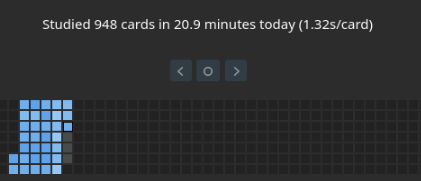
Now that I’m consistently averaging under 2 seconds per pair, I’ve changed the max review interval to 3 days. So now, I’ll be reviewing about 900 pairs per day, but it will only take about 30 minutes. This allows me to not only go through my scheduled pairs, but also do one pass with my “tough” pairs that I’ve had to press “again” on in Anki…
Anki notes how many “again’s” a given card gets. The more of them, the tougher the card is because in theory you’re self-grading honestly and asking Anki to show you that card again in your session. I have about 350 pairs that have an again count of 7 or more. These are the “toughest” cards for me to recognize. So I can tag them as “tough” and then do a custom study with only those cards whenever I want. Now that its taking less time to get through the scheduled reviews, I actually have the time to specifically target and work on these tough ones via additional reps.
I realize that some of these are actually quite easy now, since the “again” count has been adding up since the very first review session. A pair may have a dozen “again’s” but they were all early on in the learning process and that pair is no problem now. When I come across one of those, I can just remove the “tough” tag and filter it out of the review pool.
Now that I’m able to push more reviews through per day in the same amount of time, I expect my recognition speed and ability to improve at an accelerated pace. I’m hoping that by the end of April, I’ll be fairly automatic and close to a 1 second per pair pace. At that point, I can adjust the max review interval down to just 2 so that I see half the pairs each day. This will even further accelerate fluency, while keeping me in that manageable amount of daily review time.
Something that I’ve thought about previously while learning large systems, and again with this one is about how many reviews I’m able to do for each pair. I mapped it out a while back, comparing how much of a time commitment is needed in order to spend X amount of time working with each card or card pair, and it hits home when the early stages of big system learning are a slog.
There have definitely been times during this process where I’ve said to myself: “you know, if you had spent this amount of time learning a single card PAO with only 156 associations, you’d probably be lightning fast with it.” After all, this new system has 20x the number of associations to learn and upkeep… But, the journey can be the reward sometimes and I really do think that the benefits of a true 2704 system are ones that are worth the hassle!
One last thing I realized though is that there are MANY associations that have remained the same across all three of the large systems that I’ve learned. Since all of my systems have been based on Major phonetics, I’ve had 1000 or so associations that have remained the same across all systems when it comes to number/sounds, so I really haven’t started completely from scratch. Those words and images may be associated with different card pairs in each system because the reading structure differs between systems, but they’re still associated with the same sounds, so it is not very difficult to overwrite which card pairs go with them. Its just a matter of learning the new reading structure and variations of suit-combo phonetics. This explains why with each successive system attempt the onboarding has gone faster.
If I had made a switch somewhere to a CVC system like Ben’s or Josh’s, it really would require starting over from basically scratch because ALL the associations would need to change. I’m really glad that either through intentional foresight or luck I based all of my number and card learning basically from day one on Major!
Now consistently hitting 1.3 seconds per pair for recognition speed. Phonetic translation is pretty much automatic at this point and more and more words are getting locked in to be able to be read with no hesitation. Feels really really good to just blast through reading now! May bump up the Anki interval to view half the card pairs per day. 900 cards is only taking about 20 mins, so running 1352 should only take about a half hour. Will probably make that adjustment at the end of the week.
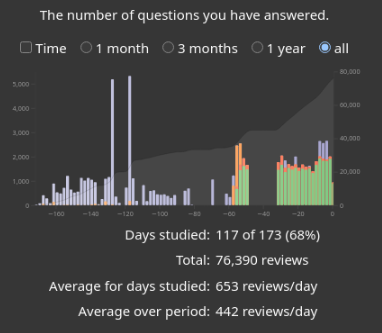
Just looked at some Anki analytics for this system’s deck. It’s showing just over 75,000 reviews so far. This seems like a lot, and it is I guess, but with 2704 unique pairs in the system, Its really only seeing each one an average of about 30 times. Worth noting is that those two big spikes in the log don’t accurately represent actual reviews. I reset the progress of the whole deck on those days and it counted them as being reviews, so in reality I’m probably closer to 65,000 total. For previous large system learning (shadow, 2704 split P/O,) I believe I was well over 100,000 reviews before I felt comfortable going fast. It took about 250,000 total reviews before getting my first sub-60 deck time. This is a great sign that this system is optimized better for me!
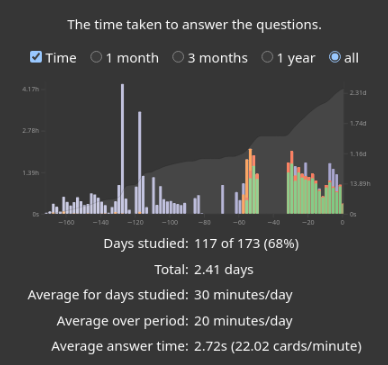
In terms of time spent working with the system, I’m at about 50 hours. In my previous system build(s) I don’t think I reached similar recognition speeds until I was over 100 hours and it took me over 160 hours before hitting a sub-60 deck. Again this tells me that this system is working better for me in terms of getting fluent more quickly!
Pushing the pace!

Faster, faster…

Maintaining that recognition speed. I’ve been consistently under one second for the past few days. I feel like I’m in the zone now where a sub-60 is possible. Time to stop procrastinating and get to it! I’ve got next week off of work so I’m going to do some consistent deck runs and see what happens. I think I’m going to set the auto-advance pacing to finish in 57 seconds, which would be a new PR. I’d like to get to 52 seconds for a deck, as the 1 second per card time would feel pretty good. Lets see what happens!