I’ve been away from my desk/computer for the past three weeks, so sorry for the delay in replying.
Basically - and choosing some easy images for the moment - I use one for gun, two for shoe, three for three, four for door, five for dive etc.
If the first image was a duck, then I would imagine blasting it away with a huge gun. I make it as big and loud as possible. (If it was a lake, I’d imagine the water exploding everywhere.) If the second was a mouse, I’d imagine myself in big hob-nailed boots treading on lots of mice. I’d hear the squeals and everything else. If 3 was a cloud, I’d imagine lots of big fluffy white clouds hanging from a big Christmas tree in my house. If 4 was a horse, I’d imagine opening the front door of my house and a big horse comes rushing out, sending me flying. If 5 was a fruit bowl, I’d imagine myself diving from a great height into a fruit bowl. I’d feel the fruit burst/taste it etc.
I often try to memorise lists of 30 words using the number/rhyme system. So as not to make things too easy, I sometimes use concepts - words like idea, compassion, belief etc - or even TV programmes/famous people. On one occasion, when I was attempting (and ultimately failing ) to learn German, I memorised 30 random German words. That was especially hard - but great practice!
The actions associated with my images are always the same, which helps a lot.
That said, for a long series of images (certainly 30+ if I can ever manage it), I will have to use the journey system - and probably have two images at each spot as you do. I use the journey system for playing cards.
I’ve been trying a new system for Images recently, somewhat similar to JamesW’s approach above. I have an action for each letter of the alphabet and apply them in turn to the images. The first image, I chop with an Axe. The second image, I throw a Ball at. The third image, I Clingwrap. And so on, up to the 26th image which I Zoom in on. The last 4 images I store quickly in verbal working memory by repeating words to myself.
I think this has some advantages over placing the images along a journey (which I did previously):
No journeys are required, which is nice.
I can do any number of trials without any confusion between them. During recall, I’m not thinking “What did I chop with an axe?” in which there would be confusion with a previous trial. I’m thinking “What did I do to that image?” And since I haven’t seen that image before this trial, there’s no confusion.
I can immediately put any image into its correct position during recall. With a journey system, I’d be thinking “OK, there was a sheep at the first location - now where is that picture of a sheep?” and take a few seconds hunting for it. With this system, I look at the first recall image and think “Oh yes, that’s the thing I punched”, and since I know that P is the 16th letter of the alphabet, I can put it straight into position 16. I can usually recall everything in about a minute, and if there are any images I’m not sure of straight away, I can easily figure them out from the remaining possibilities at the end.
I almost never confuse similar images. That’s because I’m imagining the action happening on the image itself, rather than imagining the object in the image somewhere else.
It’s early days yet and I’m still becoming more familiar with my set of actions, but I score 30 much more consistently now and I’m already about as fast as I used to be with the journey method.
I’m soo glad to learn taht this is a consistent method later as well!
I’ve naturally switched from journeys to a peg system myself,
but I only had 10 pegs, after the 10th image, I’d imagine “something” on a stick for 10-19,
then “something” on a duck for 20-29, etc…
Wow, great method! I’ve been using the loci method for images but had hit the wall. Started using your peg system and I’ve gone from level 6 to level 10 in an hour. Brilliant!
always review the memory palace you created over and over to a good “walk through” speed and “clearness” before you start memorising. Have 2 images per loci or just in the room. I usually have the second image interact with the first or vice versa depending on the room and the image it is. E.g if it is grass first then mice, then mice bites the grass. That is it, move on to the next loci and start remembering the next 2 images
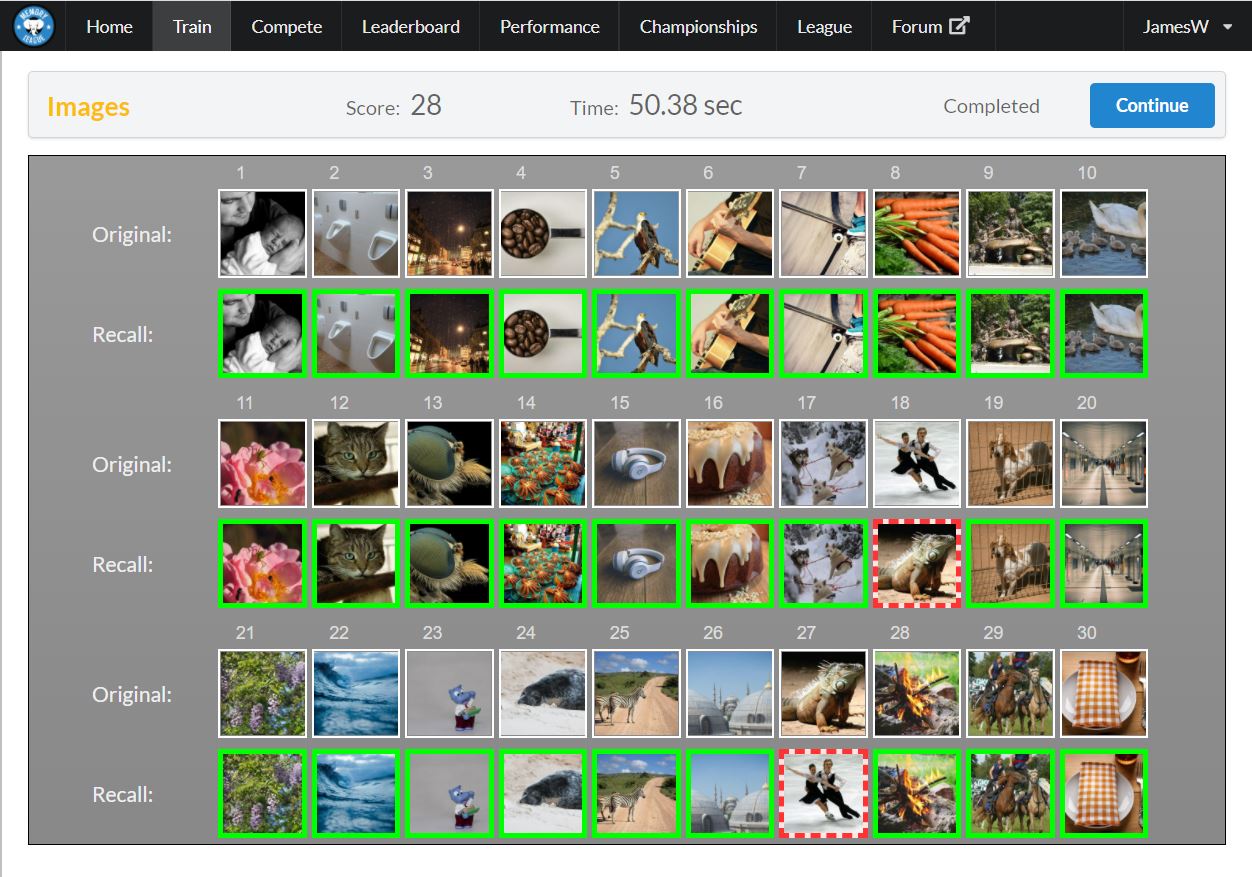
Though I long ago reached 30 images in 60 seconds, my best to date is still only 53.47. Today, I managed 28 in 50.38 - getting two images the wrong way round. That was painful. I still find the number-rhyme system works best for me and would love to break 50 seconds. At 66 years of age, I’m happy with all my current speeds, but still hope to keep improving!
Very nice. It‘s usually the scores that are painfully close to a personal best that help you improve even more
You might soon be after the 40 second mark
Interesting method, Simon.
As a matter of interest, what’s your A-Z list?
My Z is Zebra(a kicking Zebra), but Zoom seems really cool. If I find a better match than mine, I replace mine.
Here is Simon’s action list.
Letter Action
A chop with Axe
B throw Ball
C Cling-wrap
D cover with Dots
E Eat
F burn with Fire
G hit with Golf club
H imagine Hair
I Iron
J Jump over
K Kiss
L Lick
M imagine Miniature
N imagine New
O Open
P Paint
Q involve the Queen
R Rub
S Shoot
T Twist
U look Up
V Vomit
W add Water
X cross out
Y hang a Yo-yo
Z Zoom in
Anyway I don’t know why you asked this question in the first place because just above your chat, simon already gave the link of his full action list already.
 ) to learn German, I memorised 30 random German words. That was especially hard - but great practice!