Advanced Memory Palaces by Joe Reddington (2022)

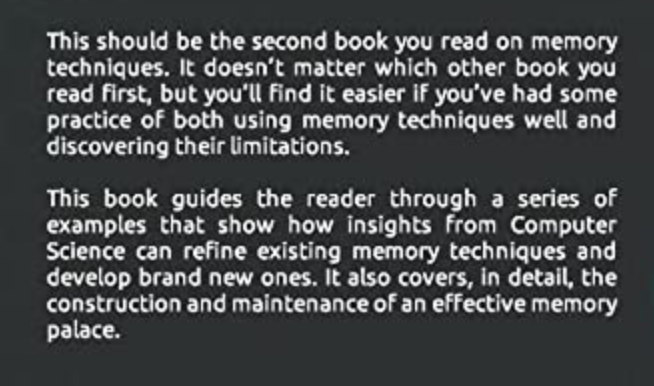
I found out about @joereddington’s book while on vacation and ordered it as soon as I arrived home. I’ve barely been home a day but I devoured it quickly. Joe’s background as a researcher in data structures is close to my experience in working with all sorts of computer languages and I enjoyed that we both are curious about how to leverage the enormous field of efficient data structures for mnemonics.
He’s been using mnemonics for personal use for quite some time so has had the personal experience to authoritatively talk about what can work. And I found no issue with his discussion of computer terms. In fact, if you are familiar with arrays, trees, maps, etc. and never thought about them as mnemonic tool types, you will find the discussion eye-opening and accurate.
He spends his observation time with trees, classes, skip lists, and Karnaugh maps. Very little time is spent with traditional mnemonic system discussion but uses many descriptive examples. I personally think classes have quite a bit of application for real-world design of memory systems and was happy to see them in a good light. But Karnaugh maps will take some time to digest for me.
Skip lists was a new concept for me that I plan on implementing by using a second list of associated items. It’s an abbreviated list of every nth item. A bestiary could be constructed from every fifth item such as your choice of animals for A, F, K, P, U, Z. Jumping to animal 22 is easy as counting by 5s to #21 Unicorn in the skip list and then adding one in the bestiary list.
Joe does redefine some mnemonic terms mostly for clarification. His bent is technical and leans towards using computer terminology in many descriptions. Fortunately, he removed his discussion on entropy because I doubt anyone would really need that. And it’s because of the technical design discussions that he makes it clear that this book is not a first read for anyone.
Joe is the first person in print that I know of that has made the connection between the two disciplines of computer science and mnemonics, which is a major milestone in my mind, and he deserves much credit for the hours of writing and thinking to do that. I look forward to his participation in our discussions here on the forum because he has a different point of view that will be valuable for programmer types to see that not all the world can be conquered by a PAO system.
PS Thanks to @JohnDen for the tip about the book!