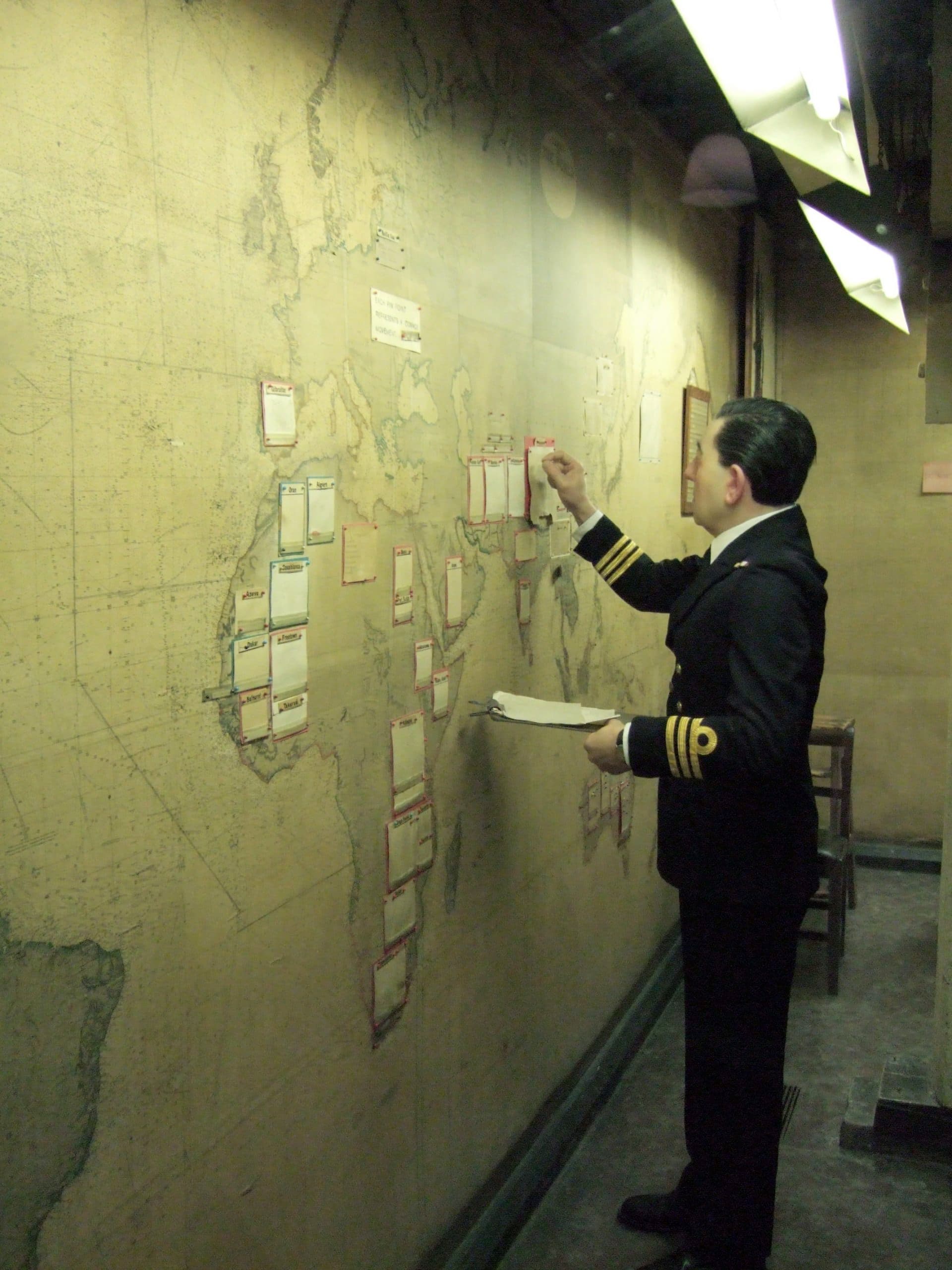
In general, I have a real interest in what might be called ‘no-computer computing’ - seeing what algorithms were and are used to share data and manage information. The displays of shipping in Churchill’s War Rooms (for a UK audience) are fabulous examples but so is, for example, the profession of accounting…
JohnDen thinking aloud here… If I have a grid of 26 different countries from A-Z (Australia, Belgium, Canada, Denmark, Egypt …, Yemen, Zimbabwe) clearly as a palace or pegs as rows (similiarly-structured pegs as you’ve put it) in the grid, what could I possibly use as “common criteria” or different data points between these various countries as columns (say 10 data points) to have a 'country memory palace grid of 24 rows x 10 columns)? If I can achieve that I would effectively have a structured memory palace of 240 loci. Just wondering how to order and structure the columns in the easiest way to remember such a grid? Hope that makes sense??
The examples in the book use complex pegs that have multiple features in the same structure. For example, 5 shops that each have a door (data point 1), a window (data point 2), a counter (data point 3), and so on. This is similar to the technique Joshua Foer described in Moonwalking with Einstein, where he used three houses, with different themes but the same layout, to remember details of three people.
I think this is difficult with countries, unless you have a deep knowledge of all 26 countries. If you do, you could associate data point 1 with the capital city, data point 2 with the leader, data point 3 with the biggest airport, and so on.
Other options are to create a 10-stage chain at each peg. Or to use a combination of 2 sets of pegs (e.g. blue-Australia, green-Australia, yellow-Australia…).
(This last option has a very rich history; in Ancient Rome the signs of the zodiac were combined with different backgrounds to make many pegs, see also the sexagenary cycle of China and East Asia.)
Very interesting stuff, and I’m intrigued to pick the book up now.
When I heard mention of entropy, my first thought was about compressibility, since the entropy of a stream of events is directly related to how redundant, structured and compressible it is. Having implemented Huffman trees in uni (almost 20 years ago now, ack) and just last week encoders and decoders for LZW, LZSS and BWT+RLE, I find that aspect to be a fascinating topic even if the book didn’t go there.
In the context of mnemonics, I think entropy is very relevant, from the POV that computers love it (easily compressed) but we don’t, because it increases our likelihood of confusion.
When I devised a system for converting Rubik’s cube algorithms to numeric codes for memorisation with the Major system, I quickly ran into this issue: many move sequences contain repeated segments like the “sexy move” (R U R’ U’). This meant I’d encounter codes like 127172 frequently, so there was considerable interference between different algorithms due to “collisions” on those common segments. One solution might be to assign new codes to common patterns rather than single moves, but this has an obvious complexity cost that may not be worth it.
My instinct is to assign new codes to ‘finger tricks’ - and I’m quite interested to know how much that overlaps with ‘common patterns’ over a reasonable number of trials. I’m certainly yet to see a satisfactory rubiks mnemonic system although it would be an interesting case study. Alas, the book as published (rather than drafted) goes into none of this; sorry.
This is key: highly compressed information is the opposite of what I want (but that memory competitions prize); however, there’s a lot of interesting mnemonic conversation to be had around the methods of compression. For example, UK car number plates are (mostly) easily decoded and are more memorable once they are (in addition to all the points made above).
Seems cool. Does anyone happen to know if there’s an EPUB version of the book? Thinking of ordering a copy but shipping will take a while as I don’t live in the states. Amazon seems to only offer a soft copy version.
There isn’t an epub version - I wasn’t satisfied with how the layout of tables and things kept showing up in electronic formats. I’ll likely give it another go when I finally commit to a second edition, but that’s hardly helpful in the circumstances.
I wish I had a good answer for you - I understand you are Singapore-based and I think there is something strange about Amazon.sp and publishing. Like - the book is accessible on the French, Japaneses, UK, German, and US sites, but not from Singapore… I’ll have a bit of a look-think.
For some reason I didn’t get a notification about this. I’m afraid Amazon is out of my hands - I do know that you aren’t the only person in Brazil having a problem - two people have messaged me to say that that haven’t been able to order at all. It’s quite vexing - part of the reason to use Amazon is that ‘everything just works’ and clearly here it doesn’t…
It turns out that my book has been targeted by scammers (presumably along with a vast number of others) who claim to offer a free download (they make money via a $1 credit card charge). This is a good place to be clear - there is no such epub of my book around and I can’t believe anyone interested in it would take the time to cut it up and scan to make a pdf.
I liked the book I read it front to back today. Ill probably reread it tomorrow since its a quick read. tbh as a memory sports competitor I have found that I can tackle all real life with PAO/Method of Loci & applying Ron Whites names & faces techniques (memorizing magazines, books, important info, names/interests& events/dates etc.) and it seemed that all of his techniques were widely capable of using arrays which is just the method of loci.
Anyway good book overall… I might just be to stuck in my ways/advanced in memory sports to feel the need to switch to lists/pegs. Although I did like the idea of linked lists
*edit
actually, thinking about it, I do naturally use the techniques listed in this book such as linking words to words I store in method of loci, just never really thought about doing it
A lot of people, including me, primarily use e-books. I hope you do end up doing an e-version at some point. Yes, data in tables is a pain to look at on a kindle.
Any chance I can pay you directly for Time limited access (via link with expiry) or a watermarked copy of the book on whatever platform it was drafted on? Not picky about it’s formatted but am quite eager to read it