I will use this thread to jot down my observations.
I.
The semiotic triangle is a model showing the indirect link between a symbol (word/sign), the thought/reference (concept in mind), and the referent (real-world object or idea) it represents.
Therefore, objects can be memorised in two ways: either by using the reference or by converting the symbol of the object in a visual concept.
If I want to memorise a cat, I can visualise its image (reference) or I can convert the word “cat” or the letters c-a-t (symbol) in visual elements.
Abstract objects usually don’t have a visual reference. E.g. numbers get memorised by exploiting their graphical form (e.g. 000011 looks like a sumo fighter) or by a multistep encoding (numbers → letters; letters → words; words → images).
Then, we create a picture or image connecting all these visual elements, i.e. there’s a link between the visual elements. Structures are needed when there are several pictures.
II.
Yesterday I finished reading @joereddington ‘s book “Advanced Memory Palaces”. It is probably the most interesting book I’ve read on the topic.
I really liked the isomorphism between mental data structures and computer data structures.
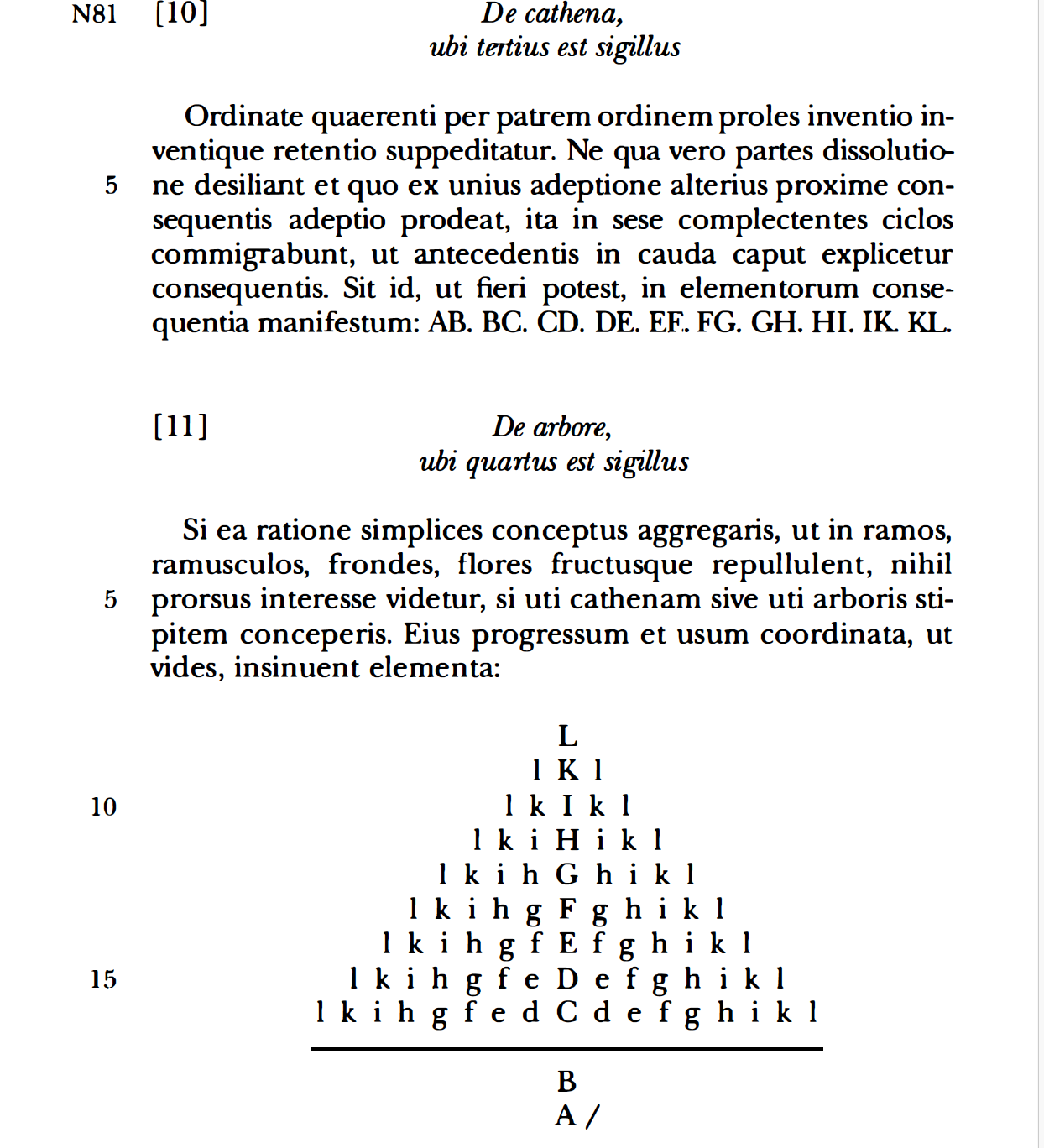
Regarding mnemonic structures there’s an author who was particularly keen on using them: Giordano Bruno.
In his treatise Explicatio triginta sigillorum he showcases thirty sigils (structures). Among these there are the chain (linked list) and the tree. I think it is a nice similitude.