Hey there! I’m Indra and am (finally) committing to writing this memory training journal!
Here are the lil projects I’m trying to do:
Encoding what I learned in high school and undergrad: Create a network of memory palaces for everything I learned during high school and undergrad.
Practical information for my job: as a software engineer and sometimes a manager, at a startup. This will be a fun one since this involves a lot of abstract information like code commands.
Encoding high school and undergrad information
It boggles my mind that we spend so much time learning but not so much time reviewing what we’ve learned! I remember the long nights I would cram information in my brain last minute for a midterm, and subsequently forget most of what I learned. I’ve been cleaning up my parent’s house recently and ran into my old notes. I was so smart back then Where has it all gone…
I think a rough framework for how this will work is:
Memorize the syllabi of classes I took, with each loci being a concept in the class
Each loci is a gateway to either a story about that concept, or more subconcepts. This depends on how complex the concept is
Map the syllabi to each other, and link the loci to each other as they overlap. (overlapping often happens in advanced classes)
What I memorize will probably also be informed by how interesting and useful the subject material is!
Practical information for my job
There are a few items that would be useful for my job to memorize:
List of terminal commands: these are code commands. Usually I have a list of these or Google them but it would be great if I could just remember it
Graph of startup terminology
Visualizations for database and other information structures: to learn more quickly
Nerdy interests
I’m a total nerd (engineering does that to a person) so I’m especially intrigued by the “efficiency” of memory techniques in terms of speed and accuracy. We already know that retention is higher with memory palaces, but what about speed? When does it make sense to use a memory palace as opposed to a note-taking document?
So, I’ll be observing:
How to nest loci many levels deep, if that makes sense. Since knowledge is often hierarchical, it also makes sense to have multiple levels!
“Memory storage” limitations for humans. Yes, a person may be able to remember even 1 million loci, but at the end of the day we do face memory limitations
“Efficiency” of different kinds of memory techniques in speed of retrieval (can I recall the thing in the middle of a conversation?) and storage cost (I’d imagine storing multiple images of one concept, or an especially sensory image, to take up more space)
Techniques with different modalities, such as audio or tactile-based techniques mentioned in Memory Craft.
Update #1 - Visual alphabet, Meta-memorizing a list of Lynne Kelly’s memory methods
Memorized: Own visual alphabet, first 3 methods of memory method table from Appendix A of Memory Craft.
Good ol’ decision paralysis!
There’s been some decision paralysis around what to start memorizing, and I realized that I am entirely overthinking this process
So I decided to externalize this outside of myself onto a Google sheet - Memory journal - Google Sheets
Hope to use this as a go-to place!
I’m going to start by memorizing the table of memory methods in the appendix of Lynne Kelly’s Memory Craft. It is a bit meta as a starting point but seems super useful to reference later on.
This table has 31 methods! Each method row also has the chapter, an example from the book, and what the method is suitable for. A snippet of the table looks like this.
The first method of the table is the Visual alphabet, so that’s what I’m trying out.
My own visual alphabet uses animals, historical, and fictional figures that I think are cool and memorable.
Update #2 - Visual alphabet, Meta-memorizing a list of Lynne Kelly’s memory methods
Memorized: Finished visualizing visual alphabet, first 3 methods of memory method table from Appendix A of Memory Craft.
I finished imagining my visual alphabet! Just in case I wrote the actions down as well to continue reviewing.
It looks like this:
Letter
Object
Action
a
Alanna
Alanna slashes bear
b
Bear
Bear grabs cat’s tail
c
Cat
Cat hides under dragon
d
Dragon
Dragon blows fire at Ender
e
Ender
Ender pierces falcon
f
Falcon
Falcon nosedives to shoulder of Gorilla
g
Gorilla
Gorilla brings book to Hypatia
h
Hypatia
Hypatia whispers advice to Indra
i
Indra
Indra extends web to pool of jellyfish
j
Jellyfish
Jellyfish are swatted by a kitten
k
Kitten
Kitten cries to lion
l
Lion
Lion hunts marmoset
m
Marmoset
Marmoset enters beard of neanderthal
n
Neanderthal
Neanderthal hoots to owl
o
Owl
Owl attacks Poseidon
p
Poseidon
Poseidon is attacked again by Quetzalcoatl
q
Quetzalcoatl
Quetzalcoatl eats rat
r
Rat
Rat scurries into skull
s
Skull
Skull is swatted by tiger
t
Tiger
Tiger attacks unicorn
u
Unicorn
Unicorn is eaten by vulture
v
Vulture
Vulture lands on spout of whale
w
Whale
Whale is swarmed by x-ray fish
x
X-ray fish
X-ray fish are thrown in air by yak
y
Yak
Yak is about to be zapped by Zeus
z
Zeus
I’ve been trying to memorize the memory method table using the visual alphabet. It seems that I’m running into an issue where, if I want to memorize a table of information that has multiple pieces of information per row, I am not sure how to encode that all into one peg.
For example, the first peg of my visual alphabet is Alanna (a warrior princess) slashing a bear. The alphabet spills out of the bear’s wound, indicating that the first row’s method is “Visual alphabet”. However, I am not sure how to encode there the second and third columns of “Example in this book” and “Suitable for”, in this case are “Public speaking” and “Temporary data, but also useful for anything that works like a list”.
Devising the actions of the visual alphabet took ~30 minutes, which seemed reasonable. Tomorrow I’ll still try memorizing the methods all through the visual alphabet as practice, but I think to encode the rows properly will require a memory palace.
Didn’t do too much today. I wrote down all the memory methods on GSheets but that’s about it. Memorized 10 total methods using the visual alphabet including yesterday’s 3.
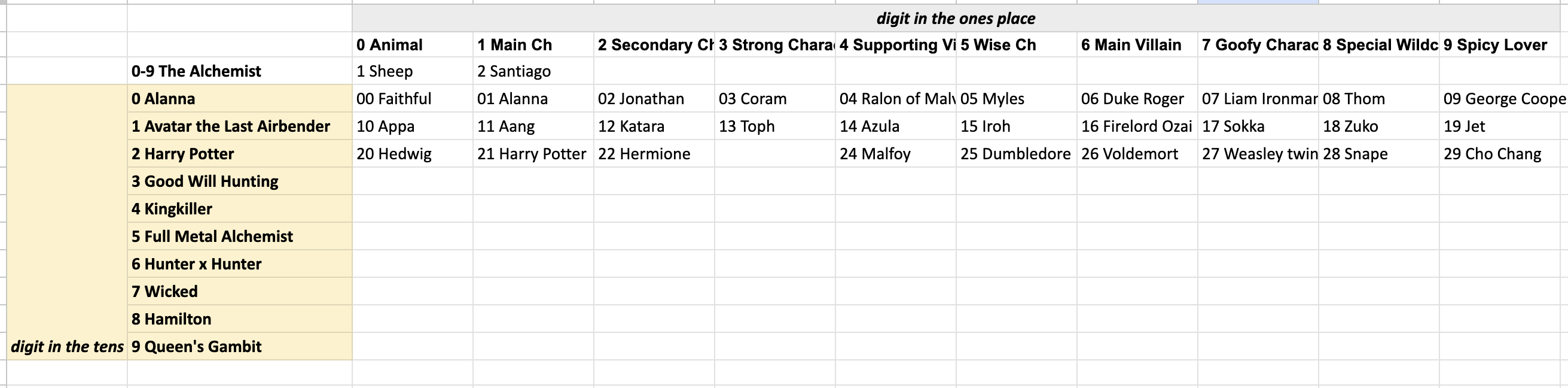
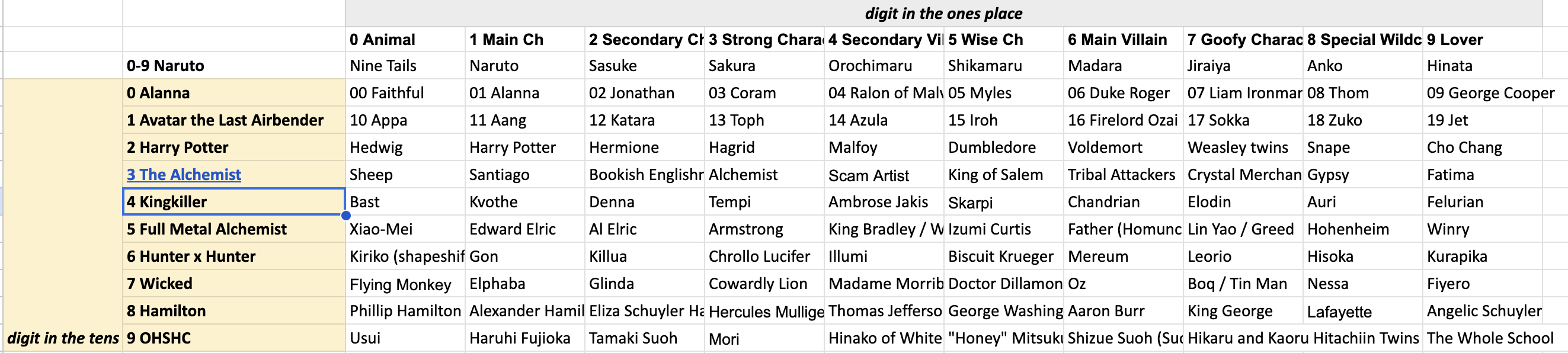
Found this post on category systems and decided to try that out since I love many shows and found this system of breaking down the shows to numbers very natural.
5 shows have come to mind, so that’s 50 characters already!
I also reflected a bit on the journey so far…
Learnings on Visual Alphabet Method
Pro: Good for word-based lists that go one level deep
Pro: Good for temporary lists
Pro: Good for really boring information because it keeps you entertained
Con: Harder to use for multi-level or a row of data
Con: The characters are a bit distracting in the visual alphabet and it feels like if I were to memorize, say, the Bayesian equation, I would get distracted from the content / meaning of the actual equation. Thus I think it might make sense to encode an example of the concept vividly, as opposed to having unrelated characters that the concept interacts with.
Insight: I think I might be able to link a particular long-term visual alphabet list with a song, movement, or visual cue for different lists that use the same visual alphabet.
Intellectuals of the Middle Ages used mnemonics often. Though, salacious images were cautioned against by the church
Francis Bacon, of the scientific method, was a big supporter of the method of loci
Ebbinghaus, of the forgetting curve, is credited for legitimatizing the scientific study of memory. This was only in the late 1800s! According to the author, it seems this led to a big shift to rote memorization as opposed to mnemonic techniques. Although, they don’t seem so separate to me. (pg 9)
It seems like the “popularity” of mnemonics waxes and wanes over the ages
Why not…rote memorization + mnemonic techniques? It seems that both help with recall and comprehension
Finished memorizing the 32 memory methods using the visual alphabet. Going to review again next time to see how much is retained…Low confidence at the moment that the retention will be high but hopefully the method will surprise me.
I got to reviewing today and unfortunately could only recall ~1/3rd
visual alphabet
bestiary
story/imagination
discrete palaces
continuous palaces
bush songline
song, dance
star skyscraper
lukasa board
lukasa board II
I wonder how my method could be improved? It might be that the visual alphabet doesn’t do too much for me. I may try more situational places or memorizing via numbers system instead
I also set up my category system for numbers from 0-99!
I decided on -
0-9 Greek Gods
0 The Alchemist
1 Alanna
2 Avatar the Last Airbender
3 Good Will Hunting
4 Kingkiller
5 Full Metal Alchemist
6 Hunter x Hunter
7 Wicked
8 Harry Potter
9 Hamilton
Update #8 - Started Memorizing Old College Classes
I made a memory journey of 50 loci in my partner’s parent’s house. I’ve started memorizing the syllabus for a Computer Logic class that I took during junior year.
The topics are about as abstract as you can get, but it was easier than expected to memorize the first few. The first four were:
Garage | Set Theory
Gate 1 | Direct Proof
Gate 2 | Proof by Contradiction
Front Door | Proof by Contrapositive
Learnings
It’s hard to reconcile Syllabus vs. Concepts. Intuitively, Concepts have more levels, versus Syllabi which has 1 level. I also am doubtful that memorizing the syllabus is the best way to go for learning, but since it’s easier I’m starting there.
Question for the future: How will overlapping concepts be mapped together?
Question for the future: How will deeper material and examples from lectures be added to the syllabus scaffolding?
Memorized my Computer Logic Class Syllabus. It has taken 36 loci, so I have 14 remaining in this memory palace. Memorization took ~45 minutes. Recall for all 36 loci took ~5 minutes.
Update #11 - Memorized 155 more loci for 7 more syllabi
Interesting stats
The first syllabus took roughly 45 minutes to fill 36 loci of the palace. It was roughly 30 min to create 50 loci points. Review takes ~5 minutes. If I do about 5 total reviews it will probably stay for the next 5 years, so that’s 25 min. To remember one syllabus takes ~100 minutes total
Reviewing the computer logic syllabus after a day, I remembered 32/36
For try 2, I’m going to try to memorize 7 more syllabi. Given a bit faster speed, I estimate 60 min per syllabi, so 7 hours to memorize the remaining 7.
Memorized 5 more places with 155 more loci, took ~75 min
Update #12 - Back on the train. Baby steps, memorizing song chords
I dropped off for a good 3 weeks But it’s ok, I’m back.
Today I spent 5 minutes memorizing chords to the song, Flowers by Miley Cyrus. The chords are Am-Dm-G-C. I memorized them using my alphabet pegs. I imagined Alanna the warrior princess crying (A minor) riding on a horse with Miley Cyrus (unique cue to indicate this particular journey). She slashes a Dragon who is also crying (D minor), and then a Gorilla (G) nurse comes to take care of the dragon’s wounds. The Gorilla walks away happy holding a purring Cat (C).
I for some reason always forget chords even if they are 4 of them. Now whenever I think of this song, I see this imagery. It helps with repetition too.
The past few weeks, although I did not practice, I finished Memory Craft and a new book, Advanced Memory Palaces by Joe Reddington. I would recommend this book to any programmers learning about memory techniques. It is not particularly rigorous in my opinion, but it does pose interesting questions of how human memory techniques could be more efficient, taking into consideration how computer memory is structured.
 Where has it all gone…

 But it’s ok, I’m back.