Biology has the kingdom, phylum, class, etc. system. I was wondering if there was a formal, hierarchical grouping like this of the specific skills within mind training like memory, mental calculation, and so on.
2 Likes
It’s the haroarcy of needs the skills that goes ant the bottom most important are the.bottim and that’s srovival stuff. Then cos socal an emotional intelligence the IQ and memory the creativity and imagination then spiritual stuff l meditation
There is nothing akin to taxonomic rank; at least nothing “formal.” Maybe @thinkaboutthebible can help you out. He’s likes to classify things in a similar manner.
Obviously though, the major system, Dominic system, etc. are digit translation systems. You could group them by phonetic or shape, etc. and subdivide further into PAO, OO, etc. single, double, or triple digit systems. Things like, loci or story method would be on a different brach. You just gotta be careful with the tree structure and not turn it into a graph… mutually exclusive and collectively exhaustive is key here.
Any reason you’re looking for such a thing? Is it just a map to get an overview that you’re after?
1 Like
Dude I’m doing this on my phone it is really hard to type. My fingers are fat you know.
Okay teach me I’d love to know.
I want my training to be a little more structured, and I have always liked being able to see the “whole” of things when studying them, like academic topics. I find it also makes it easier to teach to others.
How do I make my brain stronger I have brain damage do to autistic spectrum disorder and and event that happened when I was a kid. Can this help me with that.
Fred2 what were you posting. Better not be something mean because I don’t like mean people.
Go figure and I don’t like presumptuous people either!
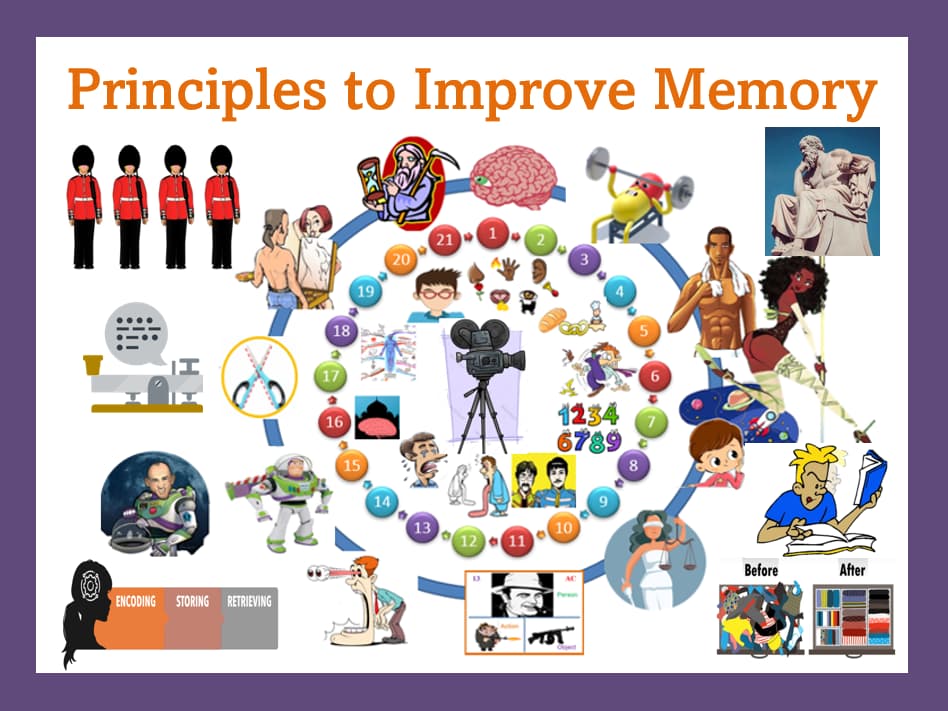
If you were building a collage of “memory principles”, what pictures would you add to depict “topics” that you would deem necessary for inclusion in such a collage? I may consider mind-mapping the “memory principles” as opposed to making a collage of them at a future date. I haven’t decided which idea would be preferable (collage or mind-map) but I have cut and pasted several pictures that I think depict the “memory principles” quite well. I want to avoid the use of words so I am only looking for suitable pictures (images) that capture the “memory principles” as a cue to the actual words themselves. For example: I have a morse code device as a picture that translates well into “encoding and decoding”. Another example I have are Queens Guards standing to “attention” to signify the concept of “Attention”. If any of the pictures I have used a not self-explanatory, then I am failing in my endeavor. But please feel free to ask if any “images” I’ve chosen to use don’t make sense to you?? I would really appreciate any ideas but preferably pictures that any of you may deem to be of importance too!
Going around in clockwise fashion:
0 = Philosophers (Why? as well as their techniques of memory pre-computer age)
1 Minds-eye (visualization)
2 Use all of the 5 senses in images if possible
3 Weight Lifting = Movement
4 Linking/chaining/story method
5 Sexuality
6 Man slipping on banana skin = Humour
7 Imagination and acronyms (planets)
8 Numbering/sequencing
9 Colour (Beatles Sgt Pepper colourful costumes)
10 Symbolism (Lady Justice)
11 PAO method
12 Exaggeration
13 Absurdity
14 Chunking (Man crying . Chunk is slang for Cry)
15 Substitution (Buzz Aldrin = Buzz Lightyear)
16 Memory Palaces
17 Pegword lists as Cues (Scissors for letter ‘X’ in alphabet system)
18 Mindmaps
19 Creativity (artist)
20 Attention (Face has no eyes)
21 Anthropomorphism (Father-Time as a picture)
22. Queens guards = Attention (also see #20)
23 Morse Code Machine (Coding and decoding)
24 Encode/Store/Retrieve model
25 Clothes cupboard (Before vs After)/ Cluttered vs Organised
26 Review/Revision (Boy revising schoolwork)
And the camera in the centre reminds me that you need to create “mini-movies” using your unlimitless imagination!
4 Likes
I also need such mind skills.
Suggest you put “Learning Strategies” into the Search Function and have a look at the first topic that comes up there. There is a lot of valuable information on what it is you are asking about there. I have put the link below where you can go straight to the topic!
3 Likes
Bloom’s Taxonomy is sort of like what you’re asking. However it is mostly related to general learning.
1 Like
Very good clasification.
1 Like
Bloom’s taxonomy is a great way of stratifying learning mechanism.
I have owned The Memory Book (by Harry Lorayne and Jerry Lucas) for many years. I have always been a little overwhelmed by the quantity of techniques described, and often the techniques build upon on previous techniques, but sometimes they do not. It is clear that there are various skills to be learned, and then practical applications of those skills that give you some real-world benefit.
I have been thinking about writing an application that would help train someone to learn the skills and achieve the practical applications.
To this end (and more relevant to this thread), I thought it would be good to create a graph of the dependencies between skills and practical applications, which could be used as a development tree or achievement tree in the application. Such a graph would make it easier for someone to identify and practice the skills needed to achieve a particular real-world benefit. It would also give some perspective on what you can do with your memory. Perhaps the different skills and practical applications could eventually be grouped into some kind of classifications.
So here is my graph. It is a work in progress. It has errors and does not yet cover the entire book. I was not as methodical in creating it as I wish I had been, but it is still potentially useful. The output is from GraphViz. The skills have black circles, and the practical applications are in orange.
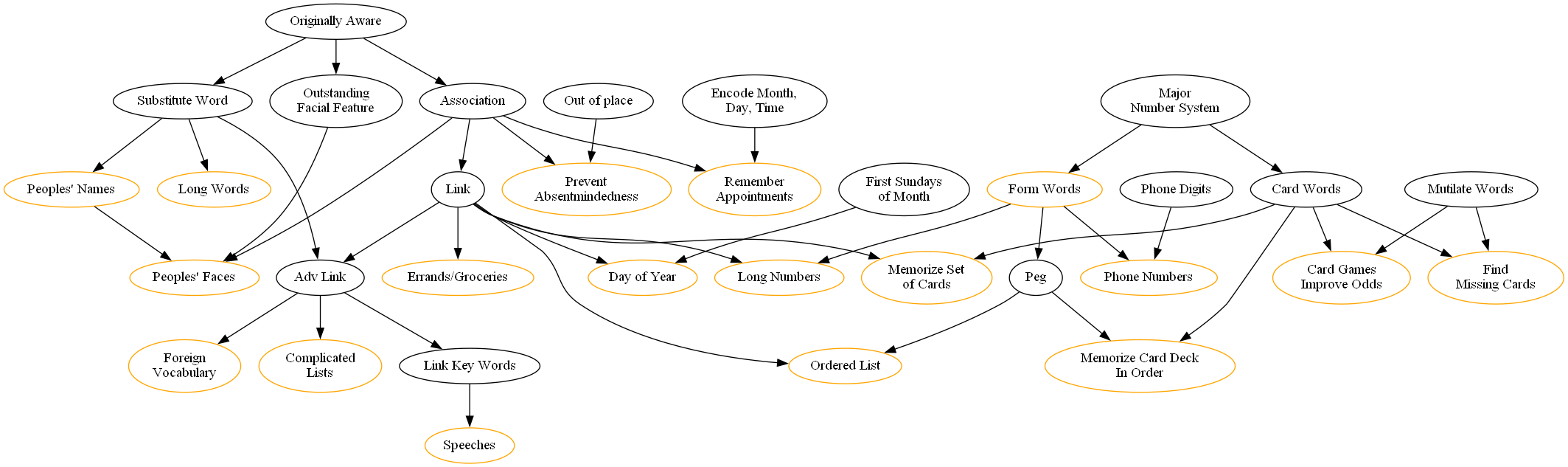
I have a book by Dominic O’Brien, as well, I might try making a similar graph for his book once I’m happy with this graph.
(P.S. Are there better words for what these are than “Skills” and “Practical applications”?
1 Like
Perhaps “learning outcomes” as opposed to “practical applications”, meaning by the end of this book you should be able to: memorize a deck of randomly shuffled playing cards? as one such example of your list of learning outcomes shown in your diagram above. But it’s really a question of semantics
@intranetmouse, I agree with you that knowing the skills that lead to the outcomes is a good task to do for analysis especially when you want to write a curriculum for memory training. Are you a teacher?
My career as an IT teacher led me on a search for all the skills necessary for useful outcomes and my analysis training helped me unravel the dependecies and structure. I like that you are visually charting out the dependencies. That’s the best first step.
You are so right that there are levels to training and building a complete memory workout instead of just focusing on one or two “muscle groups.”
There are basic skills before you get to mnemonic systems and there are variations and composed styles of systems. I took a screen shot of my Memory Manual that I am writing that outlines the basics in case you’d like my view on it.
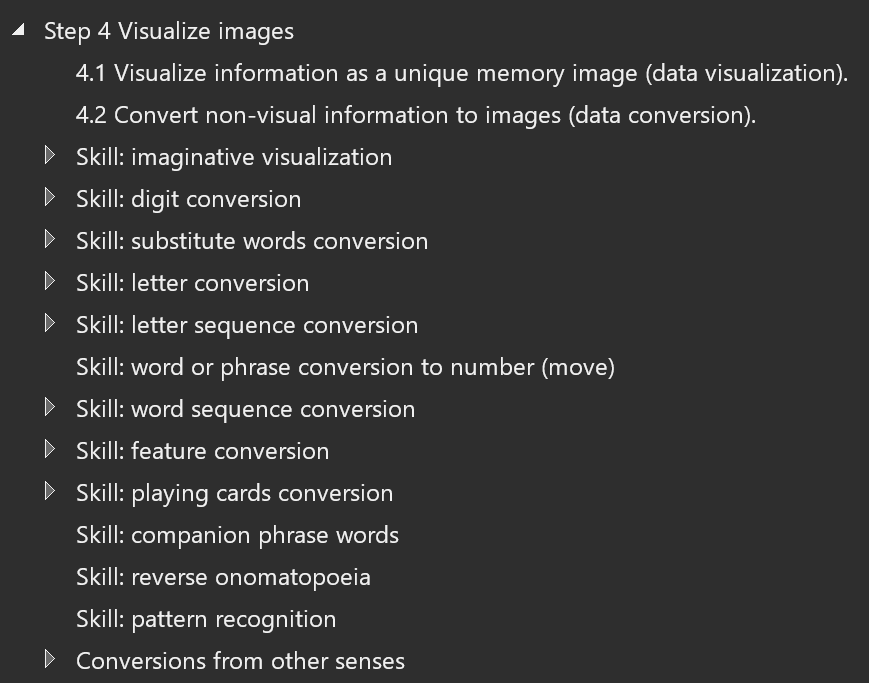
Then you get to the systems which are just two groups. There are the stories and the pegs. If you are drawing dependency lines, you’ll find that you can draw lines from just about any skill to just about any system. I gave up on mapping because of that since it’s a personal preference as to which kind of conversion a person wants to use and what kind of system they want for their particular outcome.
As a college prof, I had to use Bloom’s taxonomy to categorize my exercises and really isn’t appropriate to use here unless you are developing curriculum. I started a basic set of exercises to teach the core skills but most people don’t have the time for that and skip right into the intermediate to advanced systems which is why they have difficulty later on I believe.
@bjoern.gumboldt is right about my predilection for classification. I’ve just been travelling and couldn’t wait to post something in this topic. If you have questions, I’m happy to elaborate.
Doug
@fred2 - thanks, outcomes is definitely a better phrase than “practical applications”. I will probably migrate to that term unless something better comes up. The right word to describe a concept can make a huge difference.
I didn’t comment on it earlier, but your Principles to Improve Memory is a rather neat visualization. It is nice to see symbols for different techniques and skills. They appear to be ordered based on how fundamental or complex, and provide a reasonable path for learning.
The link you posted to “Help to Formally Update Mnemonic Classification and Nomenclature” is also very useful.
@thinkaboutthebible - I am no teacher; just a software developer by trade. I am trying to be a lifelong student. I have some ideas of what discourages me when learning, and what has helped me in learning.
Last week, I coincidentally came across Bloom’s taxonomy in a book on leadership someone left laying around at work. I feel like memorization falls into the early categories of knowledge and comprehension which hopefully leads to application.
Your list of skills is definitely along the lines of what I have been thinking. Additionally, your response here has a big list of skills and techniques.
I think @frankybuckets hits the nail on the head when he said:
Structured to me means knowing what path you are on, knowing what to do next, and learning efficiently. When reading about a technique in books, some problems for me have included, “Okay, so how do I practice that?”. And “How do I learn that efficiently?”.
I mentioned I started writing small programs to help practice (and possibly teach) memory techniques. The goal is to eventually incorporate some kind of learning tree, possibly lessons, exercises, ability to make your own lists and versions of systems, and possibly spaced repetition to guide one through any technique/skill/outcome that interests them. If it ends up being useful for me, maybe it will be useful for others. I would make it open source with a permissive license. There are of course other programs available that I should probably look at. I will definitely look through your (Doug) resources “Software, web sites” section.
2 Likes