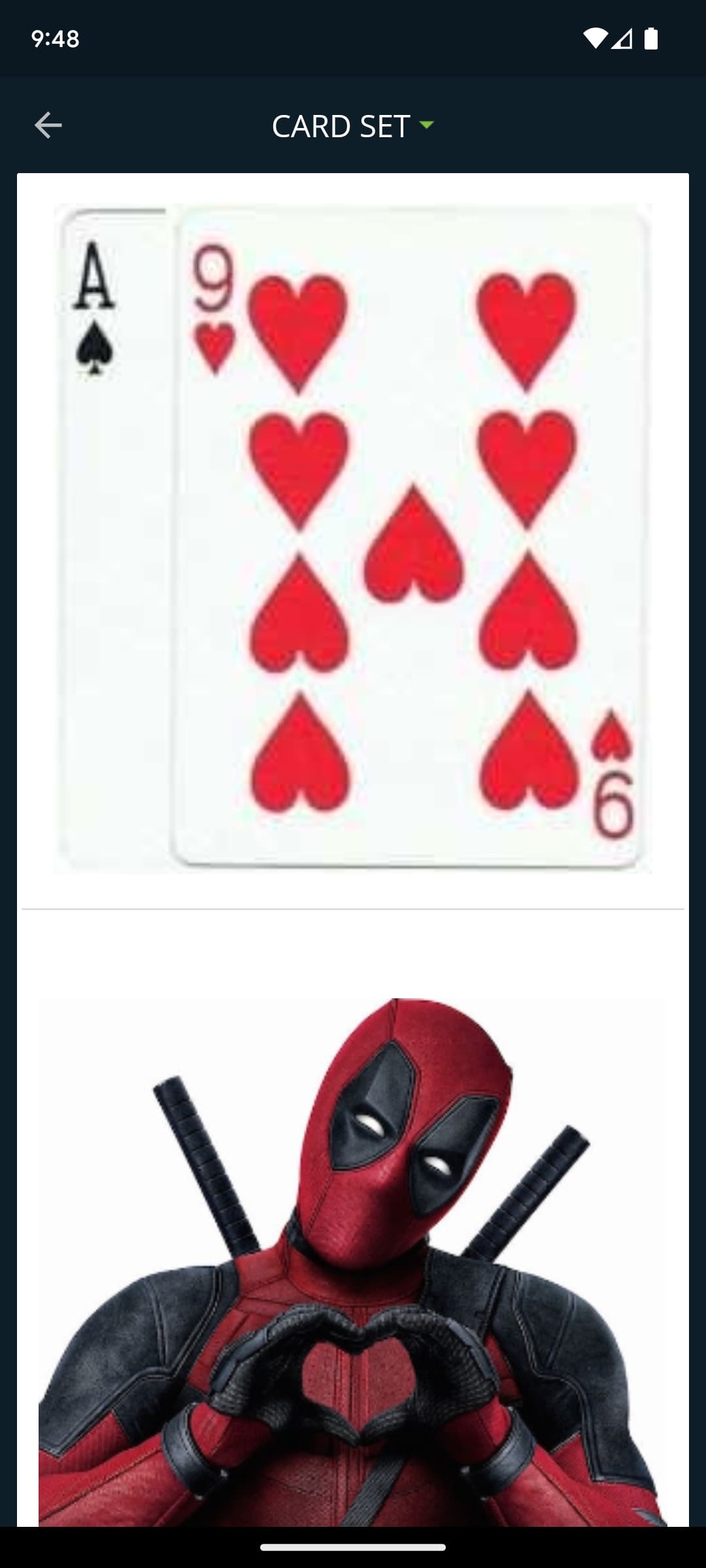
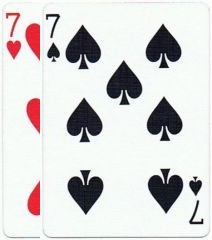
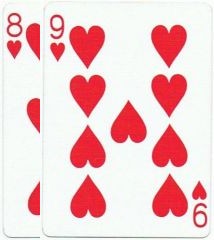
I started working on applying the Shadow System tonight!
I finally finished selecting my starting image/words for every card pair. That took SOOOOO long, hahaha, but it was actually kind of a fun brain melting puzzle.
Took @LociInTheSky’s advice and started with a deck of double Spades and Hearts, number cards only, to start getting familiar with reading images and learning the process of variable image stacking on each loci.
Let me tell you… it was pretty wild. I immediately see the advantages over my old PAO approach. Before trying it I was a bit unsure about only having a single image for a card pair and having to make it interact without having a preset or dictated action for it, but after doing a few runs through the deck it was really fun. I can totally see @BradenExplosion’s point of letting the imagery naturally animate and interact being more memorable than the formulaic nature of PAO.
It is definitely going to take a while to get automatic with all 1352 images. I’ve never attempted a 3-digit system before. I think this is gonna be a great way to kill two birds with one stone and acquire a killer card system while at the same time stepping up to a 3-digit system for numbers and even binary.
Wish me luck! I’ll update here as notable things happen as I practice!
Initial impressions of the 2-block approach… Not as difficult as I was expecting!
I’m using the pairs that start with a RED card to indicate when to STOP and move to the next loci. Its pretty intuitive for me, see RED = STOP.
I had a run of 8 pairs in a row that started with black that I had to stack at one loci and it actually wasn’t too bad. Its very much like doing random words and having to quickly link them in a short story scene. The setting for the story is the loci I’m at, so it kinda oddly works.
I’ve done some practice runs with random words in mem league and can regularly get 15 random words without a mistake in less than a minute and many of those are abstract terms. With Shadow, its unlikely to see more than that many pairs of black-first cards that would need to be stacked, but even if it happens, the words that are designated via Shadow are all highly visual and consistent, so I think my hesitance about loci stacking has been relieved!
First few days were just kinda playing around and checking out how 2-block stuff worked. Used the physical deck to generate some combos and referenced my google sheet to figure out words.
This week I’m starting a more structured practice approach.
I’ve been using cram.com for flashcards for a long time now and really love the interface on their app, especially the “third side” option for a hint or third entry per card. I’ve starting setting up flashcard sets for this project. (Sidenote: I’ve heard so many great things about ANKI, but haven’t ever found a great step-by-step tutorial on how to structure and build a project for it. If anyone has a good resource on how I could set up sets of cards like I outline below, I’d definitely take a look.)
I’m starting to learn the associations with number cards only first, starting with Spades-Spades (Hearts-Hearts equivalent) and Spades-Hearts (Hearts-Spades equivalent.) I’m trying to be as methodical as I can with this. I started with the 20 cards pairs of these suits that start with the 10 of Spades (or 10 of Hearts) and are followed by a number card of either spades or hearts.
This gives me all the cards that start with S - S and T - S sounds (0-0-X and 1-0-X in 3-digit parlance.)
So far so good. I’ve worked through 10’s, Aces, and 2’s so far… so the first 60 card pairs. Its going a little bit easier than I anticipated, but I know I still have to get all of these automatic and there are still over 1200 more images to get through. It can be pretty daunting to think about right now, but I’m trying to compartmentalize each set and work on them exclusively and not look ahead or move on until I feel that I’m strong with the current set.
I’ve made maybe 5 or 6 changes to the words that I’m using, now that I’m actively trying to form associations. I’ve found that most of the words that tripped me up consistently and I subsequently changed are ones that started with a vowel. For example: I had aSSaNGe but when I saw the card pair, I kept trying to figure it out by sounding the S sound first and I never thought about putting that vowel first, so I changed it to SaNCHez and it stuck and recalled much easier. Also changed from SoNiC to SiNK, one syllable was quicker and more intuitive to sound out by reading the values.
Goal for this first week is to get through the first 100 pairs, the equivalent of 000-049 and 100-149.
I’ve gotten through the first 100 unique images, so I’m 1/13th of the way through the initial imaging. Yay?
Still focusing on chunks of 10-20 images at a time and not worrying about the huge total left in front of me.
I really actually enjoy the review process and the brain stretching challenge of the initial recalls and locking in. I’ve got about a 30 minute commute, so I spend that time running as many images as possible.
This effort is a hybrid shadow system / 3-digit simultaneous construction effort and I’m enjoying the process a lot now that I’ve gotten past the grueling list-building stage.
I think I’m glad that I didn’t have a pre-existing locked in 3-digit list prior to this attempt. Shadow has a couple specific restrictions, mainly about S prefix words where ideally you keep a S-Vowel-Consonant structure for the start of words for 000-099 so as not to interfere with some of the face card phonetics. In my initial attempt at writing out a 3-digit system a while back I had lots of SL SN ST blend words in that range. Really glad I hadn’t started memorizing them as I’d need to change them to make the list compatible with Shadow. Same goes for many words starting with H, which now matters for Kings via Shadow. I went through and nixed all the H starters in the core list as well.
I’m finding myself tweaking things fairly regularly as I go. Still averaging one or two replacement words per set of 10 from what I originally wrote down. Its funny how it took ages to come up with a single fit for some numbers and now I’m getting multiple options popping into my head as I refine the list. I guess immersion and practice does develop mobility with Major sounds.
One thing I started today, that I’m interested in seeing the utility of is forming a short linked scene that connects all 10 words in a set to help with their initial memorization.
For example, for the ten Spade-Spade or Heart-Heart number pairs that start with 4’s, that represent numbers 040-049:
“SIRIUS swings a SWORD a SAURON and SAURUMAN who run and try to blend in with a bunch of SORORITY girls, who are devouring CEREAL by the box, which is spilling on SERJ as he performs on stage with CIRQUE contortionists who are riding SURFBOARDs that are bobbing in a sea of maple SYRUP.”
Just by writing out this quick linked scene, its gotten me to lock those words in pretty well. Its not building the association the the card images, but it’s maybe building a base of exclusivity to those words so I’m not wasting time stumbling over the phonetics trying to remember if it’s SeaRS or SoRCeror or SiRiuS.
Rest of the week will be associating card combos to these first 100 words. Will update again this weekend, unless there’s a major epiphany!
No matter how many loci you end up using in Shadow, there will still always be 26 elements to decode per deck. This doesn’t necessarily mean 26 mental images, as elements fuse to create compound single scene images.
Previously using PAO, its guaranteed that there will be 18 loci with 18 scenes, with 3 elements per scene, (besides the single final card) to decode, for a total of 52 single elements.
I like the idea of having only 26 max elements to keep track of. In an even split averaging around 3 images per loci via shadow, you’re only talking about 9 loci/scenes.
Even in a worse case scenario, to read and visualize 26 card word/images in 60 seconds is more than 2 seconds per image, which seems attainable!
Thinking about the situation where you get unlucky and hit a bunch of black-first pairs in a row, causing a huge image stack to pile up on a single loci. I’ve seen people suggest that after an arbitrary number of images, say 4 or 5, you moved on regardless of whether the pair is red-first or not. But how to differentiate between the last image at a loci that’s a normal red-first pair, and one that’s black-first? Thought about the idea of giving that last image a “negative filter” like you’re looking through an old film negative. That way you don’t have to worry about counting to your stopping number, you could vary it and end the loci stack whenever the scene feels complete. That way if there’s a really good scene that has 4 elements and you’re happy with it, make that image negative and move on. If that fifth image fits really well as a memorable continuation of the scene, let it extend, make image 5 negative and move on. This way you’re not stuck at breaking a scene at a certain length. You could also cut it short if you want if you’ve got a really funny 2 or 3 image scene that feels complete. May experiment with this idea once I have more images set. (I added the next set, up to images 000-059 and 100-159 now!)
Would really like to come up with a way to mitigate unlucky draws in the other direction, a bunch of red-first pairs in a row, which causes extended loci with single images per. Not sure how that would go…
First I needed to expand my 3 digit system to cover all 1600 number-pairs. ( 2 digit system can be used for ♧◇ and ♧ numbered pairs … or of course shadow system. )
SOOOOO long,
I use countries for pairs starting J♤ Q♤ K♤. Different than you, I focus on 13 images at a time. And then 52. Example breaking Africa up into different suits. Ace♤ and (bad example) 12 picture cards is a subset of aeronautics.
Impressed i am, so may i ask?
( random 26 cards )
Spain-Avocado-Rink-Wrench-Dilemma-Orange-Siesta-Italy-Rearview-Erasor-Rosary-Gated-Cats
Maybe making an image “negative” could always indicate red-first card pairs, so that there would always be a set amount stacked per loci?
Using this method could guarantee an optimum number, say 4 elements (8 cards) per loci, and could encode a full deck in 6.5 loci scenes.
That’d be pretty rad. It would do away with the variable image stacking. So in a way it would be like the “Shadow” in the name infers “negative imagery.” Rather than having “opposite images” like KETCHUP and MUSTARD representing mirrored pairs, it would be KETCHUP and NEGATIVE IMAGE KETCHUP to represent them.
This shouldn’t interfere or change the process of learning the words much if at all. Only adjustment would be to practice applying the film-negative mental filter when a pair starts Red… Gonna have to play around with this later.
@3nrd interesting, so do you always stack a set number (13 images) per loci? Then do a full deck with 2 loci? If you can be fast at generating a linked story with all 13, I suppose that’d be pretty efficient. I know for me, shadow was a natural fit due to it aligning explicitly with major system rules. Its cool to see all the variations that people come up with for what makes sense intuitively for them!
I am so sorry. No. For Ace of spades, i use aeronautic images for the picture cards. A♤ K◇ is "P"aper airplane.
For Jack♤, African countries. J♤ 6◇ is Chad.
I am giving a name to 2704 card pairs.
edit
Thank-you for reading my post!
Obvious interest in shadow system is in needing half the names. My 426 can be orange / ranch and might be 4♧2♧ / 4♧2♤.
Also because i am using countries i should learn the capitals of those countries. I anticipate in part using a shadow system. 156 countries start with a picture card spade. 156 capitals could start with a picture card ♧. J♤ 6◇ is Chad, so the shadoe of J♤ is J♧ and the capital of Chad becomes J♧6◇.
Ah! So a kind of category layout, with the second card determining the category and the first card filling in the starting word sound? Seems like a lot of rules to keep track of!
Yes.
Picture card spade first means country.
Africa is for 52 Jack ♤ countries. K,♤ is Europe though less discrete blending to Asia. Arab countries K♤13◇s, South America is Q♤ 13♤s. To learn 156 countries that start with K♤, Q♤, J♤ 13 at a time.
I resist the shadow system benefits.
I have known 1000 3 digit number images for decades. It was simple to learn 600 number only pairs.
Yes. 1104 pairs do not fit the phonetic numeral neumonics.
6♤-face pairs are 12 fruit juices. 40 categories for number-face pairs.
Yes.
Complex.
Wish i were better explainer.
Thank you so much for your post.
edit I see 4♧6♧ / 4♧6♤ and corrected it. Should be 4♧2♧ / 4♧2♤.
The last digit determines the suits.
There are only 10 last digits, and 16 suit configurations.
If i sent you a private message i wanted to point out my edit.
I can be dyslexic.
Whether you call it… shadow, negative, mirrored, inverted, flipped, etc… it won’t change the fact that the idea looks nice, but it’s about as workable as the “rooms on fire, ice, rain, etc. gots myself multiple memory palaces all in one”-setup that some people here promote, because they don’t want to go out and create more memory palaces. None of them place anywhere near the top in competitions by the way.
Exactly… the “original” shadow system… just so nobody gets confused by the naming convention,… ketchup/mustard. Neither the shadow of ketchup is mustard nor is the negative of ketchup mustard, so you already answered your own question.
Pretty sure that’s what @LociInTheSky was thinking about a decade ago… maybe you should have drinks with him and discuss why that’s not the way to go. I did that with him after the World Championships in Singapore… the drinks part, no the discussing techniques because after a full weekend of doing this stuff, it’s really not what you wanna talk about.
Have fun… if nothing else, it’s a learning experience. Like I said in my “shadow transition”-post, you can start out with 108… maybe add all the face cards next, and then spades/hearts, etc. as per Lance’s post… but really… just stick with the block system…
…really shouldn’t be your goal. But sometimes you just gotta see for yourself and not listen to other people’s advice… it’s fine, it’s a learning experience just the same. And, as long as it gets you closer to having a 2-card system, no harm no foul… just don’t start procrastinating by trying out 8,000 different way of using not-shadows in your shadow system instead of just learning and using your system.
Just my 2 cents for what it’s worth… props to you for sticking to it and not going back to PAO.
Haha, yeah for sure. I think commenting as I go about my in-the-moment idea pops is my way of talking through those random “what-ifs” with myself, albeit in a public setting!
I’m slowly coming around to the “just start trying it” approach! I spent enough time trying to make my initial word list perfect before giving it a test run. I know that’s one of my weaknesses is trying to be perfectionist about the setup before implementing.
So far, the trial runs I’ve done with variable image stacking were totally fine and made sense, so I’m sure I’m way overthinking things, but like you alluded to, that’s some of the fun in it for me and sort of my way of testing it for myself.
I’m sticking with it! I’m sure I’m asking many of the same questions as Lance and all of you seasoned vets have years ago, and I think it’s cool when things seem to converge to a common “best practice” approach, but who knows, maybe there’s a weird angle thats spawned from some of these musings that can make things simpler to either attain or execute the system.
I’m in no rush, but I agree in the sense that it’s time to get a move on! Its a daunting challenge to look at the whole of what is involved but I’m committed and trying to keep a reasonable pace and progressions going.
Yeah, its funny you bring that up. I had at one point set up a way to augment my original 2 digit PAO with a very similar idea that at the time I thought was pretty original, coat each image in a color-based “texture” to add a 3rd “hundreds place” digit, so for instance, TeD was 11, but a TeD who was TRANSPARENT added a 0 and made it 011. A TeD who was drenched in BLOOD made it 411… (Red, R = 4)
Its not a TERRIBLE idea for short term sequences where there’s a single digit remainder for non competitive or non long term projects… but the clunkiness and difficulty of using it as a replacement for a full-time 3-digit system quickly established itself and I pretty much abandoned it, telling myself if I want a 3-digit, to do just jump in and do it legit. So here I am, haha!
I’m seriously holding back on some of your posts… it really is just advice and not criticism in a negative way. I remember when I was doing what you are doing way back when… and you’re right for trying your own way and making your own mistakes.
Again, Lance gave a nice step-by-step with his spades/ hearts first, etc. I believe he even did the math why that’s the way to go. Now, my 1 card shadow was a bit of a joke but also a genuine “transition approach”-system… which we don’t bother much with. It’s just, go from 52 to 2,652 (i.e., 1,326 with shadows or blocks)… holy order of magnitude, Batman! That’s the daunting part… so, try and understand what I was saying in my post and why Lancy was saying, learn as you go, and do it in (t)his order…
Well, I think Lance was pretty much spot-off (as opposed to spot-on) when he reduced the suits combos from 16 to 8… albeit, shadows was not the answer… blocks, does do a nice job at it though. And now, you can just use your regular Major System with it.
I can also see where Ben was coming from with his system, but then again I also peak German pretty fluently (to put it mildly) so long and short vowels are not an issue for me… then again “less than 10” is always nice, so I’d prefer a Major System based system. Ben’s system looks like Hangul to me… if you know the Korean alphabet…
…and by all means, keep that curiosity up… don’t just do it because you read it or somebody told you. Make your own mistakes, get your own things right… what works for you may not work for others an vice versa…
yes, you are (but in a good way)
…and that’s how you learn, so keep it up… just at some point, you gotta stop and take a look around… i.e., re-reading old post, that didn’t make sense back then, but now… you see what’s going on.
I actually stopped competing back in 2017 when this whole democracy movement or whatever you wanna call it started… WMC or IAM… I don’t care, I moved on to the Mental Math World Cup, and seriously, I could do blindfolded Rubik’s (at a competition) if I wanted to, had the time, or there was no Corona… all these titles, and competitions you’ve been at are somewhat meaningless… neither schools, nor countries sponsor any of this, so you are most certainly not competing against THE BEST… it’s like calling it the “World” Series in MLB, when only the US is taking part in it.
Let me tell you… it was pretty wild. I immediately see the advantages over my old PAO approach.
nod
I randomly came across this post in my old email’s inbox. I’m glad you’re having fun. You have good ideas and staying motivated, but it all does make me feel a bit guilty: I created the optimal Big System about 5 years ago, but because I considered myself deserving of a head start in its adoption, and because I never returned to training or competing, it was never written up.
I will teach it to you if you construct it to the letter and then learn to use it precisely. It can’t be improved, so you might as well. If you just enjoy the tinkering, then you’re already in a good spot. You’ve made some excellent observations. I agree with Bjoern’s comments too. You’ll have to replace hundreds of images, but the newer images will be on average easier to fill out than the ones you’re replacing.
I’ve only gotten through practicing SPADE/SPADE and SPADE/HEART number-only pairs, 10’s, Aces, 2’s, 3’s, 4’s, 5’s, and 6’s… So nothing is automatic yet.
I’ve come up with all 1352 words in the system based on your standard shadow/major phonetics but haven’t practiced anything beyond those initial 140 yet.
I’ve never done any 3-digit stuff prior to this so don’t have any real pre-learned associations that would need to be undone.
Quite interested to hear what you’ve come up with!
Started finding some good imagery for my words and setting up the cram flashcard app with them.
At first, having text words in there is helpful, especially when first learning the list. After the words become pretty familiar, it helps to have a concrete starting image, because the eventual goal is to skip the “translation” of card pair → word → image, and hopefully just get to where it’s “see the pair → see the image.”
Really intrigued by @LociInTheSky’s offer so I’m gonna slow the advancement of new shadow associations until I see what that’s all about, but so you see what I’m doing, here’s one example:
BTW, I’m working on creating combined images of all 2704 card pairs as individual images as seen below, and when I’m done I’ll make them available to this community via Google drive or something for everyone to use!

 numbered pairs … or of course shadow system. )

 (but in a good way)