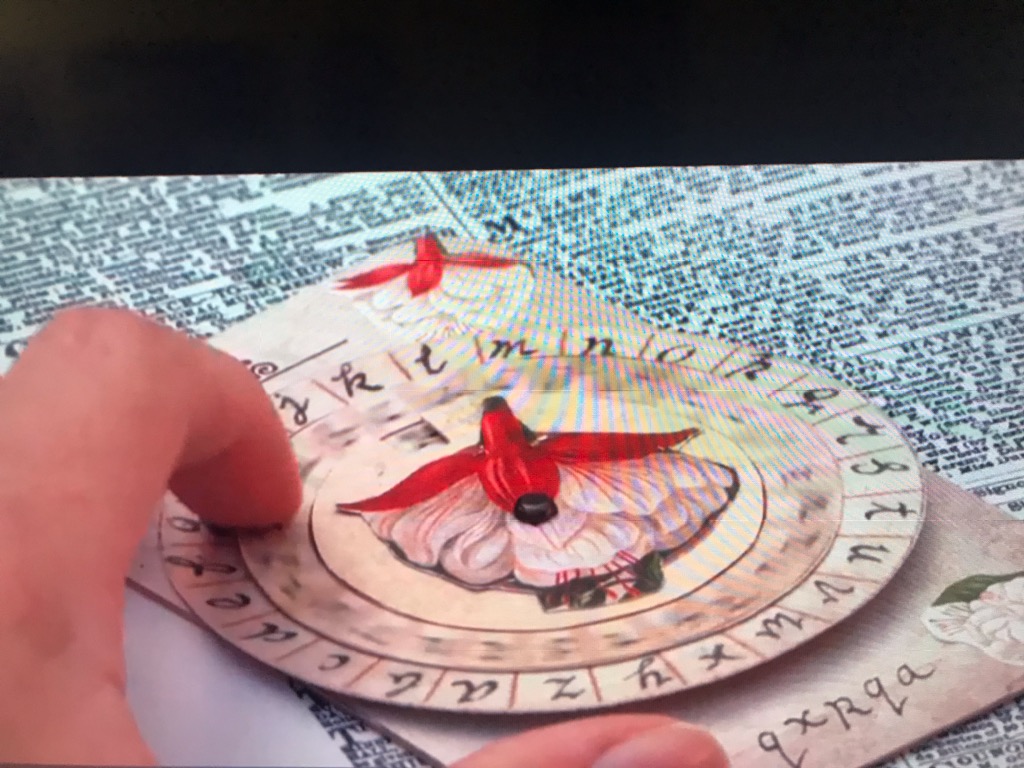
Can someone please help me identify this wheel and how to use it? I just saw it displayed in the new movie “Enola Holmes”. I believe it’s an invention of Giordano Bruno and Martin Faulks has Information on it, but I haven’t yet bought his books. Any information would be amazing!
2 Likes
I’m not sure exactly how it works, but you might be interested in some of these threads:
- Giordano Bruno’s Memory System
- Giordano Bruno's De monade numero et figura (On the Monad, Number and Figure)
- Lullian Wheels
- Ars Combinatoria, Bruno, Llull
- Giordano Bruno: De Umbris Idearum ('The Shadow of Ideas')
- Bruno’s “Incantations of Circe”
- Miniature memory palaces - including your palm
- Einstein, Creativity, and "Combinatorial Play"
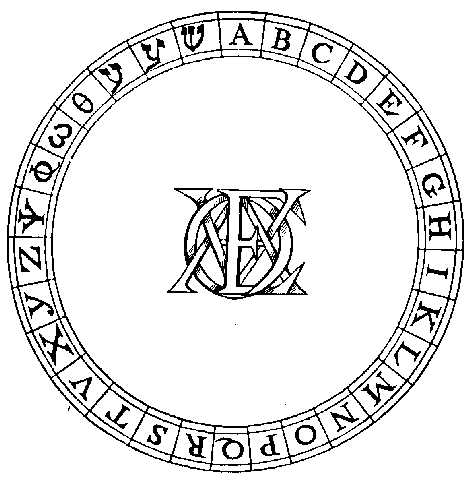
Look up De Umbris Idearum. Here’s an excerpt in Latin that shows the wheels. There is an English translation here.
It looks like the screenshot above uses the English alphabet. In the image I found from Giordano Bruno, he used 30 letters from Latin (no J, U, or W), Greek, and Hebrew, so it might be a little different.
3 Likes
Thanks so much for this. I will delve deeper
1 Like
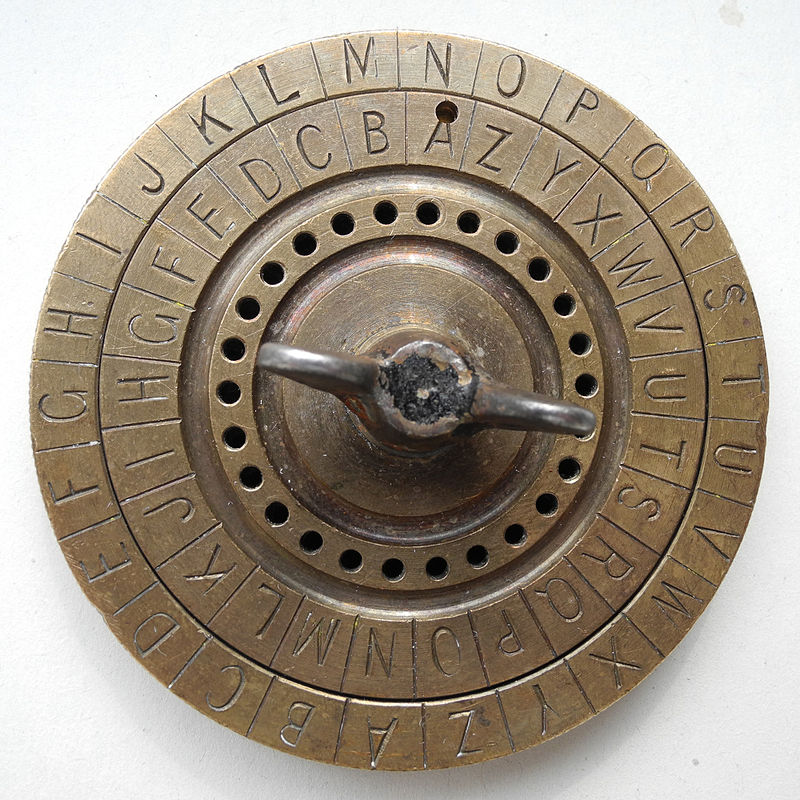
I watched the movie about a week ago. It’s definitely not a Llullan wheel, which are much too obscure to be seen in a popular film like this. It’s definitely a simple shift cipher wheel (or Caesar’s Cipher) as others have indicated. However, I note that it appears that it’s actually improperly used in the film.
1 Like
I think because there was virtually no difference between I & J and U & V? I don’t know about W
Today we have the names IVAN and JUAN
This does not look like either a Lullian wheel or a Bruno configuration to me, though the similarities are certainly there.
I don’t think anyone can be sure, but I feel that if you read Bruno closely, no one is really advised to reproduce the wheels or other schematics referred to in the text. They’re advised to understand the thinking behind their construction and develop their own. He pretty much dares you to do otherwise at the end of Shadows.
Bruno’s student Discone gives some instructions for using the mansions of the moon based on or with reference to alphanumeric coding, but again, there are consistent references to the “true” art of memory, which essentially helps you see that you create these tools on your own no matter what.
The nondual implications of hermeticism are just as confusing as other nondual philosophies, but seem to boil down to the notion that every other appears in you. Framed this way, who exactly would you learn from or copy? Much of the texts I’ve read are typical nondual puzzles meant to help the reader experience this and they all seem to assume you know Ad Herennium and can modify/innovate by coding your MPs and associations alphabetically.
It’s not unlike picking up Gödel Escher Bach in our era, a book which assumes you know at least something about programming languages and logic. If not, you’ll have to either pick some up or persist as the book teaches it to you experientially.
Oddly enough, Gödel Escher Bach also urges its own kind of nondual experiential outcome…
2 Likes