Hey, I’ve been mulling over something and I’d love to hear your thoughts. Rockefeller once said he wanted a “nation of workers, not thinkers,” and it seems like that mindset might still impact how we approach education today. Standardized tests, which were designed to sort students for specific roles, were even dismissed by their creator, Fredrick J. Kelley, as “too crude to be used and should be abandoned.” Kelley recognized the flaws and potential damage these tests could cause, warning that sticking with them might lead to serious problems. While standardized tests measure certain skills, they often push students toward rote memorization rather than encouraging creativity and critical thinking. What’s also puzzling is why schools don’t teach memory techniques like the Memory Palace or focus more on critical thinking skills. Some argue that incorporating these innovative methods could make learning more dynamic and effective. What do you think about blending traditional testing with these new approaches to better support students’ growth and creativity?
It’s in my interest that people don’t know about the mnemonics. If they find out, we won’t be any different. 
Even in my own group of friends, there will be those who are not aware of these techniques. When I want to teach techniques, they are not enthusiastic at all. I am convinced that it does not appeal to everyone.
I don’t think there’s any deliberate reason. Mnemonics are something very niche, the people who decide what has to be covered in school probably have 0 experience with mnemonics, just like most people.
If you’ve talked about mnemonics with people who aren’t into it you’ve probably experienced the fact that they usually think it’s cool but that’s it, from all the people I’ve told about mnemonics, and even demonstrated their effectiveness, not even one has tried to adopt them. People in general think it is a cool party trick and nothing more, the people who decide what to teach in school just don’t care about mnemonics.
To clarify something that might come up. Mnemonics are a common thing in learning, but most people believe mnemonics go only so far as to make acronyms and things like that. Memory palaces, number systems and the like are not something many people are aware off, or even care about it in case they know.
Because why remember stuff when you have chatGPT?
Who is “we”?
Standardized tests, which were designed to sort students for specific roles.
This kind of testing forms the premise of both the movie “Divergent” …

and a system with its own community of followers that very much seems to be in line with the ideas of the Divergent story and that goes under the name of “human design”.

Even though I still don’t fully understand the underlying philosophy of the movie Divergent, it appears that the testing that is done in this dystopian future is seen as a way to control society by means of keeping people in their proper place by discouraging them from doing anything other than what the tests shows what kind of life they must live.
While standardized tests measure certain skills, they often push students toward rote memorization rather than encouraging creativity and critical thinking.
You are in my opinion not making it very clear what kind of testing you are referring to. The rote memorisation suggests the kind of tests that you have to study for like the daily testing that is done in highschools and the final exams. These are very different from the kinds of tests that …
were designed to sort students for specific roles
Provided we are talking about the same kind of tests, I would have to say that I totally agree with your observations; I made the claim in another thread that even in universities the vast majority of students focus more on passing exams than on trying to learn things for the sake of collecting long lasting knowledge.
What’s also puzzling is why schools don’t teach memory techniques like the Memory Palace or focus more on critical thinking skills.
You are putting two separate questions together in one sentence and thus suggesting that the answer to both questions must be the same. This is possibly limiting your thinking in the same way that those standardized tests are limiting the development of students.
I don’t think we have a similar view on the potential value of the memory palace in education. I think for example that making or using summaries of the things you learn in highschool (something I should have done but didn’t) and reviewing those on a regular basis would have a much greater effect on how much knowledge you end up having than using the memory palace method.
The title of your post …

… suggest to me that you are actually looking for an answer to the question, why education isn’t better since in your opinion it could easily be better. So it is not really about the memory palace, but the memory palace is just an example of an easy way for education to be better.
If the above is more or less correct than George Carlin may have the answer you are looking for.
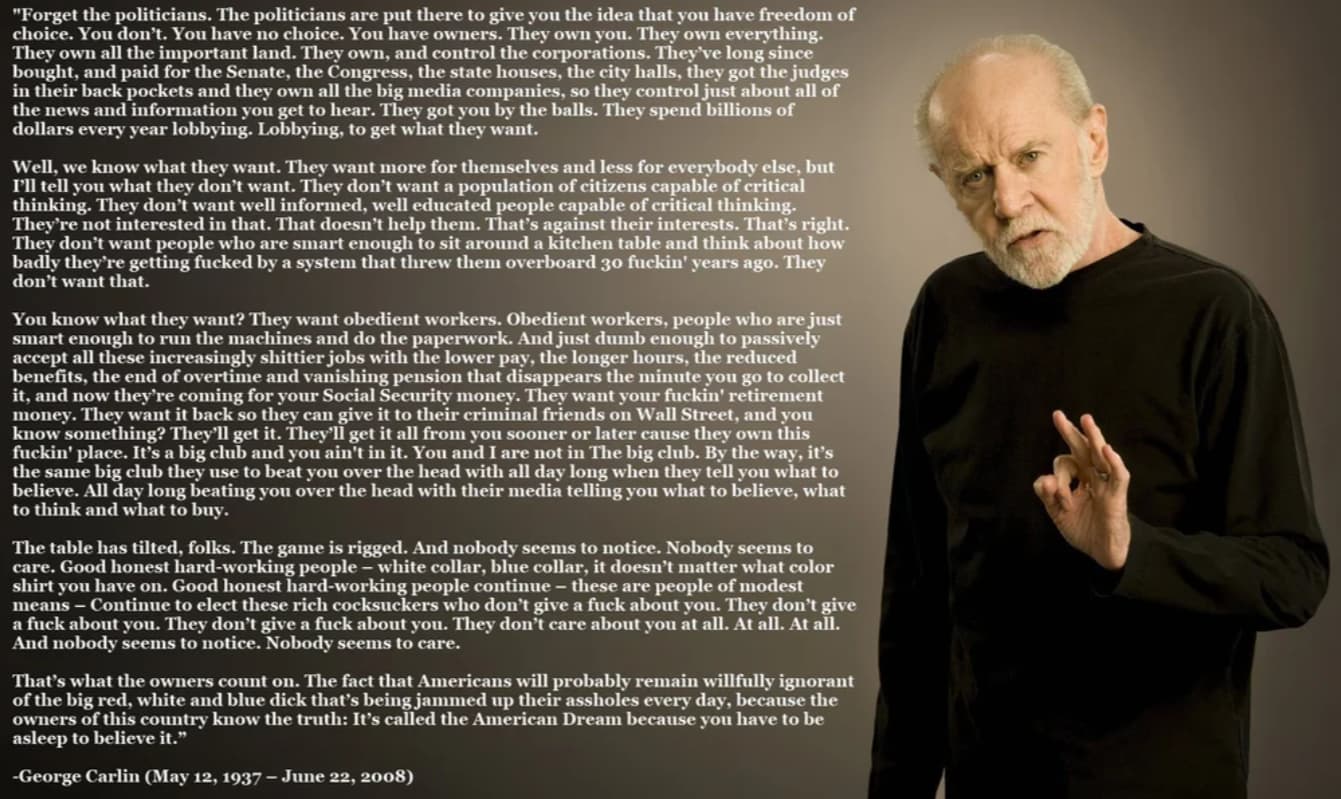
Part of his monologue is almost a copy paste of your Rockefeller quote; he adds the word obedient to workers but the general idea is the same.

Let me conclude with a short response to a quote from Nicoriossoto:
the people who decide what has to be covered in school probably have 0 experience with mnemonics, just like most people.
You may have never heard about mnemonics if it wasn’t for book companies selling books about mnemonics. Before the internet the most likely way into the wonderfull world of mnemonics would be by means of reading a book about it. From what I can remember from high school is that all school books are from the same company. This company also sells books about mnemonics. I am not a conspiracy theorist  , but if I wanted to control this world I would start by taking control of all the book companies and thus control the education of the future workers.
In 1997, world memory champion Melik Safi Duyar was the first person in Türkiye to talk about memory techniques. I don’t know if it was heard everywhere in the same way, but these techniques became known through memory programmes on television in Türkiye. I think that memory techniques may have gained popularity with the new discoveries made on the brain in the world.
How can you possibly know what people are not talking about? I can see however that the role of Melik may be somewhat similar to Joeshua Foer’s role in The US (and also in many other countries), as in making the subject more known than it used to be. In Holland you could find books about mnemonics in just about every library long before 1997; I don’t think knowledge of mnemonics in Turkey during that time would be completely hidden, not in the last place since there was already massive immigration of workers from Turkey to Holland at that time .
I think that memory techniques may have gained popularity with the new discoveries made on the brain in the world.
I don’t see how brain related science discoveries would have any impact on the popularity of mnemonics. In the book Moonwalking with Einstein, that in all likelihood has done more for the popularity of mnemonics than anything else, recent brain related science discoveries don’t seem to be an important part in the “science journalist becomes a memory champion story”. In contrast the whole book emphasizes the fact that mnemonics are a reflection of ancient old knowledge of how the brain works and the techniques have basically remained the same for a very long time.
Before 1997, I did not see any information on this subject in a TV programme or a book. The technique of memorising the Qur’an is mentioned in old sources, but we are not provided with any data on these new methods. If you find a book or article, I would love you to share it.
As I said, I do not know how the techniques spread in other countries. In my country, these techniques became widespread thanks to TV programmes. Was there even a partial secrecy in Türkiye, can you explain how do you know this? Melik Duyar is a civil engineer graduate from METU and he is interested in these issues. Can you explain how he could be similar to a journalist?
It is not possible for science and subsequent technological developments not to affect societies positively or negatively. I think Tony Buzan can be example for this. Melik Duyar and Tony Buzan worked together.
By the way, “Turkey” officially changed its name to Türkiye.
Neither of these two observations lead to the conclusion that no one is talking about mnemonics. I am open to the possibility that you meant something like “mnemonics was not a common subject of conversations” instead of “no one in our country has ever spoken a word about mnemonics ever”. I think I now have a good idea of how you meant it and I will happily accept that is indeed the case.
It is not possible for science and subsequent technological developments not to affect societies positively or negatively.
I agree, but I don’t see how that somehow shows that science discoveries would have any impact on the popularity of mnemonics.
I think Tony Buzan can be an example for this. Melik Duyar and Tony Buzan worked together.
Tony Buzan helped popularize mnemonics by means of selling books/courses, but what does that have to do with scientific discoveries impacting the popularity of mnemonics?
By the way, “Turkey” officially changed its name to Türkiye.
I have come to the conclusion that sometimes before major events take place in this world in which a certain country plays a major role, the name of that country is already triggered in the collective consciousness in various ways. Changing the name of a country would be a perfect way to focus the collective attention in a certain direction. Having a superstar with a shirt with the new country name on just about any news site or social media platform also helps a lot.

I do not ignore the possibility that it could be the other way round, and I speak as best I can with concrete data. I have not seen a document or a lukasa. If someone finds these materials in the future, I will gladly correct myself. I guess you have not found these materials, I mean concrete data.
In order for a product to sell a lot or even to be popular, companies or people use a number of techniques. Scientific developments also help at this point. It makes us think that the product is more reliable. “This product has been tested and approved by scientists.”
I agree with your words, but there is one point I need to correct. The name of my country is already Türkiye. It used to be written Turkey in English. This change is a change in official documents. But is this a shift of the collective attention to another point? Yes, it definitely is. Because this is how the collective consciousness is formed. Whether we realise it or not.
I forgot to include the following question in my article.
I feel that you are moving the goalpost in this discussion on multiple occasions. The initial claim that no one was talking about mnemonics turns into a different claim that there were no books about the subject or physical examples of mnemonic methods used. Also the claim that actual scientific discoveries have helped the popularity of mnemonics turns into the claim that companies use science as a marketing tool for increasing the popularity of their mnemonic materials.
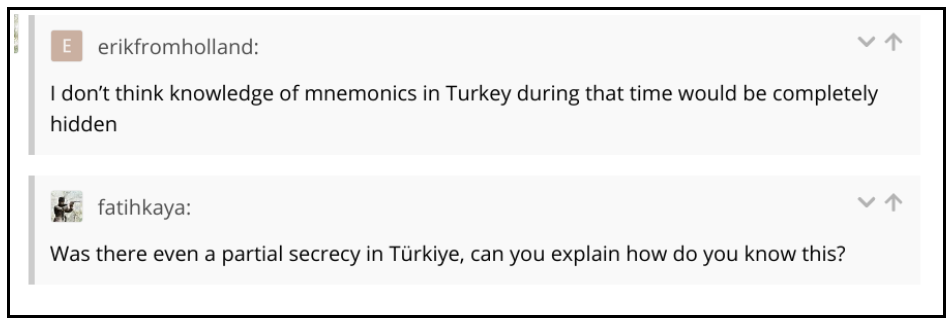
By the word “hidden” I simply meant “not available”, I didn’t mean to suggest a conspiracy aimed to hide mnemonic knowledge. Given the mass migration from Türkiye to Holland and the easy availability of mnemonic knowledge in Dutch libraries, it would be unlikely that none of the Turkish (what would be the proper word here given the “new” name?) people would bring back some mnemonic knowledge to their home country.
Thank you for all of your opinion.
Thank you for your input.
I didn’t say nobody was talking. You are the one who has been touting this in 2-3 posts as if I had said it. I said that Melik Duyar was the first person to mention it. I said this based on the evidence I have. You are the one who is deflecting by saying that because of immigration to the Holland, libraries are accessible, so people are aware of it. If you say that someone has mentioned mnemonic before, I ask you to present your evidence. I didn’t ask for your assumptions. Anyone can talk about anything, but that doesn’t give us more than a daily conversation. What they talk about, what techniques they use can only benefit us. If you say that Melik Duyar cannot be the first person, then there must be data, books, articles, etc. I said if you have any findings on this subject, could you share them? I don’t gain anything Melik Duyar is the first person, I gain if he is not.
Let’s forget it. You are right. This argument is of no use to me. Have a nice day.
What you said was this.
In 1997, world memory champion Melik Safi Duyar was the first person in Türkiye to talk about memory techniques.
That implies the claim that nobody talked about it before. Please let me know if you think that this is not in accordance with logic. So my reaction to your “Melik Safi Duyar was the first person in Türkiye to talk about memory techniques” statement was …
How can you possibly know what people are not talking about?
You are the one who is deflecting by saying that because of immigration to Holland, libraries are accessible, so people are aware of it.
My argument suggests in a plausible way that your literally articulated claim that world memory champion Melik Safi Duyar was the first person in 1997 in Türkiye to talk about memory techniques doesn’t seem very likely to be true if interpreted in absolute terms (meaning absolutely nobody …). I don’t understand how you interpret my presentation of this argument as deflecting.
If you say that someone has mentioned mnemonics before, I ask you to present your evidence.
I have never said that. You have made a claim that in my opinion you can’t possibly prove to be true. The evidence I presented that you labeled as deflecting suggests (just my opinion) that your claim is likely to be untrue.
I didn’t ask for your assumptions.
It sounds that you are a bit angry and are also using a bit of a double standard. The evidence that you claim to base your strong statement (nobody … etcetera) doesn’t prove anything. Put in another way: some people talking about mnemonics and also there being no books, documents about mnemonics to be found are not mutually exclusive. My claim on the other hand is not as strong as yours in the sense that I am only making a probabilistic claim (I think it is likely that some people have talked about mnemonics before … and so on) and the evidence (what you appear to label as assumptions you didn’t ask for) I presented (access to Dutch libraries …) seems very convincing to me.
Anyone can talk about anything, but that doesn’t give us more than a daily conversation. What they talk about, what techniques they use can only benefit us.
I don’t understand the connection between these two sentences. Talking is useless (first sentence interpretation), talking is not useless (second sentence interpretation).
If you say that Melik Duyar cannot be the first person, then there must be data, books, articles, etc.
I am honestly trying to see if I am misinterpreting what you are saying here. Mnemonics are just memory techniques. In Holland we call many mnemonics “geheugensteuntjes” (memory aids). These are passed on from one generation to the next without the help of books or without any physical evidence of their existence other than the fact that some people know them.
Let’s forget it. You are right. This argument is of no use to me. Have a nice day.
I don’t understand what you hoped to get out of this discussion and why you are (as it appears to be) so upset. Perhaps you may one day read my part of this discussion again and see that perhaps things are not as bad as they appear to you now.
Not sure if you’re being serious? ChatGPT can’t think. It has no idea if what it’s saying is the truth. All it really does is spit words that fit writing patterns, filled with some context based on the keywords you fed it.
One of the funny little AI blunders was Google’s AI telling you to put glue in your pizza. The question was something like “How do I stop the cheese from sliding off my pizza?” The answer is confidently unhinged because it can connect “stop something from sliding” to “make a pizza” but doesn’t actually comprehend these things. Even though chances are high it would advise against eating glue if asked, it can’t think this through.

How long Have you been doing memory training ?
I just started two months ago
How long have you been using memory techniques like the memory palace?