My initial response was a bit long and since you haven’t shown any sign of having read it, I have made a more to the point summary …

Let’s see that would be somewhere in the neighborhood of 44 years.
My initial response was a bit long and since you haven’t shown any sign of having read it, I have made a more to the point summary …
Let’s see that would be somewhere in the neighborhood of 44 years.
I have been using it since 1997. In our country, Melik Safi Duyar was the first person to mention the techniques. I became aware of these techniques thanks to him. I watched his commercial films on a national channel, “Flash TV”.
An interesting read!
Maybe part of the confusion here is what we each mean when we’re talking about the mnemonics available or talked about, in the past and now. Melik Duyar may not have been the first one to have literally discussed memory techniques there, but it seems likely he’s the first one to do it on a grand scale.
There were a few memory techniques taught in my local schools but they were not systems to encode and store information long term, like a PAO, or method of loci. They were mostly along the lines of “Think of a rhyme, turn something into an acronym, or turn the letters into a story. Every Good Boy Deserves Fudge.”
Other memory tricks you would hear about are things like tying a piece of string around your finger (can be dangerous advice for kids).
I definitely didn’t use any advanced mnemonics with the memory games in my childhood. There is a bonus stage in Mario 3, and a few other video games with card matching. Each game I just relied on brute working memory to do well in.
Games like Simon says I did above average (among my peers) by singing the colours… And that’s it. That’s the extent of all memory techniques I was exposed to until my mid to late 20s. Today that doesn’t seem like it’s really changed, and the question is why? The answer is conspiracy, school isn’t about equipping you for success! ;p
Even now, the only person other than myself I know who uses any kind of association techniques is my grandmother. Someone who was testing her for dementia asked how she remembered certain things about their conversation, and she said “Oh, I thought about it (with? on?) spaghetti, because I don’t really like spaghetti.”
I don’t know where she got that from, but there ya go. She associates information with things she has an emotional reaction to and uses that as pegs.
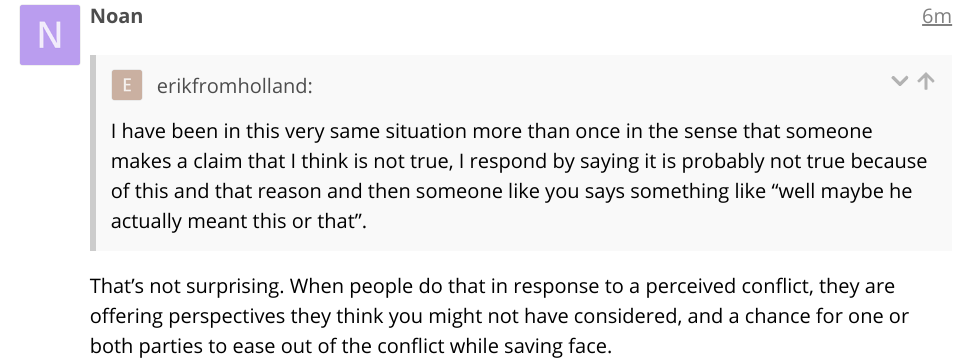
I have been in this very same situation more than once in the sense that someone makes a claim that I think is not true, I respond by saying it is probably not true because of this and that reason and then someone like you says something like “well maybe he actually meant this or that”. The track record thus far is that in every single time this happens it turns out that the person who made the claim simply meant what he said and because he or she is emotionally invested in the discussion (Fatihkaya appears to be somewhat angry about this part of the conversation) he or she can no longer admit that the initial claim is indeed not true.
Melik Duyar may not have been the first one to have literally discussed memory techniques there, but it seems likely he’s the first one to do it on a grand scale.
That may be true, but that is not what he said.
There were a few memory techniques taught in my local schools but they were not systems to encode and store information long term, like a PAO, or method of loci. They were mostly along the lines of “Think of a rhyme, turn something into an acronym, or turn the letters into a story. E very G ood B oy D eserves F udge.”
I don’t know what PAO was designed for because I don’t even know who designed it. What I can say is that it is often used in memory competitions (Joshua Foer used it to become the US champion) and in the vast majority of those competitions that system is used for short term memorisation as opposed to long term. The method of loci can be used for long term memorisation (pi memorisation, vocabulary, history facts and so on) and also short term memorisation like in (most) memory competitions or to memorize a shopping list.
They were mostly along the lines of “Think of a rhyme, turn something into an acronym, or turn the letters into a story. E very G ood B oy D eserves F udge.”
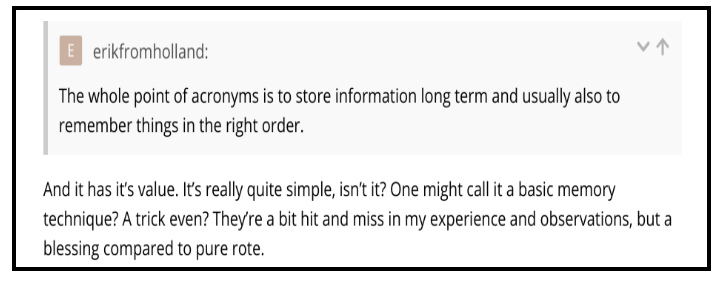
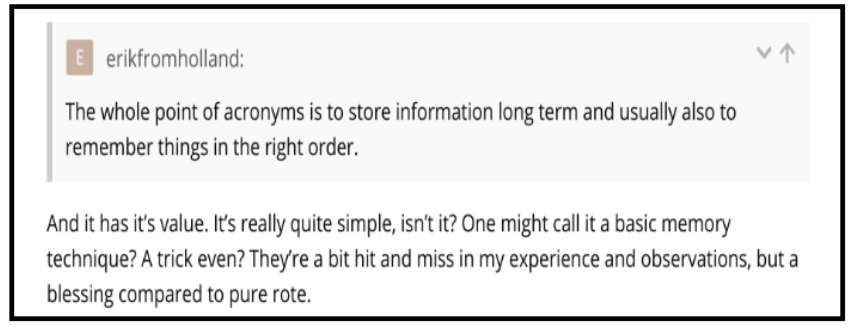
The whole point of acronyms is to store information long term and usually also to remember things in the right order. The Islands of Holland can be learned by using TVTAS (television bag in English): Texel, Vlieland, Terschelling, Ameland en Schiermonnikoog. Just about everyone who went to school decades ago in Holland still knows this, so that shows in my view that it is a long term memory technique.
I am almost afraid to ask, but could it be that we are now also possibly talking about different things?
I definitely didn’t use any advanced mnemonics with memory games in my childhood.
I am going to take somewhat of a risk here and I hope you can appreciate what I am about to do. Both you and Fatihkaya are using words in a deceptive way in my estimation.
Deceptive use of words by Fatihkaya:
In the discussion with Fatihkaya I suggested that his claim implied that “nobody was talking … and so on”. In an effort to make it seem that this is not true he now suddenly used the word “mention” instead of “talk”. This makes it look like I am the one that changed a word that he said into something that sounds very different. If you read the below sentence in your mind the emphasis is automatically placed on the word “mention”.
I didn’t say nobody was talking. You are the one who has been touting this in 2-3 posts as if I had said it. I said that Melik Duyar was the first person to mention it.
He also does something else that is just as deceptive. The first sentence is incomplete on purpose and it reinforces the idea that I and not Fatihkaya is using the word “talking” in an effort to win the debate in a dishonest way (his articulated anger suggests unfair play on my part).
Without all the word play you get something that your brain can’t make any sense of.
I never said that nobody was talking about mnemonics before Melik did, I said Melik was the first person talking about mnemonics.
Deceptive use of words by Noan:
Let me begin by saying that I feel that your (in my view) deceptive use of words is not the result of any kind of intentional dishonesty.
I definitely didn’t use any advanced mnemonics …
I see, you just used advanced memory techniques, or maybe you used mnemonics that were not advanced.
Or perhaps you didn’t use any memory techniques/mnemonics at all despite being taught some acronyms. This would not be a strange interpretation because:
Each game I just relied on brute working memory to do well in.
It is not the fault of the reader that he or she doesn’t know if you changed the word(s) memory techniques …
There were a few memory techniques taught in my local schools
… into mnemonics for the sake of variety (implying you consider them to be synonyms), or because you think they mean something significantly different. If you think that mnemonics are advanced memory techniques then advanced mnemonic becomes “advanced advanced memory techniques”.
Something that is just as confusing (perhaps deceptive can also be used) is this:
There were a few memory techniques taught in my local schools but they were not systems to encode and store information long term, like a PAO, or method of loci.
It is completely unclear what you are comparing; is it?
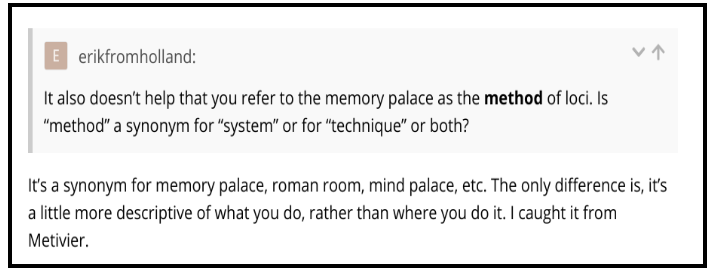
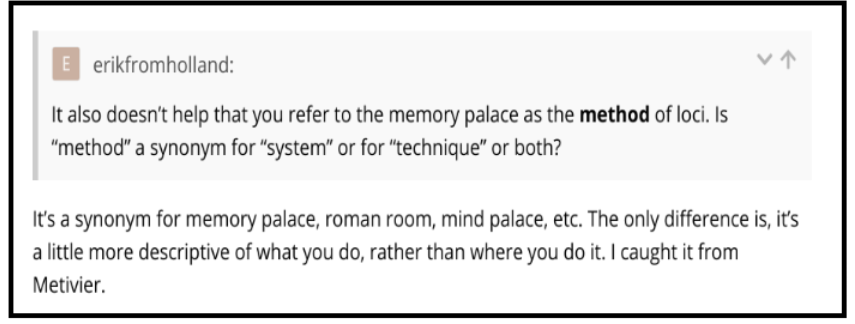
It also doesn’t help that you refer to the memory palace as the method of loci. Is “method” a synonym for “system” or for “technique” or both?
What I find even more confusing is that your initial explanation for the confusion between me and Fatihkaya focussed on the scale of the talking about mnemonics. However, everything below focuses on the difference between one kind of memory techniques and another (more advanced?) type of memory techniques.
I hope you can appreciate why I am a little bit confused about things.
you’re right, erik. we don’t need to drag this out. i’m not arguing with you. i’m not angry. why should i be angry. i would block you instead of getting angry with you. what i want is for us to talk about more productive topics. you don’t need to correct every word and sentence written, you don’t need to look for another meaning behind it. english is not the first language of the person in front of you. i’m continuing to learn. believe it or not, when you say it, i realize that i’m starting to say “mention” instead of “talk”. it doesn’t matter to me that melik duyar is the first person. I wrote that sentence only because I know that no one has ever talked about these issues before. I did not try to ignore other people when I wrote that sentence. I have not heard these techniques from anyone else in Türkiye. If someone else has told about mnemonics, please give me an example so that I can learn something useful for myself. conversations other than that give me more boredom than benefit. I am not angry, of course, but when you talk about me, I feel like writing something just to spite you. I mean, it is an unnecessary conversation. let’s not treat each other like this. if you want to find something missing instead of contributing to me, that is up to you. good day
That’s not surprising. When people do that in response to a perceived conflict, they are offering perspectives they think you might not have considered, and a chance for one or both parties to ease out of the conflict while saving face.
We learn numbers as abstract little symbols we can use to understand and manipulate quantities. They are absolutely wonderful for that! But they are just abstractions our brains quickly throw away.
Someone figured out that if you associate numbers with specific things, in this case a person, action, and object, you can mentally read and write them in a way the brain cares enough to store long term.
It doesn’t matter how competitors use it. Once you attach Michael Jordan kickboxing a Honda to some locus, you have it in long term memory and you’re free to make that number permanent through use.
And it has it’s value. It’s really quite simple, isn’t it? One might call it a basic memory technique? A trick even? They’re a bit hit and miss in my experience and observations, but a blessing compared to pure rote.
It’s a synonym for memory palace, roman room, mind palace, etc. The only difference is, it’s a little more descriptive of what you do, rather than where you do it. I caught it from Metivier.
I understand the way I communicate can be bizarre to someone who’s much more pedantic. I think in context, and cannot care about learning or using the most precise word each and every step of the way.
So when it comes to the games part, just ignore the word advanced and read it again.
People are a mystery, eh? I can tell you deception is the wrong answer.
You are reacting to a point I was trying to make, without showing the part (that comes directly after that piece of text) in which I actually make that point.
Someone figured out that if you associate numbers with specific things, in this case a person, action, and object, you can mentally read and write them in a way the brain cares enough to store long term.
I understand all of this and I also think that you know I already understand this, so I am not sure what point you are trying to make. Like what does this have to do with my quote?
It doesn’t matter how competitors use it. Once you attach Michael Jordan kickboxing a Honda to some locus, you have it in long term memory …
I don’t know what to make of this. Why would this scene be in your long term memory? You can visualize it and immediately forget it. Are you defining long term memory as something that you can remember for a long time or is the location in and physiology of the brain decisive? like the working memory is in the hippocampus and long term memory is in the cortex?
I have no idea (given the above example) what you would consider an example of a short term memory technique. You implied that acronyms are for short term memorisation:
There were a few memory techniques taught in my local schools but they were not systems to encode and store information long term, like a PAO, or method of loci. They were mostly along the lines of “Think of a rhyme, turn something into an acronym, or turn the letters into a story. E very G ood B oy D eserves F udge.”
You are reacting in a confirming manner to a statement that completely contradicts your classification of memory techniques. I don’t even know if you are aware that my statement contradicts what you said (see your quote “there were a few …”).
Is a banana yellow or green? Well let’s see it is a piece of fruit. Your entire previous response looks like an attempt to make a distinction between different types of memory techniques. But instead of making an easy to understand distinction that would serve a purpose in this discussion you are creating just more confusion. You classify PAO as long term and acronyms as short term (but you also appear to agree with the opposite, see above), you use the words techniques and mnemonics possibly as synonyms and possibly not and we also have (basic/advanced) techniques and/vs systems and/vs methods.
I understand the way I communicate can be bizarre to someone who’s much more pedantic.
Show me a person who is not pedantic and who can summarize your point of view and I will eat one of my shoes.
So when it comes to the games part, just ignore the word advanced and read it again.
I definitely didn’t use any mnemonics with memory games in my childhood.
… because …
I just relied on brute working memory
I still have no idea if you think mnemonics means something different than memory techniques.
People are a mystery, eh? I can tell you deception is the wrong answer.
You are making a mess of this conversation and I also think that you know that is what you are doing. Your previous response is not much more than one contradiction after another supplemented with some interesting anecdotes. The quote doesn’t say anything about deception (that was in my opinion the case in another part of your text), but it suggested that before you even got halfway with your initial response you had already forgotten what you had written in the beginning.
Let me confront you with how this conversation actually took place.
I didn’t say nobody was talking. You are the one who has been touting this in 2-3 posts as if I had said it. I said that Melik Duyar was the first person to mention it.
You were making a false claim (I can understand the confusion and I don’t blame you for making this mistake); I never said that. I assumed that it was a logical and undeniable implication of what you did say. You also gave the impression of being somewhat angry by using the word “touting” (there are some other parts in your response that do the same). And finally the thing that you thought I said (but didn’t) is literally what you thought according to the first quote (see all the way above).
believe it or not, when you say it, i realize that i’m starting to say “mention” instead of “talk”
I wonder if you also realize that only by doing this and by starting your argumentation with a half baked sentence you appear to make any sense.
I didn’t say nobody was talking. You are the one who has been touting this in 2-3 posts as if I had said it. I said that Melik Duyar was the first person to mention it.
… but if you summarize your statements without those two confusing elements you get something that is a contradiction.
I never said that nobody was talking about mnemonics before Melik did, I said Melik was the first person talking about mnemonics.
I still don’t know why you would make a fuss about something I said that you said, that is a logical implication of what you said and also what you thought. Noan made an attempt to assume that you may have meant something different in an effort, as he puts it, …
a chance for one or both parties to ease out of the conflict while saving face.
Because he can’t make any sense of your claims in a way that would not lead to a contradiction he writes a response that is even more confusing than your contribution to this debate.
Well I’m sorry our communication is that incompatible. You’re obvious a passionate person and while I thank you for taking the time to outline the parts of my posts you’re struggling with, I just don’t care.
The way you make your points are too consistently abrasive. They erode away any desire to work with you, and now I just don’t have the energy to bother clarifying anything.
It would be to your benefit to seek tutoring on interpersonal skills. If you learn to interact with a softer hand, you’ll have an easier time within online communities, and far fewer black eyes on the street.
I honestly feel that you were not trying to clarify much in the previous posts either. I was under the impression, just being honest here, that you don’t even know what arguments you were trying to make or what for example your classification of memory techniques is actually based on. The fact that you don’t even notice for example that I am completely contradicting you …
… suggest to me you don’t even know what you mean with certain words you are using (like long term vs short term).
Many of the (in my view) legitimate questions are very easy to answer if you had a clear idea of what you were trying to say in the first place, which as I have suggested above is in my view not the case.
When I said:
You are making a mess of this conversation and I also think that you know that is what you are doing.
… I was being completely honest and I honestly thought you could see the humor of that sentence.
Speaking of humor:
I find it hard to imagine you would give an answer like above to a question that was an attempt at understanding your underlying thoughts of using so many similar but different words if you in fact knew the answer. I was pretty much convinced that you were pretending to not understand the question. Clearly (I assume that it was) I was asking about the “method” (as part of a collection of similar words such as “technique” and “system”) and not about “the method of loci”.
My reaction that was again meant to be funny and is the most precise analogy I could think of to describe what you are doing.
Is a banana yellow or green? Well let’s see it is a piece of fruit.
Perhaps useful for me to remind you that all of the above was for me an attempt to understand the below sentence.
There were a few memory techniques taught in my local schools but they were not systems to encode and store information long term, like a PAO, or method of loci.
and my earlier reaction:
Let’s be honest, you couldn’t answer that question even if you tried.
To make a long story short, I think I have mostly done nothing other than call a spade a spade.
Ah, when cultures collide!
Reading this thread, I most want to post a gif of Michael Cain (as Austin Powers’ father) saying the line that begins:
There are only two things I can’t stand. People being intolerant of other cultures—and…
Gosh that’s a well written punchline.
Instead, enjoy a delightful read:
I’m actually a fan of the Dutch style of honesty and communication. But I’d be lying if I said that the cultural differences didn’t make me chuckle. I like this thread. And everybody is correct in it while also being wrong. It’s lovely. I like this forum.
Regards,
Beau
reply to: beau2am
Finally someone with a perspective on things that is not clouded by hurt feelings type of emotions  .
.
On youtube there appears to be a market for people outside of Holland to go to Amsterdam, (because Amsterdam = Holland in the eyes of most people in the world) and point at weird and unusual things that Dutch people do. As much as I can see the fun side of such videos, I also can’t help being aware that in order to make such videos you would have to be very dishonest. Put in another way, if you make a video that is an honest reflection of the full spectrum of Dutch behavior, nobody is going to watch any of your videos.
If you have a preconceived idea of what typical Dutch behavior is, you will look for that behavior and you will make sure that is what is shown in your videos. Given that time = money content creators may speed things up by not just looking for but also actively creating what they desire to show. So just like with the many prank videos much of what you get to see is nothing more than a staged performance.

A couple of minutes ago I was having lunch and kind of lazy scrolling through this thread using nothing other than the down button. I have to admit that this gave me a somewhat different perspective on my behavior in this thread and that of some of the other participants.
In the beginning of the discussion there appears to be nothing at all that even remotely looks like rude or disrespectful behavior of any kind. But suddenly a response shows up that is full of angry sounding and downright hostile language. I can assure you that that response was not from me. As I have on occasion used what you might consider rude language that was not always totally appropriate in the past, I assumed more or less that the angry response was a perhaps overreacted but logically to be explained phenomenon. However as I stated above in my estimation that simply was not the case this time.
I can imagine that someone looking at some of my later responses and seeing sentences that are in the realm of (paraphrasing) “you don’t know what the words you are using mean and as it appears you don’t even have a clue what you were trying to say” would label this as rude. However this hypothetical conclusion would likely be the result of a lack of imagination of the possibility that the sentence is actually an honest attempt at describing things as they are.
Personally, I enjoy reading your comments, @erikfromholland.
That said, I can only offer the plain cultural truth:
The only reason someone from the states would be as pedantic as you have been (are?  ) is if that person were, as we say, “looking for a fight”/“trying to pick an argument”/“were off their medication”.
I just happen to have the amusing and fortunate awareness that you aren’t doing any of that, you’re just Dutch!
But if folks aren’t aware of the cultural differences, then the Dutch style of communication is going to come across extremely confusing and exactly as folks have described you being in this thread! Heheh.
Just a cultural collide is all.
I believe Rory Sutherland describes in his book Alchemy the story of an English to English translation of phrases that puts what people mean beside what people hear. And compares stateside English with British English and with Dutch English for a highly amusing effect.
I watch relatively little YouTube and so haven’t encountered the videos you mention, but I also entirely agree about the bias generated in the formula for viral content.
And yes, you haven’t done anything wrong, Erik. You’re just Dutch!
And the other folks haven’t done anything wrong per se, they’re just not Dutch!
It really is a bizarre (and humorous to me) cultural collide. I used to have a boss who regularly had business negotiations with a Dutch company, and I enjoyed him recounting his experiences.
“Boss” btw, is an English derivation of a Dutch word. Just a fun fact. 

That’s a valid question! Rockefeller is the same person behind modern medicine, focusing on pills and patents to generate profits. He values workers more because thinkers could become potential competition. In his view, workers are modern-day slaves. Someone who cannot think, memorize, and create is destined to be a modern slave for the rest of their life. I have myself learn all those skills in order to evolve and doing my best to change my condition and It’s refreshing to see that people like yourself are able to think criticaly and generate that type of question!
Creating workers who cannot think makes them easily obedient, especially if they fear their job situation could be threatened.
Cool I did indeed read it. I am new to memory techniques, about known about them for just a year and 3 month of experiance using them. How should I practice every day to get be expert I have about 11 memory practice should I practice with each of them 11 times for different types of information and make more memory palaces So I can practice more? Mybe I answerd my own question. Any tips and trick that you can give me ?
thank you for giving me your story.
You can either decide to memorize something specific or just develop your creativity by playing with what you have around you when you have some dead time! For instance I would see something outside while walking down the street for instance a Sign with a name ’ remove the vowel’ from the word and keep the consonnant to form a new word! Or I would look at cars’ licence plates and compose some words from the numbers (major systems) I just try to be creative during my dead time to improve my creativity and link thinks for fun