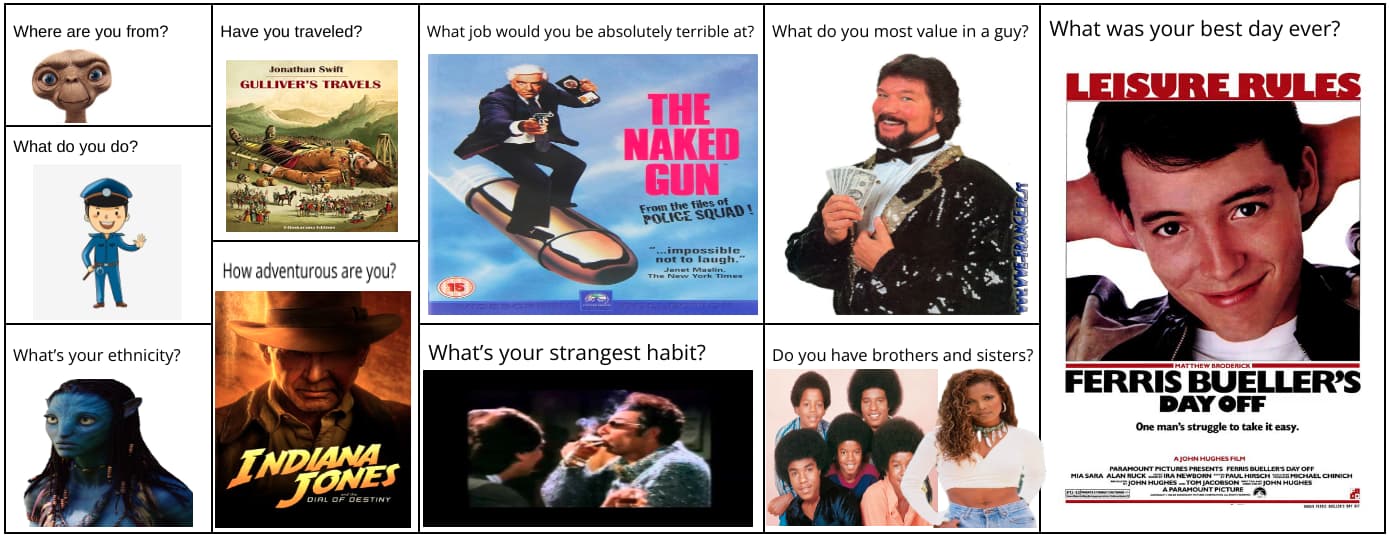
Hey all, i’m looking to memorise the list of questions below. What memory technique would you recommend?
Where – Where are you from?
Work – What do you do?
Ethnicity – What’s your ethnicity?
Logistics – Logistical questions?
Know – How do you know the people you’re here with?
Travel – Have you traveled?
Craziest – What’s the craziest thing you ever did?
Adventurous – How adventurous are you?
Perfect – What would your perfect Saturday be like?
Terrible – What job would you be absolutely terrible at?
Strangest – What’s your strangest habit or what easy things do you screw up?
Rehearse – Before making a call, do you ever rehearse what you’re going to say? Why?
Value – What do you most value in a guy?
Envision – Where would you like to live when you’re settled down?
Relationship – What was your longest relationship? Why did you break up?
Siblings – Do you have brothers and sisters, are you close with them?
Biggest – What single event has had the biggest impact on who you are?
Embarrassing – What’s the most embarrassing thing you ever did?
Sacrifice – What or who would you sacrifice your life for?
Treasured – What is your most treasured memory?
Grateful – For what in your life do you feel most grateful?
Raised – If you could change anything about the way you were raised, what would it be?
Night – What keeps you up at night?
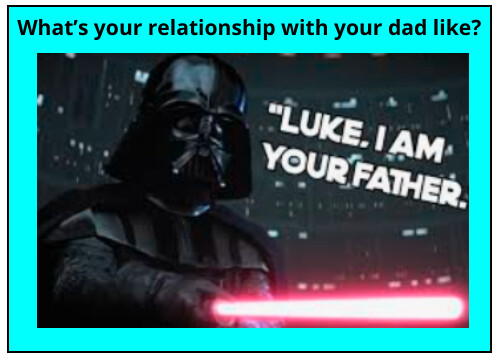
Dad – What’s your relationship with your dad like?
Day – What was your best day ever?
Death – Of all the people in your family, whose death would you find most disturbing? Why?
Cheated – Have you ever been cheated on?
Cry – When did you last cry in front of another person? By yourself?
Movie – What movie has made you cry the most?
Memory – What is your most terrible memory?
Proud – What’s the thing you are most proud of accomplishing in your life?
■■■■■■ – Which person in your life ■■■■■■ you over the most?
Regret – If you were to die this evening with no opportunity to communicate with anyone, what would you most regret not having told someone? Why haven’t you told them yet?
Embarrassing – What’s the most embarrassing thing you ever did?
Do you have several locations? Are they similar to others? Do you use adjective subjects (loci)?
You can use objects (adjective subjects) placed in each place to reinforce and give life to the places, you can also connect places by reusing the adjective subjects using shapes that move these adjective subjects like a character, all adjective subjects can perform multiple actions so it would be easy to vary them in multiple places to connect those places with each other sequentially or by hyperlinks because a shovel can be used as a cap, glass, spoon, etc. And in each place it does something different, although with the major method it can be simpler and also vary the objects of the major method with different actions in different places interacting with the places.
Before I start with answering your questions, let me just say that I am not doing any kind of project at the moment that requires me to make a new or larger memory palace than the one I already have. I am not asking for help, but I don’t mind looking at interesting ideas about how to make memory palaces larger or better. I don’t understand why you are giving me recommendations as this is not my thread and the creator of this thread is the one asking for advice regarding memory palaces. I don’t want to be part of a side discussion in someone else’s thread unless that discussion is also helpful/interesting to that person.
Do you have several locations?
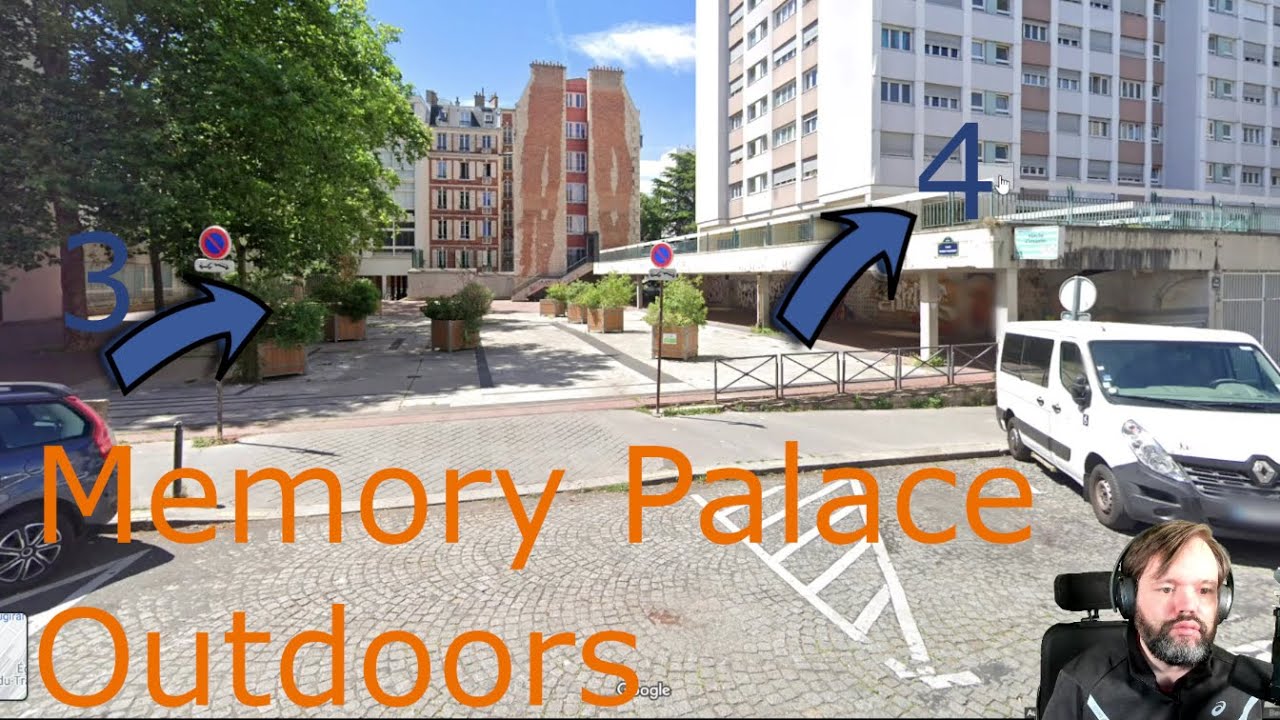
I assume you mean as part of my memory palace. The last memory palace collection I used was made up of locations in and around my house, the shopping mall, my work place, high school building and some other places. So, yes I have several places.
Do you use adjective subjects (loci)?
I don’t know what those are, that’s why I asked you to explain it to me.
I don’t really understand much of the recommendations, perhaps because I get stuck trying to imagine what those adjective subjects are. I am also kind of missing the overall goal of the recommendations; like are they meant to create a larger memory palace or something of that nature?
Adjective subjects = Objects that help the atomic places or loci.
Loci = Chair, table, door, window, corner, etc.
The only thing is that the “adjective subjects” are artificially added objects that help to retain places that without them would be a difficult task and that can be used in many places performing different actions. These adjective subjects also help in non-physical places, but with the amount of existing material it is more economical to search for places on the internet unless they are very personalized places.
But the adjective subjects can perform any type of action and must remain fixed in the noun subjects (fixed places) although they can migrate from one place to another to retain the angles and positions.
Actually the methods I use are to acquire knowledge and not for quick memory, so I need a lot of places and I focus a lot on it, besides places also characters and objects that can serve for many things based on the acquisition of knowledge, but they are complicated methods to explain, but not to implement.
I didn’t understand much of what you were saying at first and then I thought “this is actually interesting” and now I am becoming very curious. Please forgive me if my summary is not fully accurate but here goes.
You start by making a large memory palace and you don’t filter out the routes and locations that you would normally consider to be too boring or similar. After that you upgrade the boring parts with these adjective objects so that all locations are useful for retaining information. To make the palace even bigger you create imaginary structures that overlay the real structures. And perhaps in these additional structures you can once again place even more adjective objects. So the whole thing grows much like a neural network in a sort of fractal way.
I think this method is worthy of its own topic/thread. Have you already made this and/or are you planning on making one?
Yes, that’s exactly what I wanted to say now you could place lines to those places to have a general diagram in the placement of those adjective subjects and so every time you want to retain those places you will easily orient yourself by means of the diagram that could have the cardinal orientation design (compass) starting from the cardinal point or clockwise from the relog, you place your adjective subjects in each point.
Create chains between adjective subjects for the places and so you link place to place.
The chain should be scenes of those adjective subjects being moved by characters in other locations.
I think you are on the right track, but perhaps you may value some of the ideas below.
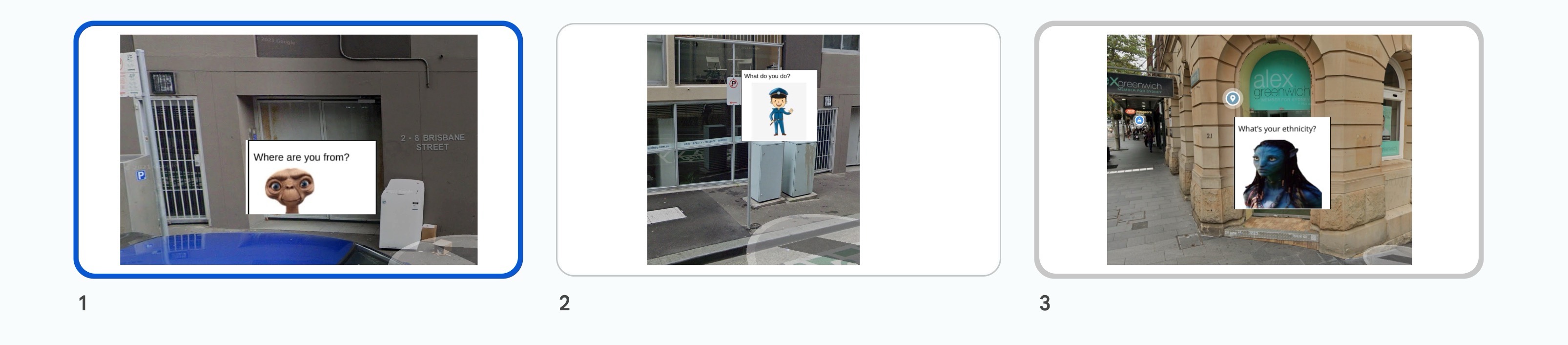
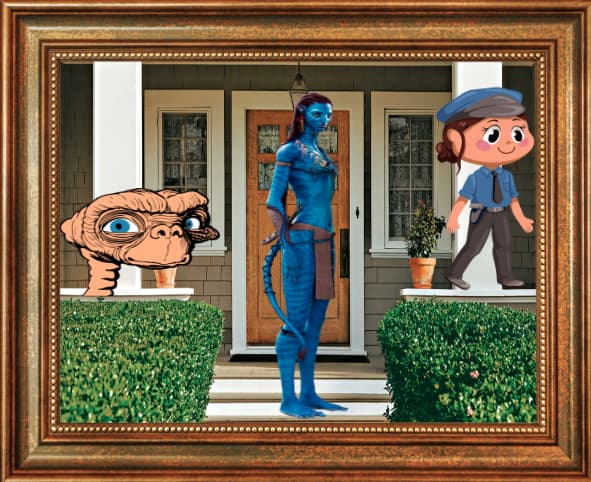
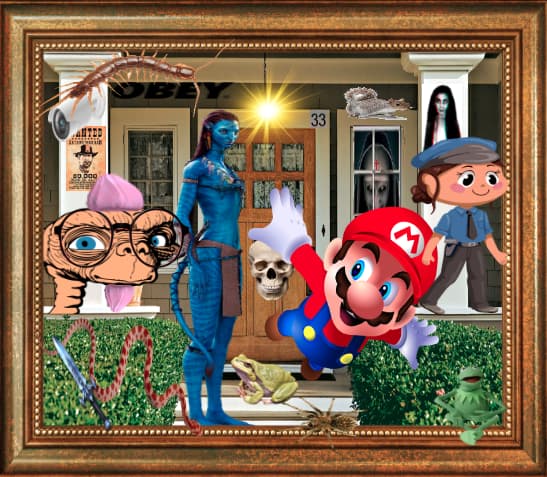
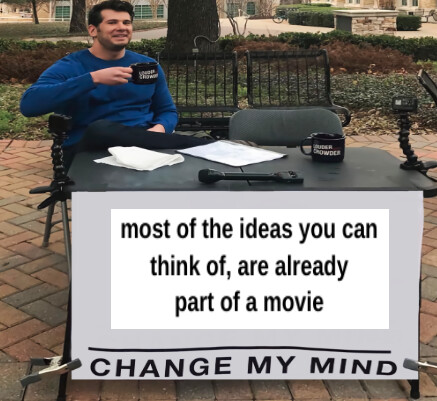
In order to memorize a list like the one you showed, you could probably just use your own home as a memory palace. If speed is not of great importance (like for a memory competition) you can chunk multiple images close together. So for example three questions can be attached to the outside of your home as below.
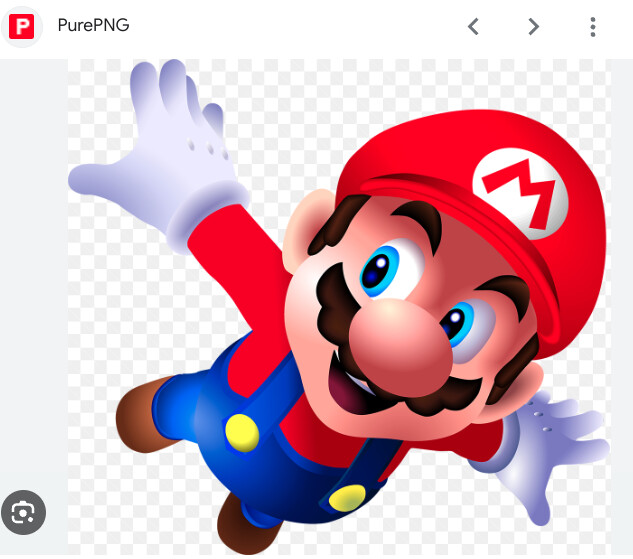
If you want to make actual pictures of both the memory palace and the images (the memory palace method also works with just the images you have in your mind, like before the internet I already used this method) you might consider using png images (no background). So if you want to find png images you just go to Google images and type what you want an image of and also type png. If you click on the image with a white background and if you get a picture with squares you know it’s a png image and then you can just copy it and adjust the size if needed.
If I can add a suggestion, when you go to place the imagery, interaction and action with the loci can provide extra memorability versus just placing the imagery at the loci. You may be doing this well already, but I find many times when people struggle to make their recall stick its due to this.
So for that first image, have the gladiator attacking the location, damaging it in a dramatic way. This should be much more memorable than just picturing him standing there or not incorporating the loci as a dynamic part of the scene.
On recall, the loci will be the thing that you’ll be relying on to clue you into the imagery. You’ll be looking at or visualizing the loci and trying to picture what was there. If you can make the loci important like that first scene with the gladiator, then when you recall you go something like “ok this first place was getting attacked, slashed with a sword or something, ah yes makes sense that was where the gladiator was fighting!”
Compare that to just placing the gladiator there with no interaction. “Ok I see this location, there was someone standing there, who was it?” Nothing in the loci would give you any clues to the identity of your image.
To your point I’ve seen a Dominic O’Brien video clip where he is explaining the relevancy of people (he uses Claudia Schiffer as his Queen of Hearts) being in a particular loci. In his example his “bed” was his first loci, so his question was… what would Claudia Schiffer be doing in my bed? So purpose/reason/relevancy and/or actions are crucial to running things back. The whole reason why people make good card peg words is that people are not inanimate and can interact and do things whereas objects can’t!
Objects can absolutely be animate and interact in tons of ways. What is more memorable than a toaster that has come to life and is shooting fire out of its slots at you or at the loci or at the next thing you need to remember? In some ways objects provide nearly limitless variability in how they can interact and react to a loci and other elements.
Now, if you’re looking at a strict PAO where the key action is non-arbitrary, then the person is the first focal point of the scene and triggers the entire interaction usually on or with the object. In that case, the object just becomes almost a prop for the person. If you use a PO where you get to decide the action, there is much more flexibility to incorporate that object in creative ways. If you use a single element list (more common with 3-digit numbers and 2-card systems), you are free to use either and the interaction potential is endless.
In terms of people vs. objects as card peg words, if I have a choice between using a person or an object to represent a card or card pair, I will pick the object nearly every time, unless I have no viable object word that fits the system or the person is INCREDIBLY distinct, unique in many sensory ways, and iconic. So like VaDeR instead of FeDoRa. But those people are definitely the exceptions for me.