Using a lukasa to represent historical figures - your thoughts

Hello there. I am based in the UK and new to the forum, but I have been thinking about memory frequently over the past year simply because I want to improve my retention and recall of knowledge. (I admire the dedication of memory competitors but I am not interested in that aspect of the field myself.)

I have dipped into Dominic’s “How to Develop a Brilliant Memory” and Lynne Kelley’s (@LynneKelly) “memory craft” but haven’t read them cover to cover. I am currently using Anki to memorise a PAO variant on the Dominic system, just adding objects to a tweaked set of the people and actions in his book, really. I guess that I am about 80% complete on that, as I seldom make mistakes, but only a few of the 100 are at the stage of instantaneous recall.

However, today I have some questions about lukasa, which is of course covered in some detail in Lynne’s book (e.g. the description of her bird lukasa which starts on p.110). Basically, I aim to use a lukasa for memorising monarchs and, from the 1700s onward, prime ministers of Britain. If possible I also want to add major events such as wars. That should provide me with a timeline for the British Isles that runs like a backbone through its history.

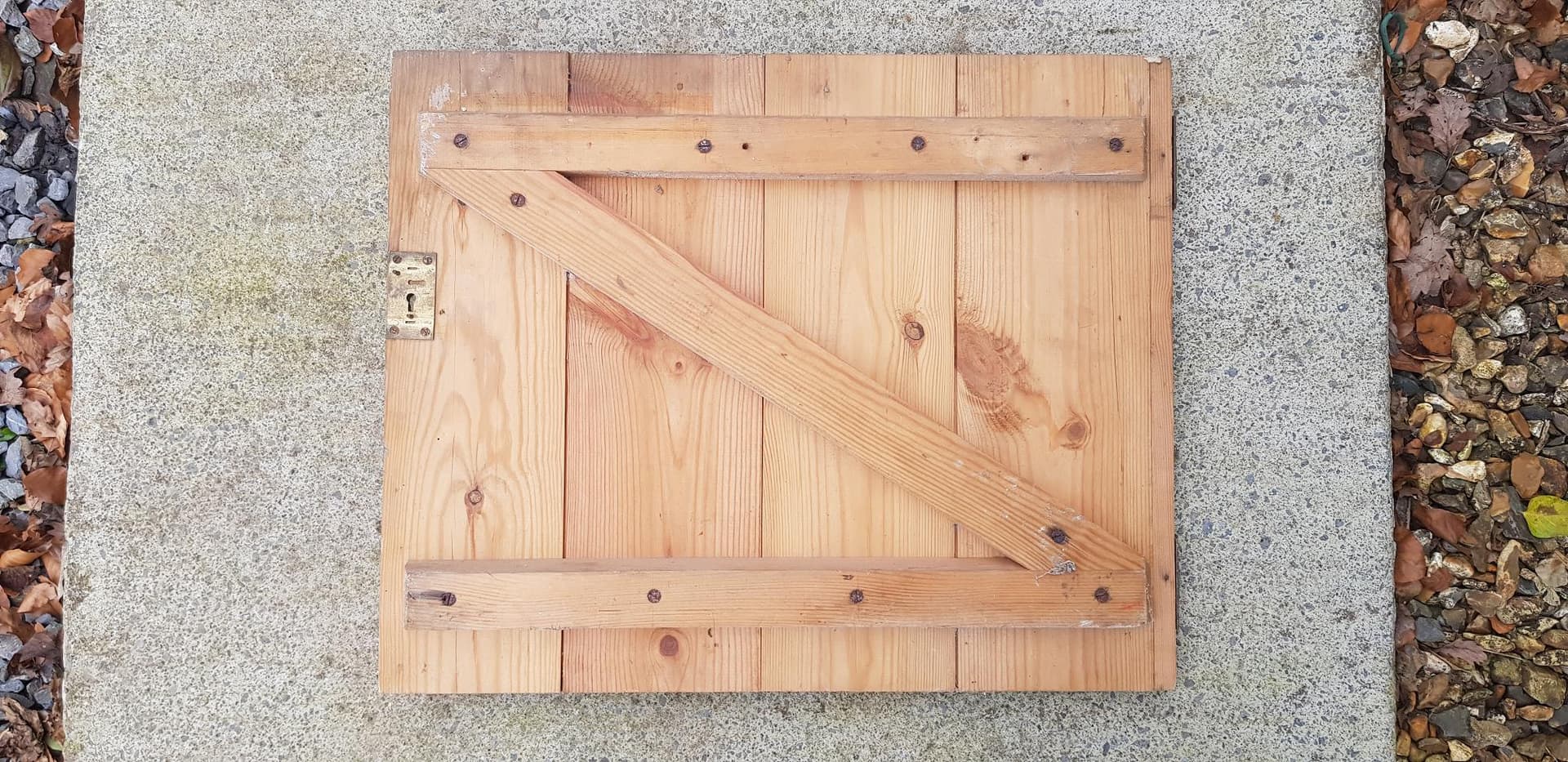
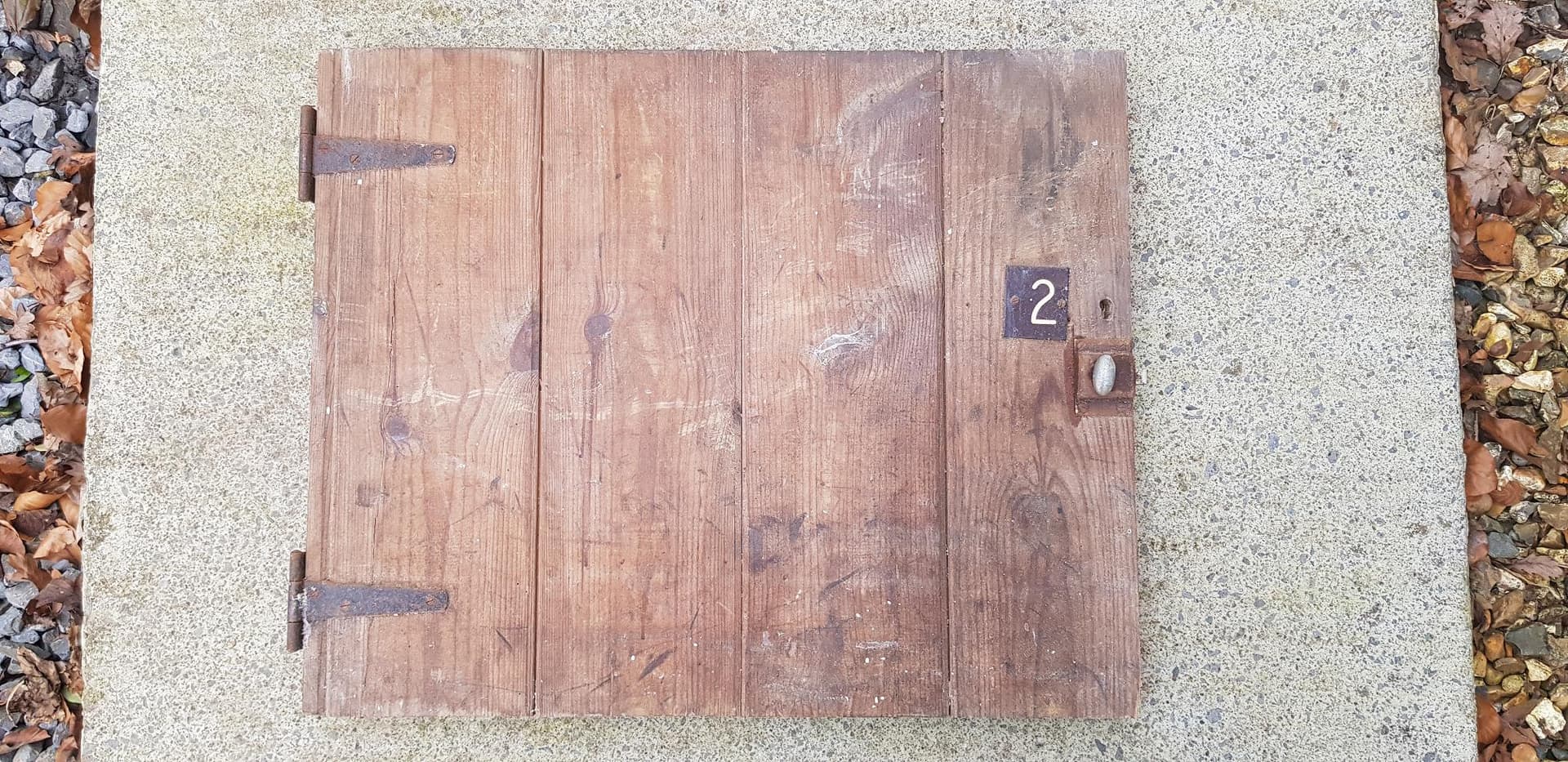
Lynne mentions that flat boards are the most common form for a lukasa. I was lucky enough to find this old cupboard door in my shed in a pile of junk (see photos below). While it is tatty, it is also free, and I think the stains, scratches and other features will make locations on the board easier to recognise and differentiate. It’s a bit larger than I would have like, being 57.5cm (nearly 23 inches) wide and 47cm (nearly 19 inches) high, and is fairly heavy. I have washed the dirt off it and it is drying.

In terms of the encoding of information, for each monarch or PM I am thinking of a name, start date, end date, and house (e.g. Tudor) or political party (Tory, Whig, etc.). That’s four items of information. If we use Robert Walpole as an example, he was in office from 1721 to 1742, so if we omit the “17” that gives us 21 and 42, so I thought I could encode those as Ben Affleck (21) smearing on makeup (the action and object for David Bowie 42).

That still leaves me needing to encode the name of the person and the dynastic house or political party. Maybe I could take initials of the name, so that Robert Walpole becomes RW, which is 18 and 23, and encode that?
I’m not sure how to approach the party either. Suppose I use a small shell to encode Robert Walpole. Could I encode his political party by varying the position of the shell relative to a centreline, or perhaps by the object’s size, or colour? Or even type - shells for Tory, stones for Whigs, and so on. But how does that work with royal houses?

So that’s one problem. The other is the physical layout and organisation of a lukasa. In her book, Lynne briefly describes the more systematic approach she took to her memory board for the story of writing and gives a picture in figure 6.1.

With monarchs and PMs, you have a kind of overlapping timeline, so instinctively I think some kind of linear sequence would be most suitable. A loose spiral beginning at the centre of the board looks interesting, and that would probably make it easy to keep the sequence in mind.

Anyway, apologies for this rather rambling first post, but I’d be grateful for any pointers and advice, either general or specific.

DJ
memory-boards #lukasa
6 Likes

I am excited to see the final product

3 Likes

Not sure if it’s bad form to comment on your own post, but it belatedly occurs to me that if you have a simple (spiral, perpendicular, whatever) line of objects then perhaps it would be difficult to distinguish between the items when treating it like a journey?

Perhaps it would make sense to deliberately create clusters, zig-zags and other features in the sequence of objects.

DJ

1 Like

Try the soundalike method or take the name literally? Looking inside that small shell, you see someone is BOBbing for apples while hanging upsidedown from a POLE that’s protruding from the WALL… BOB WALPOLE?

1 Like

Sir Robert Walpole, 1st Earl of Orford, Knight of the Order of the Garter, Privy Councillor - known to his mates as “Bob”. It could work…

Seriously, thanks for suggesting that. I have spent half an hour looking at using a different approach for the individual names (in contrast to using PAO for the dates). I quite like the idea of an alphabet peg system based on animals.

One issue that has occurred to me is the difficulty of encoding names like Henry I, Henry II and so on. Hard to distinguish between those, but that would be the case for most systems, I think.

DJ
PS and I am thinking about the “literal” approach to names too

1 Like

Hi DJ,

I don’t think it’s bad form to comment on your own post unless it is just trivial nothings to boost it. But that’s not what you did.

I love the look of your lukasa-on-sterioids. It is gorgeous! Like zweb_chess, I am really keen to see the final product, but also anything you are happy to share on the way.

I think for the sequence, you have so many guidelines in the board itself - depending on which side you use - or both?! - you can go vertical or in the zig-zag. Don’t worry too much if it isn’t a perfect layout - imperfections are wonderfully memorable! Your brain will follow the sequence even if it isn’t obvious to others.

You could use colours for the numbers, and forms (shells compared with carving maybe) for the different genres. Or colours for the genres. Do you need the dates on the lukasa as numbers, or use the PAO as the story attached to the bead / carving / paint design / …?

Some people have a tendency to overthink and never get started. Once you start, you will be amazed what your brain suggests. I usually get people to do the design without the final gluing and then they can adapt as they go until they are happy that it is working. Then they glue (or nail).

I am really keen to hear how it goes!

Lynne

2 Likes

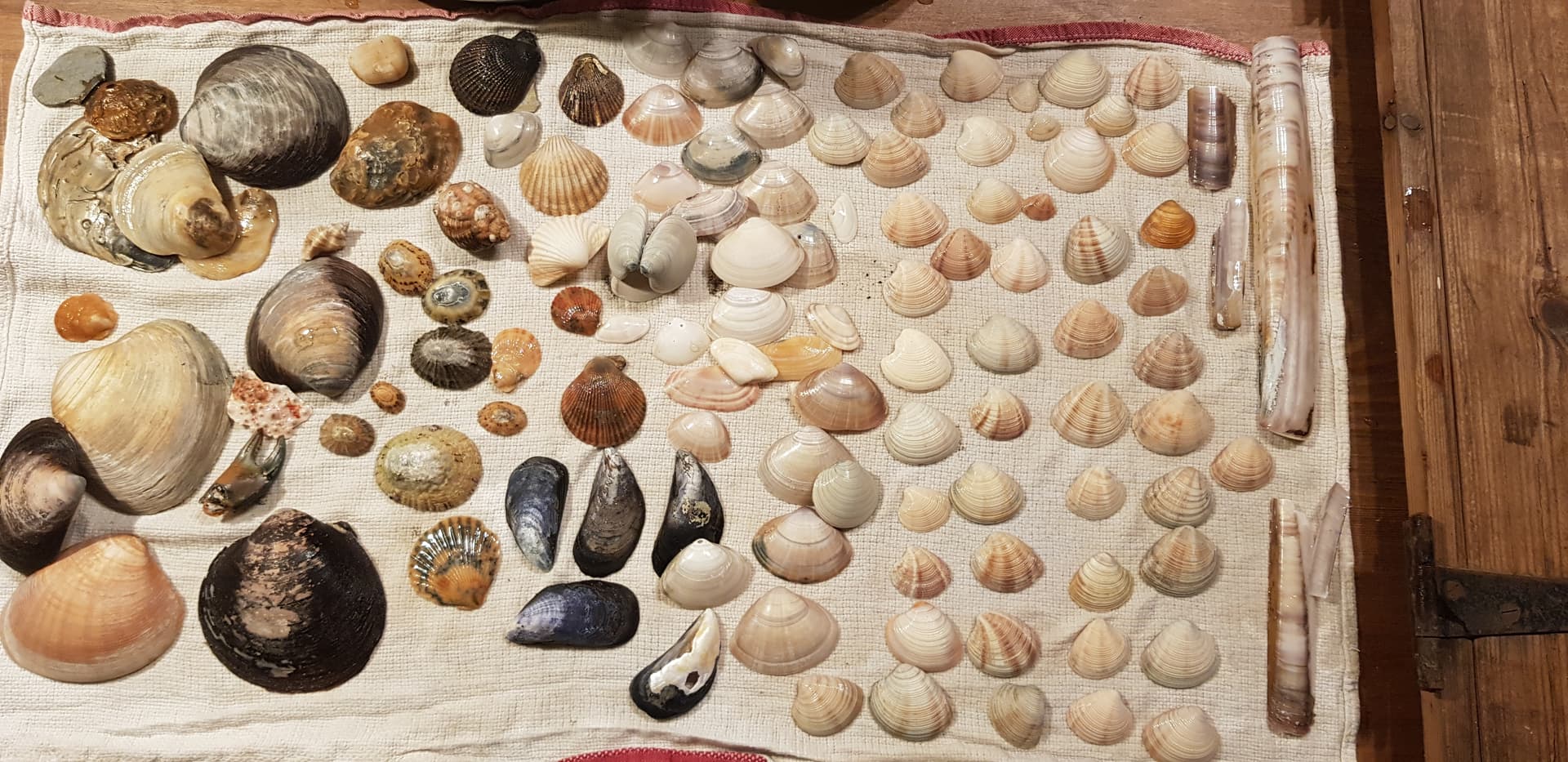
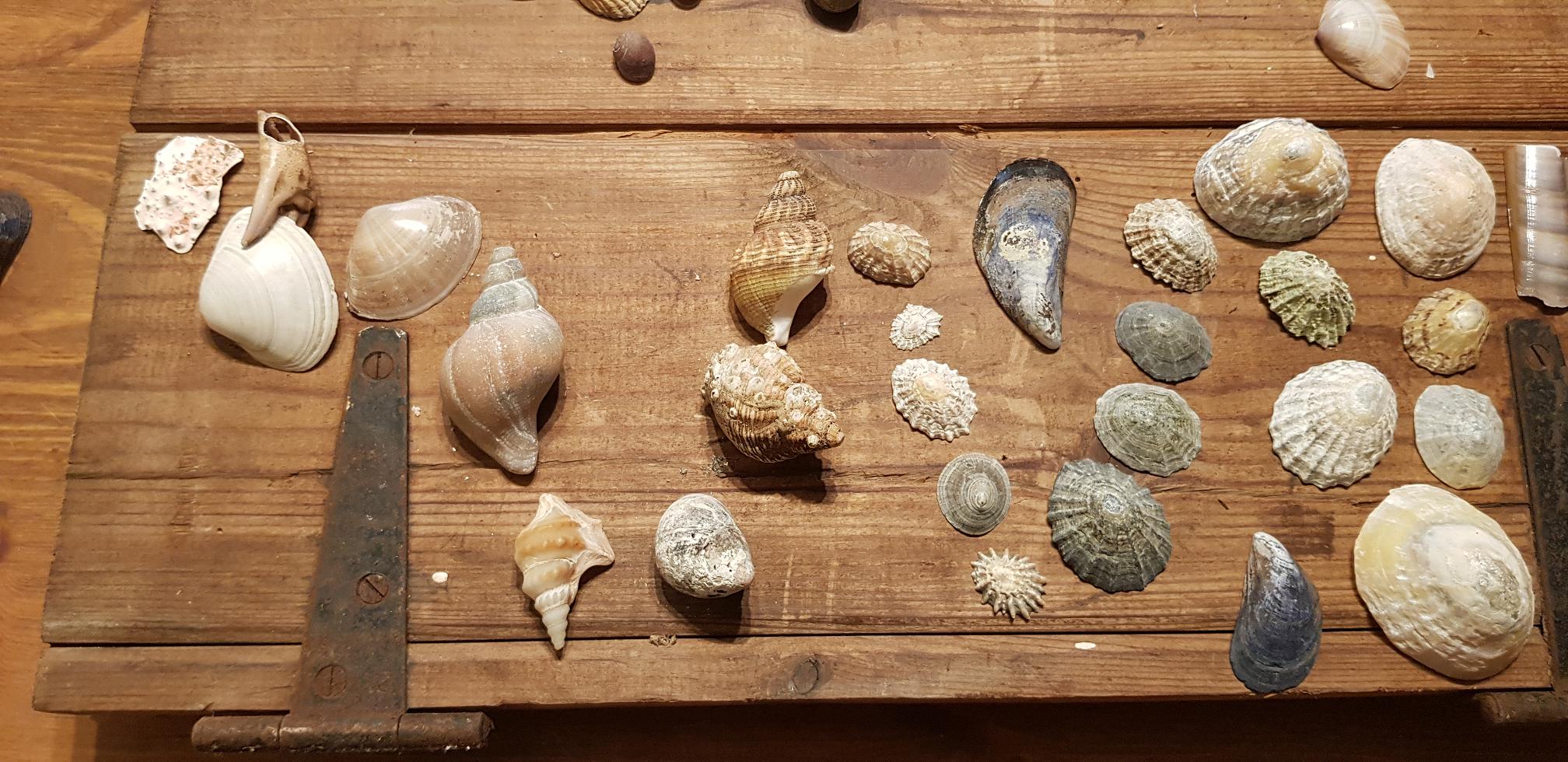
Thank you Lynne. Very sensible warning about not using glue until the final stage. This afternoon I popped down the beach at low tide and spent rather longer than I planned wandering up and down the tideline. The variety wasn’t as great as I had hoped for - very few gastropods, for one thing - but I guess different beaches will have different types depending on local conditions. This is only about a third of my haul, but represents nearly all the large ones. ↓

It’s interesting in that the different shells could be used for different characters. For example, I could use scallop shells to represent queens (of whom there are not many), or mussels for members of a particular dynasty like Hanover, or limpets for one party, cockles for another, and tellins for a third. I can see I will have to exercise some self-control to avoid getting sidetracked by seashell research. As you say, the important thing is to get started!

2 Likes

I am starting to love your project. What fantastic shells!

Please keep reporting.

Lynne

It’s been a busy week at work, so I haven’t made any obvious progress with this, but I’ve done quite a bit of data collection. There have been - depending how you count them - 45 monarchs in England and the United Kingdom, and 79 prime ministers.

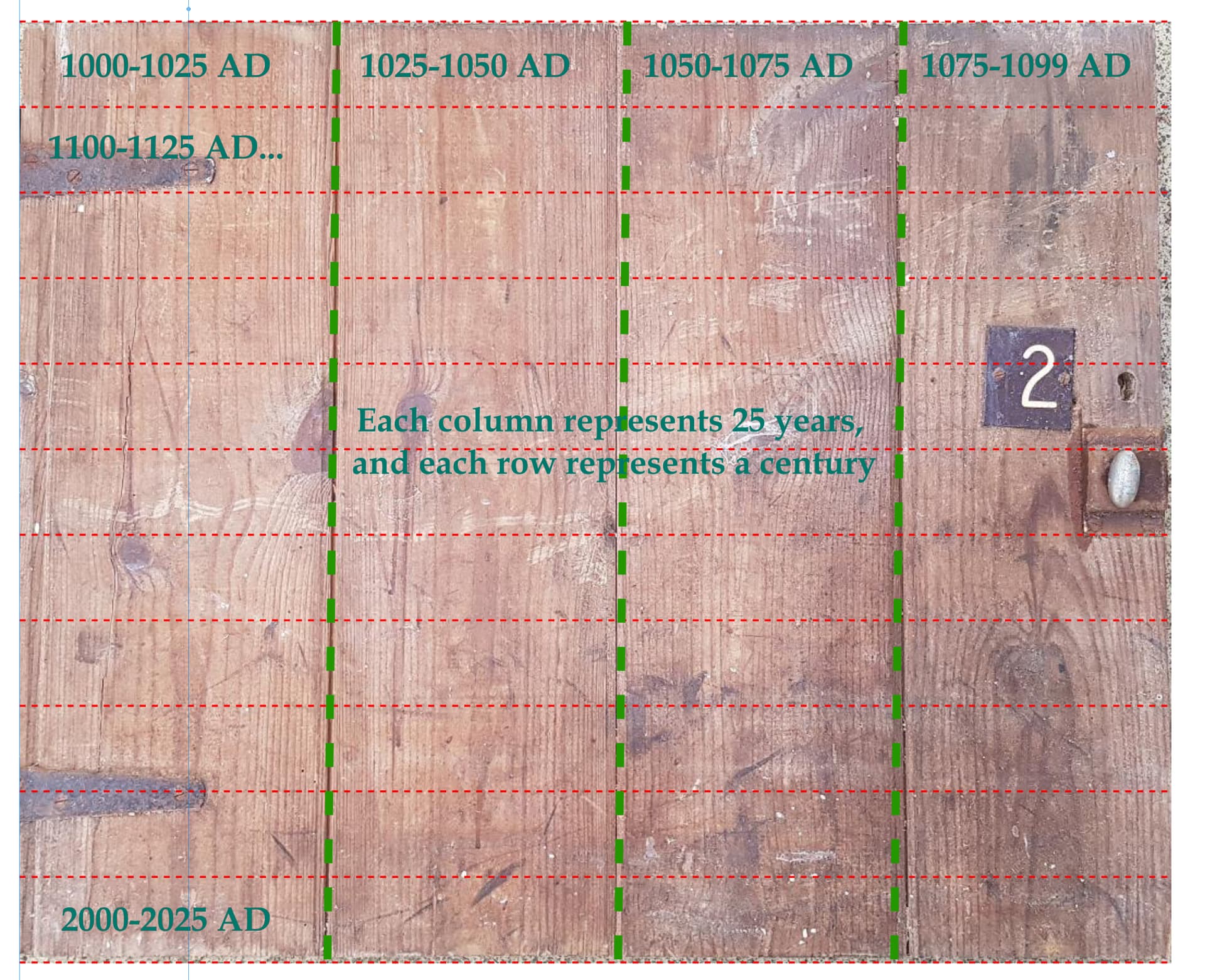
I have also been moving shells and other objects around and thinking about different layouts. For example, as you can see the door is made up of four planks running top to bottom. I have considered a layout whereby the door is divided mentally into 11 thin strips of equal height, running from left to right, beginning at the top and moving toward the bottom, with each plank representing a quarter of a century. That would mean that a glance you could see the rough chronological location of all the objects on the lukasa.

But then I started to wonder if this was such a good idea. For one thing, monarchs and prime ministers are not spread evenly through history. The 1200s saw the coronation of only two kings, whereas there were eight in the 1400s. For another thing, it would rob me of a great deal of flexibility in positioning different objects. So I’m still thinking about this.

With regard to the dates, I think I will not explicitly mark the board with numbers (or names) but instead use my PAO to memorise them. I am pondering the use of different types of shells for monarchs, such as limpets to represent the staying power of the Plantagenets (easily the most numerous of the royal dynasties, with 16 monarchs), or mussels for the Tudors, and so on. The problem is that I don’t yet have the 7 or 8 clearly distinguishable types of shell that approach would require.

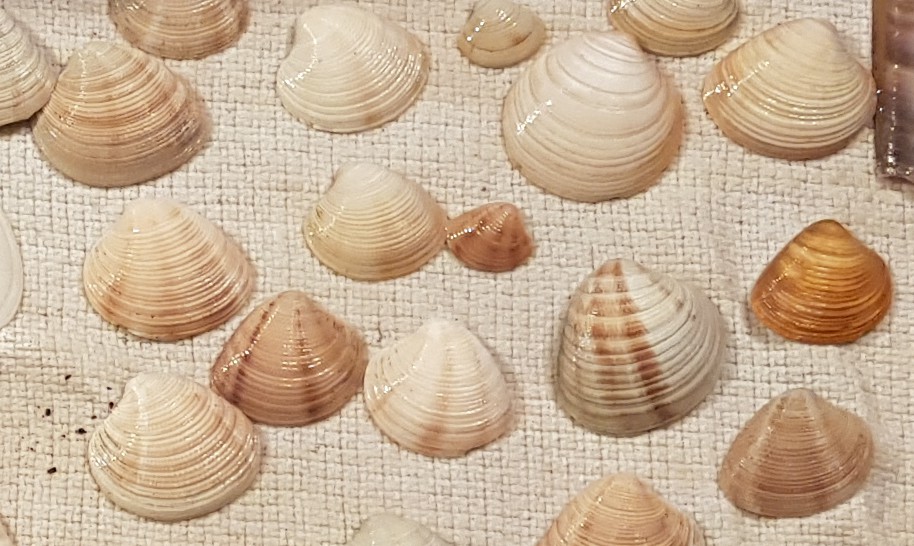
For the nearly 80 prime ministers, I am considering using combinations of shells. For example, the lucine shells - still not very good at identification - tend to have a clear “beak” pointing to either left or right. Their stripes are very distinct in some cases, less so in others. Size varies hugely.

So maybe you could use a shell with a beak pointing left for prime ministers on the left of the political spectrum (Whig, Liberal, Labour) and a beak pointing right for Tory and Conservative prime ministers.

My hope is that I will find a beach with good crop of shells from whelks and other gastropods, or maybe trough shells. If these are different enough from the lucines, the difference in form alone may be enough to express some characteristics.

DJ

1 Like

This detail is sensational, DJ. You are reflecting exactly what I have found in workshops, but to a more sophisticated level. I think the size of the board and the similarity of the shells and the logic of the data are all contributing to such clarity of thinking.

What really interests me is that you are learning huge amounts of your data from the process of designing the board. That is one of the reasons I like that you are not glueing first.

In many Indigenous formats, the process is all that matters. In Australian Aboriginal ‘sand talk’ and many other formats, the final product is of no consequence and either erased, as with sand, or just left to rot, as with many bark paintings and wooden carvings. The learning has all taken place by the creation of the work. Repeated creation of the representation of the data does the necessary repetition for long term retention.

I look forward to the next instalment. Don’t hurry it - the process is the big value!

Thank you so much for the trouble you are taking to record this project.

Lynne

1 Like

You know, this is exactly the thought that occurred to me the other day as I moved shells about. “By the time I’ve finished it I won’t need it” I muttered to myself. But as you say, that is the ultimate goal. Even before memorisation, the simple process of quantifying and organising the data prior to encoding has given me a much clearer view of the subject I am seeking to master.

More next time…

DJ

1 Like

This is wonderful for me - to watch a total stranger adapt a memory system and yet report all the same cognitive responses that I get from others, including Indigenous knowledge keepers, uni students and adults in workshops. But you are doing it slightly differently, which is what makes it so fascinating.

Please keep writing!

I would like to point to this thread on my social media, but not before you have finished and are ready for me to do so - or not. Your call!

Lynne

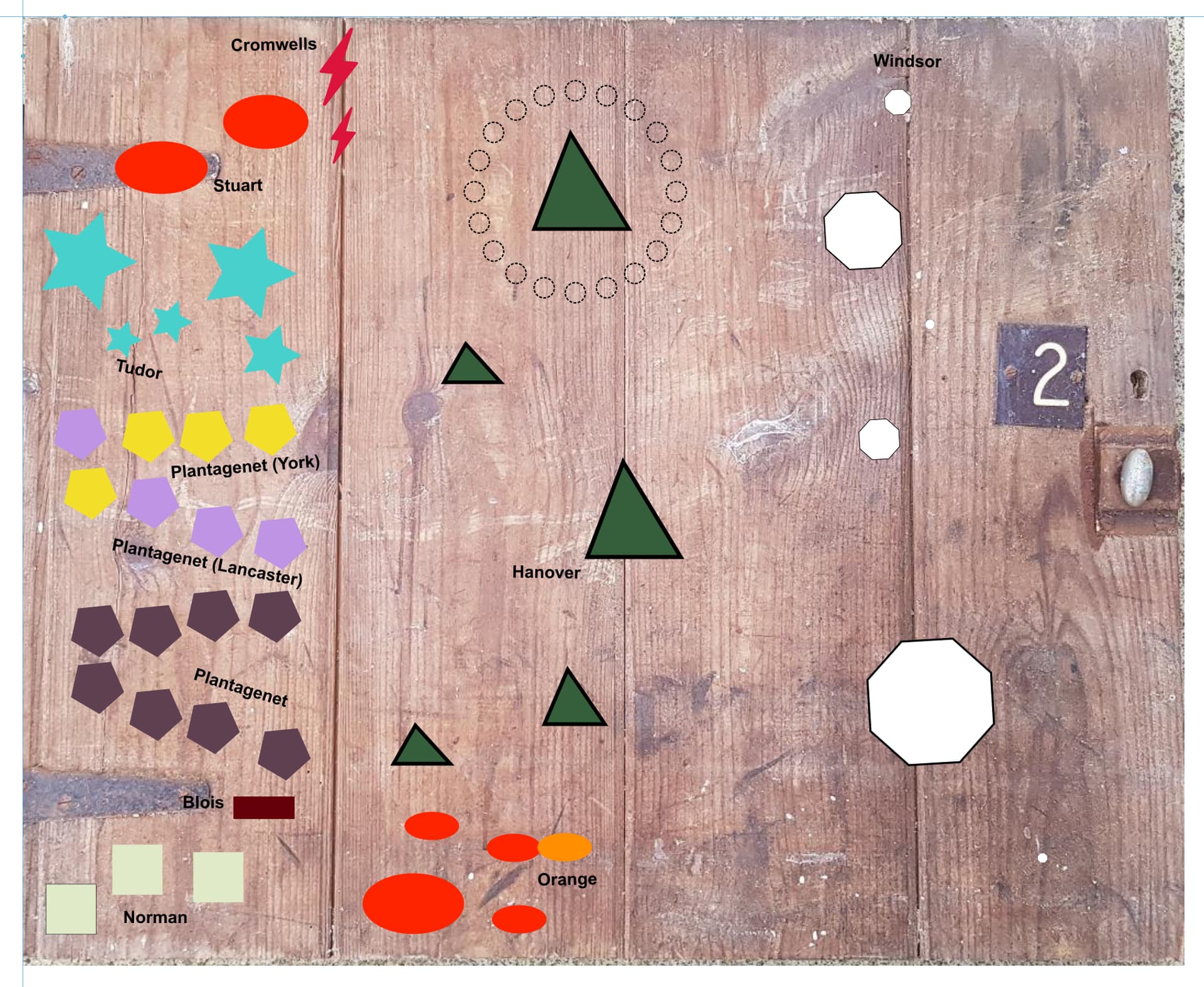
A project has been cancelled at work, and I find myself with a little time this morning to think about the design of the lukasa. I roughed up my thoughts in Inkscape. I think it’s important that the sense of touch is involved, so this won’t do for the actual board, but it allows me to play with layout without getting too distracted by the objects themselves.

I previously mentioned a spiral shape, but having thought about I don’t think a smooth, symmetrical layout is going to be easy to remember, so for this experiment I have embraced asymmetry.

One fundamental split in terms of this layout is the gap between the first plank on the left and the three planks on the right. That represents the Interregnum and the rule of the two Cromwells. So on the left-most plank, starting at the bottom, we have the house of Norman, rising to the sole Blois, then the Plantagenets, Tudors and so on up to Charles I, who managed to get himself executed by his irate subjects through a combination of absolutism, obstinacy and poor judgement.

I have used colour and shape to distinguish the different houses but the real lukasa will probably use some combination of actual shells and their attributes. For example I have used parts of larger shells for the three Normans, and they have a faint pearly sheen to them, so I have dubbed them “nacreous” Normans. Note also that the second shell, representing William II, who was mysteriously killed by an arrow in the chest while hunting, has a hole in the middle. Plantagenets are a shade of eggplant, with the Lancasters being tinted in lavender, Tudors are turquoise and so on. Just an aide memoire really.

The other fundamental split in this board is monarchs who had to deal with prime ministers in a sense close to that in which it is used today, and those who did not. That era really began with Bob Walpole in 1721, during the reign of George I. Note that George I and all monarchs that come after him have a visible border around their shapes. Monarchs before George I have no borders - the perimeters of their power are, you might say, less clearly defined. I suspect this will not be easy to translate into seashells.

It may seem that I have left a good deal of white space (brown space?) on the board, but there are nearly 80 prime ministers to add. I am considering surrounding each monarch with the prime ministers (strictly speaking, their administrations) with which they had to deal. That is why the large triangle (hunting green) at the top centre of the board, representing Victoria, the last of the house of Hanover, is surrounded by around 20 little circles, each representing a prime minister. Some, like Gladstone, appear more than once.

It’s noticeable that the monarchs with long reigns - George III, Victoria, and our own Elizabeth II, each ruled for 60 years or more - outlive huge numbers of ministers and their administrations. I think 15-20 each, maybe more for Elizabeth. So really the bulk of the 80 or so prime ministers are accounted for by only three monarchs. Anyway, this is what the board looks like at the moment.

1 Like

That’s what it’s all about!

Your thinking is fascinating. I can’t wait to see the final lukasa, but hope it doesn’t get completed too fast. The process is amazing!

May I ask what work you do, but only if you’re happy to say so. Feel free to ignore the question. I am just so impressed by your thinking and eloquence, I am intrigued to know more about your background story.

Lynne

1 Like

After an unproductive visit to a different beach yesterday, today I found a nook under the cliffs on the original beach where the tide collects all kinds of shells. This contained a goodly haul of gastropod shells large and small, so if I can find time tomorrow I am going to clean them (and by “clean” I mean give each one a desultory swish in a bowl of clean water) and start playing with patterns and different types.

I have all the shells I need, and gathering any more would just be a kind of procrastination. Mocking up the lukasa in Inkscape was useful, and I think the rising and falling sine wave it suggests is the correct shape to use, but I feel I’m at the stage where it’s important to experiment with the actual materials to hand.

I had some idea of using all shells of one type for each category of prime minister but that requires a large number of shells of each type. It may also be a bad idea to have clusters of similar shells as these may well be harder to memorise. Trial and error will show the way.

Meanwhile I’m making progress with the PAO dates for the individuals. It throws up some strange but thankfully memorable combinations, and is surprisingly easy to decode.

DJ

1 Like

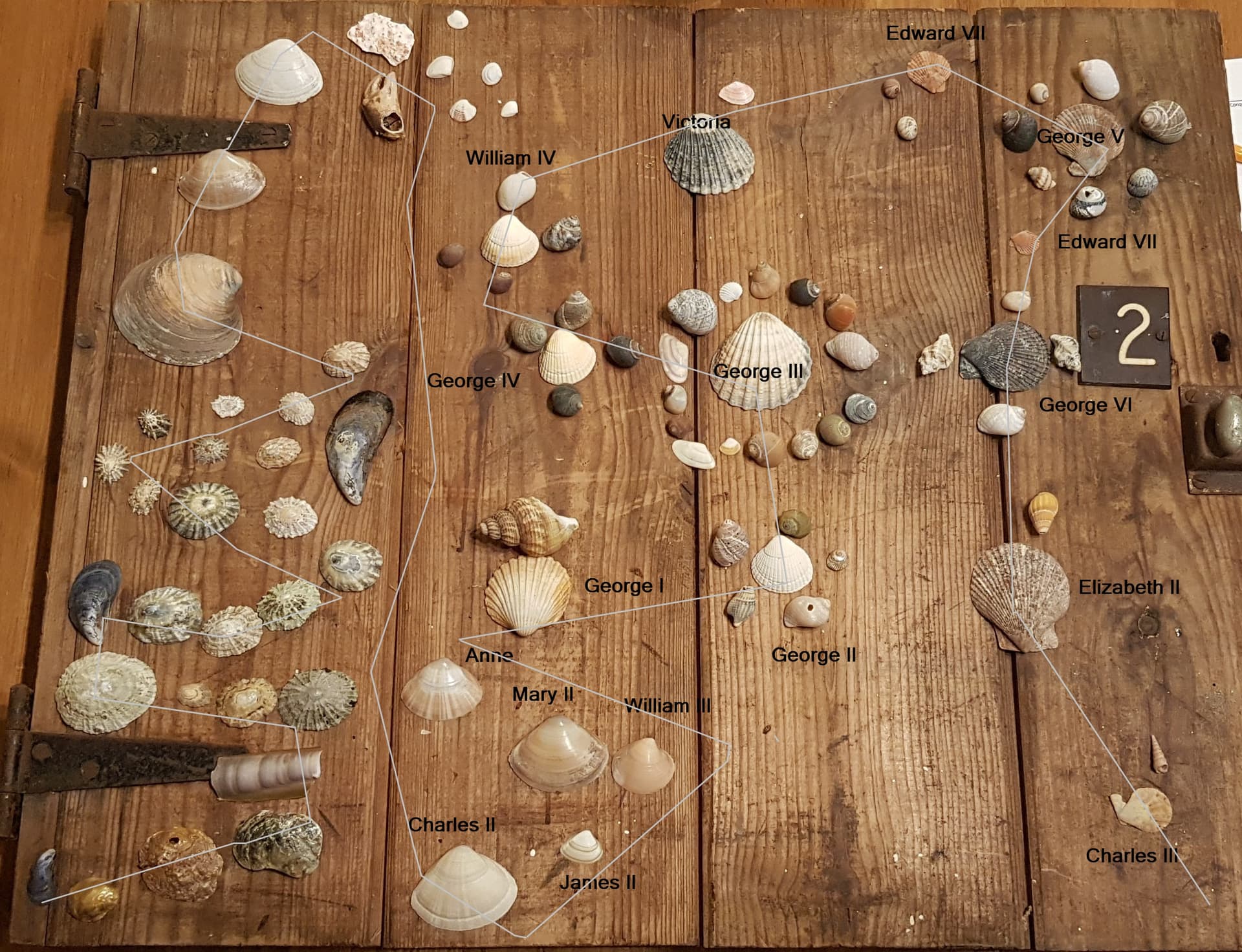
This is the first iteration. Obviously it isn’t anywhere near complete - Victoria only has one minister, and so does Elizabeth II - but it has been useful for getting a feel for practicalities. For example, after some experimentation I have decided that although I have enough gastropods to cover all the prime minsters, too many of them look quite similar. It would quickly become hard to distinguish them.

The other issue is the strengthening realisation that this will have to be a memory palace, or journey. The PAO system seems to be working well for encoding information about each person, such as the dates of reign or service, but these bubbles of data are floating above the board and I’m struggling to find some way of anchoring them to their monarch, predecessor, or successor.

As you can see, I intend to have monarchs surrounded by ministers, although in some cases they may only have been served by a few politicians. George I, for example, only ever knew Robert Walpole as prime minster.

Let’s take George III. All 16 of his ministers are in place on the board, slightly to right and above centre. So I am now wondering how I encode this. Perhaps create a story for each monarch, with links between the ministers? Or visualise each monarch located in a room with the ministers in various locations within the same room, memory palace style?

Incidentally, the first five prime ministers of George III were John Stuart, George Grenville, Charles Watson-Wentworth, William Pitt the Elder and Augustus Henry Fitzroy…

Finally there is the issue of making it clearer to the viewer of the lukasa how time flows, indicated here by a grey line. Maybe glue string to the board.

1 Like

How gorgeously you write.

We all think differently and I have aphantasia, so that may change it completely, so these are just suggestions. Your trial and error is so valuable for learning your data.

When my anchors don’t work, I engage more with the characters, talk to them, ask them about their lives, get a personality emerging, add to their story in a fantasy way. It is great fun. You will have no trouble distinguishing between fantasy and reality when you need the information.

The memory path doesn’t need to be indicated. My bird lukasa looks like a jumble to anyone else, but the path through it is really clear to me because I practice it. Key to using a lukasa, and the Australian similar format such as the Tjuringa, is using touch and movement as you tell the story. Some form of muscle memory seems to tell you which way to move yet. May I suggest you leave out any physical indication of the path at this stage and add it if you feel you need it?

I also wouldn’t worry too much about similar shells, although I think your logic is strong. The shells also have a position, and a relationship to everything around them. Plus a story links the elements and that will grow the more you play with it. I have very similar beads, but the sequence and position differentiates them when I am using it.

Love that the PAO is working!

I suspect that you might still be in academic, rational mode. The more you engage with each of your characters - royal and political - and chatter away to them as people, the more your lukasa will come to life.

Just ideas! I am loving your journey. I now want to head to the beach - a few hours drive - and gather shells and make myself a big lukasa. If it is like yours, I will be making a big lukasa and an art work at the same time!

Lynne

You may, and I’m happy to take that advice. I have a new glue gun that I’m itching to put to good use, but I’m also keenly aware of the importance of keeping my options open. And the lukasa is not for external consumption in any case, so as long as I can read it there shouldn’t be a problem.

I will start interrogating my characters and thinking about stories and links. It is a fact that even the act of physically arranging the shells has already created a clear overview in my mind of the period from 1066 to 2022. From this perspective it’s already a success.

I had about half a dozen hefty gastropod shells, which are so large that I think they would overpower their respective monarchs if I used them as prime ministers. I have taken these to see how they work for the house of Tudor, which has only five members. I’m quite pleased with the result (below).

There are other minor changes to the layout, such as a reworking of the limpets used to reflect the persistence of the Plantagenets, with darker shells representing the Lancaster side in the later era, and the shells with a yellow tinge and rays representing the faction of York (yellow = yolk → York). Mussels are placeholders for wars.

I have also repositioned Charles I and the iron claw of Oliver Cromwell for dramatic effect. The shells used for him and the other Stuarts are, I think, called trough shells (Mactridae). They are handsome, yes, but fragile and can be destroyed.

1 Like

Love it. More please!

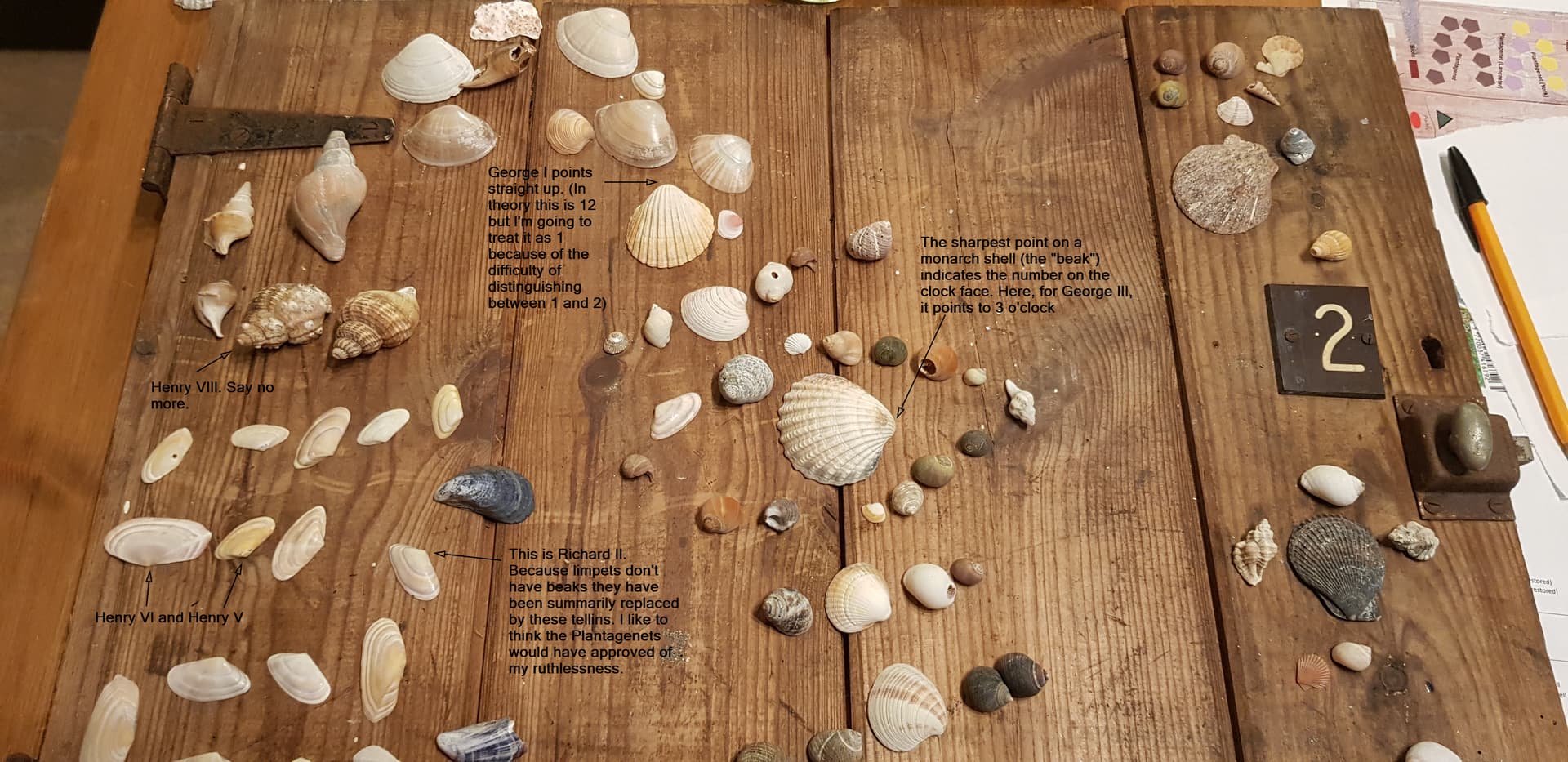
Today I made a few changes. I simplified the timeline so that it forms the shape of an “N”. I also decided to make the sharpest angle on the shell representing a monarch (usually the “beak”) point to the number on the clock face that corresponds to their own number. So, for Henry VI the beak of the shell points to 6 o’clock. In this way the orientation of the shell provides a clue to the identity of the person it represents.

I also made an executive decision to the effect that monarchs with only a few prime ministers can have those shells located to left and right, or anywhere that suits, rather than in a rough ring around them. In the case of George I (see photo) there is only one prime minister, Robert Walpole. He was nicknamed “Robin”, so if you look carefully you will see that his shell, located to the right of the king’s shell, has a pink chest.

1 Like