Two questions about using major system for cards.

Hi, I am going to start for the first time to memorize a deck if cards. My main purpose is to learn 1-2 stacks for magic tricks, so I don’t need a complex method. That said, I’d like to also be able to memorize one deck in a few minutes just for fun.

I already expanded my major system to include JQK. I plan to start with a simple 2 cards per locus method (26 total).

1- Is it better to read cards one by one (suit+number, suit+number), or read them two by two (suit+suit, number+number)?

2- In the case of reading them by pairs, is it better to memorize the left card before the right one?

Thank you!

Very cool!

Aronson/Tamariz?

The process for learning a memdeck stack and keeping it in longterm memory will be a bit different than the technique for speedcards. Quick notes about those, then I’ll address your two questions.

For a memdeck, you’ll want to be able to associate every card with its stack number and vice versa. A great way that I used to learn both of these stacks is using a peg system to make those associations. A memory palace can be used to set the scenes for these associations, but really isn’t necessary for learning a stack. Hopefully your Major system list includes PAO or PO elements. If it does, this will be a piece of cake.

If you visualize your cards as PEOPLE, have them interacting somehow with the OBJECT that indicates the stack number. For example, if the [9 :diamonds:] is hypothetically the 52nd card in the stack, then you’d have your person for [9 :diamonds:] (lets say thats Barry White) doing something with 52’s object (maybe a LioN.) Barry is being eaten by a lion, or he’s trying to tame a lion, something active and memorable. Now when you need to remember what position the 9 of Diamonds is in, you translate [9 :diamonds:] to “Barry” and then think of what object Barry was interacting with… oh yeah! the lion! Lion = 52, so the 9 of Diamonds is the 52nd card.

The great thing about associating card people with number objects (or vice versa) is that you can do the reverse which is very necessary for memdeck magic. If I need to know what the 52nd card is, I just recall the object for 52, the lion, and think about who was interacting with it. Barry was getting eaten by that lion! Barry is the 9 :diamonds:, so card 52 is the 9 of diamonds.

After just a few times practicing those type of associations, you should have the card/number links down pretty well. I wouldn’t really bother with using a memory palace for this since those loci are irrelevent to what you’re trying to accomplish. You could however, use a 52 loci memory palace and associate each loci with a number. Then you can place the card images at each loci. Say your bed is loci 52. If you have your 9 of diamonds image stationed at your bed, you can accomplish the same number/card and card/number link as using a person-object approach. In this case, the link is between a single loci representing the number and a single card. I think this is less efficient than the Person/Object approach because you need to learn loci to number, then card to loci, then try to get rid of the loci step to get to card to number directly. But if you don’t have a Person/Object list for Major, it could be an option to consider.

Ok, so now to speedcards and your questions!

A key for ease of memorizing quickly for cards is consistent natural “reading” of the cards. Doing this in the order they appear usually makes the most sense. For the strategy you’re employing, I’d definitely recommend reading them one at a time completely (card 1 value/suit + card 2 value/suit) so that you can form clear images for each card quickly without backtracking or using extra steps and have them doing their interactions in a logical way from first to second, this way you’ll minimize the chances of flipping card order at the loci.

Think about the process of reading suit+suit then number+number. For a one-card/one-image system, you’d have to hold all four pieces of information in your mind at the same time in the correct order. For a card pair like:


You’d be going “ok its spade diamond, and its queen jack, so that means its spade queen first, or rather the queen of spades… which is “X” image, then its diamond jack second, err, jack of diamonds, which is “Y” image… so my scene needs to be X interacting with Y…”

Now compare that to: “ok its the Queen of Spades which is “X.” X is interacting with the Jack of Diamonds which is “Y.” So my scene is X doing something with Y.” Way easier to process. And when you get fast with your card to image translation, you can basically just go “ok, card one’s image is X, card two’s is Y. Thats my scene.” It doesn’t make sense to read them broken up because you have to reconstruct them again anyway.

Left and Right depend on which way you spread or flip the deck. If your card pair looks like this


then the Queen would be read first, Jack second, which would be the order that you’d encounter them when dealing cards singly face up.

Hope this helps! Good luck and if you’ve got any other thoughts or questions don’t hesitate to toss them out here!

2 Likes

There is a whole section if you use the search engine pertaining to magic of which “Stacked Deck” tricks are a subset.

In performing any Memdeck tricks, I suggest you learn how to do at least one pass. A pass is cutting the deck without being noticed to move a keycard to a certain position within the stack for ACAAN (a card at any number) effect. Added to this, a couple of false shuffles and false cuts would greatly assist you in achieving a suitable level of competence in Memdeck routines.

I agree with what @TheHumanTim has told you as far as Memdeck routines are concerned. Your aim should be to be able to recall any card in its designated allocated position in the card stack or if given a particular card to be able to immediately know what position the card is in.

Perhaps the first few cards of the following familiar stack known as the Tamariz stack will illustrate this better:

Above is the exact order that you need to know for the ordering in the Tamariz Stack.

Before coding cards into images, you need to have a ready-made system of 52 pegs for positions 1 through to positions 52:

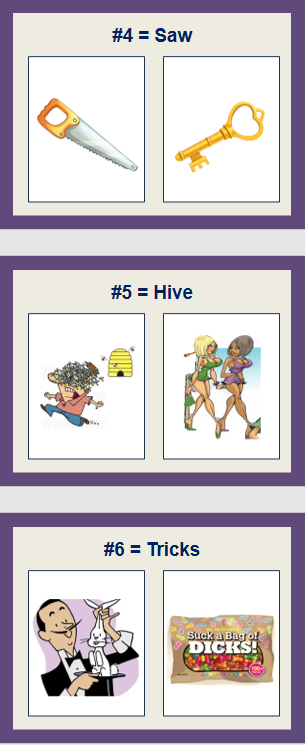
Above position #1 to position #9 (as shown on the LHS of the pictures are:

  1. Gun
  2. Shoe
  3. Tree
  4. Saw
  5. Hive (think of swarming bees)
  6. Tricks (think of something being pulled out of a hat)
  7. Heaven
  8. Gate
  9. Wine

The RHS of each of the pictures shown above are the actual card values found by Rhyming as follows:

First Letter denotes card suit where:

H = Hearts
C = Clubs
D = Diamonds
S = Spades

The value of the card is found by rhyming:

Position #1 = (C)ore = Clubs Four = 4C
Position #2 = (H)oo = Hearts Two = 2H
Position #3 = (D)evon = Diamonds Seven = 7D
Position #4 = (K)ey = Clubs Three = 3C etc.

You could have as easily used a Person/Object (PO) System in Traditional Major Phonetic System to have achieved the same feat where:

Position pegs (or # in stack) = Person
Card Value = Unique peg word using the Major System e.g.:

#01 = SiD (evil kid in Toy Story) linked to a CaR (4 of Clubs)
#02 = SoNNY (Heavyweight Boxer) linked to HoNey (2 of Hearts)
#03 = Sam (Uncle Sam) linked to DuCK (7 of Diamonds)
#04 = SaRah (Sarah Palin) linked to CoMb (3 of Clubs) keeping things clean!

1 Like

Thank you very much for the long detailed answers! They really help!

I will learn Tamariz Mnemónica for sure, if I don’t I fear I would get my Spanish nationality revoked XD
And after that I will see if I want another one. I also consider to make my own stack for fun. I do both magic and mnemonics mainly as sporadic hobbies.

It is very true that my approach for speedcards was not the best for a stack, that advice is really helpful. I got hooked into memdeck after seeing a DaOrtiz effect, which doesn’t need memorized positions, but for ACAAN potential it is true that it is very powerful to remember positions.

With major system having PAO/PO elements, do you mean something like Dominic system?
My system has mainly objects and a few animals or humanoids. For chaining I just do linking method (into loci if needed).
Every time I tried to fill a table with people for PAO, I failed miserably because I almost don’t consume Media, sports or movies. So far it only worked for me with single characters.

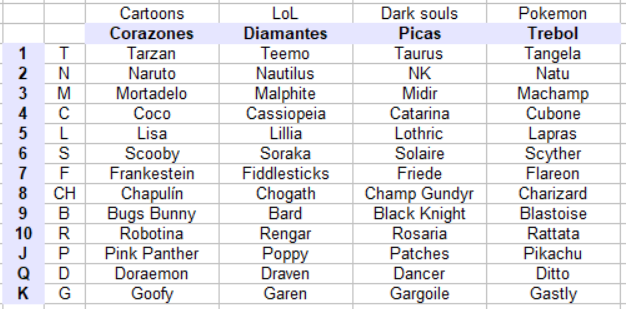
That said, yesterday I managed to fill a P system using videogame characters (four thematic suits, 13 values with Major system initial letters). Untested but should work.
So, I could probably use 1-52 positions with my standard Major system objects, and the P deck coding for the cards.

My worry with this approach is that it might clutter my Major system, and that if I have that LioN eating Barry, then when I will use the LioN in something like memorizing a bank account or phone, a phantom Barry would appear. I know the images inside of a loci won’t have this problem, but maybe the short memory linking method would?

Also, if I don’t use loci, I will not be able to memorize two stacks. If I have LioN with Barry and also with Gandhi, both stacks would get mixed (unless I am missing something).

I also thought about the “bed + lion + Barry” you said, and seems a lot safer. Yes, it has slower building, but I feel all the cross contamination would be solved. It is slower to recall, true. But I feel the extra 2 seconds are ok for the pace of events in magic. Also, with enough practice would be automatic, like all languages.

Another option I thought is to make a very structured loci, where positions would get visually understood. Let’s say five images of 10 loci, with objects following an approximate 5x2 grid. At least for my brain, it would be very fast to find the relative order number for a locus.
Do you know if something like this has been tried?


So, back to my questions (now related mostly about Major system for speedcards). I agree that 1 by 1 is simpler and maybe safer.
I don’t think there would be risk of flipping card order, maybe I didn’t explain properly my idea. I would read horizontally by pairs.
At your Q :spades: + J :diamonds: example, I would visually have QJ = Depp, and suits :spades: :diamonds: SD = SoDa. So I would just link Depp drinking Soda at the locus. As long as the cards are always read in the same order, shouln’t be a problem.
It would be a lot slower to recall the cards, that is true. There would come the mental juggling you mentioned. It would be: "ok I have Depp, which is QJ. What suits? Soda is SD, so it is Q :spades: and J :diamonds: ". The first card would be recalled slower, but at least the pair is revealed almost at the same time.
Terrible for magic stack, good enough for speedcards, imo.
I mean, is similar to what e.g. Mullen does, right? Read suits then values and put all of it in one chunk of information very fast, and then need extra time to decode and recall.


About left-right for two card systems. I like reading like Mullen or Bat-Enkh, so starting from 52 going towards 1.
This means that memorization order would be 53-54, 51-52, 49-50, etc?


Yesterday I spent all the evening and I believe I already read every topic about stacked decks. There I found you shared a thematic PAO with LotR and other stuff which made me try my own. Way better than famous people for me. Anyway I don’t think I would use PAO, just P. Maaaybe I try something like a PA vs PA approach, but for fun.

Yes I am starting to learn passes now :slight_smile: They seem great for anything requiring a controlled card, but suitable for memdecks, because controls I know are done through shuffles.

I tried your approach of rhyming, but from scratch because I have to make it for Spanish. Because of the number names and how rhyming works, it became difficult to find good words. I tried different approaches and filled half the cards, but the result isn’t convincing enough yet. I can see it working, but so far I feel more comfortable with other approachs based on Major system.
The same for normal numbers, I never felt comfortable with Shaper system or (rhyming) Pegs.
But anyway is a fun exercise and I am sure the rhyming system is better for people that don’t like math or hardcore stuff, or also for children.

So, right now I am convinced I should try the thematic P system for cards linked to Major objects, and possibly inside a loci to avoid phantoms.

Again, thank you very much to both!

PS: In case you are curious or want to spot weak points, I share my current approaches to (Spanish) Major for 14 digits and thematic cards to videogame characters one (P expandable to PAO).

1 Like

This is definitely a great way to start. I began with a category system of only people and combined with a simple mem palace its how I learned my first stack! It was learning about that and succeeding in remembering the stack that got me interested in other things related to memory techniques!

Even of you dont use “loci” in the classic sense, you kind of provide a context with the purpose of the memorization. What does the lion do when relating to your bank? Eats something else. I suppose this is sort of like creating a pseudo-loci. I think you’ll find when you put this all into practice that the scenes won’t really just be floating in the void. You’ll naturally provide some kind of setting or context to them and that will be enough to keep them straight in most cases.

It will be tougher for sure. It can still be tough even with different palaces for each stack, but its much easier to think of what the lion does at your house for one stack and what the lion does at your workplace for the other or wherever your palaces are.

I’d probably go with this approach as you begin the process. It definitely will become automatic with practice. At some point for me the characters representing the cards kind of faded away and the cards themselves were being recalled directly at the loci, and then the loci just “became” the number.

Often people will use some kind defined loci structure combined with some kind of visual marker to designate every 5th one. So 5 rooms with 10 loci each, maybe the 5th, 15th, 25th, etc are all engulfed in flames or its snowing on the loci or whatever works for you, then you can easily jump to the nearest 5 and count up or down to the target. This is a great idea when first learning to associate loci to numbers. After a while, the need for it will fall away, but it helps a ton when learning.

(Note: All of this advice is for memorizing a stack for long term use. As I said earlier, I would recommend a different approach with fewer “extras” when going for speed and short term retention.)

You’d have to try and see how you like it. It would drive me crazy to do that split read then recombine approach haha but different things click differently for different people.

Many elite speed card folks use a 2-card system which combines a pair of cards into a single visual element. So in one system something like [Ace :spades: 2 :spades:] could be immediately recognized and visualized as SaTaN. The translation structure is based on reading the four pieces of information in certain combinations… the suit combination provides the first sound, the 1st value provides the second, the 2nd value provides the 3rd. The advantage is that you cut the elements needed to memorize a full deck in half. Only 26 things to recall and you can decode them into all 52 cards. The disadvantage is that you have to learn over a thousand associations because of the number of possible pairs.

By looking at the two cards in the way you’re suggesting, you’ll need to come up with many more words/images I think… There are 13 values, so 13x13 combinations of values, 169 value combinations total. 4 suits, so 4x4 suit combinations, 16 suit combinations. This is 185 images to figure out and learn.

If you just make an image for each single card… Its just 52 images. Even making a person and object for each is 104. Way less than trying to learn the combinations and more natural way of reading in sequence.

(Unless I’m misunderstanding how you’re planning on constructing your images if you read two at a time?)

Agreed! Get started! :wink:

1 Like

Your post spurred me onto revisiting my own PO System for the Major System. I have used First Names and Surnames of People I am familiar with. I believe the biggest advantage of using initials of people is that they are transferable across many languages, so Sashin Tendulkar whom I have as number #01 in my English Major People would work equally well as a Person in a Spanish list too, assuming you are not changing the traditionally assigned values of the Traditional Major System where:

This is what I came up with for my first 15 People:

The corresponding OBJECTS for each card are all coded again using the method I first discovered through the readings of Harry Lorayne’s books i.e. “How to Develop a Super Powerful Memory”.

The exceptions being: Jacks (which each take the object of the Suit themselves:

Jack of Hearts = Heart
Jack of Clubs = Club
Jack of Diamonds = Diamond
Jack of Spades = Spade

Queen of Hearts = Queen, all other Queens use rhyming words:
Queen of Hearts = Queen
Queen of Clubs = Cream
Queen of Diamonds = Dream
Queen of Spades = Steam

King of Clubs = King (or King Kong), all other Kings use rhyming words:

King of Hearts = Hinge
King of Clubs = King
King of Diamonds = Drink
King of Spades = Sing

An example to illustrate using a mini-video in my minds eye for position #48 which translates into the person’s initials RF, yes Roger Federer does nicely! As the Queen of Spades is in the 48th position and the Card Peg for QS = Steam, we need only link (by a paired association Roger Federer to the Steam (train). Perhaps Roger Federer is serving a tennis ball to a runaway Steam Train. Whatever the image (picture) it needs to be able to be recalled from the prompt of Queen of Spades or from what card is position 48 (Roger Federer) linked to? A bit of a lengthily explanation I know, but I’m sure you fully catch the gist of it?!

Hope that helps further?

That’s great!
My case is the opposite: I first discovered mnemonics and speedreading, but I usually lack places to make use of them, so when I realised I could have fun memorizing with magic application I was like “let’s goooo!”

Yesterday night I memorized half the stack, this morning the other half. Quite basic interactions, but I tried the visualization in 3D method (which works very very well, I will use this for long term stuff).
It was a test so I used the 26loci I had prepared, divided in two parts left-right. Not the best, I know, but I wanted to test the system.

I tried ordered a shuffled deck. First time I forgot 3 (weak associations). Second time I did in exactly 15 minutes, no failures. So, it works. Recalling random numbers works very well.
I put the emphasis on the card-position linking, and used loci only as a background for context.

I tried ‘mind reading’ by cutting deck at random card and peeking (like classic key card). Did the card–> get position, add +1 to position → get next card. Even with a bit slow recalling, it works great.

If/when I will memorize a new stack, I will try to get a carefully chosen loci and use a similar method, instead of focusing on the Major linking.

Do you know other possible uses for numbered loci?

Yes, I read a lot of bibles in this forum before I made my mind about what I more or less wanted to use. The pair reading seemed very fast to do. I understand the main powerful part is the 50% reduction of the image generation, but I thought maybe the pair reading was actually giving extra speed even for 52 images systems.

That 169+16 was my idea, yes.
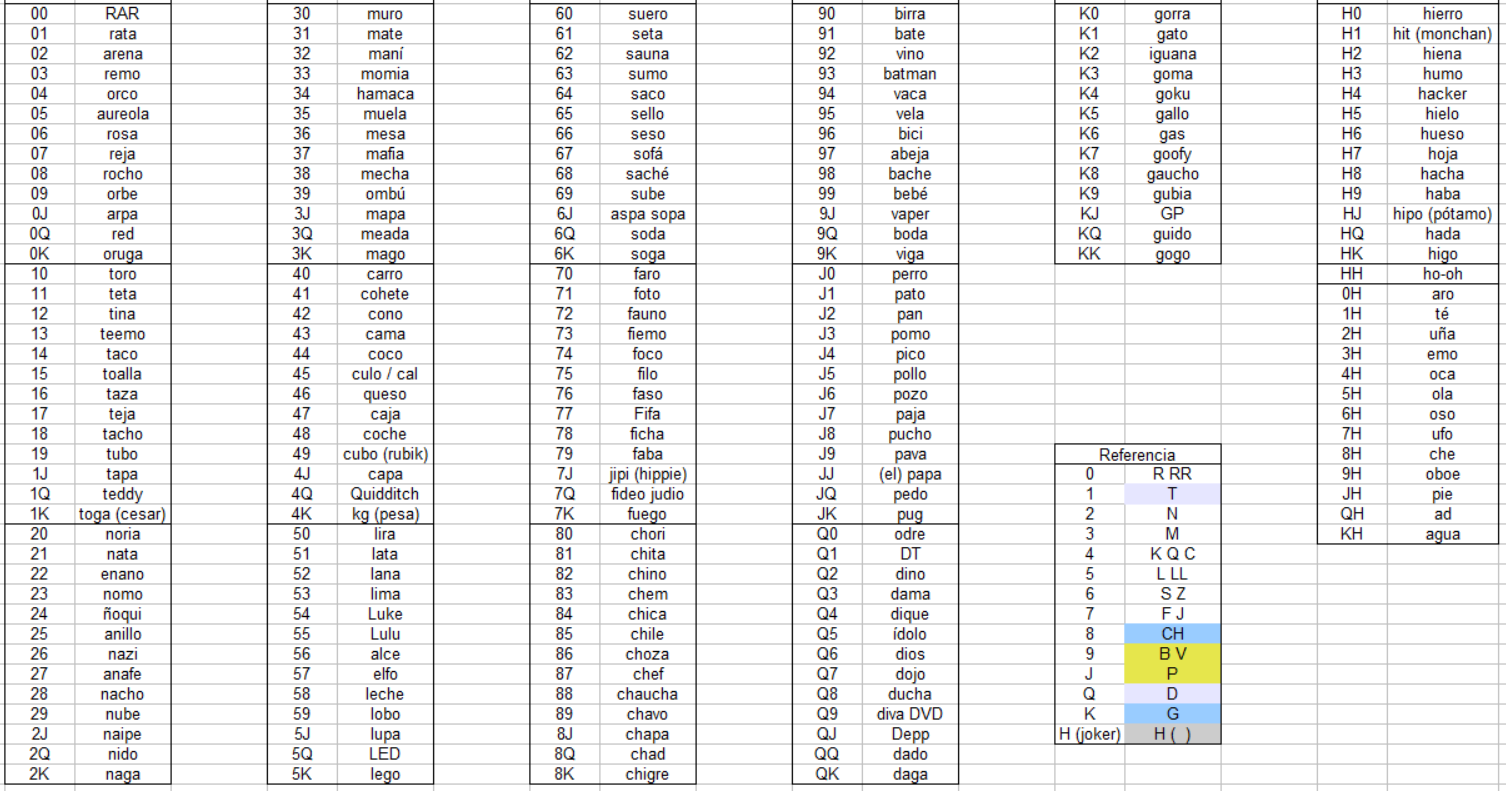
I already had 100 from Major system I used for years. I expanded it to 169 easily while bored at New Year family conversations. The 16 suits could be taken from Major system too (HDSC=4QJ1 for me), but I would make something different to reduce repetitions. So, from the point I am now, it would be only 16, and I have the freedom to make anything, because only 16 can even be brute forced.
But that said, I agree that 52 is usually a smaller number, with the bonus that a P system made specifically for cards is very clean.

Another question. If I would want to expand my poker deck P to PAO (for speedcards), would it be better to:

  • Use initials for AO too. E.g: Homer Hunts Hat
  • Use what the character would do. E.g: Homer drinks beer.

Thanks!


In theory, yes. But the problem are that social and culture circles can be very different (even for people with the same nationality). In the cases you shared, I only know who Jobs and Freud are, the others are complete unknown to me :confused:

The objects for cards system merging initials for suits with major followings, is very good! Removes the thematic need and thus makes it possible for objects. I like that it shows that it is possible to make the PO associations in both ways.

I personally don’t have a Major with People so wouldn’t work.
My Major letter-number is a bit different, yes. The most common Spanish one is already different, and I made some changes.

1- T
2- N
3- M
4- K Q C
5- L
6- S Z
7- F J
8- CH
9- B V
0- R
J- P (originally was in 9)
Q- D (originally was in 1)
K- G (originally was in 8)
Joker- H + voids

But anyway, I already got the Tamariz moving, so thank you very much for the help again!

1 Like

Any ordered list… Presidents of a country in order. Sports stats. Periodic Table Of Elements. It can be very useful for studying and schoolwork.

This is the subject of many debates!

There is no generically applicable “best” system or “better” technique. The results using various systems can be as variable as the people who are using them.

I usually suggest using matching major phonetics to generate the other elements. This way each element can be read directly by looking at the card without having to first think of the person.

If you’d like an example of how that can work, here’s my 2-digit + cards list (based on “standard” major sounds.)

Lots of people have success going the traditional route like you described with “Homer Drinking Beer” after some practice the step of linking back to the person fades and you cam get to that direct connection which is key for speed.

Ultimately the specific system is less important than the effort you dedicate to making it fluent. You should try messing a bit with both approaches and see what you like better.

I have a few more related thoughts on the process of practicing and learning a PAO here:

1 Like

Some could be good, true. The thing is, most of the times I found (numbered) “ordered lists”, the real substance that needs to be remembered isn’t the sequential part, but the number to matter stuff.

For the Periodic Table is a similar case to the deck stack, because the important part is the number-name relationship. 9-F is important, but knowing that comes before 10-Ne is kinda useless. I’d rather memorize it before to 17-Cl, right? But anyway this is difficult to discuss without proper usage context, so…

In a similar way, I wanted to memorize a set of poems from a specific author, and those poems have a number as a title. I could use a loci as starting point, but then I realised that just using the mnemonic image of the author + link to the different numbers was enough to get into the poem loci. Again, poem 3 and 4 had no relationships, and if for some reason I would want to recite them all in order, I could just recall Major order.

I am curious about presidents (we never study that here), is it needed to know the number, or only the order? If both, that would be the best case of ordered list!

This was my guess, but I asked because I saw examples of both, thanks!

Your table is very interesting, may I ask how do you use the Location and Adjective columns?

Exactly this is why I try to use the simplest possible methods :slight_smile: I know myself and my tendency to change activities all the time :laughing:

This is a really good point. As I think about it more, I think I agree that this is more important much more often.

President numbers and order are a unique case where both can matter. We’ll often reference “Abraham Lincoln, the 16th president” or whoever in American History courses, civics, etc.

1 Like

The “location” element was an experiment to see if I could self-generate a starting loci for a single series of numbers.

“Adjective” was a natural additional element that provided a way to add two more digits into a scene using something that we tend to do anyway which is add a memorable or surprising aspect to a person or object.

Having 5 elements, you could encode 10 digits in one self contained scene. Perfect for US phone numbers.

An example:
My hypothetical friend’s phone number is 8371098470

I’d picture them at a FoaM party (83) where KaTe (71) is SiPPing (09) some kind of drink from out of a FieRy (84) GooSe (70).

The location element isn’t very useful beyond these kind of tasks, but the adjectives were key in my Pi memorizing project where I encoded 8 digits per scene using a long series of memory palace loci.

Besides those uses, both were kind of exercises in seeing if I could fill new categories of mnemonic elements completely via the Major System phonetics.

That 5 element encoding seems fun to do! Maybe the problem is to remember Locations without checking the table. I mean, due to low usage, unless is put into Anki.
I may open a big excel table and try to slowly fill it :slight_smile:

Did you find problems when memorizing adjectives as keywords? I guess for example ReD would be more difficult to memorize than RuDe, because it is a passive adjective vs an active one, right?

How do you memorize weird ones like MeaN, RaRe? MeaN GooSe hiding coins with greed? Right now I can only imagine RaRe through the addition of objects to the GooSe, but that’s not the main idea.

Yeah, I didn’t really ever use it when doing anything for speed, but it works pretty well when you have time to think about the material and the scene itself.

You’re right, Red is tougher for me to visualize and recall than Rude. I tried to pick adjectives that could be visualized a bit more actively like you suggested.

Mean was pretty easy. With “emotional” adjectives like that I found that the subject almost gave off an aura of emotion. Maybe I’d picture the “mean” thing scowling and cursing, but most often there was just a sense of “meanness” to it. Kinda weird and tough to describe but maybe you can relate?

Rare is an interesting one. I looked at it almost like a revered treasure. It gave off a feeling of respect and awe like it was a unique work of art. Pictured it almost like a statue or a valuable painting. So a “rare goose” would be like a goose statue that was sculpted by michaelangelo or something like that.

Again, didn’t use these categories for speed, so I was able to plan how I could imagine those adjectives a bit more within each scene.

This is exactly what I do with new systems or projects. Some people do crossword puzzles or soduku, I like filling in system grids haha

2 Likes