Tom's endless adventures in card- and number-land

Hi all

My previous ‘training journal’ is a bit tired and out of date and I’d like to start again with a better explanation of the system I’ve settled on, and the attitude I take into it. I really don’t know how often I’ll update this, but I wanted to explain where I’m at with it to myself (mostly) and to anyone else who might be interested (possibly), as well as creating a space where I can post progress notes as and when I feel like it.

My systems
For memorising card decks, I use a two-block system that’s identical to @katiek’s, except that I’ve played around with the suit combo > vowel associations so that they are more intuitive to me. An explanation of her system is available here: https://katiekermode.com/card-system.html
I’m also using some tips from Katie that she’s offered elsewhere, including:

  • a consistent person at every locus point in a memory palace, normally someone I know personally, who is effectively ready and waiting to interact with any syllable/image I throw at them;
  • never more than 3 syllable/images per locus. In my system, I keep ‘stacking’ images into each locus point until I reach a black-first pair of cards, which could go on indefinitely; but I stop at 3 and just add a “weird” visual/emotional overlay to that locus if I’ve had to stop at a red-first card pair (which is fairly unusual, hence “weird”).

For memorising long numbers, I use a 3-digit system that’s identical to @Zoomy’s, except that, again, I’ve changed the way digits translate to vowels in a way that makes more sense to me. An explanation of Ben’s system is available here: https://artofmemory.com/wiki/Ben_System/

My adaptations
Here’s how I translate digits to vowel sounds:
0 = oh; 1 = i; 2 = a; 3 = e; 4 = o; 5 = u; 6 = ay; 7 = ee; 8 = oo; 9 = igh

And here’s how I generate vowel sounds from suit combos:
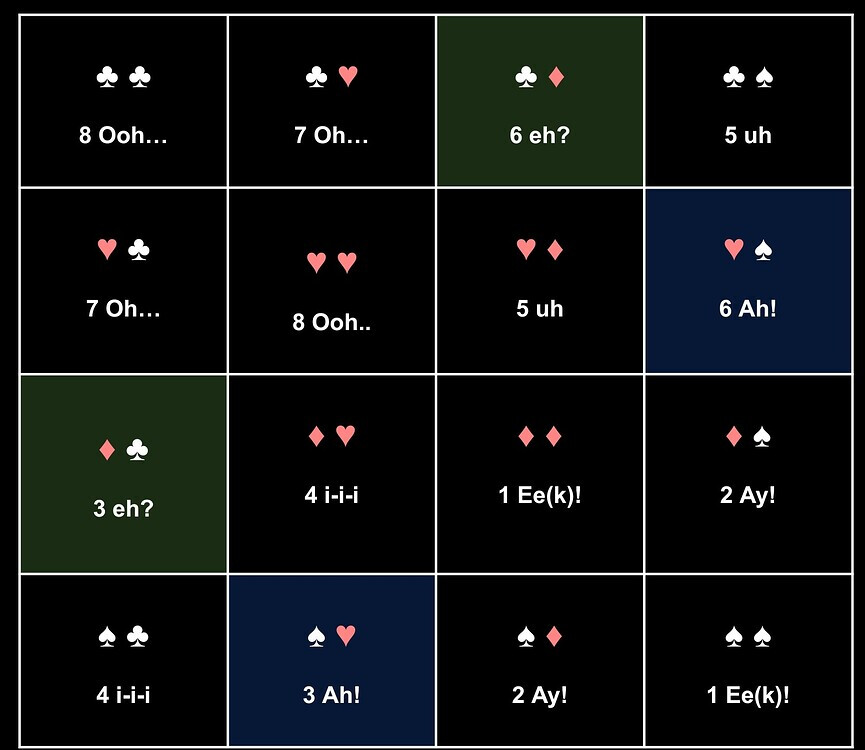

(I’m pleased with these - I’ve used an emotional ‘tone’ for each sound to reinforce the association with the suit pair. For instance, “Ee(k)!” is fear of the sharp points of double diamonds/spades; “i-i-i” suggests discomfort of a sharp diamond/spade poking into a softer, rounder club/heart.)

Finished but not
At the time of writing, this system isn’t “finished” in the sense that I haven’t come up with discrete images for every syllable generated by each 3-digit number and pair of cards. However, I consider the system “ready to go” as it’s possible to come up with associations for each syllable “on the fly,” with some obviously coming easier than others.

E.g., “t-i-n” is easy (Tin Man, or a tin can), “j-oo-f” is harder, but a “jelly hoof” will do in a pinch (picture a hoof made of jelly, as clearly as you can and hope that you can work out what you meant when you come to the recall).

Perfectly imperfect
I maybe ought to add that I’m naturally pretty bad at this pastime and my speed and accuracy is still very low. I consider this to be an aspect of dyspraxia, which is at root an issue with short term verbal/visual memory, and I think that the reason I keep getting drawn back into memory sports is in part because I want a fun way to practise this (my brain knows what’s good for it, generally speaking!).

So, I’m not currently chasing a specific time limit or accuracy level. I’m just having fun with the images and mini-stories that this process generates. It’s like a game I can play on my own, anytime, with nothing but a physical or virtual pack of cards. I love it. :slight_smile:

4 Likes
What is your mnemonic image for number 997?
What is your mnemonic image for the number 400 and why?
What is your mnemonic image for number 101?
What is your mnemonic image for the number 945, and why?
What is your mnemonic image for number 999?
What is your mnemonic image for number 201?
What is your mnemonic image for the number 702?
What is your mnemonic image for the number 501?
What is your mnemonic image for 329?
What is your mnemonic image for the number 897, and why?
What is your mnemonic image for the number 705, and why?
What is your mnemonic image for number 00 and/or 000?
What is your mnemonic image for the number 229, and why?
What is your mnemonic image for the number 939, and why?
What is your mnemonic image for the number 303, and why?
What is your mnemonic image for the number 967, and why?
What is your mnemonic image for the number 986, and why?
What is your mnemonic image for the number 184, and why?
What is your mnemonic image for the number 177, and why?
What is your mnemonic image for the number 284, and why?
What is your mnemonic image for the number 577, and why?
What is your mnemonic image for the numbers 18 and/or 018, and why?
What is your mnemonic image for the number 254, and why?
What is your mnemonic image for the number 976, and why?
What is your mnemonic image for the number 220, and why?
What is your mnemonic image for the number 413, and why?
What is your mnemonic image for the number 809, and why?
What is your mnemonic image for the number 221, and why?
What is your mnemonic image for the number 537, and why?
What is your mnemonic image for the number 634, and why?
What is your mnemonic image for the number 269, and why?
What is your mnemonic image for the number 197, and why?
What is your mnemonic image for the number 709, and why?
What is your mnemonic image for the number 276, and why?

Looking forward to following your progress!

One important note on terminology…

You refer to your system as a “Shadow” system, but this isn’t really correct.

What you’ve created is a “2-Block” system. This is a generic term for a card technique where two “blocks” of card pairs are designated, with each pair in one block linked in some logical way to a pair in the other block. You choose a block to designate as the “primary” one and create images for the cards in that block, then use some kind of secondary indicator when memorizing to differentiate between the two linked card pair options (basically letting you know which “block” the pair comes from.) 2-block systems don’t HAVE to use variable image stacking, but it is a common way to determine which “block” of pairs your image belongs to.

This should really be “some 2-block card systems use a variable number of images per locus.”

“Shadow,” especially here on the forum, typically refers to the very specific structural method and phonetic mapping created by Lance Tschirhart. Lance’s Shadow System makes use of the two-block approach by incorporating variable image stacking, but Shadow is a specific subset in the “2-block systems” category.

Hope you don’t take offense to this, just want to make you aware so there is less confusion when communicating about your approach!

1 Like

Thanks Tim. Happily corrected and zero offence taken! :blush:

1 Like

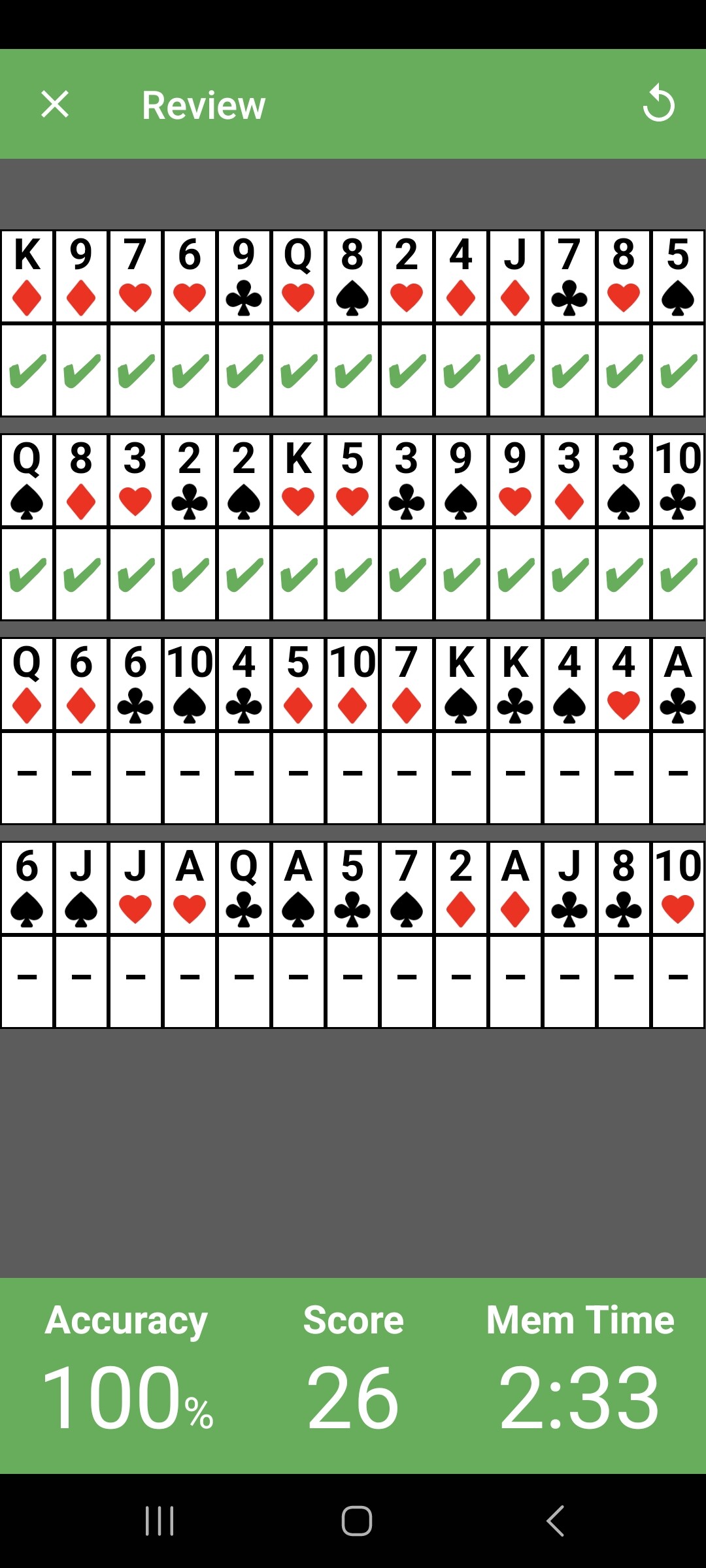
Attempted to go through the whole deck this morning. Took a bit over 6 minutes (I didn’t time to the second) and I only made one mix-up in the recall, which was based on not having ‘noted’ the fact that one group of 3 ended on a red-first pair.

Some interesting spontaneous images from the syllables: “t-u-j” was an ET finger touching the next object; “p-oo-k” was a cat made of poo; “m-e-p” was a map of Australia (because of its Aussie pronunciation, to my English ear!). :world_map: :kangaroo:

1 Like

I’m gonna make a change I think.

‘R’ in last position just keeps causing me problems.

E.g. mer … is that mer as in mermaid or merr as in merry?

E.g. mor (344)… vs moor (384)… - which, if either, should make the sound “more”? What do you do with the other one?

This has been a consistent thorn in my side when assigning words to syllables, both spontaneously and systematically.

@Zoomy himself has said that he’d replace the R if he were starting again, which got me thinking… So from now on, 4s in last position mean B.

4s in first position still mean R, and 9s in first position are still flexible between P and B.

I’ve tried it out a bit and I think it works well enough. Obviously it’s more restrictive in some instances but it offers a LOT more clarity and flexibility in others, especially because it opens up the possibility of using more alternative vowel sounds when I get stuck…

E.g. a can become ar, in any word.
o can become or
Etc.

Excited by the possibilities opened by this one. In general I’d say I’m moving towards a more flexible/spontaneous system, rather than one with a specific image necessarily assigned to each word. So clarity of phonemes is pretty essential, and that’s better achieved with this change.

3 Likes

You have worked with these R sounds to be fluent with them?

Not yet, but it feels pretty natural to me to make vowel sounds flexible like this by adding an R when needed. o isn’t very far from or in my mind, ditto a to ar, ay to air, etc.

2 Likes

Just did a run of 40 cards digitally, not sure how long it took me but it felt smooth and enjoyable with a new memory palace I started creating yesterday based on my local library (populated with story book characters).

Fully accurate recall, which I’m very happy with. Got a bit confused with a spontaneous image “Jesus dog” for the syllable “jeed” - I wanted to read it as “deeg” for some reason.

I wonder what a better image for “jeed” could be? :thinking:

Got it! Don Cheadle.

/dʒiːd/ Geed, past tense of gee
Command a horse to go faster.
Encourage a person to work faster.
Stage driver jumping yelling for horse team to show more enthusiasm.

1 Like

Thanks, that’s another option.

I tend not to use past tense or plurals if I can avoid it, as there’s the danger of confusion with other forms of the word that I might be using elsewhere.

Just memorised a whole deck with no mistakes, using the above system, a virtual deck pulled from Random.Org for memorisation and a real deck for recall.

I made two mistakes in encoding (read 6 as a hard g at the end of a word, and somehow read 6 as L at the start of a word elsewhere), and had two blanks on recall with the word/images ‘kid’ and ‘soda bread’. But was able to go back and sort out these mistakes with the info I had from the rest of the memorisation.

It took a while - I didn’t time it. But I enjoyed using the system and the feeling of getting them all right was really good.

2 Likes

Getting back into this, with the help of an amazing app built by Robert Sessions. I’m just doing half a deck at a time at the minute.

1 Like