I remember a blues piano player saying that “…all the best notes were to be found between the cracks!”
meaning the cracks between the piano keys, I guess.
Now that kinda stuck in my mind & made me think of the acronym ‘Everything Falls/Between the Cracks’
How does this help?
Well, ‘Everything Falls’ reminds you that you can see there is nothing between Notes E & F (they’ve disappeared down the cracks!)
Also ‘Between the Cracks’ reminds us that there is nothing between Notes B & C.
Still with me…?
So as long as you know your Alaphabet ( God bless Sesame St!) at least up to the G AND that you know to what notes you tune the strings of whatever instrument you are playing -in the case of the bass this will be either EADG or BEADG or BEAD or EADGF or EADGC but 80% of the time EADG- you are all set!
Let’s pick the E string frinstance:
Well, our first note is E, obviously, then we remind ourselves
“Everything Falls Between the Cracks” which means… what comes after E?
That’s right: F!
…so the next note after the open Estring, when you put your finger down between the nut & the first fret, you will be playing an F.
So what’s next?
Well, if you know your alphabet and you know that after E comes F then you’ll work out what comes after F and all the rest too!
IF there is nothing between E&F (Everything Falls…)
Then it must time for a note that is Sharp of Flat -an inbetween note, in other words.
It may be easier to think of the alphabet between A and G having an ‘inbetween note’ bridging each of the other ‘alphabetical notes’ ALL EXCEPT E&F and B&C, okay?
For our application let’s call these notes Sharps & name them as the ‘sharp half’, as it were, of the previous note. In our current example F#
Sharp is written ‘#’
Flat is written ‘b’ but more on this later…
In summary, then, the thickest open string on your Bass is an E then comes F then comes -ya guessed it- F# then, well what comes after an F in the alphabet? G of course, so we have E then F then F# then G then G# (now you’ve come to the end of your notes, so circle back) then A Then of course A# then B but here, now, we have our “…Between the Cracks” phrase so no # no flat or anything after the B & we go straight on over to the next alphabet letter which is C (as in “…Between the Cracks”)
Then we have C# then after a C type note we alphabetically have D then D# then E
Yep, now we’re back to an E again, where we started. Most instruments have two dots here at this 12th position or fret. You can consider this another Top Nut, as it were, & the cycle starts over again
Traditionally as we go up the neck we call our ‘enharmonic notes’, that is to say, our inbetween/non-alphabetic Notes: Sharps/#
As we go down the neck we (traditionally) call our ‘enharmonic notes’: Flats/b
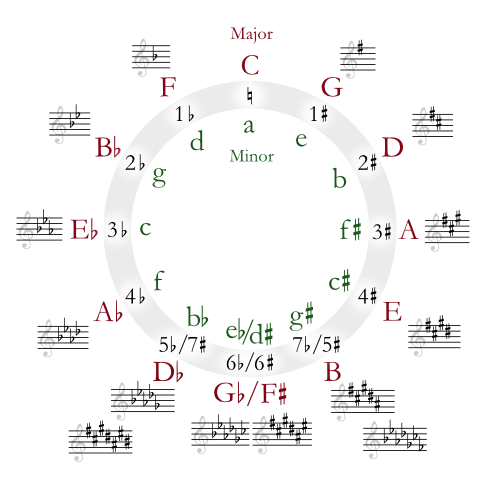
So going up the neck, for instance on the Open A String, we have A, A#, B, C, C#, D, D#, E, F, F#, G, G# & then back to our ‘virtual’ double-dot 12th fret & it carries on as before until ya run outta neck!
Reversing from that 12th fret we traditionally call our ‘enharmonic notes’: Flats/b
So going down the neck on, say, that A String, where we are at the 12th fret, we go backwards from A, Ab, G, Gb, F, E, Eb, D, Db, C, B, Bb, then back to our actual Top Nut & we’ve run outta neck again!
REMEMBER:
1)Alphabet 7steps from A to G
2)Every note has its ‘middle’ note between it & its Alphabetical neighbour EXCEPT E&F and B&C
3)E&F and B&C can be remembered by reciting “Everything Falls Between the Cracks”
Hope this helps someone as much as it helps me