[To keep the page readable for the English-speaking readers, I’ve collapsed the translations. Click those links to expand the text. You may want to try pasting the URL of this page into Google Translate.]
I think that this technique probably requires some practice with these other techniques first:
If you haven’t used all of those techniques already, I recommend learning and practicing them individually first.
If you’re already experienced with those three techniques, then maybe try a smaller version of the system first that only uses the title and alpha characters (ignore the S-S-S and F-A-C-E parts for now).
Daily-life Example
Here’s another example that only uses the title and alpha characters (at least to the extent that I understand the system).
This example uses a shopping list, because it’s a quick, regular task.
The shopping list is:
- watermelon
- beans
- broccoli
- rice
- carrots
- celery
The name of the supermarket is Berkeley Bowl – that name becomes the title.
Divide the number of items to be memorized by 4 and round up. 6 divided by 4 is 1.5, so round up to 2. For the most basic version, you need a title that is at least two letters long. Our title (Berkeley Bowl) is 12 letters, so it will work.
Imagine that this is the front of the supermarket:

To memorize six items, we need two letters from the title (“Berkeley Bowl”):
- B
- E
Those letters get turned into alpha characters (people, characters, or things that you’re familiar with). You can create several alpha characters for each letter of the alphabet. Here’s an example:
| Letter | Male | Female | Object |
|---|---|---|---|
| A | Abe | Amy | Apple |
| B | Bob | Beth | Box |
| C | Charles | Cindy | Cantaloupe |
| D | Dave | Debbie | Door |
| E | Edward | Elaine | Egg |
| etc. |
Based on the sample table above, “B” and “E” will get converted into “Bob” and “Edward” in this example. They get placed in a clockwise arrangement around your memory environment. (The front of the supermarket itself is the memory environment in this case.)
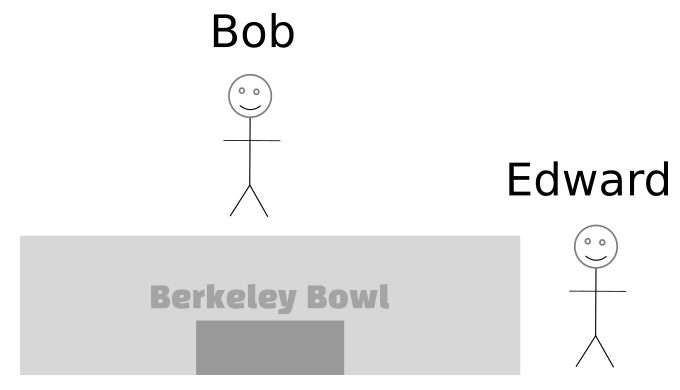
Bob and Edward each have four locations on them: top, right, bottom, and left (clockwise).
Here is the shopping list again:
- watermelon
- beans
- broccoli
- rice
- carrots
- celery
The first four items go on Bob and the last two on Edward:
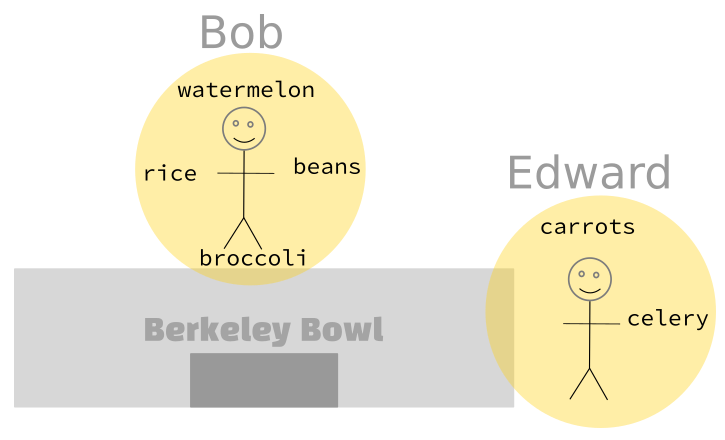
Once you have that memorized, you can think of where you’re going (“Berkeley Bowl”), extract the alpha characters (“B” and “E” → Bob and Edward), and then visit the locations to recall the list.
I created my own alpha characters table that isn’t based on people I know. I think it would work just as well with fictional characters, cartoon characters, objects, or anything else that normally works in a memory system.