Picture Notation: A Mnemonic System for Chess

Lots of people on this forum are far better at chess than me, but there is a key thing to consider here.

PAO works at its best when the information to memorise is uniformly distributed. i.e. 100 rolls of a single dice.¹ When the same Ps,As, or Os turn up a lot, you get very likely to make mistakes (‘Einstein is moonwalking with a banana, now Einstein is moonwalking with a Lego, now Trump is moonwalking with a banana’)

Chess move destinations are anything but randomly distributed:
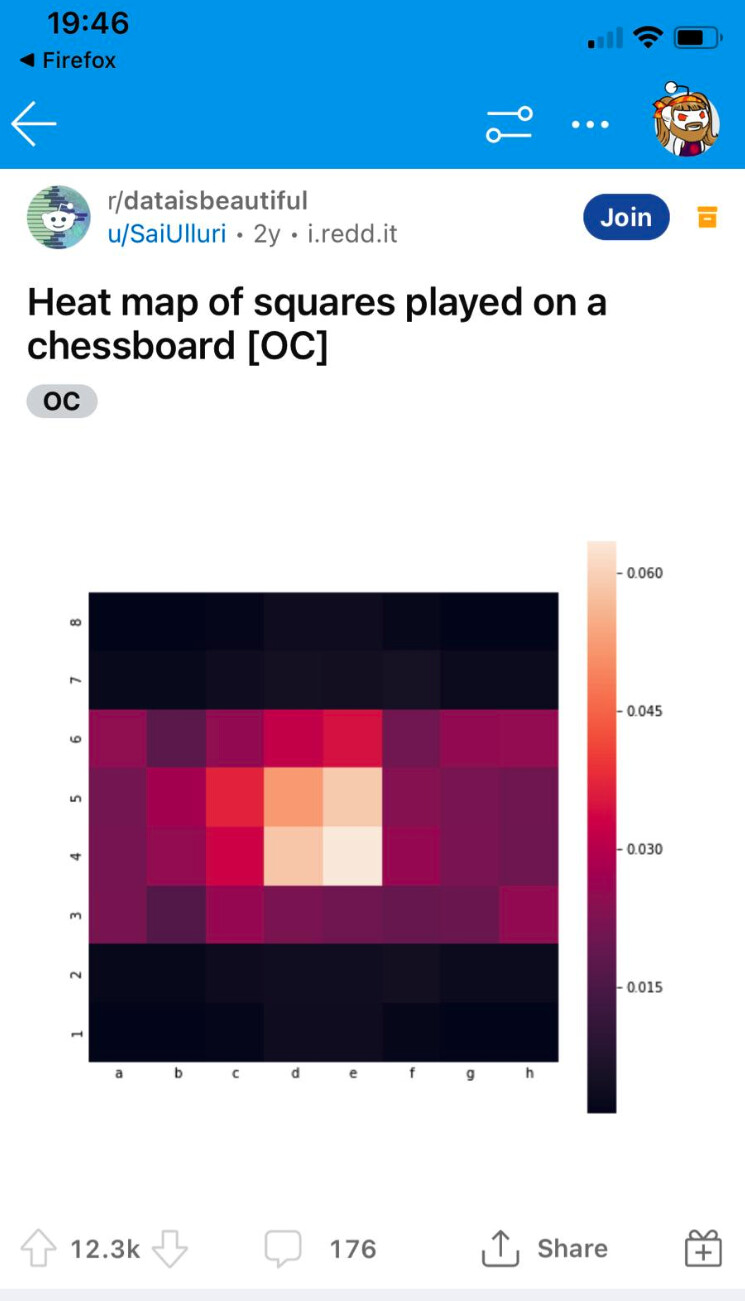
Trying to use PAO on a decent amount of this sort of data feels like your world is going to get very small, very fast, and that’s going to hurt.

@JohnDen’s approach with number of syllables length is a nice alternative because it both ‘hashes’ the value to be reasonably evenly distributed⁰, and more importantly, allows a lot of creativity to be used for the key.

In general, I’d go as far as to say that PAO is a poor choice for any structured data (British phone numbers or numberplates are good examples), but particularly so far anything quite as narrative as chess moves…

(I actually really like this chess example as a good one for pointing out problems with approaches like PAO and I think I might try and write that up properly)

⁰ I actually have to check this with a script and a database of games, I might be wrong
¹ Although rolling two dice and recording the total 100 times definately isn’t…
4 Likes

In my experience so far this is mitigated by the additional review a project without encoding time pressure allows. I am free to keep enhancing my mnemonic stories for any reviews I fail.

I notice which ones I confuse and then add more mnemonic detail usually via concept to clarify. I might have the issue you describe on the 1st or 2nd recall but by the 6th its no issue as I have layered additional detail in all the problem spots by that point.

It also helps that I did a frequency study of the most used destination squares and assigned my most desirable and flexible images to these squares.

“Star Wars” allows for a large variety of images that will tag the scene as Star Wars. Lightsaber battles, Alien cantina, Blizzard battle, Yoda etc.

One huge plus of PAO is you can use existing hierarchies of people you already know to mirror branching. Family trees mirror chess branching.

I think the only true best practice when memorizing chess is store 2 images per loci, one for a friendly and enemy move just tracking the destination squares the pieces are moving to. How branching and MP construction is handled can be fairly flexible.

Truly strong chess players also need far less images. A chess GM could likely memorize a large number of variations with a low number of mnemonic images only in key spots they are failing. They are essentially just using mnemonic images as a gateway to the chess information already in their head conventionally.

1 Like

There are lots of possible ways to mnemonically-encode chess moves, and it’s worth picking your favourite before you begin memorising a large repertoire.

Having said that, I believe Picture Notation is the best chess system for a general audience. Here is why:

(1) First, it makes sense to memorise moves in pairs, because an opening repertoire can branch after any pair of moves.

(2) Second, and most crucial, it generally requires 3* items of information to encode a move: target file (8 options), target rank (8 options), and candidate piece (4 options if you use picture notation’s candidate piece system).

Algebraic notation causes problems because you need to deal with unusual cases, like when 2 rooks can move to the same square. You can deal with these unusual cases, but only by using a more elaborate system than syllables (e.g. 3rd consonant sound and a priority rule). This would need more ‘data storage’, allow less flexibility in keywords, and also undermine the purpose of being simpler to understand. So I don’t think algebraic notation is the best basis for mnemonics.

Of course, you can just memorise the target square and not bother about memorising which piece to move. This requires 2 items of information instead of 3. But I wanted an unambiguous system.

All of this means that it effectively takes 6 digits to store a pair of moves. Picture notation achieves this in 2 pictures (shark lol => 64(1)55(1) => …Qxf4 Ne5+), while leaving a lot of room for creativity in the pictures and how they interact, as JFJ and JoeReddington both note. I don’t think PAO would be any simpler.

(3) Third, Picture Notation is easier to share in a book, because we can all use the same picture words, while we don’t all know the same people. But, even without this constraint, I think Picture Notation has a lot of advantages.


*A computer could probably store a move with 2 digits, for example by listing every possible move in some kind of order, then declaring ‘move 30’. But I don’t believe it’s possible to make a 2-digit system that’s intuitive for humans.

3 Likes

A couple of other comments.

I played around with ideas like this in the early versions of picture notation. You can also use vowel sounds or, in other languages, tone and grammatical gender. I chose consonant sounds + syllables because it gives lots of options and it’s easy to do in your head.

Also just to note, you don’t need to memorise all the objects in advance! You only need to memorise your repertoire – it’s easy to decode the picture words back into moves at the board.

I make a comment a bit like this on page 89 (when not to memorise a variation). This is why mnemonics for chess are so exciting! Unlike memorising random data, you can memorise a large amount for the long term by choosing your variations carefully.

I thought about room for creativity, but I didn’t explicitly think about even distribution, which is a really interesting point.

I wrote the candidate piece system as ‘start from the back, break ties from the a-file’ because it usually produces 1- and 2- syllable words, which are often easier to visualise than the 4-syllable words. But the system does in practice pseudo-randomise between 1 and 2 syllables (sometimes 3, occasionally 4), which might help keep things distinct.

If anyone finds it hard to memorise the same picture word too often, you can of course use the alternatives. e.g. heart (d1, 1 syllable) and robber (d4, 2 syllables) occur often. You can switch some of the time to broth/Earth/rat (all d1, 1 syllable) or briar/razor/wrapper (all d4, 2 syllables). When I first made chess memory palaces I did this a lot; now I prefer to stick to my favourites.

2 Likes

The piece to move is clear to a strong chess player 95% of the time. I have universal images for piece clarifiers and add them only intermittently when I predict I might be confused which piece to move.

One other note on this I discovered a nice solution to solve the problem of which piece to move while practicing. You just continue to follow the variation in your mind and usually it will become completely clear based on the next 2 moves destination squares which piece moved this loci because otherwise the next 2 loci would be complete nonsense hanging pieces.

2 Likes

That’s an interesting point that I hadn’t mentioned against PAO for structured data. I think it is holds a problem with the image system though.

I’m not sure what you mean when you say that @JohnDen’s approach hashes the value to be reasonably evenly distributed. I do see how it could allow a lot of creativity for the action key as the latter does not need to encode anything- ensuing some potential repetition there. If what you meant was that several words could represent the same square, avoiding repetition, then I don’t know if this really helps.

In a PAO system, I think the key to moving past the repetitive narrative issue is to consider it an opportunity to further chunk the information. To borrow from - and potentially bastardize- Timur Gareyeve’s approach: If D4 is Princess Diana, then Princess Diana with a horseshoe becomes D4N4 - chunking 2 pairs in only the person - leading the way to a 2 turn (4 move) loci. That way more information is encoded, while at the same time, more detail is added preventing confusion, at least in the early opening.

Another way to potentially solve this would be to encode
[(Piece) Column Row (Piece) Column Row,] much like chess notation. This way (and I’m just going to add a pawn (p=1) and a bishop (B=5) notation just because it will simplify things here.) pd4 pd5 is, 14,41,45 and Be4 Be5 is 54,45,55 - none of these have any repeating People Action or Objects, despite the fact that we are using the same squares.

The PAO would move in pairs

and has the potential to double the encoding when moves are common. In fact it provides an easy way to continue chunking information up the food chain by adding details to the image. D4 = Princess Diana D4N4= Princess Diana with a horsehoe then Action.

Again that’s what PAO’s two extra digits of encoding are for. It’s ideal for this.

On the rare occasions that two pieces of the same type attack the same square, then yes there’s no way to simply encode the extra information within the PAO as a PAO is usually utilized. I don’t know how often this will happen though, and if it really is a deal-breaker. Generally using a number as substitute for a piece will be much simpler than decoding the type piece via the image system method. Also, keep in mind that the same Image system method can be applied via PAO: Instead of counting syllables I just have a ready made number. The one potential downfall really, is that the PAO needs those two extra action pairs so I can’t be as creative with the action.

1 Like

Thinking about it, I think the biggest advantage of the image system is that you are only memorizing objects, as opposed to scenes.

Or perhaps that’s not well phrased. I would imagine that the extra potential step in a PAO is to bring the person, action or object back to the scene which represents the number. I can imagine instances where the action is not clearly linking back to the scene and number that it requires. This demand is a step not required of the Image system which links directly back to the coordinate. In other words, Shark Decodes into Number, Shark Links back to Scene which then represents a number. Honestly I don’t know if this much of an advantage once the PAO is properly learned but it might be. That being said I’m not convinced consonant sounds are the easiest way to do the encoding.

1 Like

In summary, you can memorise a pair of moves using a PAO or by using 2 picture words / “objects” (picture notation). I definitely prefer 2 objects because it requires 2 “elements” per location instead of 3: a 33% reduction in the number of elements to memorise. (object + object, instead of person + action + object).

As well as providing lots of flexibility in picture words (objects) and interactions, there is another advantage of picture notation that I didn’t mention: you can decode one picture word at a time. E.g. you can check whether your opponent played shark, then decode the reply lol only if you need to. With PAO the two half-moves are stored together (3 digits belong to the P and half the A; 3 digits belong to half the A and the O). Not an insurmountable hurdle, but not ideal. We want as little mental effort at the board as possible.

Of course, if you prefer to memorise algebraic notation (with PAO) rather than the candidate piece system (with picture notation, including syllables) there’s nothing stopping you doing that! Overall though I think picture notation holds up well, and I’m happy to recommend it.

This conversation is the first time I have articulated the design principles behind picture notation by the way, it’s been good to write them down.

bit of gauntlet to push it through,

I do wonder if just two images, without the action will be sticky - I hazard to guess, that, much as in your examples, the action will have to be added. If this is the case, then I’m not sure you can decode 1 at a time. I agree that decoding 3 digits, then the other 3 digits from the 6 digits is an extra step. This step can be done away with, if the digits are stored (Pieces, Move, Move) but then we might get a lot of repeating imagery. That being said this imagery also repeats with the image system.

Some central square repetition would be avoided with different images for different pieces but most of the repetition in my journeys so far is stuff like h6-Bh4 which would be just as repetitive.

Do you find that the PAO breaks down because of this repetition? Any ideas on how to get past this issue?

Not really so far because I can review as much as I want and add conceptual reasons why that repeating image combo is happening to that specific person.

h6-Bh4 is a heavy repeater for me. This image combo is Duct Tape / Kool-Aid Man smashes through wall. I always have his jar breaking and the person duct tape repairing it. Very often I will add a conceptual reason that person broke his jar at that loci.

Its also mutually exclusive for any 2 people to be Tape-Smash at the same loci or else they would be in the same shared scene for me. This allows me to infer other characters are NOT tape-smash at a specific loci by just knowing what character IS tape-smash at that loci.

It is also mitigated by using broad category based images for the central squares. e4 = Harry Potter, e5 = Star Wars. Both allow for a wide variety of unique images that will tag the scene as Harry Potter or Star Wars.

If it ever does become a serious issue for me I will simply expand my system assigning new alternative image choices to the problem squares. e4 in the future could be Harry Potter and/or Back to the Future since back to the future is not in my system at all currently.

1 Like

Brother the only person who says that is someone who never tried memory palaces before, they come naturally to you , your brain once practice memorization enough it becomes addicted to it , it’s the opposite this method is ground breaking!! Also only an beginner or a liar says chess isn’t about memory, it’s literally all about memory and pattern recognition, bobby Fischer said it himself.