Picture Notation: A Mnemonic System for Chess

Hi all. I have been working on a system for chess, called Picture Notation. I have been gradually improving it over several years, and it is now the simplest mnemonic system for chess that I know of. I think it is time to share!

Picture Notation uses an adapted major system to identify the target square of a chess move. The piece to move is identified using the number of syllables in the word. For example, jam is 1.Nf3, shampoo is 1.f3. This means almost every chess move can be shown in a single word.

21 Likes

@JohnDen, quite a well thought out chess notation! Congratulations on designing it and publishing it!

1 Like

Awesome ! I’ve been looking for mnemonics for chess since a long time :slight_smile: I’ll look attentively your pdf and read it and let you know what I think about it but it seems like a great work already

This could be groundbraking.

Right now most grandmasters memorize their preparations by rote and use their intuition to recognize their positions. This could give them a significant edge over their opponent.

1 Like

This is an excellent system for memorising chess moves as a sort of party trick for non-players who haven’t developed board vision yet, and is by far the best mnemonic for chess that I’ve seen so far. Well done.

That being said, I’m not sure I really see how this could help an improving player in practice? Even typical tournament players (class A or expert) have literally hundreds, maybe thousands of lines in their repertoire. And this number goes well beyond the tens of thousands when considering master players. It is impractical to convert all these moves into mnemonic images, store them in a unique place and then constantly review the mnemonic images for every line in your repertoire, especially considering the purpose of playing moves is to understand the meaning behind the moves instead of mindlessly playing them because they’ve been stored in a palace. Not to mention the fact that if a player uses this system they will be completely left in the dark if they ever want to play blitz or bullet chess, because mentally travelling to a palace and converting a mnemonic image to tell you which move to play is not possible under such time constraints.

The only situation I can really think of where it might be beneficial for tournament player to use this in practice is for something like the refutation of 1.e4 b6 2.d4 Bb7 3.Bd3 e6 4.Nc3 f5. Where the refutation is a long and forcing engine line where the moves only need to be played by rote and not understood, since white will have a winning position 100% of the time if he remembers the correct moves.

Thanks for the kind comments.

@CelineDL , let me know if anything is unclear!

@chump, that’s a good challenge. I’ve wondered about that too. Rote memory is definitely useful for chess, because it’s easier to read a move from a book/memory, and then recall its purpose, rather than continually work out the move from the needs of the position. This is especially true in tactical engine lines, as you note. (And this does not deny the importance of understanding your moves.) So the question is, is it easier to memorise a memory palace, or to just memorise the chess moves directly?

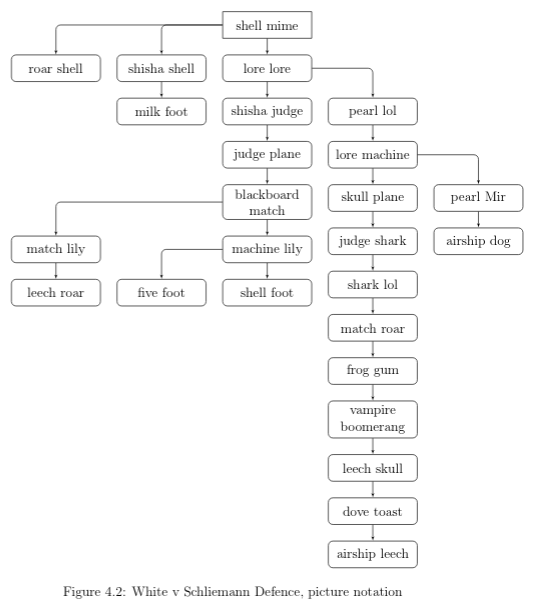
This is an empirical question, and I’d be interested to hear the experiences of anyone who tries the picture notation method. Here is a small repertoire against the Schliemann. I’m sure some people on this site could memorise it in minutes. But on the other hand, elite chess players of course have excellent memory for chess, and a real repertoire is much larger than this. You may be right that there is too much for a palace to be practical.

Still, elite players do seem to spend a lot of time memorising openings, and don’t always remember them successfully. In Hikaru Nakamura’s interview on the Perpetual Chess Pod, he says memory is the most important thing for becoming a grandmaster, and laments that his second would also be a GM if he had a better memory. I don’t think a memory palace is out of the question, at least for some parts of a repertoire.

On a separate application, Timur Gareyev used a kind of memory technique for his blindfold simuls. I wonder if this could be taken further.

It’s a good point about speed chess too. I haven’t read much about improving speed of recall - competitors are more interested in speed of memorisation I think. Perhaps with practice you could use a memory palace quickly enough for blitz. But there is no chance for bullet!

I’m not a chess player, so some of my assumptions may be wrong, but as I understand it, chess players don’t literally have thousands of openings memorized. Rather, much of their chess knowledge is through an intimate knowledge of chess, which allows them to easily chunk certain moves (oh, this move is opening X with a knight instead of a bishop).

That being said, memory palaces help to facilitate information into both your short and long-term memory, much faster than rote. When you have more information in your long-term memory, you can more effectively chunk it, and these chunks themselves can also be stored in your memory palace.

In my own personal experience, if I’ve memorized something enough times and/or created an especially compelling mnemonic, then I can recall the information without the mnemonic. I’ve forgotten many images in some of my memory palaces, but the knowledge stored there can still be easily and actively recalled.

I think that the use of mnemonics can help you get moves into your long-term memory quickly, and then the next step would be to automatize the information through retrieval drills and spaced repetition. Expanding your knowledge of chess, in general, should also facilitate the memorization process as well, as you will be able to chunk more effectively.

I’m not sure if my theory is sound, but I think that it’s definitely worth trying. From all the searches I’ve done, practically no one uses mnemonics for chess except for Simon Reinhard and Timur Gareyev (and even he said he quit because it was too difficult for him to manage). Chess, like many memory-heavy topics, seems to still be under the “cult of understanding” instead of using mnemonics.

2 Likes

Having gone through others, for several years I have been using a similar system in a “chess experiment” that I am developing in my spare time.

Although the experiment does not involve only memotechnics, I call my representation system “Chess code” (because it is just one more among my codes -Phonetic numeric code, Morphological numeric code, Rhyming numeric code, Alphabetic code, Color code, etc.). It consists of 395 single images -mostly single words, but not always-, generated by representing each piece (pawn, rook, knight, bishop, queen or king) on each square (a1 to h8).

While captures made by pieces are coded simply as moves (Bxc1 = Bc1), pawn captures are represented by 14 additional images without its numbers (bxa = Ben Affleck, for example). Two others represent 0-0 and 0-0-0.

In addition, about 20 images represent concepts I use in plans (“or”, “and”, “structure”, “change”, “search”, “duplicate move” -to avoid repeating images in captures and re-captures, such as 4.Cxd5 Cxd5-, kingside, queenside, etc.).

I put it to the test in several test games doing well in the opening against Houdini 1.3a even winning one of them at depth 13 (average of 2430 ELO -moves between 2354 and 2500- following the work of Ferreyra: http://web.ist.utl.pt/diogo.ferreira/papers/ferreira13impact.pdf-]
Also against an International Master friend.

However, what I have been changing the most is the way of using it due to encoding speed (when memorizing), decoding speed (when playing), etc.

Without going into detail about @Chump’s interesting comments, about yours…

…in my experience a palace is the most practical way (vs large chains, for example) AND in my experience it’s better in time and effort than learning the moves by heart without a system. However, the palaces can be used in different ways and the images can be stored in different ways as well (being the identification of the branches in a practical way the biggest problem).

Finally, even if it could be used in the faster games that are growing in popularity, my system/experiment is intended for classical games (which is the only chess that actually maintains its essence of thinking strategically, etc. vs winning mostly by tactical means).

2 Likes

Thanks @mad10000 . It sounds like you have your own version of Picture Notation which you then store in memory palaces. Good to hear that you have had success with it!

I’m interested to know,

  1. “or”, “and”, “structure”, “change”, “search” – how do these work?
  2. What do your memory palaces look like? It sounds like you have tried branching structures? I’m experimenting with something like this: “After going through the ticket barriers, you can walk up the platform where you see a match burning a lily, or you can get on the train where you see a machine producing a lily.” This branching structure fits an opening repertoire nicely, but you have to put more thought into its design compared to a normal linear journey.

As I said, these words are mostly used in plans, or as shortcuts to reduce images/locations/time/effort. Examples:

  • If facing three possible rival moves I will answer the same move (and from then on the line will remain the same), I prefer to store them as image1 + image of OR + image2 + image of OR + image3 + my move, etc.

  • In known structures I must play a certain plan if the rival plays certain move TOGETHER WITH another one: image1 + image of AND + image2 + my move, etc.

  • If part of a plan is to eliminate a certain piece, let’s say Bc8: image of “ELIMINATE” + image of Bc8 (notice that this kind of reminders/objectives are not always followed by my moves, as they can be achieved by various means).

Now they are linear, regular palaces

Yes, using in a special way the images of the pieces themselves to arborize/branch the geography of the palace. It is an interesting structure but comparatively suffers from the problems mentioned below (plus others that I cannot mention without spending too much time on the answer)

I’ve been there and, as you have noticed, one has to put more time and effort in coding them. Only when you record in detail the times it takes to encode a certain number of moves and then calculate how much it will take to encode n more, you notice that it is a system that is not scalable beyond a fairly low amount (of course, it depends on what one aspires to).

In addition, the moves are retained for comparatively less time, so they require more frequent rehearsals. Finally, they demand comparatively much more time to recover in real games (you can get to a good opening position but “eating the clock”).

So, although I can’t go into details, now my moves are stored in a manner similar to one of the ways in which tree structures can be represented linearly in programming languages. Incidentally, it is a particular case of an area to which I have devoted a lot of time over the years: the various ways of representing tree structures with memotechnics, about which I may one day have the time to write.

Although @Buddycl uses a different system both in the coding of the moves and in the way of storing them, it is worth reading -if you haven’t already- her/his chess system: Help to memorize numbers long, focused on chess - #2 by InMyMemoryWorld

3 Likes

This looks promising for sure. I hope the book will come out and thanks for sharing this system with us. I think this system will be very practical for (rare) sidelines that only come up once in a while. It is very hard to remember them and I keep forgetting them. I think this will work great for example for small repertoires against the King Gambit etc… You don’t need to many moves and lines just a bunch will most of the time be enough to survive that opening.

2 Likes

I am writing up this mnemonic method for chess as a short book. I have decided to post the chapters as I write/edit them, to give people a chance to read it (and send me any corrections) as I go along. Please find below chapter 2, Essential Memory Techniques. Much of chapter 2 will be familiar to readers of this forum, but it combines and builds on a few different sources, so should be of interest.

3 Likes

I doubt very much that using memory systems can really help people play chess beyond some basic openings. Masters, International Masters, Grand Masters, etc., I think besides the thousands of hours of practice probably have a talent for the game and remembering “chess play” and probably learn the openings and transformations to openings from practice and a VERY strong desire to learn.
I doubt using mnemonics and palaces can re-create for example this short clip of Magnus Carlsen’s chess memory. https://www.youtube.com/watch?v=eC1BAcOzHyY

1 Like

Thanks for the link. Mnemonics is definitely not a ‘cheat code’ for chess. It can’t replicate memory of board positions and patterns like Carlsen shows in the video, which is arguably the #1 ingredient for chess skill.

Instead, a picture notation memory palace is like printing out your repertoire in notation and reading it while at the board. Will it help your chess understanding? Not really. Will it help play a new position by analogy to a different line in your repertoire? No. But will it let you play your prepared opening (and some endgame) moves with perfect recall? Yes.

Whether this is valuable, I leave up to the reader. Personally I think it is. Even Carlsen forgets his prep sometimes. I might skip ahead to chapter 7 next, where I discuss this question at more length.

3 Likes

I based my Chess system off this Buddycl post. His system is very nice except one thing he is memorizing 2x the data he really needs to. Just the destination square is enough 90% of the time and you get to test yourself in private studies. If you forget which piece to move during your self tests then you can add a clarifier of which piece to your journey.

2 Likes

Very nice system. I’ve also been working on …well I’ve been training two systems for chess. The first one is the Dominic system. In chapter 20 of his book “How to develop a perfect memory”. He used this system to win an event in the world memory championship 1991 which involved memorizing a sequence of chess moves.

Dominic managed to memorize 11 moves (23 half/single moves) without error. What’s impressive is that he came up with this system very quickly. Ofcourse the chess segment/event was dropped from from subsequent events because experienced chess players .

I’ve also been recently working on a major system system for chess openings. However, because I have the complete 1000 list, it was easy to come up with images for each move. Kf5 = 765 = cashwell. The second number corresponds to the letter’s position in the alphabet. Rg4 = 474 = wrecker (wrecking ball). short castle = 00 = “saw/chainsaw”. 0-0-0 = “sauces” or “tomato sauce/ketchup”.

The only issue is when two pieces of the same type have to move to the same square. I’ve read some of what you’ve written and I think you solve this problem pretty well. As far as understanding. I think using spaced repetition is a good idea when understanding typical pawn structures and plans/ideas. Rote Repetition can also aid in “meaningful memory”/semantics is what I’ve noted from my experiments. So getting flash card software is very good to aid in understanding of “typical plans” and pawn structures and ideas.

Also using a short term link system with spaced repetition for ideas and typical moves and maneuvers is very useful. It’s definitely sticks a lot longer than using your “natural” short term/working memory.

One final note. I’ve noted that with mnemonics I tended to become a lot lazier and have observed a decrease in motivation in work ethic…often just procrastinating until something urgent comes up and I use these techniques at the last minute.

3 Likes

I think these are the key insights behind Picture Notation. Adding the syllable system for candidate pieces eliminates the remaining uncertainty. Interesting to hear you use flashcards too.

If anyone is interested in book progress: I have jumped ahead to chapter 7, which attempts to answer the question a few people have raised, Why should you memorise theory (using picture notation)?

This is quite a long essay, which reaches the conclusion I wrote in the comments above: picture notation doesn’t replace chess understanding, but it does let you play your theory perfectly. This in turn reminds you of your plans.

I also explain spaced repetition and some side topics. I find mnemonic techniques for blindfold simuls very interesting, so I discuss that too.

4 Likes

I agree completely and I think most actual Chess opening experts will agree as well. The trope “don’t memorize, understand” usually comes from either low rated players as a coping mechanism for lack of study or from high rated players who also can recite all the specific moves undermining their argument.

I am planning to self-test in the following order.

  1. Opening lines in random number format (postal notation conversion) first laying perfect specific move order groundwork
  2. Self tests with chess moves and compare pgns for any wrong piece selections, add journey clarifiers for the specific piece if needed
  3. Full active recall pgns + annotate strategic ideas (some which may come from journey as well).

I will self-grade steps 1-2 and my coach will grade my strategic understanding annotations.

4 Likes

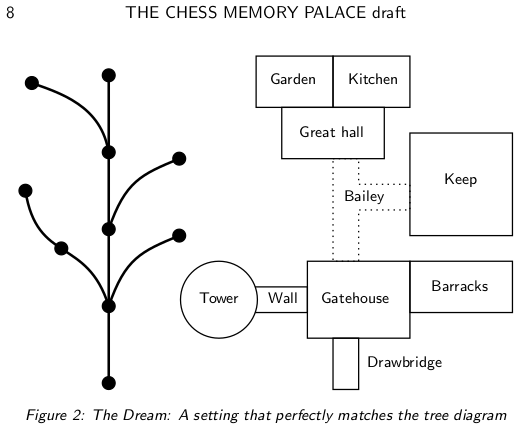
I have finished a draft of Chapter 3: Memory Palace Architecture.

From the perspective of people familiar with memory techniques, the interesting part of this chapter is discussion of a branching structure, i.e. how to memorise tree-shaped data.

This topic comes up every now and then in this forum, and indeed on this thread. The two main approaches to memorising branching data structures are (1) mapping out a branching memory palace, or (2) borrowing computer science techniques to convert
the tree into a linear (or tabular) shape, then memorising it in a traditional linear memory palace. I have gone for approach 1. It is more intuitive, and it is easy to extend variations and add new branches. Still, I’m interested to read other peoples’ experiences with branching data.

The ideal case (in miniature) is something like this:

2 Likes

I use standard structured memory palaces and handle branching variations with related people.

Since each variation in my system is associated with an individual person I select “families” of people for the variations based on how many branches there are.

If there are 5 branching variations at one locus I may use all 5 of the Simpsons doing different actions (enemy move) with the same object (my move).

2 Likes