Could you expand on this? Do each of the people then start their own chain of images at that locus, or start their own palace somewhere, or something else?
1 Like
Each palace I plan to store ~50 journeys. The objects transform the locus in some way.
D5 object is blizzard. If my first move beginning at the tabia is D5 the first locus becomes a blizzard. For each possible enemy move there will be a different person in blizzard locus one doing different actions.
I follow each of the persons journeys to next locus. If there is more branching I know ahead of time and can select more complex family structures. Each persons journey is ~10-15 loci long and the same person is in each locus.
My triggering question comparing to Jonas history sample of “what is the art here?” Is going to be “who is in the blizzard version of this locus?” Or “who is in the Olympics version of this locus?” Or “who is in the Harry Potter version of this locus?”. Each of these is an object and relates to a friendly move destination square.
It’s just PAO applied to the use case. O=Friendly move, A=Enemy move, P=variation tracking person
For example in my pilot I used fraternity guys for a big branch of variations. Then within that branch the variations that had a lot of additional branching I selected guys who have their own families now and branched future variations into their wives and girlfriends.
If there is someone unrelated to the current family structure doing an action at a certain locus this helps me identify that my opponent just left my prep and I shouldn’t follow that journey because it is for an unrelated variation that branched earlier and I might just happen to be playing D5 on the same half move.
My first step with all new openings will be understand the branching structure, assign each branch families of people, and memorize the branches.
1 Like
If I understand correctly, you are counting moves using the loci, and solving the branching problem by mapping the variations onto a family tree. That’s an ingenious solution.
1 Like
Yes each loci has 2 half moves. The 3rd locus in my memory palace is always the 3rd move away from the initial tabia. People from unrelated families can appear in the same locus if I am playing the same move on that half move distance from initial tabia.
If people are in a related family at a locus I know those are good opponent move choices.
The initial tabia is selected by using the table tab of chessbase to determine which tabias have ~50 resulting positions. For some openings this may be 10+ moves deep before the tabia but usually 5-6 moves.
I plan to memorize the initial moves to each tabia with conventional chess memory.
1 Like
I have finished Chapter 4, which is an example repertoire for White in the Ruy Lopez, against the Schliemann Defence (1. e4 e5 2. Nf3 Nc6 3. Bb5 f5). The idea is to take a repertoire in picture notation:
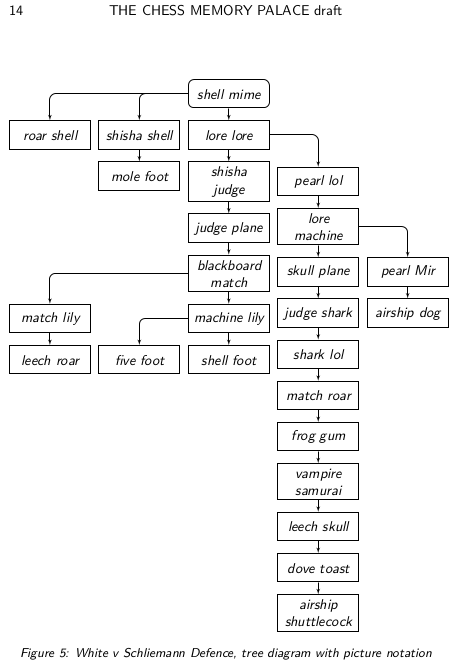
And map it to a branching memory palace, starting like this:
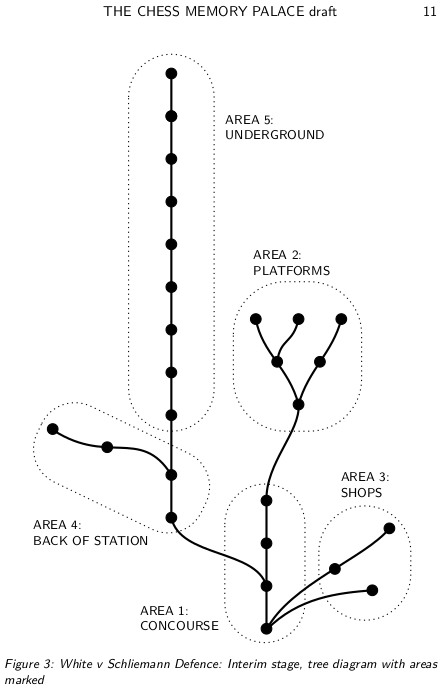
Full chapter here:
4 Likes
This week I finished Chapter 5, an example memory palace in the Spanish Exchange. This is a larger repertoire, and with two special features: transpositions, and options for both colours. We take a repertoire in picture notation:
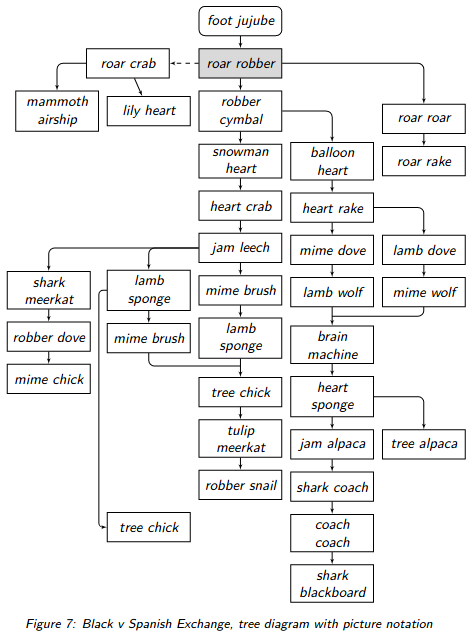
Then map it to a setting, in this case an airport. Interim step below:
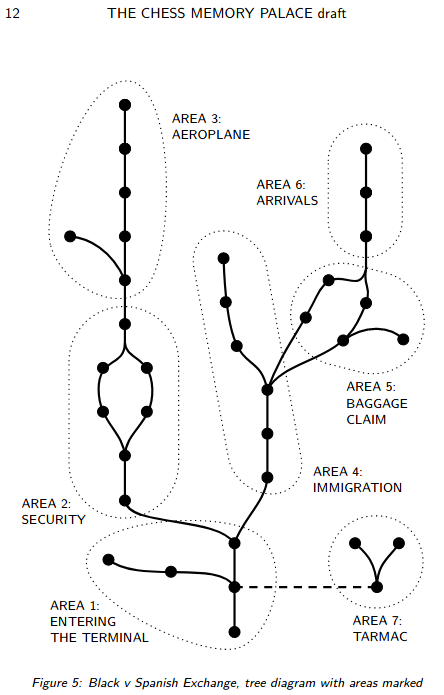
Finally we give every move pair a location, and memorise with standard memory techniques. Full chapter here:
6 Likes
@JohnDen, this is a wonderful design. I like large designs and appreciate all the work it takes including the writing of the book. Side note: ordered your Curious Letter.
I have been looking for what is the way you distinguish openings when multiple openings are possible. In technical terms, it would be the question of how you build a graph in visual mnemonics. @mad10000 also seemed to touch on the subject. But maybe this has already been covered and you could point me to the posts.
3 Likes
My plan for this is to use conventional Chess memory until a key position or “tabia” is reached.
Each tabia will be a separate palace and the starting point of mnemonic based memory.
The tabias I select will be ones that result in 50 branching lines so for some openings this won’t begin until after move 10. Most around move 5-6.
2 Likes
@zweb_chess, that makes sense as the number of possibilities are constrained. And I assume that the tabia should then be a terrain/locus that is useful for of mapping out all of the variations from there? I suppose then that learning the tabias would be a matter of chess study.
1 Like
From the tabia the palace locations would need to branch under John’s system I believe.
My plan for branching is a bit different I am adding a person to each variation to track it. The same person will move to each loci as long as the resulting variation is. When the variation branches they split into a new related person and the original person continues their journey as well.
With this strategy I plan to make conventional memory palaces and mine won’t need to branch location style because I have the extra tracking person.
One potential downside of my plan is some loci will be very crowded. If I was to memorize 50 variations per palace there would actually be 50 people per scene. The way I intend to handle this is all my objects (friendly moves) transform the locus.
There will be blizzard version of locus, Harry potter version of locus, Sherlock Holmes version of locus etc. each containing only a handful of people that happened to be the object destination square on the same distance from the tabia. My triggering question will be “who is at the blizzard version of the driveway?”
The first ~15 loci of my palaces I plan to make entire rooms to facilitate this strategy more easily.
2 Likes
@zweb_chess, that sounds very implementable. I prefer using subjects in terrains/loci to initiate actions like you are doing. I’ll have to think about whether or not they should all travel as a group to begin with though.
In your elaborations of the terrain/locus, why wouldn’t you riff off of a substitute word from the actual name of the variation? Sicilian (pizza parlor), Naidorf (night of the living dead), English attack (English muffin in armor).
These types of details are all conventional Chess memory to the tabia for me.
I actually intend to do my initial rehearsal of all my journeys in their random number format first (there is 100% crossover with my 00-99 images) so I can’t “cheat” leveraging Chess knowledge.
- Finalize the 50 variations
- Convert them to equivalent numbers
3.1 Write scripts for all my journeys, beginning with the most crowded scenes
3.2 Create a grade file where I will need to input peoples names and their related number (50 per file) - Once recalling the random numbers perfectly recall them as Chess moves
4.1 If I move any wrong pieces to the destination square frequently add bridging objects to the journey in the specific problem spot - Long-term do recall rehearsal of the Chessbase file from scratch
- Annotate my created files with strategic ideas
6.1 Potentially enhance some journeys with bridging objects for specific strategic follow up plans related to certain variations if I often find myself playing the wrong plan after I leave prep
I will have very few specific punishments in mnemonics and the journeys will only contain good moves for both players. If my opponent leaves the journey I won’t know the specific punishment but I will know the move is likely bad and also all the typical moves I would be playing if they played the good move.
2 Likes
Both @zweb_chess and I don’t start our memory palaces from the very first move. The Spanish Exchange Airport repertoire starts from this position:
https://i.imgur.com/x1r8vNY.png
From there, you can follow the tree/graph. In this case, the picture word diagram I posted today maps onto this memory palace in an airport:
https://i.imgur.com/91fRTMV.png
So it’s a memory palace, but in a branching shape instead of a traditional linear shape. For example after you get off the plane, you reach the gate. Then you can climb a ladder down to the tarmac road, or go to the water fountain, or continue into the airport concourse. Each location has 2 picture words attached (e.g. the concourse has robber and cymbal). The picture words code to your opponent’s move followed by your reply.
I’ve been posting chapters as I go along; Chapter 3 is an intro to branching memory palaces, chapter 4 is a smaller example set on an urban transit line.
Thanks! I hope you like it!
3 Likes
I’ve enjoyed reading through these. It’s particularly nice to see someone using LaTeX. (Thinking about it I’ve got a .bib file that might be useful to you if you haven’t already been building one up).
I’ve got a few questions/comments that can probably wait until later editions, but I wanted to check a (probably ignorant) point first.
I think I read that you are only memorising the ‘good’ reply to each of your opponent’s moves. I can see why that’s desirable from a tree-pruning perspective. Do I understand correctly then that you would have to create a separate tree for playing as the other side in the same situation? (i.e. have a separate tree for Black playing the Schliemann Defence)?
More generally (and this is a thing for us to have an email conversion about) I don’t think you need a branching structure at all for this example (I appreciate the data branches, but I think your memory structure doesn’t have to…)
2 Likes
I plan to use completely separate palaces for white and black openings and the lines will be much different with some overlap because I will need to be familiar with all possible responses instead of just what I play.
In my white openings white moves will be scenery changing objects and enemy moves are actions. In my black openings black moves are scenery changing objects and enemy white moves are actions.
The opening prep in general is more important as black because white usually gets to dictate the initial tabia position you enter so there is a lot more room for opponent specific prep or only knowing one pet line as white. As black it is a lot more need to know everything. I will be learning all my black openings with mnemonics before I touch white.
1 Like
Everyone,
I’m currently trying to memorise chess openings. I think I start to understand but I do have one concerns : Memory Palace.
As a memory athlete, I already have so many palaces and all of them are prioritary to be used in memory competitions.
Building again a big amount of MP for chess openings doesn’t excite me. I was thinking : is it just a simpler way to store, for example with stories or chain ?
You can start in a specific locations that reminds you the opening (let’s say : london you re in london) but then, all the movements and variations are just the images interacting all with each others without the loci rules.
Maybe you covered it already in the discussion, sorry if I missed it.
3 Likes
I think it is possible. Any mnemonics system that can effectively memorize 4-digits per locus or whatever is equivalent to a locus in the memory system should be serviceable for Chess.
The only true best practice in my opinion is storing 2 half moves together.
2 Likes
Yes, a separate tree from White’s perspective and Black’s perspective. Both because you’d want to learn different variations, and because each location contains your opponent’s move followed by your reply, so it only works for one colour.
Happy to hear them!
2 Likes
This is actually what I first tried for chess, back in 2012. Using a story/chain is fine for a single game (linear shape, no branches), but it gets difficult when you want to memorise a whole repertoire (tree shape, branches for variations).
A story/chain will work for an opening repertoire, if you can keep a branching story in your head. (“After the jam covers the leech, a mime cleans it with a brush, then a lamb helps with a sponge. But, if the mime doesn’t show up, then a shark eats a meerkat next to the jam-leech …”)
Personally I think this is very difficult, so I have to map the pictures to a branching palace.
1 Like
Perfect, thanks a lot 
1 Like