Photoreading, The Einstein Factor?

Hey guys, I’m new to the forum. I was wondering if anyone has had any success with photoreading? You know, the Paul Scheele recall technique?

Also, has anyone come across Win Wenger’s The Einstein Factor? He proposed many techniques of building intelligence such as holding ones breath (to train the carotid arteries to take in more oxygen), Image Streaming, Freenoting and much much more.

Thoughts?

2 Likes

interesting. never heard about things like that. any book u can recommend? :slight_smile:

The Einstein Factor by Win Wenger.

There was a NASA study on Photoreading that concluded that it didn’t work.

Here are some more links about those kinds of claims:

There’s also a good post about speedreading in general here.

3 Likes

I’ve read and practiced Photoreading by Paul Scheele for a few weeks but it just felt like systematic skimming to me. Instead, I practiced Breakthrough Rapid Reading and did the drills religiously. It has been 2.5 months since I started and I can say that there is significant improvements in my reading.

I’ve also read up on the Einstein Factor and did the image streaming for a few months. In my opinion, it really does boost up creativity, but it’s hard to shut my mind off when I want to relax. The end result is that I discontinued it. But I think it would be very helpful when it comes to creating images for memory palaces.

1 Like

I think that PhotoReading does not work for everyone and maybe PhotoReading did not work for all the people included in NASA’s study but I might be wrong.

1 Like

I read this book. Absolutely worthless.

Aside from the image streaming, this is pretty spot on.

I didn’t like image streaming too. It works. But Tesla’s imagery journey is too much better.

1 Like

Oh. First time I heard of that. Could you perhaps provide links for references? I searched in Google but Tesla cars pops up haha

1 Like

Nikola Tesla did it to save himself from flashbacks and created the most complete method of imagery training.

2 Likes

Thank you, @AttiLa-24 ! I will try doing this exercise. To be honest, I think majority of the visualization improvement exercises can be found in keytostudy.com. That guy, Lev, knows his stuff.

2 Likes

Do you know where I can study more about it? a training guide, or how could I contact you for a chat

I’ve heard of it and did take a look at it.

To me, it’s more like an advance way to skim through books and get the essentials only.

Speaking of speed reading, I’ve read a book title “Speed Reading with the Right Brain: Learning to Read Ideas Instead of Just Words”. The central idea in the book is to imagine what the words are while reading, almost like making a mini movie in your head.

Been practicing it for months now actually and I can say, the concept presented in the book actually makes sense. The main thing the book emphasizes is to focus on comprehension rather than reading fast as to read fast, you need to comprehend fast as well.

1 Like

Derren Brown called Photoreading “■■■■■■■■■” (his words), so that should be a VERY IMPORTANT example that this is a hoax. If it were true, the memory competitions would serve no purpose.

Really? I remember a video of him claiming it worked by “demonstrating” it. He supposedly photoread a dictionary and then asked a “random” person to find a word, describe where it was in the book, and then telling the person what that word was.

NASA did a study on this:

Derren Brown is a magician, everything he does is based on deception. So basically anything he claims to be able to demonstrate is a trick, sometimes a very simple one. During interviews he’s not hiding the fact that he is a magician and that everything he does is only for showmanship.

1 Like

It is quite a sobering determination that one has to convince many people, as you just eloquently did, of the fact that magicians use tricks. Imagine that if one has the motivation to convince those same people that other people that are not known to be magicians are also using tricks, how difficult a task that might be.

In my country there was a tv show with a Dutch mentalist (much like Darren Brown). In the office I worked people were thinking out loud how the acts could have been done. I told them that I didn’t watch the show, but that I could give a possible explanation for every act and I was willing to make a bet for a box of chocolats. After my bet was excepted I said “everyone on camera is simply acting out a script” and I ended up with a nice box of chocolats.

3 Likes

I have created all kinds of content on this forum with the expectation that people will find it interesting and that it will provoke a lively debate. Reasonably often nothing happens, no likes and no replies. I see this as part of the game and at some occasions the mismatch between expectation and reality is so big that it is just funny.

However, as I already have received 3 likes (thanks for that) I feel motivated to expand a little on what I already have said. So here is some more content.

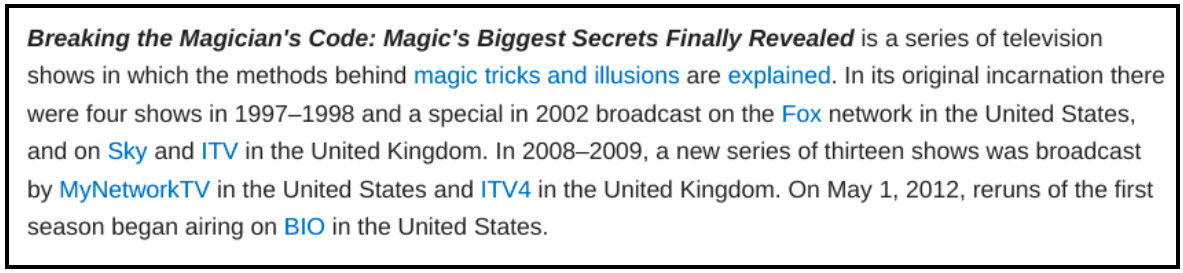
Breaking the Magician’s Code: Magic’s Biggest Secrets Finally Revealed

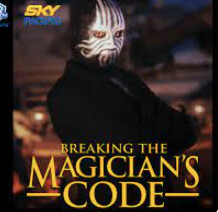
At the end of tye 20th century a tv show was presented to the world in which a masked magician not only showed high level magic tricks, but also explained how those tricks are done. Below some more (WikipediA) info and a picture.


Not only was this show a big commercial success, it also revealed more than just the magic behind the tricks.

“Yes, but …” reactions

As guillaumepetitjean has already made clear, sometimes you have to explain to people that magicians are using tricks even though that’s basically what a magician is supposed to do. There is one variation (of many) of this interesting paradox and that is the following.

“Yes , I now know how that trick is done, because you showed me how it is done, but that other trick that looks very similar can’t possibly have been done that way.”

This is usually accompanied by something like:

“Yes, but that is not a “real” magician, sure he knows many tricks, but he is no David Copperfield.”

Magicians are aware of many of these paradoxes in human thinking and that notion can be nicely bridged to another interesting aspect of the tv show, namely the alleged drama it created.

Controversy or clever marketing?

It appears that within the magician’s community it is not accepted to expose how big tricks/ illusions are done. So if you go on magic forums for example trying to find big magic secrets, you are very likely going to be disappointed.

Since the masked magician was breaking the above described “magician’s code” in a big way it is not a surprise that quite a bit of drama appeared to have been created as a consequence. Did the masked magicians totally ruin the profession of magic and does he now have to hide from the wrath of fellow magicians? Or is something going on that most people would never even have considered?

I promised somewhere earlier in my text that I was going to bridge the “Yes, I know how that trick is done, … , but …” paradox to this part. So here it goes. It is obvious, not just to me but also to the general magic watching public, that the drama/controversy will hype the tv show. However, the just mentioned paradox will possibly make the expected ruining of magic to be an illusion in and of itself.

Paradox on steroids

If you have made it to this point of my text and your head is already spinning, please make sure you are sitting down before you continue reading as things will get even weirder. Since big magic tricks are now revealed it has been suggested in the media (like in newspapers and general interest magazines) that for magicians to save their career they have to reinvent themselves and more to the point, they have to do their tricks in a different way. Not only is this not really true because of all the paradoxes in human thinking, but the powerful suggestion that magicians are going to do tricks differently is the very reason that they don’t have to do that all.

Using tricks to sell memory books

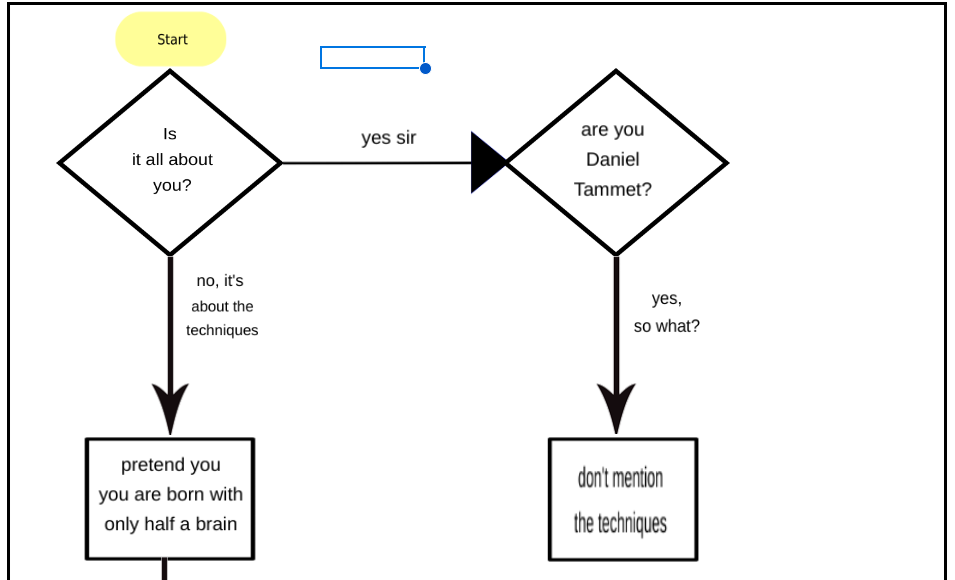
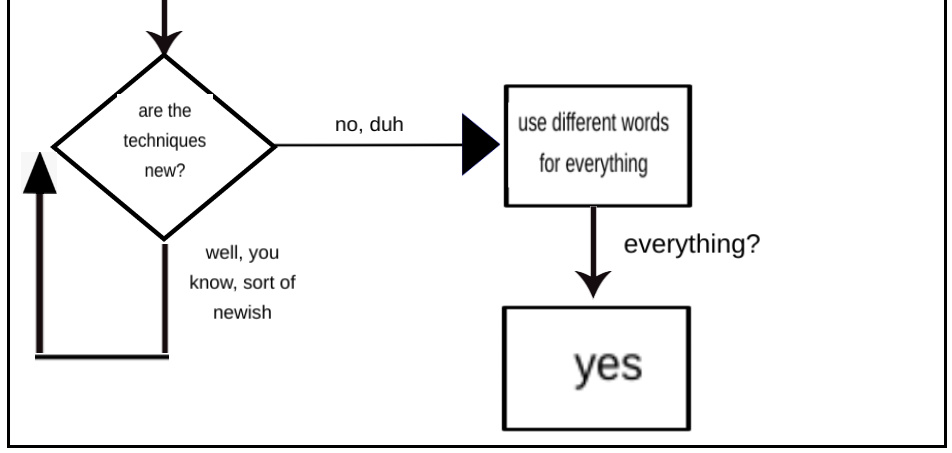
In my previous reply I suggested that it is not just magicians that use tricks. Below is a flowchart that helps you sell your memory books with the help of time-honoured marketing techniques.

1 Like