Hey, hope everyone is doing well. I found an interesting tool to play with the number system.
I have a short commute to work, about 20 minutes. Before, I would listen to a YouTube video and try to remember the content or facts.
Now, I thought I could work with my two-digit major system.
For that, I used ChatGPT. I asked ChatGPT to give me two-digit numbers every time I say “number.”
It would provide a number, and I try to store it in a memory palace. By the end of my commute, I would have numbers memorized.
I can check for mistakes by reviewing the chat with ChatGPT.
That’s how I cycle and enjoy memorizing numbers. I hope this idea is useful for someone.
1 Like
Hello Memory folks! I’m working on memorizing geography like maps and country locations which is a lot of fun. But I’m struggling with memory palaces or loci. The problem is that the objects or loci in my palace don’t stay stable; they keep changing. These objects like a sofa or dehumidifier are the stations where I attach new images or information. Since the stations themselves shift, it’s hard to recall accurately, and I wonder if I’ve left anything out.
Another issue is that loci usually have about five or ten stations per room. But in my case, some rooms have seven objects, others just four. I try to edit or remove objects in my imagination to have exactly five or ten stations, but that feels unnatural. I don’t know how to deal with this. I’ll probably think more about it or research here on the forum.
What do you mean they move? Do you mean the furniture in the actual place you use as a reference for your memory palace moves? If that’s the case, I might suggest you try to set up your palace to a location as it was in a particular time.
I once (15 years ago) made a palace out of my drive to work. Various stops changed ownership, new buildings were erected (e.g. an Amazon warehouse), a new overpass was built. I don’t use that palace anymore.
The other option is to only pick stops with things that don’t move. Don’t choose a dehumidifier, choose a stove or a stairwell.
Hopefully others will have better suggestions.
1 Like
Thanks for your reply!
I think I wasn’t very clear in my original message about the issue with items in my loci or memory palaces moving around.
What I meant is that I usually try to use real-life places, like my old apartment, and remember all the details naturally like walking into a room and seeing the mirror, cupboard, desk, drawer, bed, and so on.
But sometimes when I revisit that room later to use it for memorization, I suddenly recall extra details I’d forgotten before like a carpet or a unique lamp on the table and then I get confused.
Should I include those newly remembered items in the memory palace or not?
After thinking about it yesterday, I feel like the best approach might be to fix a specific set of items for that room and just ignore any extra ones that pop up later. That might help keep things more consistent.
I’m thinking that if you have a palace you use for long term storage, or that you use to memorize something in position (e.g. what is the 37th item), you want a static palace.
If you are memorizing cards, you can use a palace that is occasionally embellished with additional stops.
1 Like
Hi folks.
I am making some progress with structuring my loci.
Essentially what I am doing now:
- Snaping a picture of a place. Let’s say it’s at my workplace.
- I would pick 5 objects from the picture
3)I would memorize the sequence of objects
A key mistake of mine was that I would focus on space and whatever objects were in my memory. Which would lead to confusion. Now loci in my perception appears like a string of objects with spacial cues.
Here is an example from my glamorous work.
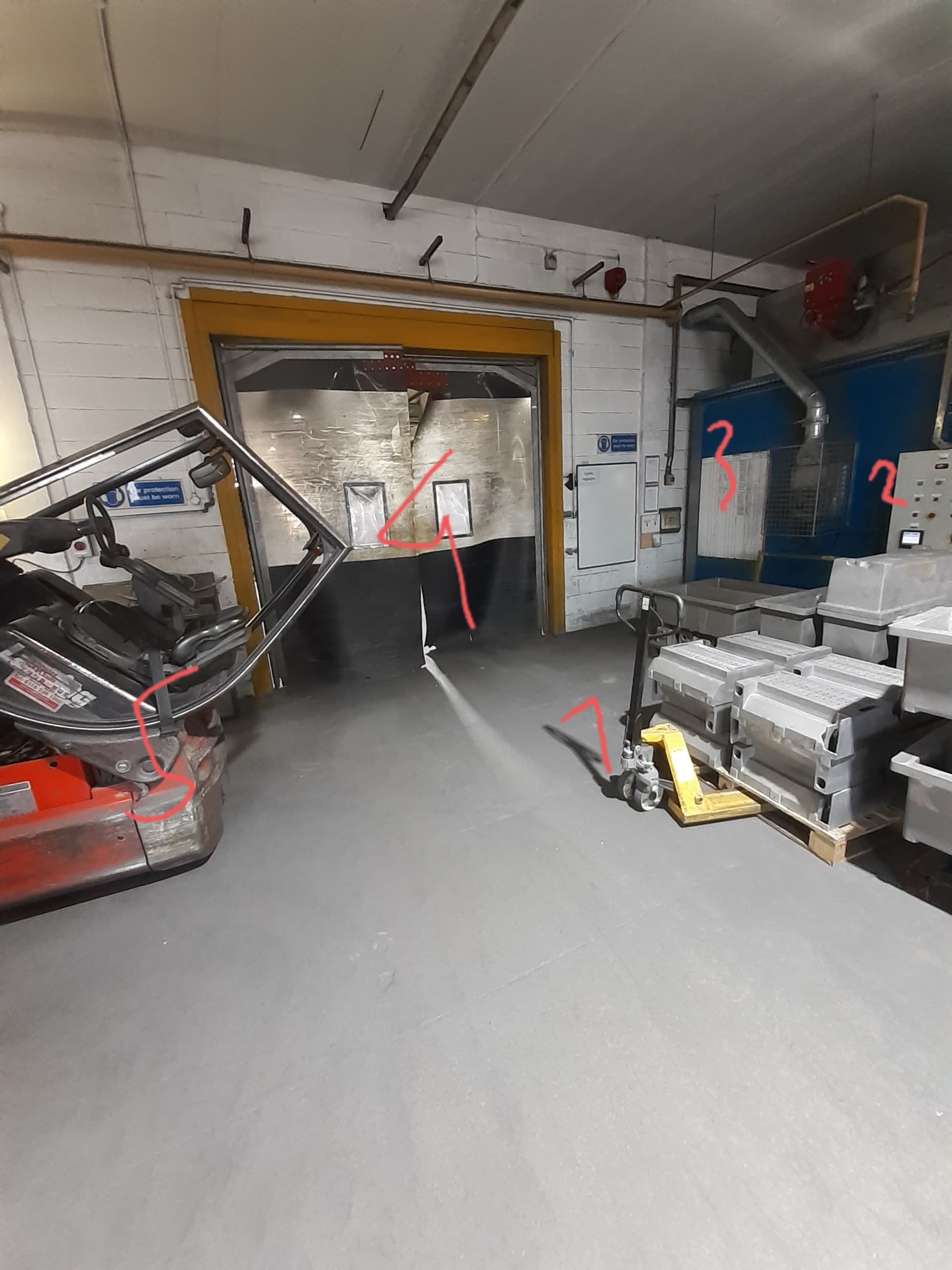
If I need to make sense of plenty of pictures I would create a journey, like if I am going to a particular department at my work, and thus sequences of images would have a structure.
Also, lately, I was listening to this guy, who explains Hercules’s labours.
I found it interesting and memorised all of those labours. I mean they are kinda distinct and memorable.
Here they are:
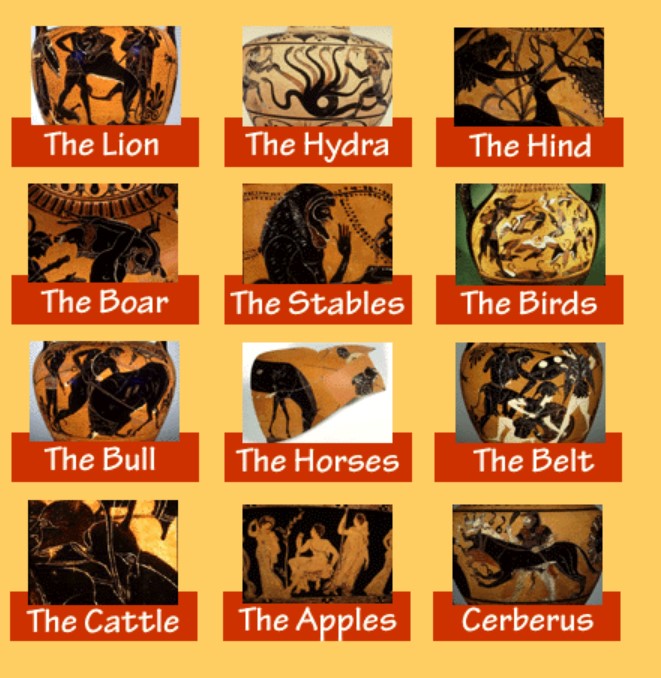
What is interesting, I was reading something and somehow did not have loci to put the key points. And I used those beasts as loci, and voila! It worked very well. Better than body pegs for example.
So yeah, nothing fancy, just trying to be more curious. Hope this will be helpful to someone.
1 Like
I’m currently working on the 3-digit Major System and finding it challenging to associate numbers with sounds.
For example, ‘T’ and ‘D’ both represent ‘1’, and this overlap makes it hard for me to form associations.
For instance, ‘174’ is represented by ‘Tiger’, but the actual letters ‘T’, ‘K’, and ‘R’ don’t immediately connect for me.
Or like 177 is represented by ‘Hotcake’. But when I say T-K-K nothing comes out.
One approach I’m considering is using loci with 10 different words so that I can recall them more effectively.
Another idea is to focus on learning words and then trying to see numbers within sounds like ‘eat Chilli’ is T-SH-L which is 165.
For now, it is very boring attempt to try to drill the associations based on sounds that cannot trigger what I need. Hmm..
Good luck! i will personally try a 3 digit system, but maybe when i mastered fully the 2 digit one. Also, i have noticed that for many numbers there are no easy words to pick, so i am thinking that after a certain point the major system becomes very tedious. And that perhaps it’s much easier to remember the 174 - Tiger if it’s in a structured memory palace. Or you could just make the 100 like, hmm, ambiance? some kind of distinct bioma?
Like for me 74 is Hogger, in order to remember 174 i would just imagine hogger getting frozen in an ice lake, 274 would be him on the moon etc This is just an idea that came to my mind when reading your post, it needs further testing 
1 Like
I started with two-digit numbers. I just made an Anki set with numbers and images on the back. I don’t remember exactly how I memorized them — I think I was just trying to recall them through repetition. It doesn’t sound very cool.
For three-digit numbers, I’d take something like 111, and whatever the sound T-T-T reminds me of, I’d link it visually to the word I need. So the first cue is the sound T-T-T, which gives me a visual impression that then leads to another image.
For example, 111 is T-T-T, which might make me think of a Tall ToaD with an ugly TaTToo.
The tattoo is the final mnemonic image I need.
By repeating this a few times, it somehow sticks. Can do Loci if needed, but one is lazy
P.S
For me 74 is (CRUB) a Krusty Krab from Sponge bob that counts stacks of money
111 = teetotum
my 000-999 is not complete, I’m filling it as I need it
1 Like
Have found an interesting book about mnemonics:
From this guy Ernest Wood
The Book = Mind and memory training
Can get it free online.
It is like 150 years old, and if you ignore the spiritual nonsense, it has some interesting points.
-
Argues for “natural” mnemonics, vs crazy/weird stories. For example, linking by seeing familiarities or seeing attributes.
-
Tries to explain the process of understanding and connection from a different angle. Like baker/Baker paradox, but different
As I have said, the only problem with this book is that it feels very esoteric in some places, or guru-like with unproven metaphysical claims.
So yeah, hope this book will be useful for someone.
i will check it out 
1 Like