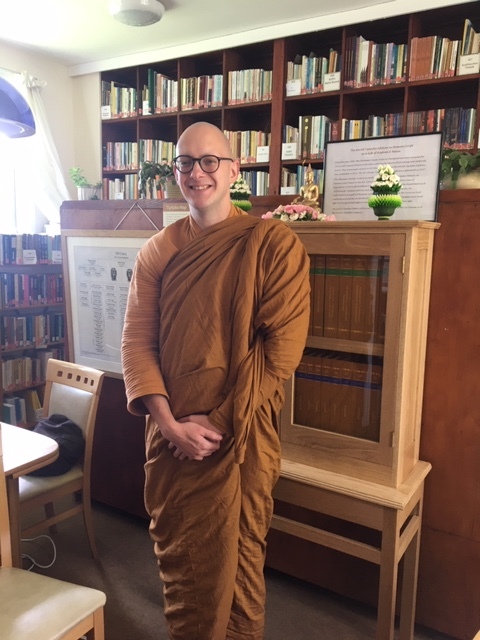
Hey, I am Aleks. I am 30 years old.
Born in Latvia in a Russian family, moved to the UK when I was 21.
Recently I am living in Leicester, moved there after being a Buddhist monk for a few years.
I got interested in memory after trying to memorize long chants in the Pali language.
Now I am trying to learn some Japanese as a hobby.
The biggest challenge I am facing now is that I have no structure or training plan on how to remember more.
I wrote here in the hope to find like-minded memory enthusiasts, and probably someone who could help me with it.
If you type “training plan” into the forum search box, there are some discussions about it that might provide ideas. See also the getting started guide.
Currently, I am working in the foundry. It’s exhausting and boring, but luckily I still have mental space to repeat many things I am learning now, or maybe have an imaginary stroll in my loci while working.
Now I am learning Japanese basic words.
Didn’t find anything better and downloaded an app, and trying to make connections between unknown weird words and meanings.
The process looks like this:
Repeat Japanese word until association comes in the concreate picture, if a word is difficult then I break it into many pictures
Find a picture for translation
Make an interaction or story between them and put them in the place somewhere.
Now I noticed some difficulties with decoding unknown Japanese words.
For an example a world:
Yappari - witch means- “I knew it”
Sometimes I cannot find an association for one of the chunks of the word. Then I tend to remember this bit by rote memorisation. I will try to find the solution for that.
Sometimes I have no idea how to picture the meaning of the word, in this case, it is “I knew it”. Seems too abstract to turn into a picture.
The next problem I faced is difficulties with sequence my loci.
For example:
If I use multiple items in my room, then there is a high chance for me to mix the order and end up confused. But if I use one room for one picture then there is no problem. Need to experiment with this too.
Thank you very much, hope you all will have a good weekend.
If I use multiple items in my room, then there is a high chance for me to mix the order and end up confused. But if I use one room for one picture then there is no problem. Need to experiment with this too.
If I use a memory palace, I generally have a rather rigid rule of going clockwise round the room. So, generally, for a square shaped, average sized room, the loci are always rigidly:
Doorway
Bottom left corner
Centre of left wall
Top left corner
Top wall (i.e. wall opposite the doorway)
Top right corner
Right wall
Bottom right corner
Also the memory objects I put there will interact with that part of the room e.g. If there is a chest of drawers in that corner, and I want to remember “axe”, I will imagine chopping the chest of drawers with an axe.
I also try to make consecutive memory images interact with each other. For example, having chopped the chest of drawers to bits, I will then do something to the item at the next locus the axe. For example, if the next item to remember is “teddy bear”, and it is sitting on the chair, I will imagine throwing the axe into the teddy bear and chair, releasing splinters and fluff that will hit the next item on the list.
Hi Santipalo,
Welcome to the site! I’m also based in the UK. When you have a quite abstract meaning, it can be very helpful to think of a concrete situation or scene in which the word/phrase could be used. E.g. “I knew it” makes me think of the end of a Scooby-Doo episode where they uncover the villain. Then link your Japanese word to that image or scene, which becomes a “location” of sorts. So, I’m imagining one of the Scooby gang revealing the villain, and Scooby-Doo “yapping” (“yappari”).
What I gather, is generally, for remembering verbal material, the memory object (the “image”, but it can also incluse taste, smell etc.) cannot always represent the word you want to remember exactly (this is only possible in digits, cards etc. because of a concrete scheme that codes digits to things).
There will always be an element of approximation involved. It is sometimes easy to get the memory and the mnemonic mixed up, like grabbing the finger which is pointing to the moon.
1.Doorway
2.Bottom left corner
3.Centre of the left wall
4.Top left corner
5.Top wall (i.e. wall opposite the doorway)
6.Top right corner
7.Right wall
8.Bottom right corner
If I understood you correctly, then if there is not any particular object for example in the left corner then you are using it anyway?
I also try to make consecutive memory images interact with each other.
I was just answering your question (2) about picturing the meaning when it’s a more complex phrase. Otherwise, it’s the same process as for a simple object (i.e. linking an image for the meaning with an image for the word, which I assume is what you are already doing).
As regards creating 3/4 images for a word, you can do that if you like, but I think it’s easier to first try using just one image, representing part of the word. Then if you still have trouble remembering the word, maybe extend it to a little sentence. E.g. “itadakimasu” could be someone saying “Ta-da! It’s Christmas” when they serve the food.
If there isn’t an interesting object in that corner I can either move the furniture in my imagination, or create something, so that there is something there.
I also sometimes use numerical/alphabetical pegs for lists, placing a number object in that position, as well an object denoting the thing that I want to remember. Then, if I remember that there are 7 items to remember, and I’ve forgotten something, I know which item I’ve forgot.
This is because you can sometimes get some oddly shaped rooms/streets, and you may lose track of how many things you remember. I generally use memory techniques for learning, not competition, so I don’t know if this is efficient in a competitive setting.
Oh, it is a brilliant idea to capture the essence of the word in one picture and then moderate it afterwords if needed. I give a try on this one.
May I ask a question about how do you organise your loci?
Do you have let say 10 location per room, or any other structure?
In my case, it is just a journey from the front door to the different rooms of the house.
But there is not much structure apart from going clockwise. Meaning in one room I can have 5 locations, in another 7. Do you think this need to be fixed?
Thank you very much!
P.S.
Sorry if English is a bit confusing, one is working on it.
Tried to memorise 20 words in 5 minutes using Loki and images. Worked well, used two pictures per location.
I usually will use the very first association and enrich it with colour, size, action, texture and context.
Tried to memorise 20 digits with a major system, somehow it was easier than memorising the words. The difference between memorising words and numbers is in my case, the necessity to verbalise to find the first association.
On my way from work while cycling I tried to memorise the main points of The TED talk I listen to. I had no idea how to do it. So thinking logically and using the principle of categories. I created the main image for other pictures to be attached to.
Worked well, but I need to be more careful and pay attention to the road to avoid any accident.
In the past, while being a Buddhist monk, I had to memorise chants in the Pali language. The basic strategy at that time was to repeat one line and then try to connect the second one till it gets connected. Basically, it was your mantra.
This is the method of how some of the guys were able to learn 45min long chant in the half of the year. But it takes dedication and discipline.
If I’m using locations within a room then I like to group them in 5s (e.g. 5 or 10 in a room). Most of my locations are simply whole rooms or outdoor spaces, but I know when every group of 5 starts. For me the grouping of 5 is due to the length of the rows/columns in memory competitions (e.g. 20 words per column and I have 2 words per locus, so there are 10 loci per column - but 5 is a nice convenient unit).
Found some side effects of memorizing in the evenings. Somehow I can not fall asleep and stay up all night even though I am incredibly tired.
Need to work on that.
@Santipalo, interesting. I’ve been reviewing in the evenings and then walking through my journeys while in bed. When I wake I can tell how tired I was by how far I made it in my journey. Maybe you could journey through your number pegs. Or I could share my 261 locations in my New Testament journey, sure to put anyone to sleep by the fourth gospel.