I would love to know more, Carollyn. Bruegel is my favourite artist. How are you ensuring a sequence in the painting for your palace? Which painting have you chosen? I can see some, like the wedding feast one, which would work with a palace.
Hi, Lynne! It’s lovely to hear from you and I’m excited to learn that Bruegel is your favorite artist.
I decided to try The Census at Bethlehem first. Here’s a link:
The first thing I did was just look at the painting. I had thought I might just start in the upper left corner and go from left to right and from top to bottom, like reading a book. Then I thought I might try superimposing a clock on the painting and choosing one image for each time on the clock. But I ended up, after just spending time with the painting, deciding to go in a spiral starting from Mary’s face in the center foreground, and then working my way in towards the center in a clockwise direction. There is arbitrariness in choosing the loci, which definitely creates challenges. In creating memory palaces for rooms, I usually choose ten loci per room, with memorable objects at the fifth and tenth places to help me keep my place. So I started with Mary’s face. Then, going left (clockwise), I chose the saw as my number five. Then for three items between the saw, I chose -2- the basket Mary is carrying, which seems to symbolize her pregnancy, don’t you think? -3- the ox eye looking directly at the viewer and -4- the donkey.
So the first five loci are Mary’s face, the basket, the ox eye, the donkey and the saw.
Joseph’s hat is round and seems formally to echo the basket, so that stood out to me to be #6 and for #10 I chose those long wooden handles of the cart, which seem to be an important formal element in the painting’s composition as they establish a very strong diagonal line. Then the task was to fill in loci 7, 8, and 9.
I find this more challenging than remember a room, but the items are very rich and I think once the loci are memorized the connections may be easier to form than connections with more quotidian items. For example, if you make a memory palace out of a living room, you then have to associate something with your living room sofa. But you have a lot of associations with your living room sofa, other than the thing you want to memorize. The items in Bruegel’s paintings are fresher. What do you think, Lynne?
I’m eager to hear your reaction!
I have just spent half an hour staring at Brugel’s ‘The Census at Bethlehem’. I am just more convinced that he is my favourite artist. Thank you!
This is a really clever idea. I wish I had thought of it! I am keen to try it. I thought that I would use “Peasant’s Wedding” because it would be easier, but you have convinced me not to be a wimp. I am going to try “Children’s Games”. I think there is a lot of varied action there to use.
I don’t have any visual memory - I don’t actually see images. It’s called aphantasia (as you may well know) so I expect this to be quite difficult. But I am keen to explore the idea.
To chatter about Bruegel, my favourite of all is his Tower of Babel paintings. I think the use of colour is absolutely brilliant. But I don’t think that would work as well as a memory palace.
I am really keen to hear how you go. What do you intend to memorise with the palace, or is it for temporary use such as for competitions?
This is tricky because all paintings are different and unique in composition. I can imagine it would be easy to forget the path for each painting and get the loci in the wrong order on recall. Even if you do just use spirals, what if you make the spiral too big? You’ll skip right past your loci!
There must be a way for us to systematically find paths that are infallible and work for every painting.
Thanks for writing. I agree with you. For the “Census” it’s very logical to start with Mary because she is the focus of the painting (in my opinion) and to spiral clockwise to the center, where you find a wheel that has been removed from its cart. I think this path itself will be memorable for me, because I invented it and I feel it is very logical. I think a general approach would be useful too, so that every painting doesn’t require a new strategy. Perhaps if you just want 12 items from a painting, a clock could be superimposed on the painting and one item chosen where each hand would be. Or the painting could be divided with grid lines and in each square on the grid an item chosen - something more systematic. Do you have any suggestions, dnoparker?
Lynne - I’m not a competitor and I’m doing this for things I’d like to remember for myself. So, it’s really just for fun. The painting is in my main memory palace, as a “nested” memory palace. I don’t know about aphantasia. Is it a matter of degree? I noticed, searching online, that there is a scale. Are you just low on the scale? I wonder if you could improve your visual memory with practice.
Do you have a memory for geometric shapes? For colors? Perhaps you want to go through the painting noticing all the round things or following some pattern of color?
How do you normally construct your memory palaces, given your aphantasia?
Hi, Lynne. I found an article on Children’s Games that might be helpful to you. On page 25 of this PDF there is a diagram numbering the games. The author tries to identify them all.
Good luck. Let us know if you decide to go with the order of the chart, or if another system serves you better.
I agree totally, dnoparker, but I don’t imagine that I would be using all the paintings. I can’t imagine using more than one or maybe two. But having used quite a few memory boards at the same time, I think it would be possible to use more than one because you get to know miniature memory palaces really well as you encode them.
I am not sure if Carollyn is intending to use more than one painting.
I am interested to see how well I can work a pathway through it, but then again, my first lukasa-type memory board had a random array of beads and shells glued on, and a path just seemed to pop out at me.
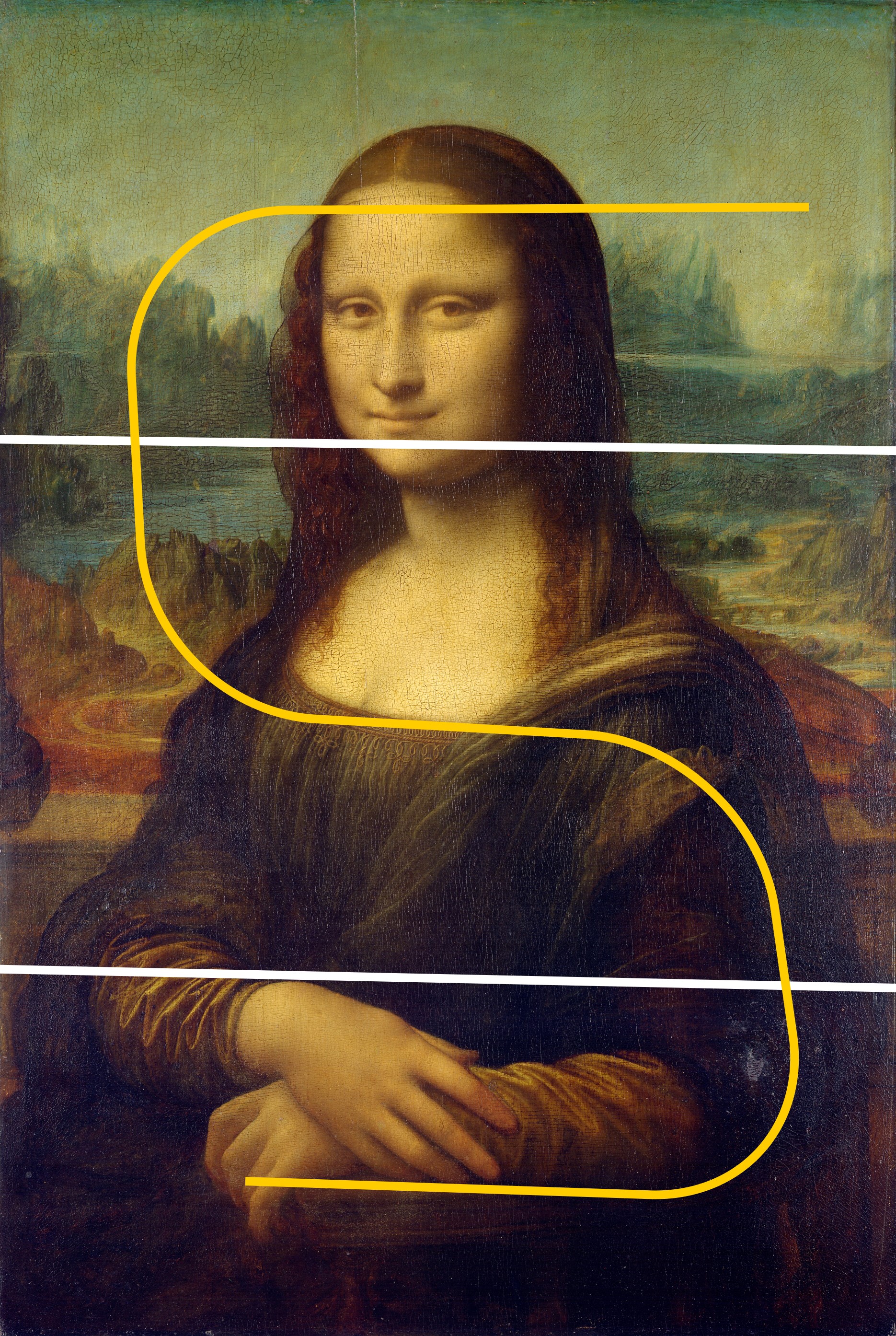
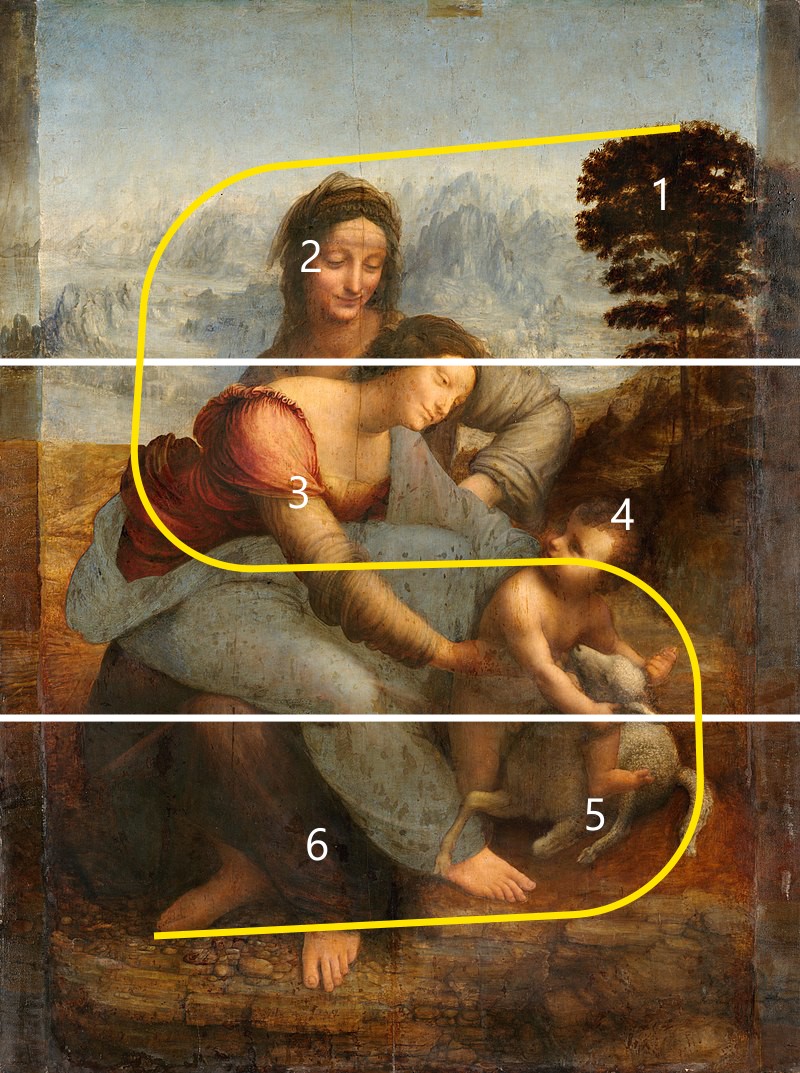
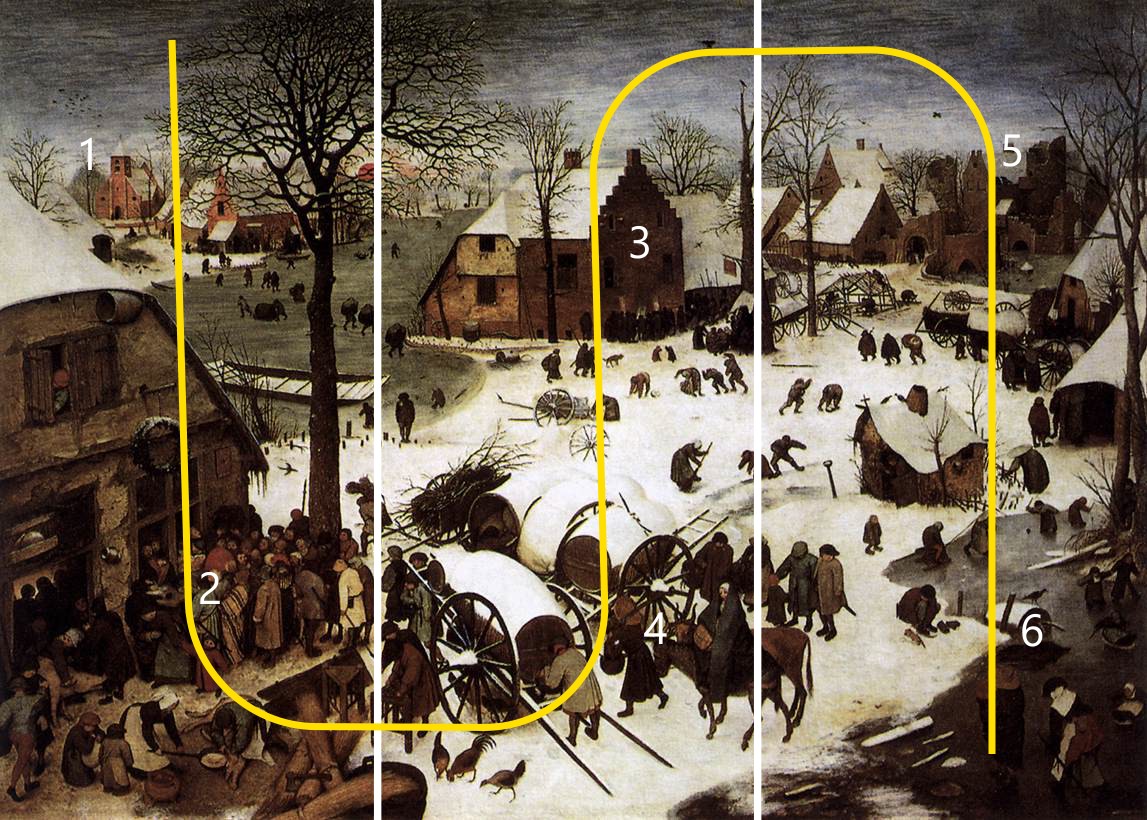
I don’t know if this is much better at all. I am just thinking out loud. But I wonder if you use thirds as guiding rule to path an S through the image? I think we can easily cut an image into thirds in our minds and it helps keep the S the same relative size each time you revisit the piece.
Either way, I am going to try this myself! I’ll let you know how it goes.
I don’t know that I’m going to try using a painting, but I realized this fascinates me because it seems I’m naturally inclined to a different approach than those who’ve posted about this. It feels, from your descriptions, that you’re moving over/across the painting in specific ways, but always treating the painting as a painting.
My first response, though, was to treat these paintings as actual three-dimensional scenes that I could step into and walk through. (So, the “Mona Lisa” would not be nearly as useful to me as the “Census at Bethlehem” painting.) I’d walk through the scene, exploring the buildings, imagining the interiors, stepping around the obstacles, interacting with the animals and people populating the image.
I see advantages to both approaches. If you treat it as a painting, even a brushstroke that goes in a new direction could be the basis for a new location. If you treat it as a 3-dimensional scene, it allows for a more immersive sensory experience, I think.
Hello. I have tried this on many occasions. As I mentioned in another post, I only succeeded when the image or painting was the body of a person, otherwise I would get lost. Perhaps it is because the painting lacks the three-dimensionality of the rooms of ordinary loci mansions. So, in the example above, I would follow a natural order of describing the parts of the body of the Mona Lisa, oblivious to the landscape at the back, not the S path. But in any case, each person is different and has different ways of memorizing.
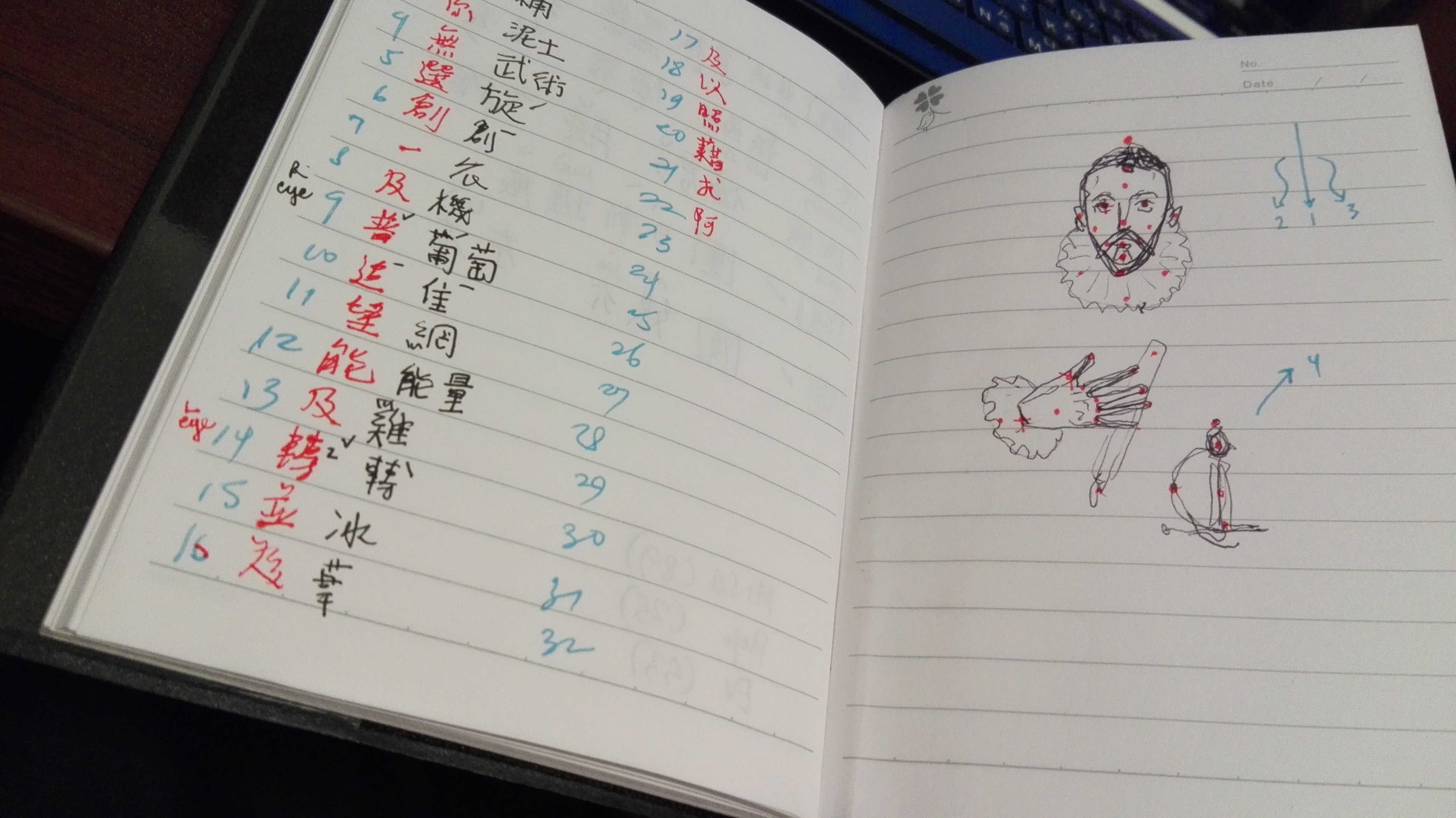
Some progress assigning content to each locus. In this case I can use the palm of my hand, as mentioned in the title of this post, but with the reference to this specific painting, as an aid for the imagination, and, as mentioned above by Lynne Kelly, for the sequence.
I agree with Bob, yes, try to walk through the painting, interacting with the objects and using all the senses. I wonder if Google “VR” version would help. Here’s a link to their active version of “The Fall of the Rebel Angels”. Google uses VR to put you inside a Bruegel painting
I don’t think you have to choose either/or. You can notice brush strokes and larger compositional choices made by the painter as well as attributes of the depicted objects themselves. Whatever makes it memorable.
Oooooo, what interesting replies. I have just printed off Bruegel’s Children’s Games. I looked at doing a curve through it on thirds, as dnoparker suggests, or following a natural path, the latter works better for me. I instantly wanted to start bottom right. I have no idea why. I should want to start top left. I have found that if something jumps out at me for a memory palace, I just go with it.
Bob’s idea of walking through the scene is great for this painting as it would be for Census at Bethlehem. My brain went straight into overdrive when I thought about it at all. I really want to know what they are doing down in that corner!
I really want to know how the rest of you go with this. I haven’t worked out what kind of information I am going to encode. What are others doing? Or are you just constructing the palace at this stage?
The Google 3D was amazing. Thank you, Carollyn. I am not sure if that one would give me nightmares or sea sickness if I concentrated on it. That is more about the painting than the 3D, I suspect.
I want to walk through the scene as I would through a memory palace, and do so slowly.
In case anyone hasn’t seen them, there are some related discussions about memory journeys in paintings:
How to memorize an image or picture? - #3 by Josh – I added that Van Gogh painting to the public memory journeys of the memory journey software, though some of the locations might be a bit close to each other. Mona Lisa is also there, used to memorize 10 Famous Works of Leonardo da Vinci. (You can find them in the “public memo sets” and “public journeys”.)
Thank you for all that, Josh. This gets more and more intriguing. The medieval frescoes were often designed to be used for memory, but I hadn’t thought about using an existing painting before this discussion.
Thank you also for the pointer to the software. I didn’t realise that I could log into that as well. Time to start exploring. This is the best site!