I also use Peg list of “Persons/Characters”. I have got hundreds of Alphabet Peg list with “Person and Objects”!  Here is a small list of my “Person+Object” Alphabet Pegs >> Alphabet PAO System
2 Likes
Oh, yeah, I’ve seen that post, is great! I actually took your idea and used my already memorized Animal Alphabet (also taken inspiration from Lynne’s description of her visual alphabet) and used that for codifications “in real time” (as in listening to a podcast, or watching a youtube video), with a slightly different technique. For example, to memorize “multitasking” I would use the Minotaur talking on the phone and writing an email at the same time, the M giving me a very good hint on the word I’m aiming for. I also use a colored alphabet (with ten different colors for the letters) so it can give me another clue to the word (in the prior example, the Minotaur would have a cyan letter U in his chest, lets say).
I works pretty good but, specially with important or recurrent concepts, the ability to give them a character with a great image have proven to be extremely useful and satisfactory (for example “progressivism”, “being”, “logic”, “truth”, have a perfectly distinct character in my mind, which can do any number of actions, etc.). This is my character for progressivism, just to give you an idea:
How does that sound to you? Just curious.
1 Like
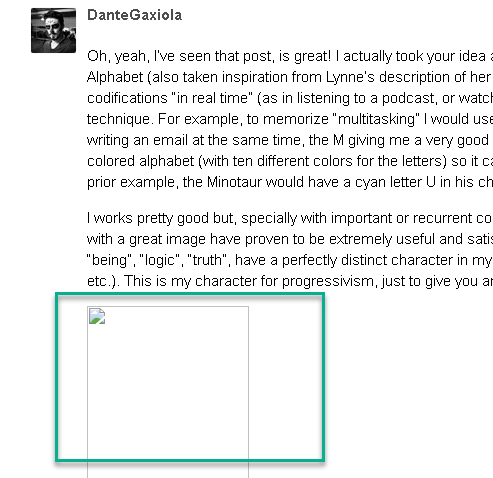
Whoops, let me try again. Here is my progressivism character.
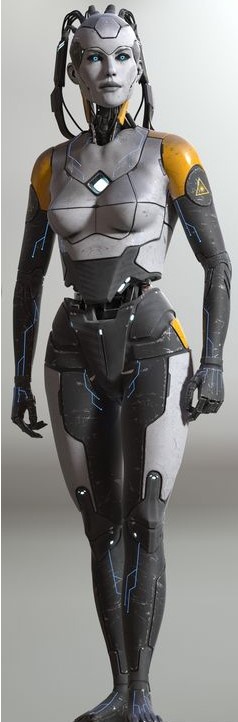
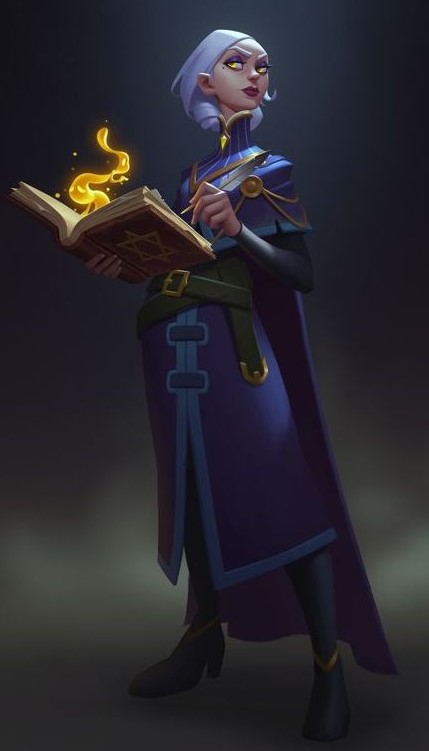
I find it pleasant if they have any relation with the meaning of the concept, like in this case, but also I’ve found that the relation doesn’t have to be direct or obvious, if it exist at all. I think that it happens just the same with words, their relation with their meaning is, in the end, arbitrary. So, this is my character for “content”, as another example:

Or this one for “logic”.
1 Like
I just realized I only shared “feminine” characters, hahaha. Just to balance it a little:
My character for “surplus value”:
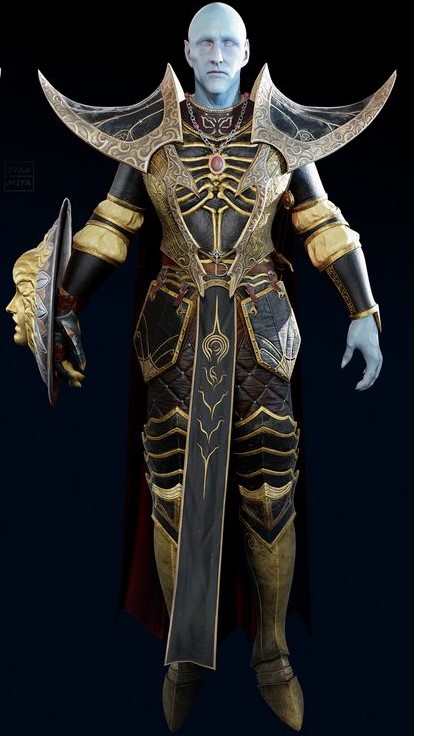
And of course, I can use “known” characters and give them a new meaning, like this for “enemy”:

2 Likes
Nice collection,man…Interesting idea…I tried memorizing the “Terot cards” characters,but they are limited in number…

You should create a separate thread and share your characters(if you are willing)…
1 Like
Thanks, Mamunur! Yeah, I’ve been thinking about sharing my technique. I’ve seen, here in the forum, a lot of good methods or techniques to transform abstract concepts into mnemonic images, but couldn’t find anyone doing it the way I am. Not sure about sharing my collection, since for me the important thing is memorizing only the most relevant concepts from the material I’m working on. I just saw a post in which @Erol tried to make a collaborative list for the most useful abstract words, which I found really interesting, but the downside for me would be the need to memorize words for which I don’t have a immediate use. However I will do a post explaining the way I select, memorize and use the images, with various examples.
Yeah, since the difficulty seems actually very low, I think that with time and a consistent effort I can make a huge Visual Dictionary made entirely of characters. I tried that with symbols, and gathered and memorized hundreds of them, but using characters just is in another level for me. Thank you for the encouragement!
2 Likes
Will eagerly wait for your post…
2 Likes
I’m interested how you use Anki or other SRS to refresh Memory Palaces.
Memory palaces are a sequential journey like a linked list, so it makes sense to think about one loci then the next one on.
But if you create a deck for a palace and a card for each loci then they probably won’t come up sequentially and the strength of the journey/path will not be immediately apparent.
However at the other extreme, if you only had one card for each palace that could be overwhelming with many loci.
So what spaced repetition method might you use to help achieve good memory palace recall?
Thanks,
Phil
The memory palace is not strong because it is sequential. It is strong because it is a location based mnemonic and our brain is really good at remembering locations.
There is no need to review it sequentially, and there is no need to review it in its entirety every time (although you can if you wish to).
2 Likes
I think it’s worth reviewing it sequentially right at the start when it’s a brand new palace without anything stored in it. Just to make sure you’ve got the sequence of loci locked in memory. No?
Sure, once you’ve got it setup and populated I’m pretty sure revising single locations or chunks would be fine.