Dear All,
I am trying to memorise 1000 SAT words but the problem is I don’t have that much rooms for every object. Does anybody know how could I memorise? How can I create 1000 loci locations?
Dear All,
I am trying to memorise 1000 SAT words but the problem is I don’t have that much rooms for every object. Does anybody know how could I memorise? How can I create 1000 loci locations?
Focus on the quality of seats. Remember the route from your flat to the station or airport, even to another country. But the important thing is the route. And work through the places, memorise them. Gradually…gradually and hooray, you have lots of quality places to remember.
I just use mnemonic dictionary in google
You could create the locations dynamically as you memorize the information.
Jonas Von Essen memorized 100k digits of pi and he extended the palace at the same time as he added the next images to my understanding.
He talks a lot about that project in this podcast episode:
How far have you gone already? Are you able to memorize a definition: the gist or verbatim? A 1000 loci is too much, if it is just for words. What I’d would do, this being easy for me:
100 loci → 10 palaces* → 10 mnemonic images per loci → 1000 words memorized.
Process:
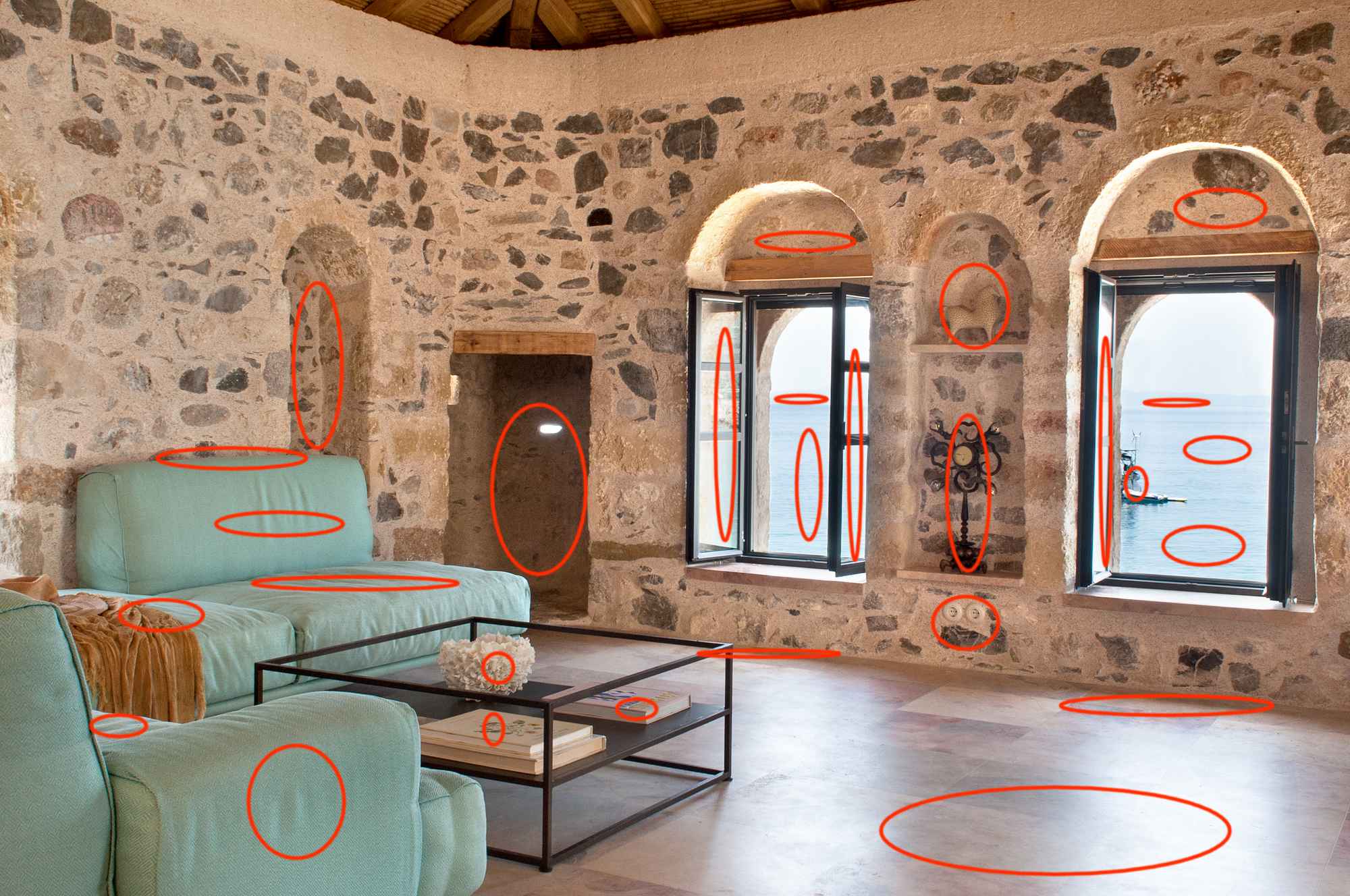
*I use the term palace to refer to spots that are collections of loci, you could imagine a bottle, a shoe, a person, a Barret cal. 50 and the Royal Palace of Caserta
and use all of them as “memory palace” just as much.
Being simplistic each of this ovals could be used as loci.
Consider contrived palaces from your own mind, of all sorts. You have to be delivered, I consider this palaces much more enriching as they make use of cognitive biases of memory that prime us to remember/memorize. (self reference, generation effect, availability bias, primacy effect, humor effect, modality effect).
Memory worlds, as I could these, could be of any kind and a mixture of all sort of imaginary things: valleys and houses, cities, continental views, maps, mansions with reference to memory palaces (portals). But even these kind suffer from being too formal, consistent with what you’ve seen in reality or media, what’s best is that the world is so imaginary that it comes from your mind, like dreaming awake. But this is a conversation for another day.
Interesting that a single image would create enough of a memory trace to be able to recall the new word and its definition. Maybe you are using the palace less as initial encoding but more as an index for the purpose of multiple reviews. I would be curious if you have any comments about that. Thanks.
Anything in your world can be used as a loci. It’s easy to think of the word “palace” and think that all the loci need to be in one location. They don’t for your purpose. They can be distributed across many different locations. Your brain will know where to go.
You might consider doing a few passes of the list of 1000 words and only use loci for the most hard to learn words. You probably already know some of those words and some of them will be easy to learn. That will save you time.
Have fun.
I make a habit of forming images like movies, like an internal link system, but those movies become snapshots and become a single image.
Memory palaces aren’t supposed to be used for mnemonic images, the memory palace is just where you place the mnemonic images. Once the associations are made, idea to image aka mnemonic image, then you look for a place where you plan to look in the future to recall.
Hi there!
I’m new and still figuring this all out. But after reading Memory Craft, I’d say some ideas you might look into (besides others mentioned here) are using places in virtual worlds (maybe your favorite video game?) and memory boards. Have a look at Dr. Lynne Kelly’s Ted Talk to see an example of a lukasa memory board.
Also, are the words grouped in any particular way? If so, you could make a separate memory palace for each group.
I have just started searching. I am amateur on memorising techniques. Is there any source how implent this techniques with examples? I basicly know it but when it comes to 1000 location the small area gets complicated.
Regarding locations:
If you have questions, go ahead.
The easiest way to start with those 1000 words would be the link method. A link from one word to the next can be done with one sentence. So linking them would be 1000 sentences. You could even number each sentence but when read together they form a journey.
Hi
Majors works best for me. No way would I be able to remember 1000 ‘insignificant’ loci!
For example - 991
99 is PuB
1 is Bun
I go to a PUB and order a BUN
Pierre
How about using a palace of palaces?
First palace has 10 loci and every loci acts as a link to a 100 loci palace. There you have 1000 loci.
Could you please explain it in dept? How could I find another 100 loci to link it?
@riyadist First of all, a disclaimer. I am not a memory expert. This is what I learned over the years.
Memory techniques are not to be used all the time. They are like trump cards. You should use them sparingly. Only when usual ways of remembering are not helping in remembering the stuff.
Here is an example:
Let’s say you want to remember SAT word Ambivalence = Uncertainty
step 1: AmbiValence can be broken down to Ambi-val-ence. Just chunking the word.
step 2: Can we find out how it got originated? Google helps.
step 3: Is Ambivalence a negative or positive, or neutral word? Google helps
step 4: Can you create a sentence using ambivalence and imagine talking with your peers/parents?
example: “I feel ambivalent about using memory techniques all the time!” as if you are talking to your friend John/Sara : )
step 5: Repeat the sentence before sleep and after waking up.
step 6. If you don’t remember after previous steps, bring out your big weapon, memory palace, and put the word in there.
Most likely, you won’t need that.
HTH
For making palaces there must be some posts on the forum. You have to just think about familiar places / streets / etc and chunk them into loci like @InMyMemoryWorld showed earlier. Somebody else might be better at explaining this.
Could you not make a 100 peg list from some of the words and then have 10 word lists off them?
There are people who have 100 places in a room however I think that is advanced to do especially in modern rooms.
As mentioned earlier Dr Lynne Kelly has a description of various things including large item journeys.
Is there a place to find more of these pictures with loci already marked. Seems like it would save some time.