Memory journeys with fixed 'people' at each locus point

I’m working mostly on my memory journeys (/palaces) at the moment - the ones I’ll use for temporary information such as card drills.

I came across @katiek 's idea of having a fixed ‘person’ at each locus point, so that they can interact with whatever else you put there (including more abstract words or verbs, for example). I’m finding this is working really well for building memorable images and I’d be interested to know if anyone else has tried this?

As a side note, I started by using people from my real life that I can imagine being at that locus point - e.g. a friend who likes parks sitting on the park bench - but just now I’m experimenting with cartoon characters, in alphabetical order like a peg list - my local park is busy at the moment with the likes of Apu, Bart, C. Montgomery Burns, etc. doing their things at the different locus points. Jury’s out on which is more effective for me currently. Would be interested to hear anyone else’s thoughts.

2 Likes

I use that for MP’s of more permanent subjects.
For example, in a MP on psychology, I would be met at the door by Freud who would walk with me through several loci, explaining the materials at them to me (I can ask questions too, if I require more explanation).

Depending on where I’m going, Freud would hand me over to another psychologist who would then be my guide.

At other times and/or other subjects, it could be a self-guided tour.

2 Likes

I haven’t tried it before, but it sounds like an intriguing idea. I do have a question, though. If we’re supposed to assign one person to each locus, then if we have, say, 1000 loci, we would need to find 1000 distinct individuals, which means we need to be familiar with 1000 people, whether they’re real or fictional characters. Identifying one person for each locus, especially for 1000 loci, seems quite challenging! How to address and overcome this challenge?

Does this actually create permanent memories and mental images in your memory palace? Could you please explain further?

Hi, I should be clear that these are memory journeys that I’m planning to use for non-permanent information like card memorisation (my focus currently), random numbers and random words.

My card system produces syllables, like ‘hit, sim, cot’, for example (see here: Adventures with a 2-card system). So let’s say I’m using my local park/Simpsons characters journey and those syllables are produced by the cards. I’d see Mr Burns by the swings my local park, and he’d then HIT a SIM card in a COT - that’s easier for me than creating an image for those three syllables without a person to attach them to. The next time I use the journey, Mr Burns would still be standing by those same swings but he’d have new syllables/words to interact with.

As regards repeating people, I haven’t done so yet but I’d be open to it. It wouldn’t be a problem if a friend I met at work appears once in my “old work” journey and once in my “old house” journey, for example. But between all of the people I’ve met in real life and those that I know from TV, film, etc. I doubt I’ll need to repeat too much anyway!

2 Likes

It isn’t too much of a challenge to find people - I use people I know, TV characters, film characters, sportspeople. I have several thousand locations and I don’t repeat people, except in a handful of cases where I’ve done it accidentally and it just stuck. Not really an issue if it’s a different journey (i.e. a person appearing in my Cards journey as well as my Numbers journey shouldn’t cause too much confusion).

2 Likes

After testing by placing some random fictional and real people in one of my journeys, I found that remembering people and the information linked to them is much easier than recalling typical inanimate objects and their associated mental images. I also noticed that associating information and mental images with people is significantly easier and faster. Is this the main reason why you and some other mnemonists use people in your memory palaces?

I tried this with manga characters, and it didn’t work well when it comes to re-usability. However, it might be because I was the practising on the 1 minute format one set after the other, so that the whole process was very prone to ghosting.

Additionally, I am of the opinion that anything extra that is meant to serve as part of the palace might engender inefficiencies given that it is a form recall overhead; it is something that you must retrieve on-top of the palace, and is not part of the memory itself.

I would like to ask: What do you think it would be like if we wanted to create memory palaces for our needs and luxuries and if we ranked our needs according to our five senses? We would identify each of our needs and go to a building accordingly. Our sense of hearing may be related to music, health sector. Our sense of sight may be related to cinema, theatre, visual arts; our sense of taste may be related to the food sector. All these sectors have a corporate identity and a building.

2 Likes

For me the person is almost more important than the location, I don’t recall them separately before adding the information.

2 Likes

Yes, I initially did it by accident because a person who I’d memorised in the location got almost “stuck” there, and I found it was easier to memorise the information by attaching to them rather than to the location.

4 Likes

If you have a cast of 100 people in Major System from #00 - #99 then surely you don’t need to use loci to your point?

I have just completed a cast of 100 people coded in Major and I think I could just use them as a memory palace instead of doing a journey method through my environment?

2 Likes

I would have thought that you need to picture them somewhere, though? Everyone’s different but people floating in space doesn’t work well for me. If they’re placed along a familiar route then recalling them and the journey quickly becomes automatic, and they have a place to do all of the interacting that I need them to do with the new, added elements.

2 Likes

Yeah you need quite a few of them cos using the same journey within, say, 10 minutes of the last time is fatal for ghosting/muddling up. At the moment I’m working with 5 memory journeys of 20 loci each. I work through each of them forwards, then each of them again backwards, so I’ve effectively got 10 journeys, which is ample for me currently.

1 Like

Yes.
The MPs, are standard (various objects and portals) at each loci. The person helps identify to what subject the objects/portals belong.

I can ignore Freud or whomever for regular recall (although they are still there, aiding in identifying the loci)…they just stand there in this case, (although they will hold open a door). Or, I can interact if I want to take a ‘stroll’ through the MP (for occasional review).

If i want to remember to add something to a loci, I can ask the character and they will write it down in their notebook, then when I see them again, I will be reminded.

1 Like

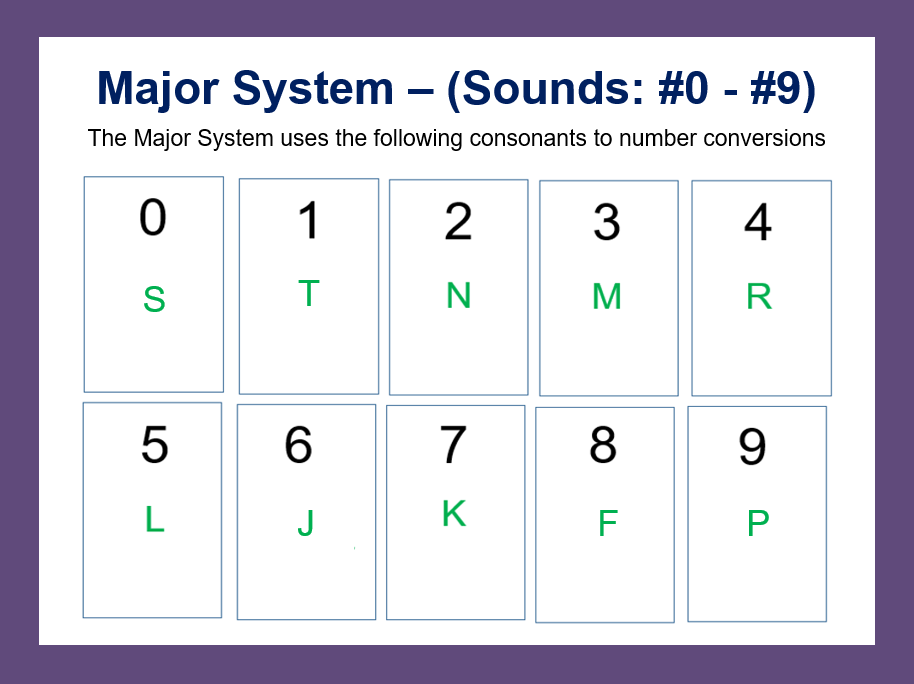
No I think maybe you are missing my point. The people I have chosen in my “People Palace” all follow a sequential numeric pattern from positions: 00, 01, 02, 03, 04 …95, 96, 97, 98 and 99. The numbers follow the letter patterns below to give me the initials of each cast member (Person):

So the cast of characters or People I have in positions 95, 96, 97, 98 and 99 would be as given as:

#95 = Peggy Lee
#96 = Pat Jennings
#97 = Paul Kruger
#98 = Peter Falk
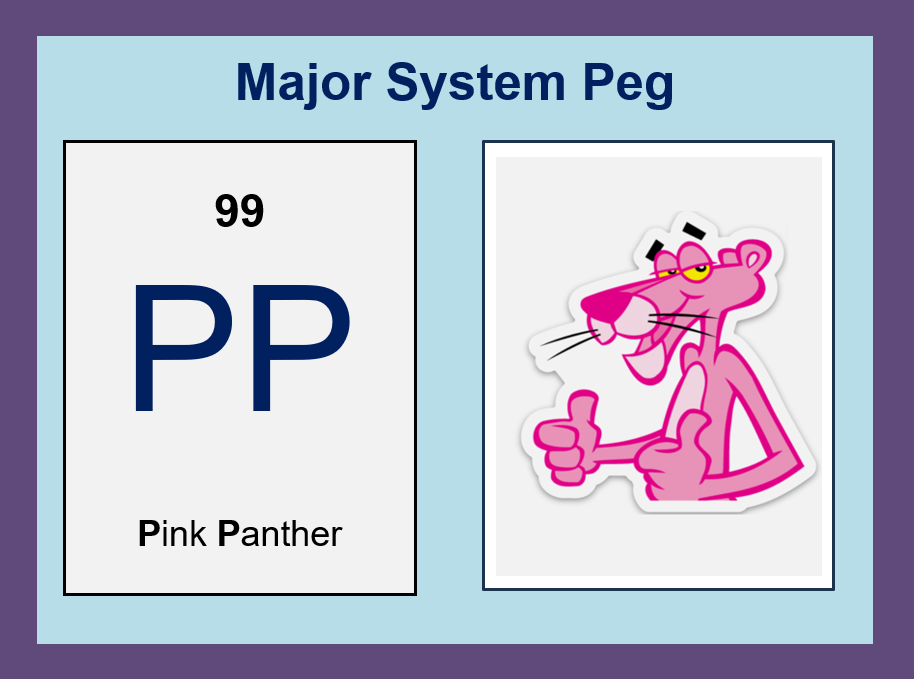
and #99 = Pink Panther

Note: I am only interested in encoding the first names - first letter and the surnames - first letter as shown in bold. For example, #99 = Pink Panther:

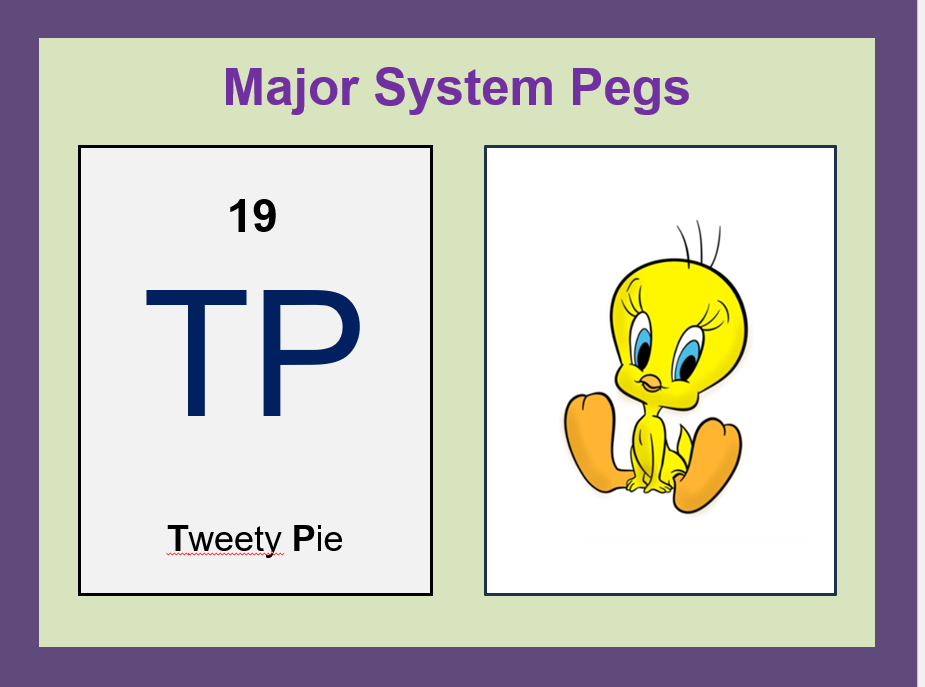
Note further that some of my “People” (for example: #99 = Pink Panther and #19 = Tweety Pie) are actually cartoon characters as People stand-ins):

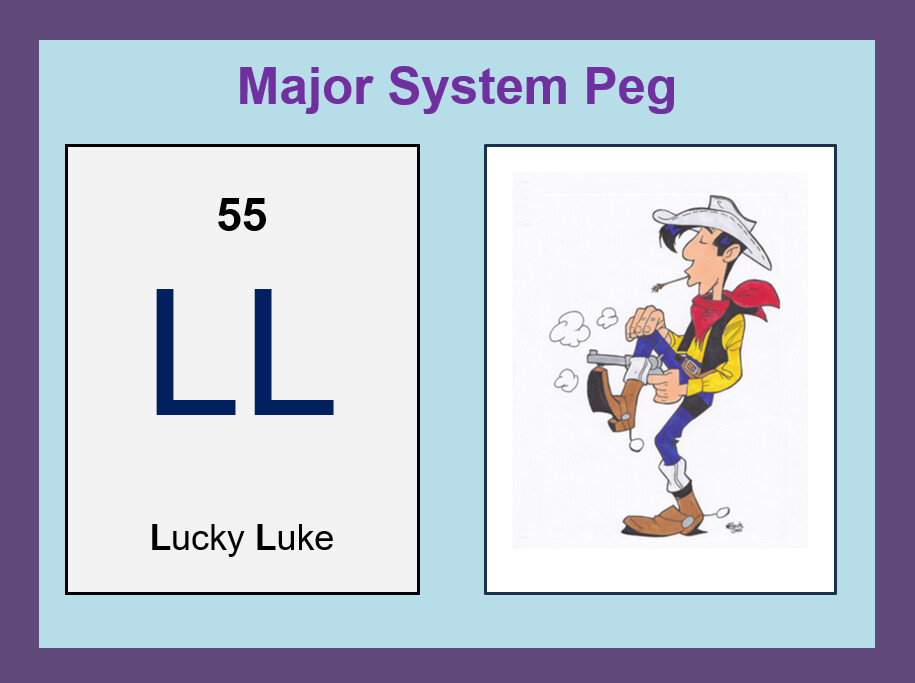
If you have encoded 100 people according to the code I have given above then you will immediately known, for arguments sake that position #55 is taken up by Lucky Luke!

I have always found that PEOPLE are always far more memorable to me than either ACTIONS or OBJECTS.

So what constitutes a weak image for PEOPLE? Those that slip my memory or are ambiguous in some way. Weak PEOPLE images are commonplace, boring and mundane. So to make my PEOPLE images as strong as possible, I am careful to select as wide as cast of PEOPLE as possible. It doesn’t help to have #81 = Fernando Torres and #84 = Frank Rijkaart and #85 = Frank Lampard. Too many FOOTBALLERS spoil the broth, so choose #85 = Frank Lampard but jettison both Fernado Torres as #81 (Rather use Friar Tuck) and get rid of Frank Rijkaart and rather use Finn Russel for #84. I choose PEOPLE who are diverse and colourful. Forget about the bland PEOPLE they don’t work as well. Rather have villians and mass-murderers, etc. in your cast as opposed to sticking rigidly to "A-rated Hollywood actors”. Importantly, PEOPLE are animate and can DO THINGS (ACTIONS) to OBJECTS in PLACES. So PEOPLE come out trumps hands down for me over ACTIONS and OBJECTS. I have also found cartoon versions of ALL my PEOPLE (#00 - #99) as cartoons offer far more MEMORABILITY as they usually, exaggerate, and ridicule the PEOPLE they are portraying. At least that is the way things work for me.

I hope that clarifies the PEG SYSTEM or PEOPLE PALACE that I use better for you?
Exactly. I have 100 “2-digit people” that I could use in place of a journey, but the spatial aspect of the locations really helps.

3 Likes

Would an Object that supplements the PERSON in some way work equally as well as a LOCATION? If you are putting PEOPLE at each LOCI, can it be said that the loci are embellishing upon your PEOPLE images and that possibly an OBJECT may work equally as well?

By way of example my person peg for #64 = Jack the Ripper. His obvious go to OBJECT is the glimmering silver coloured blood stained knife that he has just commited his heinous crime with.

1 Like

Hi @fred2 - thanks, I do understand your system. If it works for you to just use a sequence of people in a logical order and to add the new elements (e.g. random words, cards or numbers) to those, then all power to you! Personally I find the combination of a familiar (real world) journey and familiar people/characters to be very potent, both in terms of creating memorable, contextualised images and for easily recalling who the next person and location on my journey is, before adding the new elements to them.

I think I’d struggle if it were just a bunch of people in a particular order (e.g. alphabetical, or using the Major System as you describe), but without a spatial context that I can move through mentally.

3 Likes