Hi all, I thought I’d start a wee thread about my progress in creating and using a 2-card system, similar to what @TheHumanTim has been doing for a good while now. The aim is just to have fun with it, ultimately I’d like to be able to memorise a whole pack within a minute or so, but I’m not in any rush.
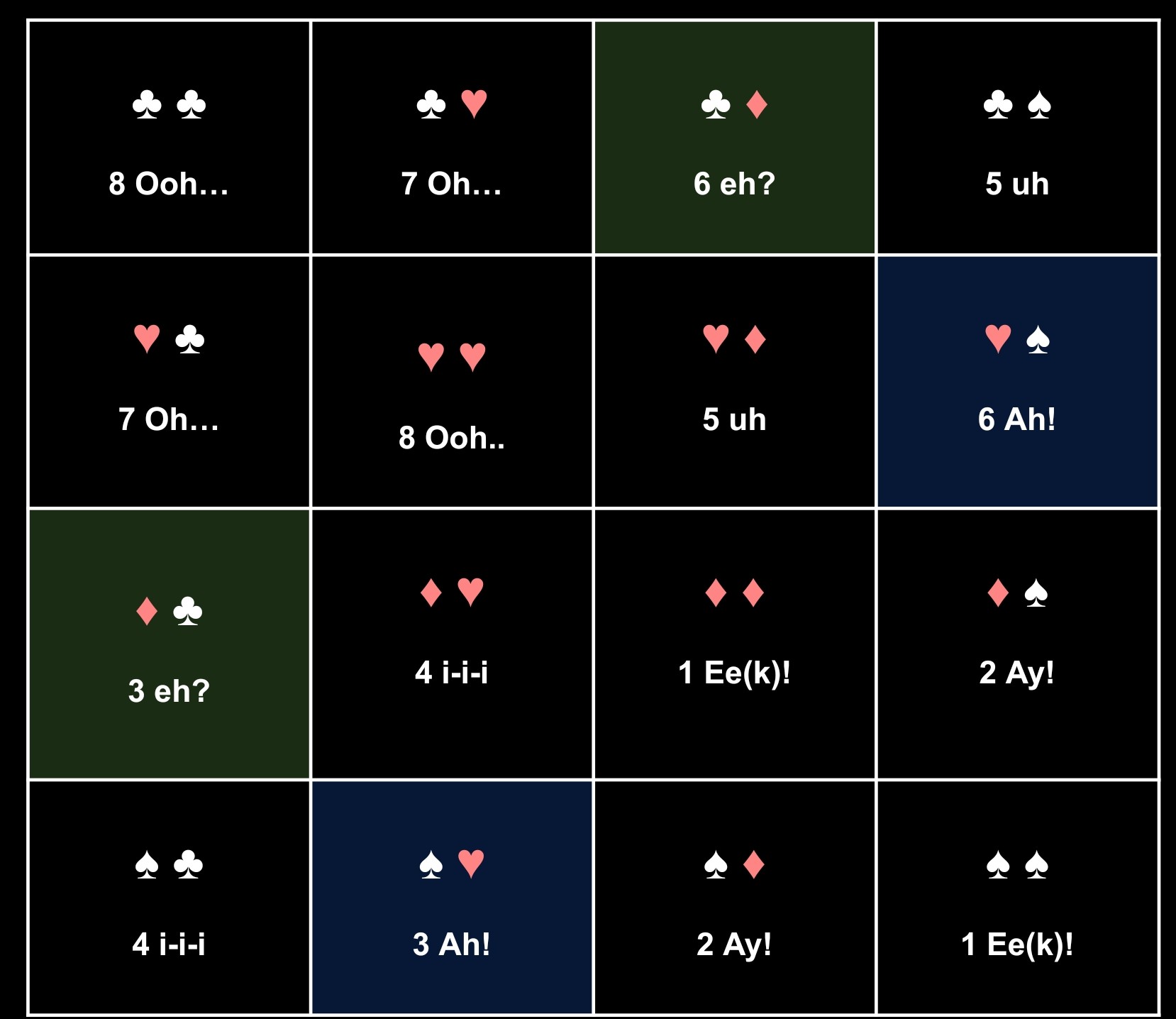
I’m using Katie Kermode (@katiek)'s card system, explained here https://katiekermode.com/card-system.html, though I’ve changed the way some of the vowels are generated into something that feels more intuitive to me. Essentially, I see clubs/hearts as ‘rounder’ shapes and spades/diamonds as ‘pointier’ shapes, so using this table, the ‘rounder’ card pairs are matched with ‘rounder’ sounds, and the ‘pointier’ card pairs to ‘sharper’ sounds (at least to my ear).
Each vowel sound is linked to a kind of feeling/emotion, hence the way I’ve written them: ‘ee’ (Eek!) is fear (at all those sharp points), ‘i’ (i-i-i) is discomfort as the point of the diamond pokes the soft surface of the heart, for example. These associations have helped me to learn the rules pretty quickly.
I’m gradually building a list of image/word associations for each potential syllable, but I’m actually getting some pretty good results already, just making these associations ‘on the fly’ as I ‘read’ the cards and place them in one of my palaces. Good fun!
The adapted ‘Katie’ system that I’m using requires word/image associations for syllables like ‘to-’ and ‘te-’, with no final consonant (when the card pair ends with a King). I’ve been struggling a bit with these, so today I decided that all of these would be people or characters from pop culture whose names start with this sound. I might also use these for 2-digit numbers when I need to remember these for whatever reason: so 72 becomes ‘ke-’: Kelly Macdonald (), 45 becomes ‘ru-’ Russell Brand (), etc.
This will help me to differentiate from other card pairs and numbers if I try to use inanimate objects elsewhere, so ‘kel’ could be kelp (seaweed) and ‘rus’ could be rusty machinery.
@katiek I’d be interested to know what sorts of associations you came up with for these CV syllables with no obvious independent meaning (e.g. to-, te-, ke-, ru-)? Did you have a consistent strategy for dealing with these or was it more varied?
Hi, I treat them like any other syllables in that some of them make words and some don’t. For the ones that don’t, as always I just try to come up with something similar or use a longer word that has that syllable in it. For instance, “ru” is the flag of Peru, or some other association with Peru. “ke” is Queso (a cartoon character). I used a few of the Japanese katakana too, like ミ for “mi”.
Your idea is nice though!
Just wanted to check, “to” isn’t used, unless you changed the vowels to include the short “o”, or did you mean “toh”, which would be “toe” of course…
Hi Katie, thank you. You’re right that I won’t be using ‘to’ in my card system (so it was arguably a bad example to use!), but I’m including it in word/image list for now as I think I’d like to use these images for 2-digit numbers when necessary too. So ‘to’ would be 14 and might be Tom from Tom & Jerry. I think I just like the idea of strong character images for 2-digit numbers, maybe cos I’m nostalgic for my (never-quite-completed) PAO system!
Makes sense. I also have 2-digit people, and they’re really useful for all sorts of real-life things. I don’t use many people in my Cards/Numbers system as I tend to forget which person it was (but that’s just me!).
Great, yeah I’m limiting the number of people I use in my system, apart from these 100 entries, for similar reasons. I’m also using the ‘one consistent person per locus’ idea that you mentioned on a podcast some time ago, which is really helping images to stick better. ‘Suit, fork, calf’ (e.g.) interacting with my old housemate is a lot more memorable to me than ‘suit, fork, calf’ interacting with each other in the corner of a room of my old house!
I’m making intentionally quite slow progress on this atm, because I want/need to focus on other things. Still don’t have a list of 1552 consonant associations (1352 for cards + an additional 200 for numbers). Instead I’m focusing on building a few good memory palaces and working through them using just one consonant at a time, by randomising the full list of ‘Katie’ syllables in a randomiser app.
Without having invented a fixed association for each syllable, I’m being inventive with the ‘nonsense’ syllables - for example, jAg became an angel going for a jog (jog + A vowel sound), which is working well enough for now!
This evening I attempted to memorise a full deck using my current sort-of system and a newish memory journey.
My results:
7.5 mins encoding
19m attempting to decode
21 card pairs guessed correctly
3 card pairs guessed incorrectly, 2 card pairs missed altogether
It’s quite sobering having actually timed myself! I should add that I have COVID atm and feel like dog poo. Also, that I kind of enjoyed the journey (though that 19m of decoding was pretty painful!). Over and out for now.
I link color to each and noticed this too, but have not put words ( except for yellōw and maybe dark grāy). I felt the expression in my face while drilling the matching vowel sound and felt perplexed. It will add depth to follow your lead and note how many of these 16 have an emotion.
I’m going back and forth a bit at the moment between different ways of doing things - after flirting with the idea of a two-block system over the weekend, I’m going back to the shadow system for now, with a few adaptations:
16-loci memory journeys. I’m finding 20- loci journeys a bit unwieldy and hard to work with. According to some maths done by @TheHumanTim a while ago, there’s a less than 1/20 chance of needing more than 16 loci, each time you run through a deck of cards using the shadow system. I’m good with those odds. On the odd occasion that I run out of loci, I can just jump to another palace.
Rhyming image lists. I was creating images for syllables in alphabetical order, which meant creating lists that went da, dad, daf, dag, daj, etc. … But after some play, it now seems more intuitive to me to create rhyming lists, e.g. had, dad, gad, tad, nad, etc. It feels more natural and image associations are coming more easily.
Pegging images to body parts. I’m reviewing image lists periodically as I go, and I’m keen not to use flashcards for now. To that end, I’ve started mentally ‘pinning’ images to consistent parts of my body, based on first letter, like so:
head h
tummy d
groin g
left shoulder t
right shoulder n
left elbow m
right elbow r
left hand l
right hand f
left knee k
right knee f
left foot p
right foot s
So one list so far looks like:
head: heet, heater
tummy: deet, DEET spray
groin: geet, Bhagavad-Gita
left shoulder: teet, animal’s teat
right shoulder: meet, hunk of meat
etc.
All of this is feeling more fun and fulfilling so far than my previous way of doing things. Onwards and upwards!
 ), 45 becomes ‘ru-’ Russell Brand (
 ), etc.