I would argue against it being taught as a subject on its own. The schools I am working with are introducing the techniques through the curriculum when it suits. Then they are building on those techniques. I saw the most amazing memory palace based on Australian Aboriginal songlines last week. The students did all the major historical civilisations in chronological order in a pathway through the bush at the back of their school. They then did a ‘woodhenge’ like my interpretation of the Neolithic version of timber (and stone) circles. At the Woodhenge, they drew together their knowledge of the civilisations and what we have retained from them today. It worked a treat - and these kids were 9 year-olds. The school will then be using the same pathway for other classes and other topics.
I wrote about that here:
Students have created handheld memory devices (based on the African lukasa) for specific topics. Uni students for astronomical constellations, little kids for specific topics in biology. Others have used characters, songs, stories, art … all in the context of subjects though. The aim is to slowly build up their toolbox of methods for life!
But so far it has been a few exceptional schools / uni departments with very enthusiastic and imaginative teachers. I haven’t infiltrated far. I am involved with a major study at one university in the Psychology department which is going to get (if all goes to plan) over 2000 first year students building songlines as memory palaces. It will be with Indigenous experts as well and part of a study for a post-grad student. The post-grad has Memory Craft with so many stickers in it, I think she knows it better than I do!
I must stop equating songlines and memory palaces - the professor and student involved see the complexity of songlines as a level higher than memory palaces because so much knowledge and understanding is layered. The first post-grad working on my stuff, and she’s found fault already! And rightly so. They are also arguing against some researcher who claims that the peg system and the method of loci are equivalent. That is part of the research project, but I haven’t read the psychology papers they have sent yet.
So I am exploring the implementation in education, but it will take time. I was a teacher for over 40 years, so have some street cred with educators.
I am so pleased that you loved the Rapscallions. I think I still underestimate the value of physical characters with whom the students (and anyone else) has an emotional attachment. I see it working so well in schools.
I wish I’d known about memory journeys decades ago. We owe it to the next generations to ensure that they do.
@LynneKelly Hi Lynne, I love your books Memory Code and Memory Craft! Two questions occur to me:
(1) You noticed many cultures destroy their memory objects when there is nobody to pass the knowledge on to. Why is this, if memory objects are meaningless without being taught the associated stories?
(2) On cowrie shells as a memory aid: A lukasa works by associating a unique shell/bead (the peg) with an image/story. A memory palace works by associating a unique location (the peg) with an image/story. I don’t understand how tossing palm nuts or cowrie shells can create a memorable peg. Is it essentially a random number generator, to prompt you to ‘review a topic’, a bit like spaced repetition? (‘Today there were 7 face-up cowrie shells, so I practise song number 7.’) If so it seems strange, since numbers 7-9 will come up a lot, and 0 and 16 hardly ever – and you would still need another mnemonic device to remember the information. Or does the pattern of the physical objects somehow form memorable peg, so e.g. if you want to remember the properties of a plant, you imagine 10 face-up cowries and 6 face-down cowries, which form a peg that triggers your memory of the relevant images? I find it hard to believe this would work, but I’m willing to be corrected.
(The closest I can imagine to this is seeing a chess opening position, which I can immediately recognise as ‘the Sicilian defence’ for example. Over time I see lots of positions (Sicilian, English, Morphy…) which could prompt me to review my knowledge of those places and people, a bit like spaced repetition. But it would be very hard to go a step further and use the layout of the wooden pieces as a memory peg.)
Lovely to hear from you. These objects are more than just devices once you have used one and invested emotional energy into them. I feel something I can’t explain with my various lukasas (technically, the plural is nkasa). My attachment to them is huge. In Indigenous terms, they are spiritual, powerful and can’t just be handed on like ordinary objects. They have been given that power by ancestors, usually. That is the case with my coolamon. So my Warlpiri colleague who gave it to me said that these objects aren’t owned. Like Country, you have custodianship of them, not ownership.
If there is no-one initiated to a level to be trusted in taking it over (what that is varies between different cultures) then the object must be destroyed lest it come into the control of someone unsuitable. The term I often hear is that it would be ‘dangerous’ otherwise. Not being part of any of those cultures, I can’t fully understand, nor would I be in a position to be given a full explanation.
Sorry - but that’s the best I can manage.
I have gone back to my references on the cowries, and noticed something relevant to my new research which wouldn’t have been of consequence before. So I am distracted. I shall return to your questions soon. Thank you so much for sending me back to this research!
The methodology is more complicated than either of the possibilities you mention. Plus there are various systems, so the method is not consistent between cultural groups. I simplified in the book, but a memory expert will memorise all the verses, learning them in order, I gather. That is the way the knowledge is stored. So memorisation and divination are different processes.
When the system is used for divination - the way the cowries / pinenuts or whatever fall gives the reader the key to answer the questions of the client. Hence the pattern triggers the information. The fact that this isn’t evenly spread may reflect that some information is required much more often than others (health, wealth …).
I had a limited number of words, so summarised. The sixteen cowrie version is in this book, Sixteen Cowries:
where about 300 pages are translations of the knowledge memorised. The fact that this is documented so thoroughly shows that the system must work. I cannot imagine how they do it. I have tried and found it does work, but is so much harder than using a lukasa or memory palace or almost any of the other techniques that I abandoned that experiment.
The other book, which talked about a number of versions is The Cult of If a among the Yoruba:
This is how strong chess players memorize in practice without the aid of memory techniques. They immediately recognize pawn structure skeletons and the related opening themes. They associate strong moves or ideal squares for their pieces in relation to the pawn structure skeleton.
If an English pawn structure transforms to a Sicilian pawn structure they quickly can recognize the new structure and adapt to the strong moves and squares associated with that structure.
More mid-level tournament players often can’t recognize the new structure unless it was a Sicilian from move 1.
Alternatively they often remember complete chess games that they associate to the person who played it and the event location and year.
On somewhat rare occasion “stupid looking” or anti-positional moves are the strongest moves in the position for immediate tactical reasons. These moves are the hardest for professional players to remember because they can’t chunk it to the pawn structure as a universal idea. I believe these “stupid moves” will be one area of chess memory enhanced a lot by using memory palace.
God, I LOVE this website. So many people, with varying background, with varying educational levels and skills, and EVERY. ONE. is pursuing something of intellectual benefit. So much to learn.
Thank you for answering both my questions. I think I can (begin to) understand. I imagine it must be a sad day when you realise you are the last in the line, and destroy the lukasa or monument.
Good day.
I have a question regarding the books. From what I have seen, it seems “The Memory Craft” is a more practical book, while “The Memory Code” is the historical background in ancient civilizations. The Amazon Preview only shows the index and few pages.
I am already familiar with many things of the “art of memory,” so I am not so interested in the practical aspect. I would like to go to the purely historical part.
Is “The Memory Code” what I need?
Thanks
Your assessment is right. The Memory Code is the way Indigenous cultures implement complex memory palaces and store vast amounts of information, but also using decorated objects, music and performance. That understanding is then applied to ancient monuments like Stonehenge. Not the belief systems, just the memory technologies, showing how perfect ancient monuments are for this if you take all aspects of their archaeology and chronology, not just the famous bits.
I am leaning Chinese / Mandarin, but simplified script. Both The Memory Code and Memory Craft are being translated into Simplified at the moment. I want to try reading them when they come but I’ll be nowhere near ready. I haven’t looked at the Traditional one since I started learning. I shall go and do that now!
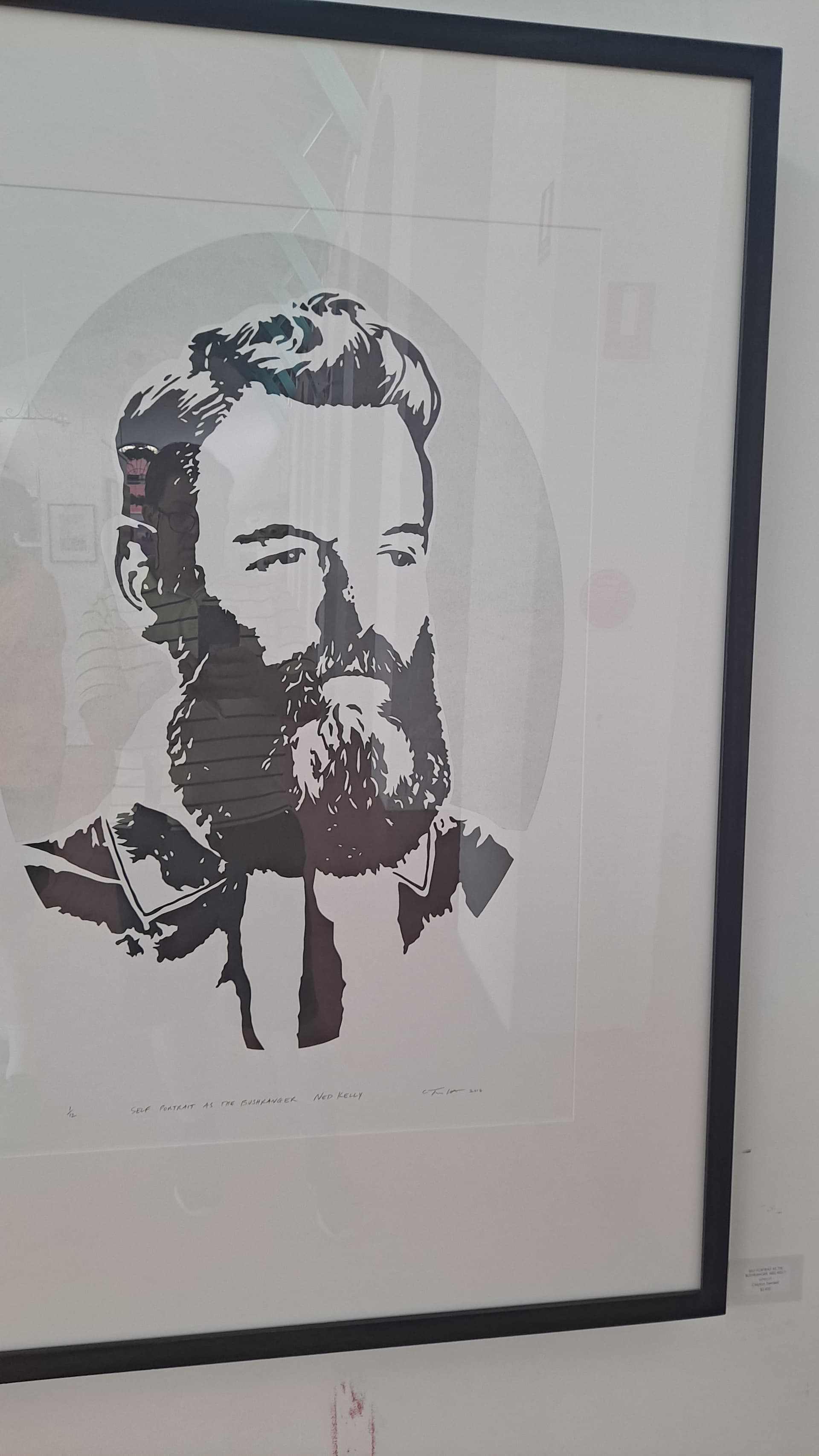
Is that in the Castlemaine Museum, and art work by Clayton Tremlett? I live a few blocks from there and know Clayton.
As to the question, no relative. Kelly is my married name. He is not a relative of my husband either. Damian’s great grandfather was one of the police pursuing Ned Kelly. So we’re related to the other side!
So I just finished Memory Craft, and it motivated me to get back into the world of memory, and join this forum!
Many years ago I read Tony Buzan’s books… I guess… nearly 30 years ago? I picked up a few techniques and got quite into the major system, learnt the periodic table as a “proof of concept” but then my interest tailed off. I’ve read some more books and occasionally dabbled with bits and pieces since then, particularly when starting to learn Chinese 10 years ago, but nothing really stuck in regular use.
I really enjoyed your book for the historical / cultural context as much as the memory techniques themselves, although your descriptions of actually practically trying to use the different methods was the best and most motivating part! It’s certainly the first “memory” book where the content definitely justified a full book treatment, often they are more like 20 pages of actual content and 200 pages of examples
Looking back now I can see I made some poor choices in structuring memory systems (e.g. not using memory palaces or journeys as a structure and instead trying to rely on number-based frameworks).
Anyway, thank you for writing the book, and (looking at this post and others) being so active and engaged in responding to readers!
 And rightly so. They are also arguing against some researcher who claims that the peg system and the method of loci are equivalent. That is part of the research project, but I haven’t read the psychology papers they have sent yet.