How to turn the new passive vocabulary stored in memory palaces into active vocabulary?

Hello!

English isn’t my first language. I work at a foreign company and I’ve been struggling with communication, especially in meetings because my speaking abilities are quite poor. I’ve concluded the main reason is my inability to find words to describe what I see/know/feel/need, etc. My vocabulary is minimal and I’m always left scratching my head thinking or attempting to recall the word of this or that

To remedy this, I’ve been attempting to improve it by learning new vocabulary. I’ve downloaded a list of 10000 common words and spent months focusing on storing these new vocabulary in my memory palace and spacial repetitioning them. I’ve memorized ~200 words so far (I’m very slow with memorizing words)

Unfortunately, I’ve discovered that I don’t use any of those words in my speech or even in writing, at all.
I tried going through a set of words and attempting to put them in a sentence to become comfortable using them. I also tried categorizing them into topics to talk about and use them. It’s a long agonizing process that bears no results. I still resort to the vocabulary I’m most comfortable with. Same with grammar. I spent time on it but my brain forgets the grammar and goes with what I already know, be it correct or wrong.

I can’t tell what I’m doing wrong. This isn’t the first time I’ve used memory palace wrong so there are a LOT of doubts about what to do

What should I do? Please help.

  • Please suggest a schedule that I could mimic
  • Please suggest how to analyze what’s working or not. I have no idea when am I supposed to see the results. Days? Months? Am I supposed to be able to use a word or a list of words at the end of the day/month/year. What/when to change strategy if I saw no results
  • What to do with words that contain several meanings? For example, Cultivate, Yoke

Any suggestions would help me tremendously in this long tedious lonely journey because this isn’t my first second or third attempt at this

I’m attaching one of the memory palaces I created if it helps:
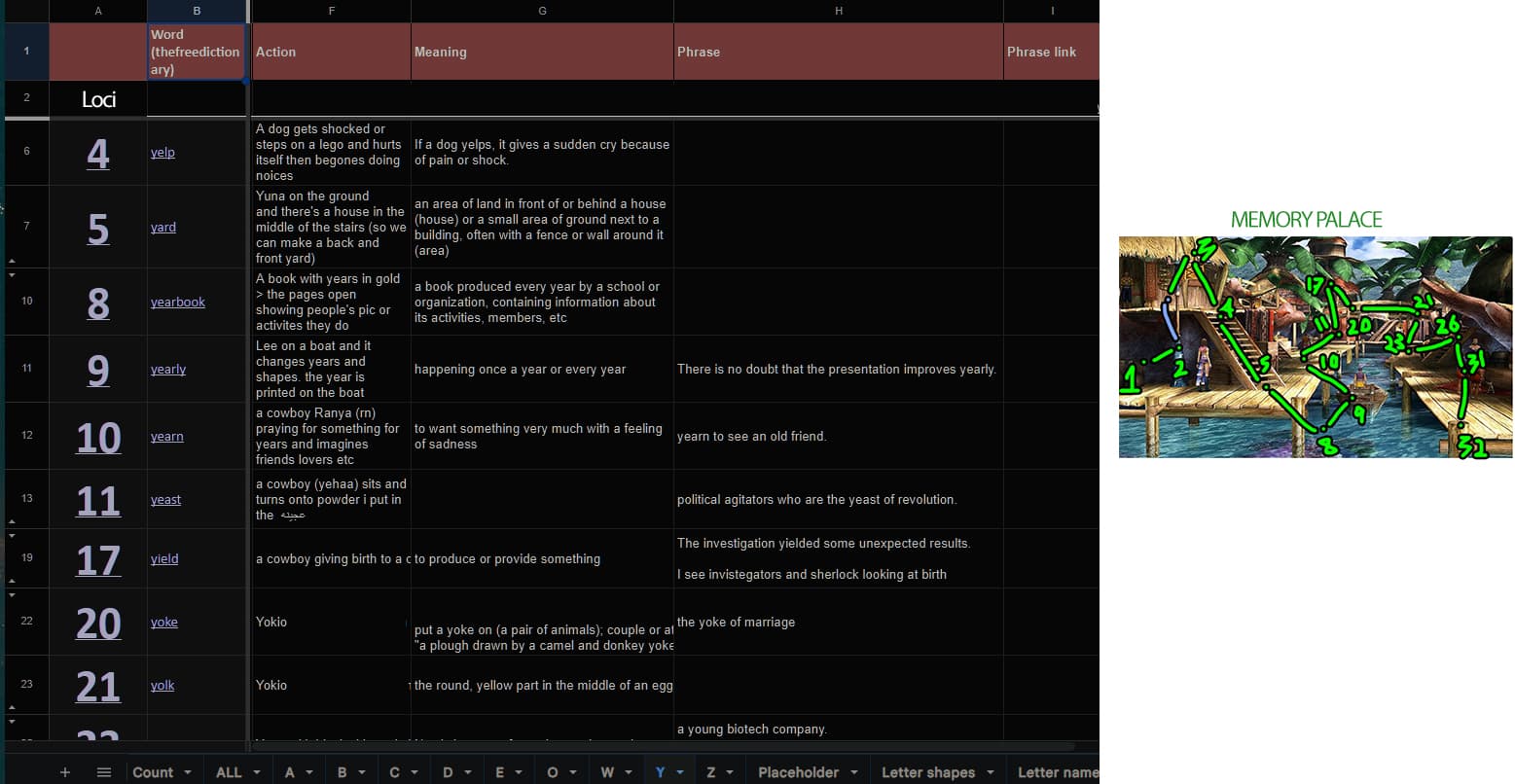
Thank you in advance!

1 Like

The thing is, a memory palace is not great for active vocabulary. It’s great to get a start on a language if you start from zero, or to get to reading more advanced texts quicker. But for your particular problem, I’m not sure it’s the right tool.

For active vocabulary there is nothing that will replace practice. And lots of it. When you’re in a stressful situation (a real life spontaneous conversation), your linguisitc abilities are the first thing that go out the window.

Between using the new words, prononcing them correctly and using correct grammar, and adding to that, processing what is being said and what you want to say (not only the words, but the ideas, reading the room, etc.)… It’s just too much to do at once and only the things that you have repeated so much that they are completely automatic are going to stay.

(In short your difficulties are perfectly normal :smiling_face:)

You need deliberate/targeted practice. It’s not going to be enough to just use a word or expression once or twice in a sentence.

Here’s what I would try. Choose a few expressions that you wish you had used in a meeting and that you think are going to be useful again.

Drill them for prononciation, for voice intonation, etc. Every time you repeat them, concentrate on one thing at a time. Never learn words in isolation, but repeat them in sentences so that the correct grammar becomes automatic too. Then roleplay or record yourself making a video using it in different sentences. Talk to yourself in the mirror every chance you’ve got… This is the basis, about ten minutes of targeted practice a day. Slow and steady wins the race.

Also it’s hard to do it alone… It probably would be a good investment to get a coach, at least to start with, to give you the tools to evaluate yourself and design your practices more effectively. It’s really hard to pinpoint the exact problems without actually speaking with you.

And if (ideally through your coach) you find a community of people in the same situation that also want to practice and are going to be non judgemental, it’s going to be extremely useful.

Also a coach could help you with fixing goals that are actually useful and actionable (because formulating good goals is really not so easy).

Judging progress with languages is hard. Often I feel like nothing happens and then suddenly I notice that something that was hard a few months ago feels… normal. A good coach will help you learn to evaluate yourself and determine if what you are doing is effective or not, even if you don’t feel it in the moment.

5 Likes

Sorry that you’ve put all of this effort in without having much results! For what it’s worth, you communicate very well in your written post here :slight_smile:

What you describe is precisely why I’ve often recommended people not to use memory palaces for learning languages: the retrieval process from the memory palace is far too slow for speaking/listening. Similar to what @Hari-P has already stated.

Memory palaces are a great tool (I’d say the best tool) for quickly recording sequences of data, but not suitable for everything related to memory.

I would suggest to concentrate on the spaced repetition / flashcards aspect of what you’ve worked through so far, because this associative memory (native word ↔ English word) is exactly what you need when speaking/listening to English (or to whatever other language) to get the correct word in real time.

  • Find whatever flashcards tool you want to use (doesn’t matter really which one) e.g. Anki or Mnemosyne or whatever
  • Arrange the vocabulary that you don’t already know (you’ll know quite a lot from the attention you’ve given it so far preparing the memory palace! And from using it in everyday life! And because some words are just obvious) and that you want to learn (I’m a native English speaker and I’ve never used the word “yoke” in my life except when talking about electric motors) so that will significantly reduce the number of words you want to learn.
  • Put the vocabulary terms that you want to learn into the spaced repetition software. it might be helpful to do it by theme (maybe based on how you have sorted them in your memory palace). Furthermore, I’d recommend starting with verbs and adjectives before nouns.
  • Use the spaced repetition software with extra drills to get the associations into your longer-term memory and be able to use them.

Some words might just be difficult for you for no particular reason. Then maybe you can recall where you put them in your memory palace, to help you remember. But in the longer-term you’ll skip that step. Or, you might find some other ad-hoc mnemonic for some words to help shoehorn them into memory.

Separately, real fluency comes from active practice speaking the language.

I got good at Portuguese very quickly in the following way:

  • It’s similar to Spanish, which I already learned at age 20+
  • I used spaced repetition software to learn the most important words before going to Brazil
  • In Brazil, I just spoken Portuguese as much as possible (and realized my terrible pronunciation and non-native phrasing haha)

Additionally, although I’m strongly recommending against relying on memory palaces for vocabulary, if you search these forums, you’ll find other people who have the opposite opinion, and some of their suggestions might be useful to you.

3 Likes

It’s a very good point that Daniel T. made: be selective.
Better ten new words (or rather expressions, because words in isolation aren’t very useful) that you really know and can use, than a hundred that are usually passive anyway, even in your mother tongue.
For example phrasal verbs are going to be much more useful than literary words.
You can always add more later when you found a system that worked.
One good way to select words would be to listen to what other people said and write down the words they use when you think “oh she said that, and I know it mean this, and it was appropriate and expressed something I usually struggle to say.”

Something that is also good to do is to learn the afi and alphabetize, I also use virtual places and add links to them, I use characters in alphabetical order in the center and double consonant for the centers.

I agree with a lot of what has been written. Another very useful tool could be using ChatGPT as a personal tutor, with which you can practice using certain words in a sentence.

2 Likes

Good idea—I’ve used this as well with Portuguese.

I ask ChatGPT to ask me questions in (Brazilian) Portuguese, and then to correct my answers. What it did in practice was to repeat the text I typed, but rephrased in a more natural way that a Brazilian might write. Then I manually compared them and checked whether I should learn something from the differences.

e.g. if I use ser rather than estar, if I use an incorrect tense within the subjunctive mood, or if I phrase something unnaturally and I should learn a more natural way to say it.

1 Like

Oh man thank you so much for the detailed response!

I’ve signed up with a tutor months ago and their advice was to… speak a lot.
I wasn’t convinced because if doing something repeatedly would improve my skills then I would’ve been great about A LOT of things

I think my problem is that I’m not great at anything. I’m not saying this because I’m being harsh on myself. More like, I’ve no idea how someone improves at something. What to monitor? How long something should take for you to feel ready to start the next step? How do you know you are improving at what you are practicing?

My English is average. The problem is that it reached B2 level without me putting in any effort. I have no idea how to improve it. I’ve been trying to practice a lot of things for years now but because I’m not seeing the result of my effort, I’m clueless about what right or wrong I’m doing now.

A few days back, I found someone sharing an example of their anki Resource: 0-9 / 00-99 PAO - Anki template deck
I found a lot of issues in how I practiced PAO. To me, this cemented the idea that years of being lost on how to practice something had led me to be clueless on how to work on an ability to improve it. Is there a routine you recommend I follow or mimic just to have a general idea on how to “practice” a language or an area in it?

You need deliberate/targeted practice. It’s not going to be enough to just use a word or expression once or twice in a sentence.

Language, from my understanding, takes everything to learn. Memorization, passive learning, active practice, drills. If I discover a routine to improve at it, then hopefully I could learn almost anything else

I think deliberate practice is the right path, it’s what I should be focusing on. However, there are a lot of topics, vocabulary, and grammar to go through for my line of work. I would be spending hours a day practicing, speaking, drilling and using a group of twenty-something selected words. If I were to add more words to the list, it would require me to spend more hours. The coach shared a document filled with vocabulary about “Environment” to expand my vocabulary (not a list I need for my work at all but it’s a place to experiment in I guess?). Maybe I should create a memory palace for it and practice speaking about this topic?

Thank you so much for taking the time to write this thorough response!

Yeah, I’ve unfortunately discovered super late that storing vocabulary in a memory palace isn’t helpful for active vocabulary, which is something I’ve been looking for

I think I’ll use memory palace for difficult and unusual words but that’s about it.

Could you give an example of how your card looks like? Does it contain the word only? Am I supposed to recall the word, meaning, or sentence, etc?

I’ve just mentioned this in the previous comment but I’ll post it here because it can give an idea of why and where I’m struggling:
My English is average. The problem is that it reached B2 level without me putting in any effort. I have no idea how to improve it. I’ve been trying to practice a lot of things for years now but because I’m not seeing the result of my effort, I’m clueless about what right or wrong I’m doing now.

A few days back, I found someone sharing an example of their anki Resource: 0-9 / 00-99 PAO - Anki template deck
I found a lot of issues in how I practiced PAO. To me, this cemented the idea that years of being lost on how to practice something had led me to be clueless on how to work on an ability to improve it. Is there a routine you recommend I follow or mimic just to have a general idea of how to “practice” a language or an area in it?

Interesting. Could you share an example of a word or two? Execuse my English but I’ve never heard of “afi” before

Thank you! I’ll incorporate ChatGPT in my future sessions

Language learning is one of these things that is both completely natural and really really hard.
I feel there are so many different ways to go about it that it’s hard to give a “program” to follow.
But here are some of the things that helped me, maybe it can be useful:

One example of deliberate practice (especially useful if you are starting in the language to progress fast):

  • Put aside one hour a week. Choose a situation you are going to be in and write a dialog for it (introducting yourself, presenting a project you do for work, talking about your hobbies, explaining a problem you have, etc.). Don’t take a pre-made dialog from somewhere, write it yourself (yes writing yourself is harder, but that’s how you learn), so it will be interesting to you and relevant to your life.
  • Post it on lang-8 to get it corrected and ensure it’s idiomatic, or show it to your coach/teacher to get it corrected (it should not take a very big part of your session, your only goal at this point is to make sure it’s correct and idiomatic).
  • Learn the dialog you made by heart (more or less), until the prononciation is impeccable and the sentences flow out of your mouth easily.
  • If you have a coach/teacher/language partner, now you spend more time with them roleplaying it (and some variations of it, if you have time). Get from them precise feedback about the things that are a problem for you (prononciation, etc.).
  • Don’t waste your precious time with a coach waiting for them to give you goals or material you can find yourself, come prepared to the sessions. Coaches can give you good material if you ask them, and by all means ask them the questions you have, and ask them for advice on your plan/approach, but if you come to the session aimless, it’s going to be less productive.
  • Then do it again the next week for another situation you are going to be in / theme you’re interested about. And the next week. And the next week.
    In the beginning, the writing is going to be slow and frustrating, maybe you’ll spend a lot of time checking words/expressions, or even grammar points (yuck). But with practice it becomes easier and quicker.
  • I feel like memorization is useful for deliberate practice, because it means moving on a different subject every week, which helps broaden the themes you’ll be able to talk/write about. Also once you know a sentence by heart, you internalize the grammar “naturally” and can re-use it many many times by creating variations by putting other words in it.

Integrate the language into your life.

  • Talk to yourself in your target language, while getting dressed, while cooking, etc. describing to yourself what you’re doing or telling your plans for the day. If you are watching a youtube video, learning about a subject, etc. do it in your target language.
  • This, for me, is the “secret”. During the last ten years, I haven’t taken a course or watched a movie in my native tongue. I learnt about music in Spanish, I learnt about investing and taxes in German, I come to this forum and interact with people in English (every time I answer to a post, it’s a writing exercice), I played pokemon go with my niece in German, etc.
  • It’s easy to put in place, because you are doing activities that you would normally do, so you don’t need to put aside extra time out of your busy schedule. And you are doing things that you would do anyway and/or that you enjoy, so it’s motivating.
  • To do that you need to have a good level of the language already (which I think you have if you’re B2) and living in a multi-lingual country/environment is a huge advantage. That being said, with the internet, you have access to so many communities that it doesn’t make such a difference any more, especially if the language you want to learn is English.

Make it a habit.

  • 15 minutes every day is going to be better than 3 hours once a month.
    “You don’t raise to the level of your goals, you fall to the level of your habits.” That’s why the “integrating into your life” bit is super important.

Evaluate regularly

  • Weekly (or biweekly) review : once a week/once every two weeks, I ask myself what habits I followed, and which habits I didn’t follow.
    For the habits I followed, I ask myself if I enjoyed / felt satisfied following them.
    For the habits I didn’t follow, I ask myself if I they were realistic, if I could make it smaller to help myself get started, if I could take up another habit that would help with the same goal, and if I should give up on it (for now).
  • For all habits, check that they really align with your goals.
  • It seems complicated, but it’s not really. Once you… made it a habit^^, it’s really quick, I do it on the weekend, while I’m consulting my calender to check my appointments for the next week. No need to make it a huge deal.
  • Also review your habits that aren’t related to language learning. Are they things that would improve your life in general (decluttering your house or your schedule, fitness and/or eating better, more activities that allow your brain to go into diffuse mode, etc.) that would free time and/or brain power?
  • Start small! Be realistic and change only one small thing at a time. When you become intentional in one part of your life, usually you will become more intentional in other areas. You can change yourself, but not radically in one go. It’s the small good habits accumulating over time that give progress.
  • Once /twice a year: review your overarching goals. Looking at the larger picture, is there something that you need to correct?
    For example, I noticed that, in everyday situations and for talking about my interests (like memory training), I often felt a bit frustrated while speaking German. I can always say what I want (because I can find ways around the missing words/expressions), but I’m never sure if it’s idiomatic or not. I didn’t manage to acquire the same “feel for the language” that I have in English, and it’s frustrating for me. So this year I’m careful to consume more media in German, when I want to chill and watch a movie, it’s in German, or if I want to learn more about a subject (f. e. about artificial intelligence), I search first for ressources in German (even if English is easier).
  • Be careful that the measure doesn’t become the goal.
    For example, it’s great that I did two Japanese lessons every week on NativShark the past semester. But do I actually understand the anime I watch better than before? The goal is not to “learn X things every week”, but that these X things actually help me for my goal. (Well you can have a goal “I enjoy the learning process and I just want to have fun”. It’s a perfectly valid goal too, as long as you are honest with yourself about it.)

Honestly I think most people aren’t especially talented, they just are passionate about things.

People keep saying I must be good at languages (because I love languages, and translating is my job), but the truth is that I’m not. Partly because I really don’t have an hear for languages (or music). After years of music and language learning, I very well know I’m not especially talented and that I certainly don’t have good pitch. It doesn’t mean I can’t have fun with it and I definitely can make progress. Sure I’ll never be a professional musician, but I don’t care, I just want to enjoy what I do. I know it’s my weak point, so I just have to be deliberate about practicing prononciation especially when learning a new language. It doesn’t mean I can’t do it.

It’s not being harsh, it’s just being realistic. Better be realistic to target your weaknesses and set achievable goals.

2 Likes

Usually just simple one-word vocabulary. For example in Portuguese:

spoon ↔ colher

But then incorporating anything grammatical in the simplestand easiest possible phrase:

the spoon ↔ a colher (to show that its grammatical gender is feminine)

I hope you are here ↔ espero que você esteja aqui (to recall that in the present subjunctive, estar → esteja / estejam / etc.)

Note that in the last example, this works for me only because:

  • I know the Portuguese words for “i hope”, “you” and “here”; and
  • I understand that “I hope that [verb]” means I use this form of the subjunctive.

So for me, the card tests only one thing. And it’s more effective than having a card saying:

“What is the third person singular present subjunctive for ‘estar’?” because the original card is directly the way that you might use “esteja” in a sentence, without thinking about memorized conjugation tables.