How many memory methods are there in total?

There is an interesting question for you: how many (effective?) memorisation methods are there? Can we make a clear list in one file and a short description of them? Are there a lot of them or is it really less than 10 and the rest is like a foundation build-up?

Let’s look at mnemonics as a whole system. This system is made up of ways of remembering, which combine with each other and allow you to work with any information.

[Notion]
There is a question of classification. Because rote learning is also a mnemonic, but it is ineffective, as we know. Alphabets, words, etc. are also mnemonics. So we need to separate them in the future.

Yes, there is a wiki, but it is incomplete. It would be great if everyone could see in one file what exists. A complete view. Then put the information on the wiki as well.

2 Likes

[This comment was removed by the author.]

2 Likes

Yes, we need to find the ‘core’, the basic mechanisms of remembering. Efficiency is subjective, but you can say about energy expenditures or remove this point.

Too much time is quite relative. For me, 50 hours in a basic subject is normal. As well as mastering further what would take 100+ hours or so.

1 Like
  1. :wink:
8 Likes

The classification of mnemonic systems has been a passion of mine since joining the forum and after multiple revisions which have all been documented and published, I’ve finally slowed down to where I think I have a structure that makes sense and complies well with how psychology views the systems.

Here are the basics of my analysis. You have associative and conversion techniques to begin with. In associative systems, you have the peg and the story systems. There are three divisions of the associative based on subject, item, and terrain.

You can keep breaking down the types into subtypes forever so the number of possible memory techniques are limitless. What was important was to see the common ties and find the largest granular categorizations, a task which in my teaching of analysis posed the biggest problem to my students.

I will be updating my files for easier access later but that’s how I see it for now.

5 Likes

I’ve been recently thinking about how to learn the optimal way of categorizing things, so it’s fortunate that you seem to have some experience with it. What would you say are some good resources for learning about categorization and analysis for someone who has a degree in Compsci?

2 Likes

@thinkaboutthebible Thank you for that. Where do you place action and purpose?

2 Likes

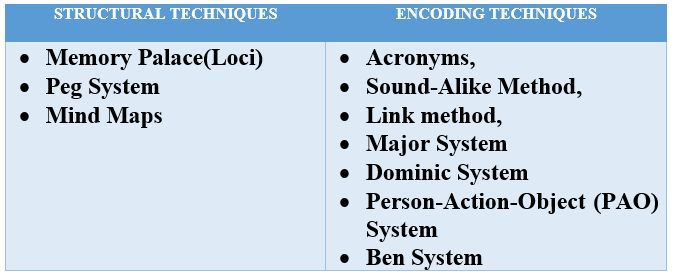
From my experience, memory techniques are divided into two large categories: structural memory techniques and encoding memory techniques.

This is my own classification of the Memory Improvement Techniques:
classification

1. Techniques that help you create a structure for your mental images (Memory Palace Method, Peg System and Mind Mapping technique).
The purpose of the structural memory techniques is to help you create an orderly structure for your mental images.
This structure can be:
• a Memory Palace (like a building or a mental journey through a town),
• different types of Pegs ( body parts, alphabet letters, ordered numbers, etc.) or
• a Mind Map.

2. Techniques that encode the things you want to remember (Acronyms, the Sound-Alike Method, the Link Method, the Major System, the Dominic System, the Person-Action-Object-PAO System, Ben System )
These techniques help you transform the abstract things you need to memorize (foreign words, numbers, dates, playing cards, topics to cover in a speech, etc.) into easy-to-remember images. Every item becomes an image that you will place along the mnemonic structure created with the structural techniques’ help, which will give you the order. The weirdness of the associations between the mnemonic images and the places where you hang them will help you to memorize better.

All the best,
Chris M Nemo

PS: Most of these systems have their own variants.
As an example, the Peg system includes several techniques, which are differentiated by peg type:

  • numbers (The Number Shape Technique, The Number Rhyme Technique);
  • the letters A through Z (The Alphabet Peg Method);
  • a list of words based on animal names (the Animal Word Peg Method);
  • your body parts (The Body Parts Method), or
  • a list of familiar songs (The Sing-a-Long Method).
6 Likes

@Readerly, I really haven’t seen any analysis that relates to computer science and I’ve taken a number of concepts from there in data structures that seem to make sense to me. I haven’t taught the low-level logic of those but used and have taught the many libraries available in Java and other languages.

Trying to merge the two worlds helped me determine the two major types of mnemonic structures beyond the basic association of an unordered list. The story or linking method is a linked list and the peg method is a dictionary/array/hashmap/key-value pair. I’ve tried to explain the mnemonic data structures with data analysis diagrams which worked well, but no one seemed too interested. If you would like to take up the gauntlet, I’ll help you.

2 Likes

@rune, you touched on a very difficult question which is not answerable through pure research. In my experience, it seemed that the action was not a separable type of visual image that was independent of the subject. Therefore, in my system of rules, that made it an elaboration of the subject but one that has been used often by PAO enthusiasts. The popularity of that has kept me from going all in on the concept but it still stands for me as an elaboration of strength as opposed to an elabloration of weakness that has little visual persistance such as the color of the subject’s hair.

Purpose is not a clear concept for me. Could you give me a few examples of that?

3 Likes

I tend to agree with you @ChrisMNemo on your breakdown in most cases and think that we need more discussion of analysis to understand mnemonic systems. I prefer the word conversion as encoding might assume that the end product is not recognizable (I was a cryptanalyst in the military) and then decoding would be to make it understandable again. But structural techniques borrows from the programming world as in the use of data structures which is very appropriate.

But I don’t see how the linking method (a story) or the PAO method (a chunking variation of a peg system) is a conversion. I also see the palace as a peg system of terrains/loci and mind maps as a tool to create candidate associations which then become a virtual palace or story.

It’s great to have another like-minded analyst to talk with and after building and re -building systems for several years, I look forward to hearing some feedback from you.

3 Likes

First of all, I must tell you that I am the author of several books and video courses on memory techniques, in which I present these methods starting from the classification above ( I won’t mention my books here since this isn’t the subject of this topic). These books were written for the purpose of putting some order in this quite hermetic field and presenting all (or most) memory techniques in a logical manner.
After some time, I realized that what matters most is how efficiently each method works for the purpose for which it was designed.
In order to memorize long materials effectively (especially if the material needs to be memorized long), I realized that it is useful to combine several memory techniques. The simplest combination is between a location and an image, which is why I divided the techniques into two categories: structural techniques and encoding techniques.
In addition, I tried to summarize some steps that can be taken by anyone to approach the learning process systematically, by combining the memory techniques. This is how the SCALM method (Structure-Chunk-Associate-Locate-Memorize- which you can read more about here), a very efficient learning method was born.
SCALM has a step-by-step approach, beginning with an overview of the material, then chunking the information into easy-to-manage pieces, and encoding each chunk using various encoding techniques (for example, the Major System is used for memorizing numbers and data, the Sound Alike Method is used for learning unfamiliar words, the Acronym Method and the Sentence Method are used for lists, and so on). In the next step, you will place these images into a memory palace, after which you will walk along the mental route a few more times and you will remember your entire text.

In response to your observations on this topic, I would like to share some thoughts:

I prefer the word conversion as encoding might assume that the end product is not recognizable (I was a cryptanalysist in the military) and then decoding would be to make it understandable again.

While I agree with your nuance, the process of associating abstract concepts with images of people, things, or animals seems to me quite similar to cryptography (Encoding-Decoding). In fact, this is how our brains translate abstract notions into images that they use as an alphabet. Let’s take The Major System as an example. This technique encodes numbers into letters, then into words and then into simple images. When we want to remember the number, decoding from images to word and then to number again is as straightforward as the initial coding.

But I don’t see how the linking method (a story) or the PAO method (a chunking variation of a peg system) is a conversion.

Several memory techniques must be combined to achieve the best results. In other words, the little story you create with The Story Method (a variation of the Link System) will be easily recalled if you place it in a memory palace. Your story encodes your information in simple images, which you then structure in a logical manner (in your memory palace). The main purpose of the structural methods is to ensure the order of the images obtained with the help of encoding techniques.
As for the PAO system, it is only effective when you use it in combination with a memory palace, i.e. when you place each of your people doing different actions to objects in a location. Memory athletes place 2-3 or more characters in each location.

I also see the palace as a peg system of terrains/loci and mind maps as a tool to create candidate associations which then become a virtual palace or story.

I would like to remind you of the origins of each system. Memory palaces were created by the ancient Greeks and used throughout history by many orators and scholars, while the Peg system was created in the mid-1600s.
Furthermore, the locations used distinguish these two methods. While Memory Palace uses physical locations (which are also very memorable), the Peg system combines physical locations (e.g. body parts ) and abstract locations (numbers, letters of the alphabet, etc.). In general, the Peg System is quite limited in number of locations, while a Memory Palace that can have hundreds or thousands of locations.

It’s great to have another like-minded analyst to talk with and after building and re -building systems for several years, I look forward to hearing some feedback from you.

I am also happy that I found a person interested in classifying memory techniques as clearly as possible and I can’t wait to discuss other aspects related to this field in the future.

3 Likes

You might enjoy Advanced Memory Palaces by Joe Reddington. It was self published last year and deserves to be better known.

From the description:
People into mnemonics and computer science both attack the same question: how do I structure this information in the most useful way? Every technique in mnemonics has an equivalent in Computer Science, but the reverse isn’t true: this book shows how a range of techniques developed for computers apply to mnemonics, how they improve on the state of the art, and how they can be used for incredible long-term personal memory.

4 Likes

Thank you for recommending and participating in our section.

I wonder why memory palaces get so much attention? Yes, they work and are effective, BUT for short-term memorisation. Not the best option for learning useful information from them.

Cicero method (synonymous) is useful for sports memorization, where 1000 reference images is enough. It is useful for memorizing lists of products, unnecessary lectures - i.e. in the role of RAM, as in a computer - memorized, used, forgotten.

If you are memorising databases, foreign languages and other types of information, then naturally everything needs to be systematised. Cicero-based routing is not advantageous in this case, due to the complexity of creating a route and the sheer number of reference images (locations) required.

2 Likes

Thank you for elaborating @thinkaboutthebible. Regarding action I think it could be separated out visually as a distinct icon, but don’t know if that changes its status.
Purpose may be my personal version of something O’Brien spoke about: finding a reason for the configuration of the visualisation to be stored. Ie why is this p doing this a to that o in this specific l? I map these labels onto a concept pulled from literature theory: the dramatic pentad, which contains the terms (with my mapping)

Scene (loci)
Act (action)
Actor (person)
Tool (object)
Purpose (reason?)

I’ve found purpose helpful in combination with the recurrent guide figures in my memory palaces, which is something I grabbed from @metivier’s podcast and free course (thank you for that @metivier).

I’m just starting out, and very thankful for your insights and elucidations.

4 Likes

@JohnDen, that is exactly what I am looking for! Thanks! I ordered the book and will post a review after I read it toward the beginning of next month.

1 Like

It seems there are a number of people who want to write books on mnemonics systems without any significant accomplishments at all using their own designed system.

For a system to have credibility I think the author of the system should at least have used it for significant memory accomplishments in practice and highlight those accomplishments otherwise it seriously undermines the credibility of the system.

I really don’t understand why so many people want to design systems and publish books on their systems without even using their own system first.

From this perspective knowing there are a lot of competing mnemonics system books where the author hasn’t even used it I think anyone aspiring to write one of these guides should make the first chapter a summary of their personal accomplishments using their own system.

This is not directed at any specific person as I already have several separate anecdotes.

5 Likes

Very Clever There! Hitch-Hikers Guide to the Galaxy

2 Likes

A method can be defined as a particular way of doing something. Processes on the other hand are step-wise actions involved in implementing the method. Thus processes will be different when we carry out a particular job with a different method. By way of analogy: Water can be purified by the method of boiling or the method of filtration. The process involved will obviously be different depending upon the method chosen. The methods used to memorize something such as 100 digits of PI are varied. Most would involve unique sets of ‘images’ and memory palaces or peg words to achieve the feat. When a “process” (such as a particular method to remember 100 digits of PI) or (how to perform a quadruple-heart bypass) becomes an official or accepted way of doing something it is termed a procedure.

1 Like