I have used all of the following. My preference is places I can currently visit and write the loci in Google Sheets as I walk through wherever I am mapping.
Places I lived ~10 palaces
Places I worked ~5 palaces
Schools I attended ~5 palaces
Misc - Past memory (Churches, Camps etc.) ~5 palaces
Misc - Active visit present with intent to create a palace (Costco and other big box stores, Art Museum, Nearby Parks, Airports, Hotels, Tourist Attractions like museums) **My preference, especially big box stores. ~20 palaces
This is mostly preference. For competitive memory not too many but for general knowledge projects you can jam-pack the rooms a lot more.
Some general knowledge projects may also have a design preference if you for example want to use 5 loci related to the same fact set then you could strictly do 5 per room.
I usually do 3-5 per room. For my Chess openings in which I intend to often transform the locus (Olympics version of locus, Blizzard version of locus, Harry Potter version of locus etc.) I plan to make the first 15 loci entire rooms so I am not needing to make the blizzard version of toilet or the wizards version of the washing machine.
The rule of 5 you will hear fairly often is just most memory competitors know where each 5th loci is, not necessarily strictly 5 per room.
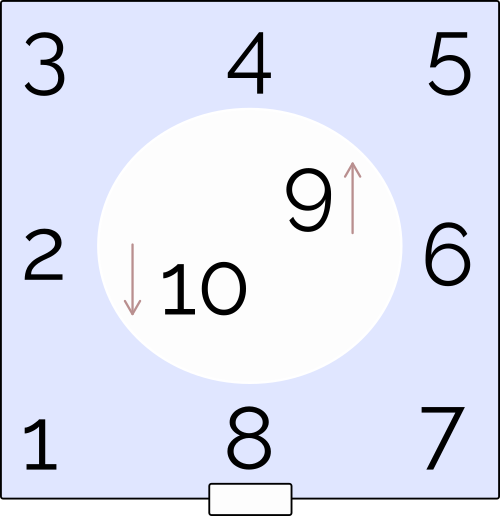
I started with 10 to a room, 5 to the window and 5 back to the door for a palace for every country in the world. I use the rule of 5 a lot, but that may be partly because I have Aphantasia and so struggle with visualisation, so need that check on the palace for recall.
I would not do 10 to a room again, but probably 5. Although the 10 works, I like to stack my palaces with lots of information, and so the more space there is, the better.
I don’t use places I can’t visit because my aphantasia limits visual memory. I struggle to remember houses I have lived in, let alone those of friends or other buildings.
But more than that, I love creating new palaces. I do that by walking the streets around the town where I live. I now add one location per house / shop / side street (marking every 5) - I will add two locations to a house, or skip one as needed to get the street to mark the fifth location.
Each morning, I walk for 40 minutes or more, walking my palaces. At the moment, it is almost always my Chinese palace for learning Mandarin and Chinese characters. It is 5 km long, so I walk to part of it, do the memory stuff, go to the shops and get fresh bread and home. It’s a wonderful start to the day - physical and mental exercise.
Your dyslexia interests me greatly, especially in terms of using memory palaces. I have only worked with a few dyslexic students, but have been astonished how well they responded to memory palaces. I am looking at diversities in terms of evolution, with special interest in memory. This article really interests me.
In contrast, the book, Rhetorica Ad Herrenium, suggests not making the locations too small or too close together:
Again, it will be more advantageous to obtain backgrounds in a deserted than in a populous region, because the crowding and passing to and fro of people confuse and weaken the impress of the images, while solitude keeps their outlines sharp. Further, backgrounds differing in form and nature must be secured, so that, thus distinguished, they may be clearly visible; for if a person has adopted many intercolumnar spaces, their resemblance to one another will so confuse him that he will no longer know what he has set in each background. And these backgrounds ought to be of moderate size and medium extent, for when excessively large they render the images vague, and when too small often seem incapable of receiving an arrangement of images. Then the backgrounds ought to be neither too bright nor too dim, so that the shadows may not obscure the images nor the lustre make them glitter. I believe that the intervals between backgrounds should be of moderate extent, approximately thirty feet; for, like the external eye, so the inner eye of thought is less powerful when you have moved the object of sight too near or too far away.
It might be worth experimenting to see what works best for you.
There are potential advantages to a fixed number per room:
You’ll know if you missed one.
You can use # of rooms seen to determine number of loci seen.
Those kind of dry up if you don’t commit to meaningful consistency though. If you choose inconsistency, I’d argue for looking at factors like-
Whether there is a clear order in which the loci should appear.
Whether the loci can be viewed from the path without any other loci appearing in the background.
Whether the loci are visually unique such that a very partial memory can capture what makes them unique in the group of loci.
Whether you need to travel through the loci in a way that would interfere with images of obstructions.
Whether the loci feels like a place with definite boundaries.
I think of having a fixed number per room as a luxury that may not be worth the cost, even if it plausibly improves overall performance if you can avoid sacrificing quality elsewhere.
Thank you, but I continue to have difficulty in creating new buildings, as I hear people who in a short time (10 - 20 minutes) manage to create buildings of 100-200 loci, which is impossible for me, since so far I have managed to find a maximum of 30 loci, very little.
Do they really? Wow, I couldn’t even conceive of doing that even though I have been using memory palaces for over a decade now.
I don’t create loci quickly. I do it quite slowly because I want them to be permanent. And I want to enjoy myself. I like to really engage with each location, so I would only add two or three new loci a day when I am creating a new palace for long term use.
I might map the whole palace out, as I did for the 214 locations for my Chinese palace, or the 167 location for 1000 digits of Pi. But that was a map on paper, walking around to make sure it worked - and having it written down so I wouldn’t forget them. That was not knowing the locations - to do that took ages!
It is MUCH harder to create new loci when you are starting out. As you get used to doing it, it becomes faster. I focus on a single aspect of the new location - whatever stands out when I first look at it - the shape of the fence, a strange door, a kid’s swing. I also name the locations. The Chinese ones are named by the Chinese character radical the represent. The Pi ones are named for some feature of the location or the story that encodes information there.
My palace for images in competition is : grog-door-pillar-post-rain… People with good visual imagery might not need to do that. I only know what works for my brain.
I never engage with the whole location in detail when I first choose it. I notice more about it as I add more data to the location.
I think that you might have unreasonable expectations of yourself. I have set up palaces with hundreds of people including kids, and they all manage it fine. But I never hurry them. I always let them experience a small palace - a dozen locations at most, and put information in it. Once you are used to doing that, you’ll understand what works best for you in defining a memory location.
Persevere, it is worth it. But don’t hurry and don’t expect to do what the champions manage just yet! I have well over 1000 locations in constant use now, but that took me years.
the last problem I still have is to create buildings quickly and to always find new places
When I struggle with this, I think it comes largely down to route planning. I may know the layout of a building, but not be familiar with a specific journey through it.
This to me is the most challenging part: Finding a journey you’ve taken many times.
When you approach it this way, a few obvious things come up, like hiking trails or the journey between classes at school / over a school day.
Ultimately however, there are few places where you make repetitive journeys. This suggests trying to base your palaces off memories of particular journeys, not places.
For example my first palace was based on a Christmas tradition where we would dance through our house, always following the same journey. My house isn’t the memory palace so much as the dance is.
(As such you might felt it helpful to internally refer to these palaces as “memory lanes” or “recall roads”, as that can make building them more intuitive imo.)
I often only use a fraction of the potential loci in order to follow a logical path completely ignoring certain rooms that would break my flow.
I also teleport through walls often to maintain a logical flow. You don’t need to walk between loci you can teleport or “jump”.
I find myself actually getting mildly annoyed at some of my palaces I created early on from this perspective. I would often go to the door of the public bathroom and make the entrance drinking fountain the initial loci then circle around the inside of the bathroom to urinals, stalls, and sinks. Now if I was creating a similar palace I would often just jump through the wall to the sinks instead of needing to use the bathroom door and just skip the drinking fountain entirely.
This reminds me very much of Sims. I bought the game second hand for exactly the purpose of helping me visualize. Unfortunately I found the game very tedious and decided that just using my imagination is far more efficient and takes less effort. What really got to me is when trying to play the game how annoying the Sims got. It brought back memories of Tamagotchi girls used to play with while I was growing up. I never got my head around why anybody would play with those things.
I don’t create my rooms quickly - in fact it can take quite a while - sometimes a frustratingly long time. Also, I’ve found that memorizing things will also help me memorize the loci (I use each palace for a few different sets of information, so the first list I memorize helps me nail down the loci which is helpful for the other lists I’ll memorize).
To help with my rooms, I make an excel spreadsheet, list each room followed by the 10 loci per room (that’s what I’ve found works well for me, with the 5 spot being on the wall opposite to where I enter the room). I also take photos of the room, and place the photos and the excel file in a folder, so I can easily review.
I (now) know the every 5 suggestion is very, very old. But somehow I just discovered it (after years of using palaces) from you and Anthony M. It’s amazingly useful. Almost like a checksum in computer science.