Hello from Almaty, Kazakhstan!
Has anyone tried a memory palace where the data decides which locus comes next?
I am new to memory sports, so sorry if this idea already has a name. I found this older topic on data structures (A CS perspective on memory palaces), but there the journey method is described as an array and the linking method as a linked list, as two separate techniques. What I describe is a mix of both, so I did not find my answer there.
In most systems the route is fixed. You walk the same path every time, and the digits fill the loci one by one. I wanted to try something different: a route that is built by the data.
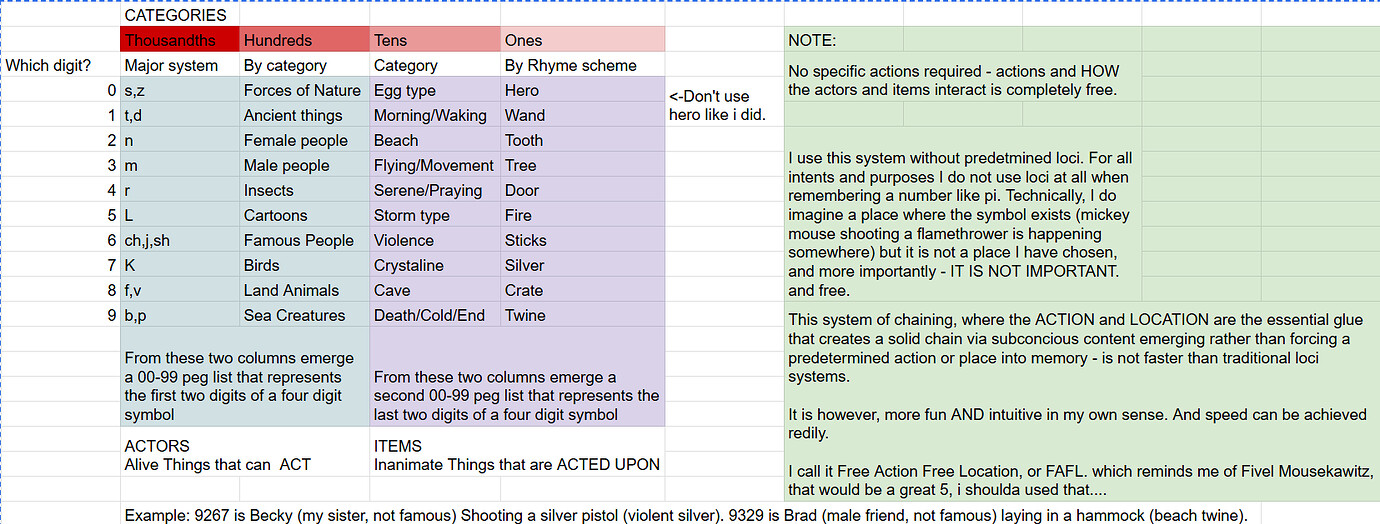
My setup. I use Ben System encoding (3 digits = 1 CVC image), but with two dictionaries on the same codes:
- Dictionary 1: objects only (things and animals, never people). These go inside the scenes.
- Dictionary 2: people only. These are the loci.
So one code gives me both an object and a person. For example, 141 is “t-o-t”, so the object could be a tote bag and the person could be Tolkien. The consonants also tell me where that person sits, so I do not need to learn a seating list. It comes from the code.
How it works:
- Every locus is a person with a 3-digit code.
- At each locus I put a scene of 3 or 4 objects.
- The LAST object in the scene is also the code of the next person.
So the pointer to the next locus is free. It is already part of the data. And because objects are never people, I always know if an image is part of a scene or is a locus.
Example with pi: 141 592 653 589 793 | 238 462 643 383 …
- I go to person 141 (Tolkien). His scene: lawn (592), gum (653), library card (589), comb (793). They interact in a chain, each one causing the next.
- The last object is the comb, 793, so the next person is 793 (Cobain).
- I go to Cobain. His scene: 238, 462, 643, 383.
- The last object is 383, so the next person is 383. And so on.
(My real dictionary is in Kazakh, so the images above are just English examples to show the structure.)
My questions:
- Does this already exist? Does it have a name?
- Collisions. There are only 1000 people, so codes repeat. In the first 9000 digits of pi, 120 people get more than one scene. That is 43% of all scenes. But I also remember where I came from, so the pair (previous person, current person) is 6 digits. I checked the real digits of pi: there are zero repeated pairs in the first 9000 digits, and only 8 repeated pairs even at 70,000 digits. Is this correct, or am I missing something?
- The weak point: this is a linked list. If I forget one scene, I do not know where to go next, and I lose everything after it. A fixed route only loses one locus. Is this why nobody uses this idea, or is there another reason?
- Is the second dictionary worth the extra work? Or would you use one mixed dictionary and separate the roles in some other way?
I am not competing. This is a hobby, so I can accept some risk. But I would like to know if people have tried this before and stopped, and why.
Thank you.