Building memory skills (& creating accountability)

I’m late to this thread, but all of these countries are recalled by puns in my own memory palace.

Myanmar - I pass a guy snuggling with actress Margo Robbie. He tells me to stay away from “Me and Mar.”
Nepal - Well…nipple.
Tajikistan - A person whose face is mostly two large round cheeks; “Two Cheeks”-istan.
Kazakhstan - Is a man so dizzy he “cannot stand” up.

All of these are close enough to the actual name to get me there.

2 Likes

Sorry, I wasn’t super clear haha - I can remember images of the countries fine - their capitals leave a lot to be desired, however.

Ah, thanks for the clarification!

Unfortunately, some of those capitals have somewhat “adult” imagery for me, so I’m reluctant to spell out my approach in too much detail. :wink:

For Nepal, maybe try to imagine either a man with feline features or a man who loves cats, raising the question of “What does the cat man do?” (Kathmandu)

For Kazakhstan I can suggest the image of someone lying on their stomach, with a tanning light focused on their bare rear end. This person is an “ass tanner” (Astana).

Bob

3 Likes

Brilliant. :grin:

3 Likes

Days 12-14:

A majority of my time has been spent on my job before I fly out to see my partner, so ive been simultaneously preoccupied yet always thinking about memory.

It’s still scratching an itch of curiosity and wanting to do and know more; places to take memory palaces from, things to try and encode, how to do PAO, etc. It all persists and I only get more questions by the day.

One genuine question for anyone that may know better than me is this: how do you encode the actions and objects of PAO separate to the person? What do you visualise when you’re first trying to come up with options for your numbers?

I know in some examples like Memory Craft the person assigned to the number will directly link with the object (a blackboard for Albert Einstein, if I recall correctly), but other consensus says that creates a barrier between spots.

Its just that when i envision an action, I don’t know how or what to envision for it. Should i make an Anki PAO deck solely for each individual category? Do i put the objects in a memory palace? Any input from people would be greatly appreciated.

1 Like

@Lukelustre,

There are ideal answers for a proper PAO and then there are practical versions.

The PAO is a specialized combination of peg lists bound by rules. You could have three different lists that weren’t associated with each other and pick the P, A, and O from each. Too difficult since they aren’t associated with each other.

Then you could choose an anchor like the Person and have the action and object be associated with them. That’s the traditional setup as I understand it. Id like to know where you have seen a consensus that it creates barrier between spots and what exactly you mean by that.

Then you can mix up the rule and pick any of the data types for your anchor making it easier to select a proper choice so that they are associated with a numerical or alphabetic order. So when you can’t think up a person that fits the letter or number combination, just use an item or a location, or an association with the number itself like a sports jersey number.

Anything that personally seems to fit is the right choice for you. This mixed anchor and exception style is what the memory athlete Nelson Dellis uses. No consistent rule but it works for him practically.

Doug

1 Like

I used the major system to generate my complete PAO list. This automatically lends itself to elements that are unrelated to each other but are directly and logically related to the number.

11 = TeD
11 = TooTing
11 = ToaD

I don’t visualize “Ted TooTing on a ToaD.” I visualize the number 11, think “person” then read TeD. Then I think “action” and read “TooT.” The. I think “object” and read “ToaD.”

If you use a flashcard app you can build 300 cards. 100 will have the front side say “Person: 00”, “Person: 01,” “Person: 02” etc. And the back will show JUST the person for that number. Then build another 100 that have fronts as “Object: 00,” Object: 01", etc. And the back has JUST the object. Then another set of 100 that has “Action: 00” etc. on the front, and JUST the action on the back.

To practice, you can either review all of one type, or mix them all in together to force yourself to isolate the elements and directly relate them to the number.

I posted my complete Major based PAO list HERE, and a couple responses later outlined how I also used it to encode cards so that you can read the card suit and values to give you the same PAO elements as the number list.

You can, of course, use arbitrary people, actions, or objects, you can base it on a category system, there are a ton of ways to tackle it. I personally like the all-major approach because every element can be read independently and directly. It’s tougher initially maybe to learn the un-related elements, but I think once you get semi-fluent with reading it, it makes it faster and simpler in the long run.

3 Likes

See what you think about this: Tip for practicing PAO

1 Like

Thinking aloud here, what I want to try and do is have a set of 52 Playing cards encoded into a PA format where: P=Person/ A=Animal. So using the suit of Clubs for A and coding in Major, I would have: Ace of Clubs = CaT, Two of Clubs = KaNgeroo, Three of Clubs = CaMel, Four of Clubs = CRab, Five of Clubs = KiLLer whale, Six of Clubs = CaGed parrot, Seven of Clubs = CoCKroach, Eight of Clubs = CaVe bat, Nine of Clubs = CoBra, Ten of Clubs = KeStral. Further animals would follow the Major System rules for playing cards Ace through to Tens in each suit value. The problem would then be how to encode the Jacks, Queens and KIngs in each Suit, using animals as the theme? Any ideas? I haven’t started encoding for Diamonds, Spades and Hearts yet, but I think they should be quite easy to complete?

If I had 26 loci, I could (with practice) then conceivably get times quite close to the one minute mark by linking an animal alongside my existing cast of characters for playing cards? Or at least that’s my theory anyway??

Turn the format around for picture cards. Instead of suit-value, make those value-suit. Pick an unused sound for each J-Q-K. You’re only using four sounds for the suits, so you have 6 left to pick from for those. Say you made Jack the J sound… Jack of clubs would be J-K… JaCKrabbit? JaCKal? Jack of Spades would be J-S… not sure what animal would fit that phonetic but you get the idea. None of these constructions should conflict with your number-suit words because there shouldn’t be a suit that starts with J, so you don’t have to worry about confusion between like the JC and the C6. The only one you may have to break with logic is the king as you’ll already have the K sound for clubs.

Animals could be limiting as a category just in terms of finding names that fit and that are also distinct enough to avoid the problem of sameness. This is why most come back to objects as the preferred category. There are tons and tons more options and you can very easily make a logical action quickly to link the person and the object. That can be difficult with an animal. Person does what to/with animal?

2 Likes

Apologies, that was just poor wording on my part. I went searching on the forum to see different approaches and ideas on the concept, and I saw Tim’s input, which was received well, and so I had assumed that was a commonplace view. It definitely seems more nuanced and catered to however you see best fit than I had said.

Right, gotcha, thank you for the clarification - I was in the process of writing up a question about how to envision an action, but then I saw the second comment you gave and that’s perfect. Really appreciate your input in the community + my question specifically, thank you once again.

4 Likes

Thanks for the kind words. There are many more experienced folks than me here, and there is usually no such thing as consensus when it comes to “optimal” systems. It all comes down to what works for you. Different approaches click differently for different brains! In the end, the details of the system matter less than the fluency you build with whatever system you pick. There have been amazing records achieved by people using many different approaches, different phonetics, different PAO strategies, just PO, just PA, Category systems, etc. (I don’t hold any of those records, not even close (yet!), so take any of my advice with healthy critical analysis!)

For me, I like having a logical structure that keeps the extra steps to a minimum, but some folks have no trouble with the “classic” PAO approach or other, less structured systems. I think it’s important to try a few different approaches and see if one just resonates better with your mindset. One thing I’ve learned on here is you really can’t generalize an approach that will be best for everyone and you can’t force a system that just doesn’t click well. You’ve gotta just jump in and try some things and build on what works.

3 Likes

Tim I think you are correct in your analysis of the inherent weakness of animals in a Person/Animal system. To your point there just aren’t enough Animals to complete the exercise. I think I will rather revert to a two-image (Person/Object System) as you have suggested. I think I will start by devising a good set of Card Characters Major System using the initials for first names and surnames. One thing though, I remember in one of Harry Lorayne’s books that he kind of awkwardly (well at least awkwardly for me) coded his cards as Suit followed by number. So his 2 of Hearts would be HeN (Major System). I have a preference for 2 of Hearts rather translating as NH. Now here’s the rub, what object has NH in it using a,e,i,o and u and w,h and y as free placeholder values? When Harry Lorayne put together his card peg words he was obviously confronted with this problem which is why he no doubt opted to encode his cards backwards (that is, suit-name first, followed by card-value). The problem I have with this reversed type of card order is that people speak of the 2 of Hearts (as a card) not a Heart-Two. Doing it Harry Lorayne’s way, you would need to reverse the card in your final step, so the image of a HeN is great for a 2 of Hearts but painful to have to reverse it in the final analysis of things. Am I just overly quirky about this? I just can’t think of an word for the 2 of Hearts coded the correct way round namely, NH?

1 Like

Maybe kNeeHigh socks?

You could also switch phonetics and use R for hearts. First consonant sound you reach after the neutral H… heaRts?

You could also base the suit value on 1,2,3,4 if you have a simple way to order the suits.

I used:

Spade 1 (one point on top of Spade)
Heart 2 (two bumps at the top of the heart)
Club 3 (three puffballs on the club symbol)
Diamond 4 (four points on a diamond.

So 2 of hearts for me could be NuN, NeoN, etc.

I’m with you on the idea that it’s not intuitive (for me anyway) to think suit first, Hearts-Two. Two of Hearts is much more natural. I just dealt with the awkward phrasing with the picture cards because there are less.

I suppose you could use the neutral H, W, and Y sounds for J Q K. Then you could keep the structure of Value-Suit. In that case you would need to change hearts to not-H.

2 Likes

Thanks Tim I also thought about encoding the suits in a similar fashion to what you’ve done but will attempt to go along with the first letter of the Suit names of the cards themselves. I like the idea of having R replace the H for the Hearts Suit. The rationale I would have used however is not as you’ve suggested i.e. 2nd permissible letter in the word HeaRT (Major System). I would rather remember it this way… when something is wrong with your Heart it is usually R’tree (Forgive my spelling for Artery) related. Or as the Heart is a ‘Pump’, I could rename the Suit: “Pumps” so the 2 of Hearts = 2 of Pumps or NP (NaPPy as an object). I like ‘brain-storming’ ideas on this forum as it gives me a lot of different ideas and perspectives in developing even better systems. I think in the final analysis renaming Hearts suit to Pumps is probably the best way to go. Thanks for your input!

2 Likes

Day 15:

As it’s now 2 weeks since I started my goals (honestly the fact I’m still here is a small feat in it of itself) I thought today would be a really good attempt at trying to see if I could complete one of my goals that I started with:

Create an alphabet peg system, and practice remembering a list of 26 random items

On my first day of starting I had already come up with my list; it’s 26 Pokemon interacting with one another, simnilar to how Memory Craft used ideas like Arachne, Xena, and more outlandish yet easy to remember creatures. As Pokemon is my bread and butter, and there’s many a distinct feature over 1000 designs and ideas, I wasn’t struggling for choice.

I had already attempted an alphabet in the past, and retained some of it quite well, but after time to marinate and realising I still recall the list spot-on, this was my goal for the day after getting my work finished.

Funnily enough, I was already at Level 5 on the Memory League for the words category, so 18 words was a good starting point for me.

I’m slightly annoyed at forgetting number 13, but I was a bit slow in the beginning and still passed. So, with it unlocking level 6 (remembering (at least 18 of) 26 words), it was a good challenge for me to try.

Attempt 1:

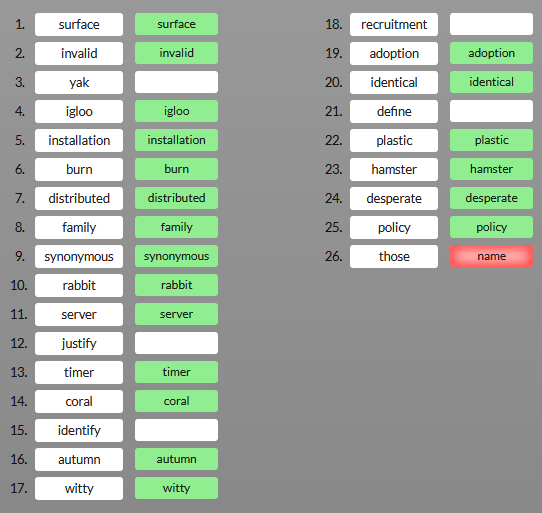
Technically a pass on the Memory League which I am happy about, but I want to try and get a perfect 100%. Missing yak was also a big blunder - I think I overthought the fact I have ~2 seconds per word and didn’t want to miss any, but skimmed over a few. Some of the words like recruitment I thought were a bit hard to come up with a word too, so still need practice!

Attempt 2:

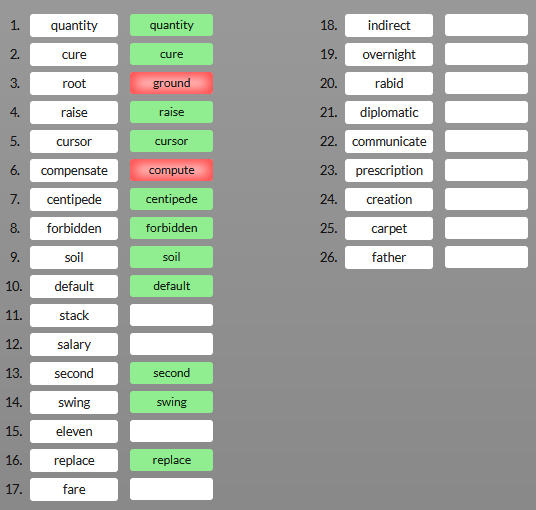
Little embarrassing for this one, but I got in my head when some of the words like salary and indirect came up - I definitely need to practice encoding more abstract words as I had given up by the 18th word.

I then did 3 more attempts, all to pretty mediocre results - my first attempt was my best and I’m not coming close. So I think I’m trying to do too much too quickly.

I went back down to 15 words to see if I could do it, and ended up getting 14/15 on every attempt I tried; a little frustrating feeling that you could just be there and you’re not quite making it! But practice makes perfect.

In some fairness to myself, I did think a few of the words were quite abstract and hard to pull from (motive and concatenate really stumped me), so to reiterate that point, I’ll be trying to learn how to quickly and efficiently remember the words I find hardest to visualise, but nonetheless a bit of a deflating result to end the day on.

So then I tried something else.

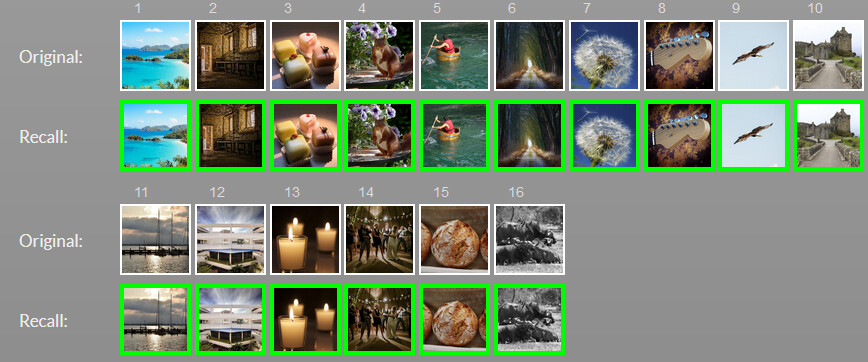
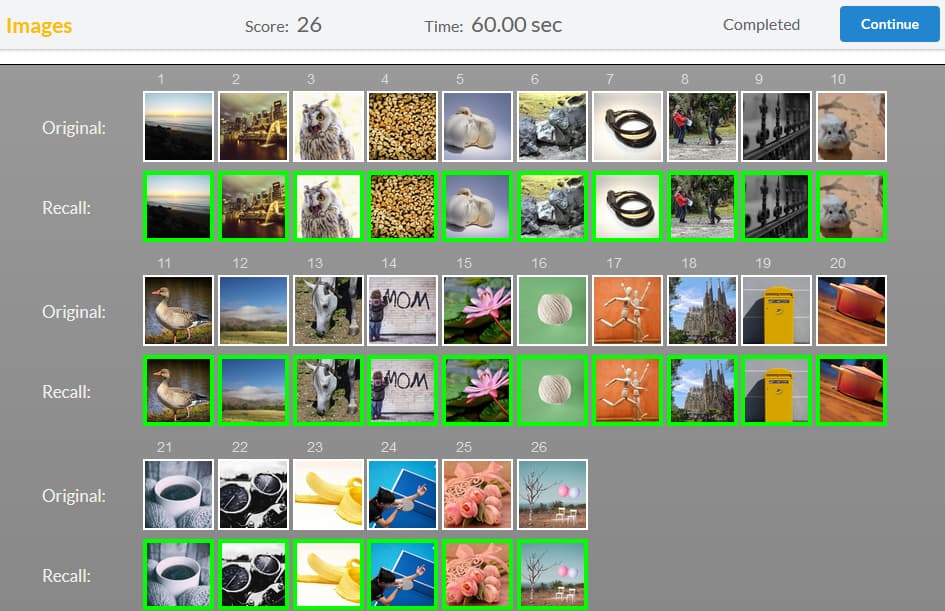
Admittedly, the image test is much easier than the word test; you see all the options and can use process of elimination if you’re really struggling with what went where; however, I did quite confidently use my alphabet list, and placed each Pokemon in the image it corresponded to in order. Without having to rely on the elimination process either!

So while I’m not going to say I’ve completed the goal until I’ve got a perfect 26/26 with random words in a minute, I feel confident in knowing I can do this.

My one question is should I be giving myself less words at 60 seconds and working myself up, or giving myself more time with 26 words, and gradually bring that down? Something to think about before I read chapter 6 of Memory Palace, at least.

2 Likes

Great job!!! My answer to this is usually to go a little bit faster than you’re comfortable with, so it looks like you’re right at that sweet spot. It’s definitely frustrating to miss by one, but you’ll hit it soon. Keep pushing your comfort zone by a hair each time. If you can 100% at a certain level, celebrate, but then it’s time to increase the difficulty and don’t look back!

3 Likes

Days 16-20:

ngl I’m on holiday so I’ve not done a lot lmao

Read Chapters 6-8 of Memory Craft while on the plane which was cool, while I definitely appreciate the insight and foray into different kinds of memory devices through cultures, I really take a shine to the parts that discuss using memory methods in modern contexts.

Also, I saw a really insightful point on a post about how they better remember abstract words:

That changed the difficulty of trying to remember 26 items with my alphavet list somewhat - it’s still not easy per se, but giving a pair of words to a letter almost synergises the memorability of each aspect, which has massively helped.

Will try and keep up with memory-realted things while I’m on holiday, and looking to see if I can make some memory palaces for where I’m at.

1 Like

Have taken a hiatus on memory things due to visiting my partner in the states, as well as some health-problems since landing back home.

Nonetheless, my fascination and drive for memory has only kept momentum. I finished Memory Craft flying back home (fantastic read, as expected), and I’m looking to start Advanced Memory Palaces by Joe Reddington. I don’t know if that will go amazingly for me - it seems like those who programme & code really get a good grasp of it - but the subheading intrigued me!

Might try to add learning German as a long term goal, implementing mnemonic technoques and seeing how well that works, but the fact it feels memory techniques can be ubiquitous in modern life, and make things more interesting, makes learning these continuously worthwhile.

1 Like

Day 21:

Almost didn’t write an update, which I’m happy I’m now doing instead; I’ve been out of habit and a tendency of mine is to just ultimately give up on something to retread ground on, so I’m going to try and motivate myself to update daily!

I’d been contemplating what to do, as I know I need to revise my countries + capitals’ memory palace(s). However, I wanted to really push myself to do something new, so I gave myself a new target and a new memory palace: the Periodic Table by number, in a Counter Strike: Global Offensive map.

I thought it would be a bit rough, as the map, while there’s definitely linear paths to destinations - such as is the intended design for the game - there’s a lot of hiding spots that might break a path or disorientate me. However, in recalling up to the first 100, Sporcle shows me I managed to get 96 of them, which I think is impressive! The only ones which evaded me where Hafnium, Tantalum, Astatine and Berkelium, and that’s largely due to not being able to encode the name to a great image + a lot of the spellings of elements routinely evaded me!

2 things I found really locked onto me:

1). Admittedly, I’ve played a lot of CSGO, and while I definitely am below average as a player, clearly hundreds of hours on just one map has helped me a lot! I might forget images, but I rarely if never forget my place, and my vision/perspective constantly shifts direction on a path to where I’m going.

2). It’s really fascinating learning things! I couldn’t remember Tantalum, but I could remember that the name is paired very similar to Tantalus, from Greek Mythology, The name evaded me, but the image of his punishment (forced to stand in a pool of water under a fruit tree, with fruit always out of reach to eat, and water out of reach to drink from) really helped cement that area on the map.

I definitely need practice in learning how to take obtuse and difficult words andtranslate them into a way that I can then encode them, but it’s always on the up! While I wait for my book on Advanced Memory Palaces to arrive, my evening reading will be The Chess Memory Palace by John Den.

1 Like