Building memory skills (& creating accountability)

I’ve been cognizant of the capabilities of memory since late 2019, when I was introduced to Moonwalking with Einstein. Memory has been something that I’ve felt has come somewhat naturally well to me since I was younger, but beyond the odd brain-training game I’d play on the DS, from then on, I didn’t utilise it in a meaningful way at all.

That was, until, I started reading the book and it began my fascination of just how powerful it could be; as someone who loves trivia and remembering general facts and figures, it felt like it would compliment that well.

On top of that, reading other books and subjects on the matter, like Lynne Kelly’s Memory Craft or any of Dominic O’Brien’s books further invigorated me in seeing how far these things could go.

However, it’s been nearly 4 years since I first gained an interest in memory truly. And I don’t have a whole lot to show for it (I didn’t even finish Foer’s book!). This isn’t a massive problem in it of itself, but it’s absolutely something of a pattern of my own behaviour(s), that I do not like in the slightest.

Whether it’s memory training, or language learning, or exercising, coding, crocheting, etc. - it doesn’t matter - I have an awful habit of finding something interesting, getting massively passionate about said subject for anywhere between a few hours to a few days, and then it eventually falters, which eventually brings on a sense of guilt, maybe some embarrassment, that I don’t stick to anything. It’s gotten quite demoralising for me to think about, because it has continuously happened for as long as it has, and I’ve been unable to break it.

That is probably/definitely an issue independent to memory learning, and something I’ll be trying to solve in its own process, but I think I’ve reached a point where I want to set up an environment where I keep up with memory training, along with hopefully creating some responsibility on my behalf to continue when I usually might feel like stopping.

(SMART) Goals:

So I don’t really have an endgame in mind for what I want to get by the end of this, but with the SMART parameters in mind (specific, measurable, achievable, relevant and time-bound), I have a few ideas of what I’d like to do in a few month’s time (ideally, the end of July):

1. Create an alphabet peg system, and practice remembering a list of 26 random items - I have a good idea of what I want to use as a base for an alphabet that I’m confident will work, but sitting down and actually doing it has been an obstacle for me.

2. Have a PAO system fully in place - Creating a system from 00-99 where I can remember most if not all of the aspects of each number. Not sure how I’ll revise this, but think this should be doable.

3. Have a list of (at least) 25 memory palaces - At present, I can probably think of only my home, and maybe my path to my previous line of employment, as a memory palace; I’d like to expand this list quite a lot.

I think I should also try and have a minimum of 10 loci per palace, but I’ll have a better idea of how many items/numbers I can encode as I do it more.

4. Finish one of the books I’ve been reading related to memory - I currently have 4 physical books related to memory - “Memory Craft” & “Memory Code” by Lynne Kelly, “Moonwalking with Einstein” by Joshua Foer, & “The Memory Book” by Harry Lorayne & Jerry Lucas. I’ve bounced between all 4, but haven’t finished any of them. So, while I’m not sure which one I’ll go for, I want to read one of them from start to finish.

5. Update how I’m doing every 1-2 days - This should ideally be the constant that keeps me somewhat liable to continue doing this. A healthy way to chronicle where I started from and keep me energised.

Perhaps having all of these goals within 2 months is at risk of overloading and burning me out, but I don’t think what I’ve written is too ambitious. And if they end up being, I’ll just change them to be much more realistic. And if I do them, then great! I’ll set up some more SMART goals following them to keep at it.

Regardless, I already feel a degree better about writing this out, and I’ll try to carry that momentum into doing some work on it right now.

Let’s get it :muscle:

22 Likes

Good luck with your memory training :+1:

This is a good perspective to have, I believe.

I suspect this is a personality trait many share – at least I do, 100%. If you talked to me sometime in the past I would probably have been obsessed and talked passionately about something that has very little to no part in my life right now.

I try to think whatever will be, will be. I’m probably not meant to be much more than decent at chess, running or whatever (or for that matter memory) and that’s fine with me. If I meet someone really passionate about these things that I’ve let consume me for months at end and then no more, I can at least relate to their enthusiuasm and have a genuine and nice conversation. Being curious and exploring is a good thing, and whatever you end up mastering has too many factors involved for you to try to predict it, or force it. This is at least what I tell myself to not feel too badly about repeating this behavioural cycle.

Luckily, memory training has managed to stick with me. I allow it to be half-dormant at times, and I suspect that this is part of why it hasn’t died on me. When I enter periods of high motivation I have dedicated high effort training sessions. Other times I just keep it relaxed. This hasn’t led to any impressive results since my last burst of dedication, admittedly, but I at least think about memory everyday and feel happy when planning out projects, searching for small improvements in my systems, or reading up on new information.

It might be the case that memory training won’t follow the pattern you described, but if you do feel your motivation taking a hit in a few weeks time, perhaps think about memory training in undulating terms. High intensity training blocks followed by relaxed phases where you enjoy what you’ve created without pressure, while focusing on other things in life more.

4 Likes

I try to think whatever will be, will be. I’m probably not meant to be much more than decent at chess, running or whatever (or for that matter memory) and that’s fine with me. If I meet someone really passionate about these things that I’ve let consume me for months at end and then no more, I can at least relate to their enthusiuasm and have a genuine and nice conversation.

That’s a very healthy attitude to have about the concept, and I appreciate both the empathy in having a tendency to try a myriad of things that you may not keep up with, as well as a much more productive perspective on the outlook for it.

Without divulging too much into personal plights, I think it comes from a place of high and/or unrealistic expectations, in my case at least. So the accompanying shame that comes with dropping things feels a bit commonplace, but trying to spin it into an appreciation that I have an evergreen curiosity would do me a lot better.

In my afternoon of memory training I’ve certainly found some goals and ideas easier than others, but if it wanes, I’ll try to remember that a mix and match of dedicated learning into a more diffused break period is probably healthy in the learning process.

4 Likes

Day 1:

I was thinking I’d make a post fresh in the mornings for when I update how I’m doing, but I actually think doing it in the evening may work better for me, to reflect on what I’ve done in that whole day. And while I haven’t touched on many goals today, I think it was a rather productive venture!

Reading - To coincide the fact that I wanted to practice my visual alphabet, I’ve opted to choose to just read Memory Craft first. It was between this and Moonwalking with Einstein, but the former felt right for now.

I’ve dipped in and out of reading it a lot of times, yet every time I pick it up, the listing of what Kelly has been able to do always manages to invigorate me no matter. When I get into later chapters properly, I hope it’ll give me a better insights to what exactly I want to train and get out of it.

I did get to a point where it discussed the horoscopes in order, and I thought that was a good practice benchmark for bringing in the alphabet pegs.

Alphabet system: This was probably the goal that I was most confident about keeping up with and continuing, because I really liked my initial idea on the subject.

My base for this comes from Lynne Kelly’s “Memory Craft”, and how she uses interactive and almost modular characters to accompany every letter. Her choices for each letter also seem quite specialised for areas she’s already interested in, which I imagine is a hugely valuable tool to bring into this.

For me, that comes with Pokemon; it’s a franchise that I know like the back of my hand, and I wasn’t short of colourful, lively and distinguishable features to choose from in making a list.

In full honesty, I had attempted this in the past, and I felt like this was a good base - on top of the fact that at points I vividly remembered a sequence of Pokemon from letters I throuth P that I felt was worth keeping, so I didn’t think this would take too long.

After about half an hour I’d come up with a visual alphabet that I felt pretty happy about, and since then I’ve been able to recall them + the Pokemon’s interactions/behaviours between one another rather well.

One line in Memory Craft specifies that eventually I should be able to learn the behaviours before the Pokemon, and I’m wondering if I’ve set up my visual alphabet for that, so it may need adjusting at some point to account for the fact I’m not there yet. But it’s a promising sign nonetheless.

Incorporating elements of the horoscopes to make them memorable was a fun exercise; for example, Gemini is the 3rd horoscope and I wanted to incorporate both the symbol + name onto my letter’s visual element, Charizard. So, I envisioned 2 Charizards conjoined next to each other, with literal gems in the eyes as it shoots flames from its mouths, and that’s an incredibly vivid image that I’ll struggle to forget.

So I think it’s going well so far! Very early to make any real assertions from merely a few hours on the first day, but I hope I can continue on a decent trajectory.

2 Likes

Day 2:

Being blessed with a bank holiday meant I could focus a bit more on anything that was interesting me, and so I started off today by reading Memory Craft again. Finished chapter 1 still a bit apprehensive if my visual alphabet is what it should be, but it has held nonetheless, and I’ll keep practicing it.

That said, I got to chapter 2, which touches on memory palaces, and I thought I’d focus on loci + remembering things today inspired by it. It turned out I was a bit premature on what I did vs what Memory Craft touches on (as it goes over all the countries of the world by population), but I thought a good point was trying to learn something I felt would be interesting and simple enough: African countries in alphabetical order.

My walk to the gym is pretty simple; you turn a corner, cross 2 roads, turn another corner, and it’s on my right - following the principles of every fifth loci being across a street or at a corner, I had 20(+) points to go with. So, I left a little earlier to have more time to sightsee. Before I got to the gym, I kept on the path I was walking to see where it would stop me, and give me more to scout out.

Dude. Genuine question: Why are memory palaces rarely if ever touched on in school?

I finished a gym session, continuing my palace to see if I could map out the remaining 29 countries before heading home. After a detour to some cul-de-sacs and other points on an alternative path, I was astonished that it all just seemed to come so easily. There are certainly some weak points - I don’t know exactly how to visualise Mozambique, or Tanzania, but I was still able to put something together after a second try.

The whole endeavour inspired me enough to go for a long dog walk, letting the little one run amok whilst I surveyed the long public path I like to take, and soon enough, I had 50 points of loci with all Asian countries in alphabetical order.

Then I took another detour of the day to map out the Oceanic countries at a different point. Getting home let me place South America in my bedroom + outside my parent’s landing, and finally North America surrounded my parent’s bedroom, bathroom and staircase.

I haven’t ever been able to name probably more than 100 countries at once in a quiz - to whoever is reading this, I can’t describe how happy it felt that I got all 197 countries on my first try. I knew Europe enough that I didn’t think I needed a memory palace for it, but it was far and away my weakest continent that took some real reflection.

Every other continent? A lovely reminiscence on my previous strolls taken today. Obviously it’ll need more reflection and time to revise in the future to encode the info in the long term, but my modest goal today was to maybe remember the African countries, and I ended up superseding my goals and then some.

Legitimately so gassed that I aced the world country quiz, and not just once; I did it again before writing this, and I finished it even quicker. I’m looking forward to learning how to further develop my memory palaces, as I have a few questions:

  • Can you/should you reuse memory palaces?
  • Can you encode further information in what you already have? I’d like to try and link capitals to the countries that I’ve already got, but I’m not sure if that’s the right approach.

Hopefully further reading on the matter gives me better insight, but if anyone here happened to be skeptical of what they could do with memory palaces, I can only sing its praises enough.

7 Likes

@Lukelustre ,

I think that it’s a matter of what teachers want to do with their class. For sure, the curriculum is state mandated and does not include mnemonics in the US. @LynneKelly is forging a path in Australia to add mnemonics in their curriculum, a massive bureaucratic task. Teachers would have to bring in their own experience to add to the standard modules but few teachers know about the techniques well enough to teach it I think so it would be not adopted as part as the local version. There’s a number of teachers on the forum and they share their experiences with teaching mnemonics. I’m a retired teacher but not in the state school system.

Congratulations on getting your countries nailed!

Short answer: yes, IMHO. Check out the forum archives with a search or read the full page on the subject.

Short answer: yes. Of course, it’s better to know what information you are planning to secure in your mind palace before you start. But having one more association for a capital city to build into your mnemonic cue works well I think. Adding even more associations starts to pose a problem as beyond five or so concrete images becomes a limit for many people. Then you have to convert the images to a story that moves from image to image with actions.

Keep working those country images, That’s a major accomplishment.
Doug

4 Likes

I am so delighted to see what you are doing with Memory Craft. You are memorising at a much more rapid rate than I would even attempt! Please take time to rewalk and revise to fix them permanently. I am amazed how often I use my Countries palace.

don’t know exactly how to visualise Mozambique, or Tanzania

I have mosquitoes buzzing around for Mozambique and someone lying out sun baking for Tanzania.

I like the fact that you have recognised that my ideas reflect my personal biases. The more you adapt to your personality, the better it will all work.

As for changing passions - you are young compared with me - so this comes from the voice of an elder, at 71 years old. I now hugely appreciate that I went through phases of passions which, at the time, seemed to lead nowhere. I am astounded how often I am now drawing on these and finding links and patterns I could not have imagined. There was a theory I read during one of those passions (if only I’d kept better notes!) that younger people tend to focus in specific domains while older people start to gain a big picture. All of those past patterns are now feeding my big picture. I could not be writing the book I am doing now without all those years of strange passions. It’s all experience from which you will benefit.

I look forward to your updates.

Lynne

P.S. Thanks for the tag, thinkaboutthebible.

7 Likes

Absolutely!

As Doug said, this is starting to happen here but it is requiring a huge amount of bureaucracy and teacher training. Teachers are just too overloaded to add something for which they can’t see an immediate benefit, and have never experienced.

We’ve introduced memory palaces, and the more complex level of memory palaces ( Indigenous sung narrative paths such as Australian Aboriginal songlines), to the senior high school Psychology curriculum in its regular review. This took two years of meetings for wording and approval, and then preparing video and written teacher resources.

This is the wording, as added to the Psychology curriculum under memory:

- the use of mnemonics (acronyms, acrostics and the method of loci) by written cultures to increase the encoding, storage and retrieval of information as compared with the use of mnemonics such as sung narrative used by oral cultures, including Aboriginal peoples’ use of songlines​.

That was all done with the government education department funding, and a lot of extra time. Then the updated text books for the course had to include the new topic, so I was involved with two of the major publishers for that.

It would be much easier to add it at primary or junior secondary school level - but we have made a start! The hope is that the newly trained teachers will start talking about it to others, or teach it in their junior classes and word of mouth will help.

But it is going to take a long time, I fear.

Lynne

7 Likes

Thank you! I appreciate it :grin: Having tried a refresher this morning, it’s still there, albeit some of the loci definitely need some fine-tuning aha

Understood, thank you for the explanation! I was trying to envision a possibility that I could add an element from each country’s flag to the loci at some point to really compound what I could process within each point, but I may think that’s ambition overreaching at the present moment.

A background goal for the next few days will be attempting to integrate the capitals, however, so thank you for you the kind words!

Thank you very much for the encouraging words! Although I’d be gracious no matter who said it, it coming from the author of one of my favourite books is very cool haha

100%, I think when I attempt to do a name bestiary it’ll be fuelled by “niche” information and names I can attribute to people, which, having played (and work for someone who covers) Pokemon, there’s an inordinate amount of creatures to draw from and attribute to people. Virtual memory palaces are also something I’m looking forward to trying to encode based off places and games I’ve explored in the past too, so I’ll see how that goes!

Hearing that is somewhat of a relief, especially as in the present it can certainly feel like I’ve been wasting the short-to-medium term on things that are rather flash-in-the-pan; while I may not to concertedly try and map out my next few developments around my small foray into learning Gaelic and rock climbing, I’m certain there’ll be something there which I take into the future. I massively appreciate the reassurance :smile:

My other half is currently trying to get her foot in the door as a full time teaching position, and as she’s someone who I feel takes to concepts of songlines quite well, I’ll see if I can impart any of my teachings to her if she is so inclined :saluting_face:

3 Likes

Good luck with your memory journey :muscle: :nerd_face: :sparkles:

2 Likes

Day 3:

It was a much slower day today in terms of progression - extraneous circumstances stifled my overall mood and motivation - but I think it was necessary and allowed for some introspection on how I’m going to approach some of these things going forward.

My foray into learning countries invigorated me to learn the capitals today, to see how well I could encode multiple elements of information into loci. Afrcan countries went fairly well, as it allowed me to conjure up some more outlandish and specific ideas on what is occurring at each point of loci. Took me a few tries to retain Yamoussoukro or Nouakchott, but ultimately the fact I could remember them and spell them correctly in this post is a small accomplishment in it of itself!

Asian countries, in contrast, were a struggle. Even though it’s only the second spot in the mind palace, I still can’t remember Armenia’s capital (this is me guessing, Yanavana? (it’s Yerevan)).

Sometimes my brain does latch onto odd spellings or ideas - it’s a miracle I still know Tbilisi or Bandar Seri Begawan - but I’ve found Myanmar, Nepal, Tajikistan and to a lesser extent Kazakhstan hard to retain in my brain.

Even though I’ve been able to remember all the countries in the world with relative ease compared to trying before mind palaces, there are a few spots still that I think my brain defaults to not visualising, just knowing, if that makes sense? I now remember Georgia and Brunei’s capital, but I don’t see them. I don’t have a concrete visual cue for Myanmar, Uzbekistan, Suriname, Vanuatu, etc. but I do know where they come in for their relevant mind palace.

I think this is quite a bad habit to keep going forward, so tomorrow I plan to sit down, think about every country in my mind palace(s), and gauge how much or little I can perceive from it. Then, for the unfortunate few that I’m still drawing a blank on, I’ll really have to push my brain to coming up with something to remembe them by. I’ve tried using ChatGPT and Mnemonic Dictionary for prompts or ideas, but the mileage varies.

So, a bit of an unfortunately plodding day following a great day yesterday - peaks and troughs though! Will continue some reading of Memory Craft before I head to bed tonight to get in a good headspace for tomorrow.

And thank you! Same to you! :grin::muscle:

3 Likes

Days 4 & 5:

I’m a bit later for my own liking, but I’m glad I was able to confront the mental block in my brain, of writing about the fact I didn’t really do much the past few days.

Personal obligations have taken a massive precendent lately and it’s clouded my brain to really do a lot - nonetheless I’m always thinking about memory, whether that’s guilt-driven or otherwise varies. However, I think time to marinate the mind palaces I’ve already established are good.

The only real push in any aspect I’ve had is musings about virtual memory palaces; Memory Craft touching on how some people can just imagine the concept of a place and build on that feels extraordinary to me, and as of right now I’ve yet to even try that. I’m more interested in using games and other more loose forms of locations for remembering things.

A small example I can think of from a while ago was using the opening cutscene & world of the game Super Mario Odyssey to remember the 10 largest bodies of water on Earth. I don’t know the exact order, but I do remember Arabian Sea and South China Sea, which I think counts for something!

So converting setpieces and already-told stories (which, to my knowledge, is a great way to link things together) that I remember vividly & utilising them as a means to store extra information off of that recall is an experiment I want to try.

I have a few bases for which I may intend to work with:

Pokemon Leafgreen: This is probably the game I have the most hours in of any other, I adored this as a kid and can recall a great deal. That being said, the game is fairly bairbones for key memory locations, so I think it would rely on the minimal beats of the story interspesed with the trainers, Pokemon and general layout that I think could work.

Pokemon Scarlet: My occupation is as a video editor for a Pokemon YouTuber, so I’ve seen this game and played it quite a few times recently as part of the job. There’s many more physical components to remember thanks to the advancements in hardware, + it’s quite story driven and has a colourful cast of character designs. Might be room for encoding physical locations, setpieces, characters, etc.

The Bouncer: Obscure pick, but it’s a PS2 title that likewise to Pokemon Leafgreen I know vividly from childhood; a fighting game with a heavy focus on story, and in that I think it’s a very good and interactive way for me to try and encode information solely into a story being told.

Taskmaster - Series 1, episode 1: Another outlandish idea, but it’s probably my favourite TV show right now, and I’ve watched it a few times. As there’s distinct characters with some recurring elements, and focus on behaviours of contestants, I’m curious if I could manage to remember a list of information through an episode and their biggest bits.

I’m not sure exactly how this will pan out - I don’t even know what information I want to try and learn with this - but I think my fascination with the propsect supersedes anything. I’d been stuck on trying to use a 360 degree virtual tour of the House of Parliament to remember the British Prime Ministers, and so something else to bounce between should hopefully scratch the itch of being stuck and procrastinating like I tend to do.

If all else fails, I’ll start chapter 3 of Memory Craft at the very least, as I’ve been slacking on my reading and want to keep it going.

2 Likes

If you want to give it a try, start small, you may surprise yourself!

My advice on this is pick a TYPE of place that you would be theoretically familiar with, but that you haven’t necessarily been to. Think of 10 sub-sections that you could easily associate with that location, then physically sketch out a very basic birdseye view “blueprint” or “map,” placing those sub locations in a logical sequence. You may find that even though your palace is completely fabricated, there is a familiarity to it, and you may start to visualize it in more and more detail as you sketch it out.

Here’s an example:
An amusement park. Let’s call it LukerLand!

Ten areas that you might commonly find in an amusement park…

  1. Entranceway arch with a giant cartoony sign
  2. Ticket booth
  3. Turnstiles to enter
  4. Midway with carnival style games. (You could just pick one game to place there, or a couple distinct ones.)
  5. A carousel
  6. A hot dog vendor
  7. A loop coaster
  8. A ferris wheel
  9. Bumper cars
  10. Gift shop.

None of these have to be actual things you’ve experienced as long as you are familiar enough with what they WOULD look, sound, smell, or feel like.

You can create as much or as little space between them as you want. You can lay it out in a straight line path, or create a circular loop path, however you want.

See if this makes any sense for you and let me know if you try it and how it goes!

5 Likes

Fascinating! That’s a really interesting way for me to hear it and I appreciate that, because I’ll aim to do just what you say.

My drawing skills are something to be desired, so that’ll take a bit of practice, but the initial seed of “amusement park” has already latched onto my mind in a way that’s translated exactly what I was struggling with in the first place.

I’ll see what I can come up with to remember with it!

1 Like

The drawing doesn’t have to be great, more just so you can use it as a reference and to solidify the path in your mind. It’s not even really required but I found it helped me organize my path and stations along it.

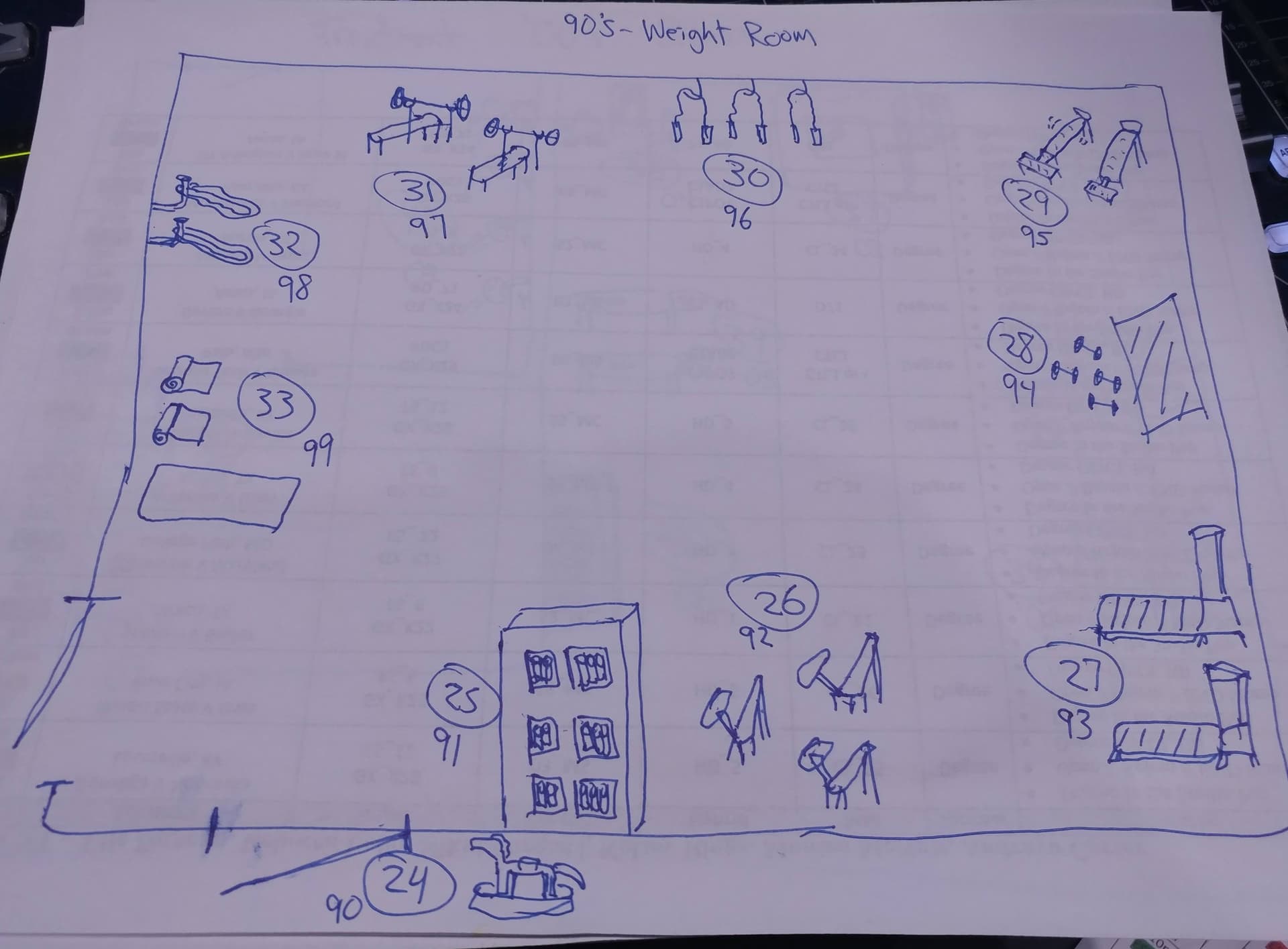
Here’s an example of one of my fictional palaces that I used to memorize Super Bowl winners/losers/scores. I created an imaginary football training facility and each area represented a decade. There were areas like Locker Room, Weight Room, Practice Field, etc. Within each area I came up with 10 items or stations that would logically be found there and linked my encoded informational imagery to those stations.

My area for the 1990’s is the Weight Room:

I did a super rough sketch of the different stations there, but it could probably be just as effective to simply use text labels.

It’s funny, I haven’t reviewed my Super Bowl stuff in probably 6 months, but just looking at this picture brings back the imagery I used and I can recall/decode it all pretty easily just by glancing again at the blueprint.

11 Likes

Days 6-8:

Admittedly my brain has shut off a bit recently because I’ve been figuring out work + travelling and seeing my partner after a holiday got cancelled, so I’ve not done much at all.

However, I did do the world countries quiz as it had been about a week since I last went over it. While my lack of a European palace definitely stumped me on Bosnia, I did recall every other continent, even if it took a second or two on some.

It’s a good sign a lot of them have still stuck, and I imagine encoding further images into each country to rememeb more about them should only serve to help it, but I definitely want to sharpen up on my capitals at some point, as well as making some more memory palaces.

One thing I’ve kind of gotten caught up on is the idea of having relevant memory palaces for certain ideas. i.e. I’m trying to encode the former UK Prime Ministers within the House of Parliament. I feel weird trying to encode the Greek gods at a friend’s house, if that makes sense? But I think that’s just a stupid blip in my brain and I’ll get accustom to having director’s films in places that aren’t pertaining to them.

My sleep schedule is all out of wack with everything going on, so bedtime reading has been off the mind! Hopefully will crack back on with Memory Craft tonight, as I have a big week ahead of me and want to keep ambitious thoughts in the mind.

1 Like

I have the U.S. Presidents encoded in my grandparent’s house. As long as you can remember where you put the info, it’s not a big deal!

2 Likes

Day 9:

I figured with how busy I knew this week would be + with how tired I’d been, that I would have only a small spur of development from the past update. And while that’s somewhat true, Memory Craft has been a massive drive in passion as it tends to be.

A very rare feeling for me is to be so engrossed in reading something that I keep at it for longer than I know I should because I’m enjoying myself that much - part of me intended to just read half of chapter 3 and call it a night, but I ended up finishing chapter 4 last night, as well as reading chapter 5 at present. I thoroughly enjoyed reading about and brainstorming around the stories and character topics.

Learning languages

As someone who majored in Japanese at university and doesn’t have much to show for it at present, it’s a bit of a sore spot for me; fortunately, reading about the effectiveness of using memory techniques as a cog in the overall machine of language learning, has somewhat helped break away from my self-pity.

Now I’m hugely interested in Kelly’s Rapscallions; there aren’t gendered words in Japanese, but there are both designated styles of adjectives, as well as verbs. Having 4 unique characters (or 5, for irregular verbs) that I can assign the traits and behaviours to may help (re)learning words hugely.

Also, coming up with a system to try and figure out how I want to learn Kanji fascinates me; attempting to encode everything relevant to the kanji (the radicals in the shape, its meaning, its readings in onyomi and kunyomi) is something that feels ambitious yet not impossible? How I’d utilise it, such as it being in a palace or not, or designating by rarity or alphabet, is something definitely for the future.

PAO

This is the big one of sorts, and it’s the one that led me to the most introspection and questions on the matter; I’ve tried to make a PAO system in the past, based on the major system, and I struggled to really make it resonate. I also felt the same about trying to use the Dominic system’s base form, as it was just hard for me to come up with a lot of the words and nothing stuck out much to me.

Reading about how Lynne Kelly has her own assigments for the system has somewhat relieved me, as I wasn’t confident about messing with the formula at risk of making it impossible for myself; so, to see that the letters were loosely defined by Kelly through their shapes and having that stick? That made me realise I need to loosen up a little about pretty much everything.

Now I’m going through the process of making my own Dominic system to see how it ends up; for example, I now have the first 3 numbers to the letters L, N & M respectively, and that one element comes from the sole lesson I had on British sign language when I was younger. It just makes sense to me and I realise that’s all I’m ever going to need to rely on.

A soft setup for me is now:

1: L
2: N
3: M
4: R
5: S
6: G
7: C/K
8: B
9: P
0: O

A mix of elements just resonating with me & the shapes aligning with a few of the numbers has given me a more familiar framework for remembeing names, and while I’m not sure how to necessarily learn PAO, I’m going to spend a few days filling in a spreadsheet.

Some other questions about it I have are:

  • How do I practice this? Do I use SRS cards to revise everything, or is that just unnecessary?
  • Wrestlers seem like a really reliable idea, as it’s something I know a lot about & different wrestlers have iconic props + moves (e.g. 57 = “Stone Cold” Steve Austin, action is flipping the bird or giving a stunner, and his object is a can of Budweiser), but I wonder if it runs the risk of being too similar.
  • Do I store them in a memory palace? Or would that inhibit me by making my mind go to a palace before recalling the number?
  • Is it worth trying to come up with actions or objects that fit the numbers rather than the person, as that might lead to more outlandish images that stick better in my mind (this is probably better fit if I try the Major system)?

Nonetheless I’m going to give it a few days to see what sticks, and if anything in particular causes issue.

Memory palaces

A small exercise I’ve been doing when I’m out and about is trying to condense more loci in a place I’ve passed. It’s somewhat hard to come up with interesting hooks near where I live, as a large swath of it is gentrified houses with not much character to their exterior, but it’s worth trying!

I managed to designate 1 specific area of my somewhat small gym I work out at, and that gave me 10 spots I can recall - my challenge is to try and get at least 50 areas to remember in there, but I might go for 100 to really exercise my brain on that front. When I have a free hour or two, I think I’ll sit down and write every memory palace/journey I can come up with, and then break each area down into as much minutia as possible.

I had one prevailing thought about palaces that I cannot remember for the life of me, so hopefully me writing this eventually knocks my brain into remembering an enquiry I had about it, but I think that’s it for now.

Generally feeling really good about it! Going to finish Chapter 5 of Memory Palace before I go to bed, but I might finish that book well ahead of schedule - if by chance someone is reading this that hasn’t yet, highly recommended.

Good to hear! I was concerned not doing something more befitting but I doubt that plays into it that much.

2 Likes

Hey everyone!

I wanted to start a discussion on building memory skills and creating accountability. Memory is such a crucial aspect of our daily lives, whether it’s remembering important information for work, recalling personal experiences, or simply retaining new knowledge.

So, I’m curious to know: What strategies or techniques have you found effective in improving memory? Do you have any favorite memory exercises or games that have helped you strengthen your cognitive abilities?

Personally, I’ve found that practicing active recall and spaced repetition have been incredibly beneficial. Active recall involves actively retrieving information from memory rather than passively reviewing it. This could be through flashcards, summarizing key points, or even teaching the material to someone else. Spaced repetition, on the other hand, involves reviewing information at increasing intervals over time to reinforce retention.

But here’s the thing - it’s easy to fall into the trap of procrastination or inconsistency when it comes to memory training. That’s where accountability comes into play. Do you have any tips or tricks for creating accountability when it comes to memory improvement? Maybe you have a study buddy or use a specific app or method to track your progress?

Let’s share our experiences, insights, and challenges when it comes to building memory skills. Together, we can support and motivate each other to enhance our memory abilities and make learning a more enjoyable and efficient process.

I’m excited to hear your thoughts and learn from your experiences!

Keywords: building memory skills, memory techniques, active recall, spaced repetition, accountability, memory improvement, study buddy, memory exercises, cognitive abilities, learning process.

3 Likes

Day 10 & 11:

Have been a bit busy with work and stress of planning travel, but I did finish chapter 5 of Memory Craft, so that counts for something!

Haven’t done much with PAO lately, but did do something I’m quite happy with, that I want to ingratiate as a strategy/tip with a reply to David’s comment.

Thank you for the input on the post! I’m really glad that someone else has a keen input on these aspects. The spaced repition sounds especially useful on recalling things, and it may do me well to have a calendar of some kind to make note of when I should be trying to recall paths + information from not too long ago.

I fell into this pitfall today; I’ve been in a small depressive slump where I’ve really found it hard to do much of anything for the past week - fortunately for me, I have memory training and techniques as some form of an escape, and there’s stull a great itch being scratched when putting something together.

While I can see that also being a struggle if you’re not engaged with the topic at hand, as I’ve tried to give myself a wide breadth of memory-related things to do, there’s almost always one thing that still sticks out to me.

This seems less of a technique or skill being picked up, but I had my first foray into using a familiar game as a memory palace. Pokemon Y for the 3DS has story beats going for it + fairly interesting world designs that can make for a slew of interesting loci.

As a somewhat curveball topic for myself, and as the game’s world is based around France, I tried to see how much information I could log in remembering France’s most populated communes.

Earnestly, I thought it’d be a struggle to remember the places I had listed within the palace, let alone the cue for the commune.

However, I think it went incredibly promising.


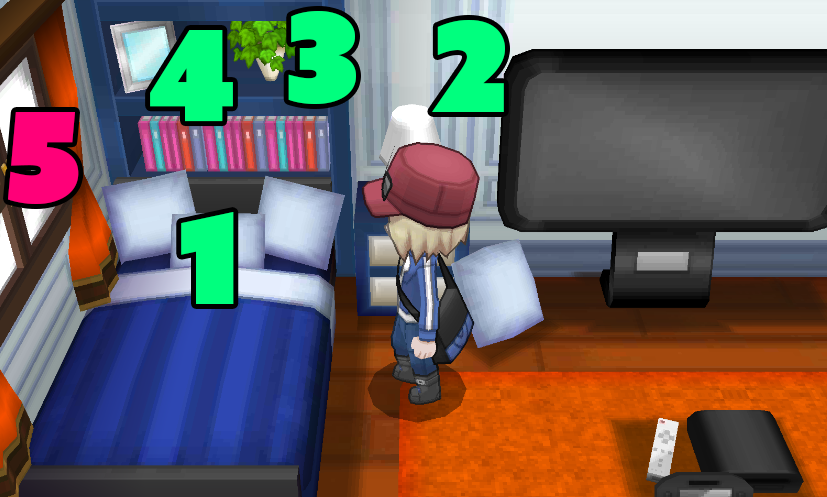
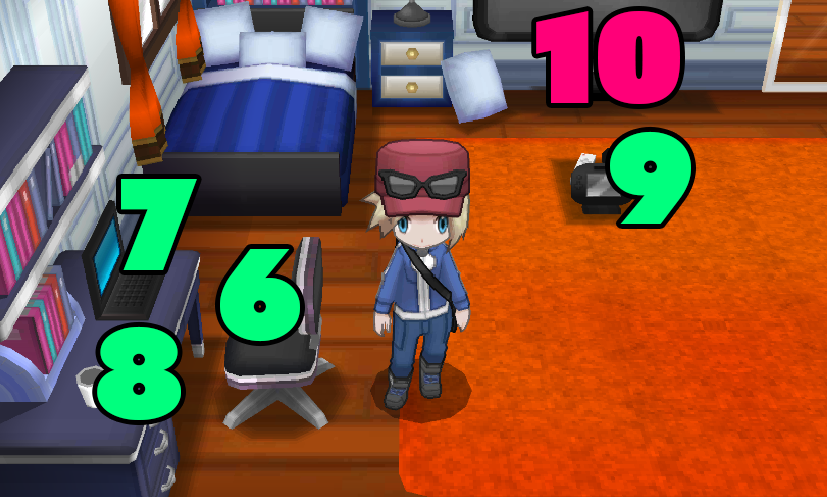
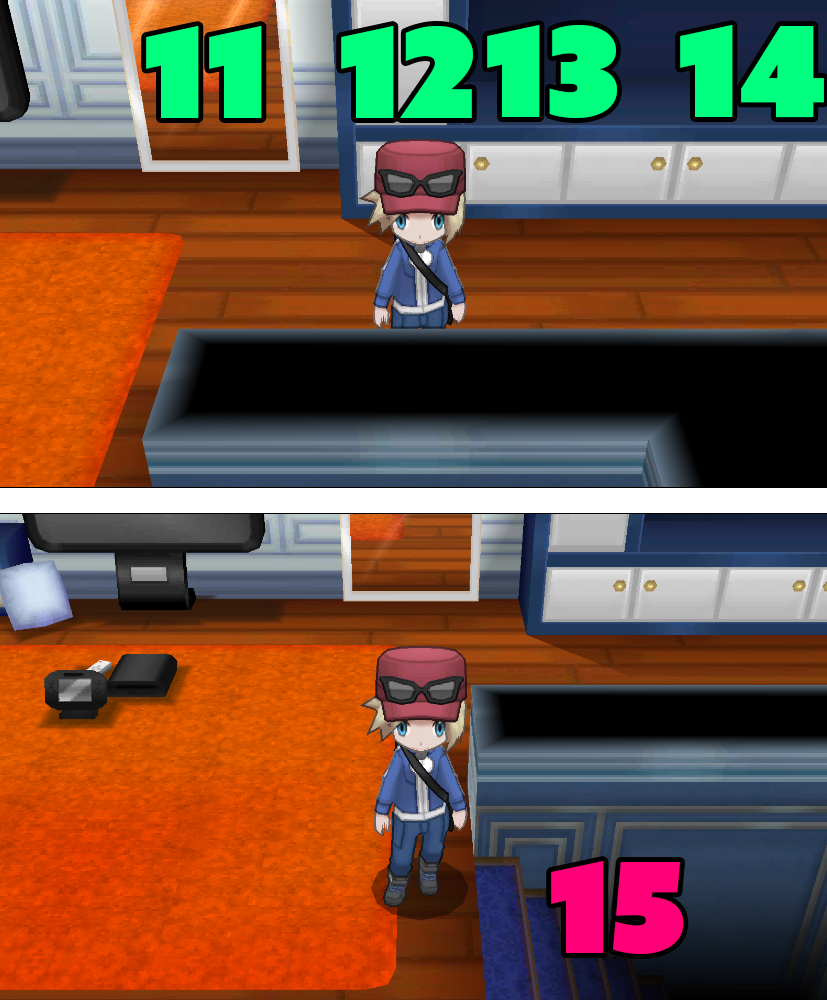
Above me is the first room of the game, and I’ve numbered each area I’ve placed. Even now, without looking at it, I can recall and place the first 15 communes in the palace, without much struggle (except the 14th commune, Saint-Etienne - it’s Saint Stephen and I occasionally forget the spelling every now and again for its French pronunciation).

As a small idea of what goes through each one:

1). My friend had an ex called Paris, which made the 1st spot rather easy to recall;
2). There’s a wrestler with the name ma.çé, which has a strikingly similar pronunciation to Marseille, so he is playing with the lamp by the desk;
3). A person named Leon has taken the shape of the plant;
4). There’s a photo of a tragic defeat - A.K.A, something to(u)lo(u)se - is 4th;
5). My ni(e)ce has repeated the intonation and style of saying the word nice like how Michael Rosen says it in this video

That’s the first 5, at least, and I’ve done something similar for the following 25.

I haven’t ever explored this place - in all honesty, I’ve barely played this game much relatively to others. But I’ve been able to encode the 30 most populous communes of France pretty securely, and though my pronunciation of the places and recall of their spelling is a bit dire, it’s proved to me that you can take something rather abstract, on a topic I have no real idea about, and still effectively remember things.

I’m definitely going to go on a few nostalgia trips, or plunges into new virtual worlds, and see how much I can encode, and what specifically I can remember. It’s an encouraging sign!

2 Likes