The technique
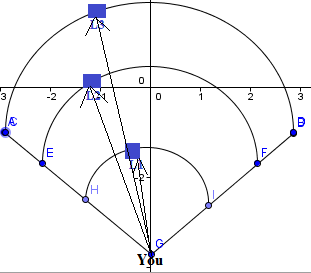
I call it Backgrounding Techique (BT). Previously it was known as BFT (Behind->Front Technique), but in my opinion that was a stupid and confusing name for such a good method. The new name represents the main idea very accuraterely - the goal is to make the images you've already placed along the journey to be visible - you see them in background, you background them. The easiest way to do it is to generally move backwards, as opposed to the way we usually walk.When I say generally, I don’t mean always. For example when you are in a room, then it’s very convinient to just stand in the middle and rotate yourself, thus you don’t move at all. I’m saying one could try moving backwards if the place is convenient for it, and when it benefits (see the 2 reasons below and when exactly they’re useful).
For example, look at this Josh’s picture:
It starts moving down the stairs (backwards), then side-ways, forward, then perhaps standing before the door and rotating yourself through the loci 7-13, and finally again backwards down the doorstep. All in all you try to move naturally. But in general we did move backwards, and a big part of the loci are visible all the time.
For example, take the stair. When we’re at the current locus (say 3), we like to zoom in to it to place the image, and of course at that moment we don’t think about the images we placed at 2 and 1. But then we move on to 4, and what will our mind do in that brief moment? It likes to zoom out to better navigate the place, and why not use that moment to see all 3 images in the background (BG)? This is for 2 reasons:
- You fix the images better in your memory.
- It's super easy to link these images this way.
Here I must emphasize that this isn’t what you want to turn your attention on when you’re doing mnemosports - then you just jump from one locus to another, and don’t think about the images you’ve already placed; essential is achieving the max speed, and those things will only slow you down. But in education? Then this technique suddenly becomes very useful.
You don’t have to even think about the “passed through” images. Just occasionally seeing them in BG will aid in memorization, since your unconscious mind still processes them. It’s good to take a pause to consciously review them, when you’ve already placed a bunch of images (say 5-10) and start forgetting the first ones. And you’ll also be consciously thinking about them when you start making links/associations between them, that’s what the whole education is about: connect new info to the one you’ve already learned.
But what would have happened if you had moved up the stairs - you go 5->4->3->2->1. Now it’s just more bothering to zoom out, your mind doesn’t need to do it to navigate any more. And thus you never see the images in BG: for review/making links between them you consciously have to move back to 5. Also the same happens when you’re rotating yourself - in order to see all images together, you consciously have to think yourself floating high above the room, and then make the necessary links. Whereas moving backwards it comes more naturally, since loci themselves move to the BG without you having to think about it.
So, that was the basic idea about the technique - moving backwards makes it easier to review/link images.
About linking in education:
In mnemonics we can link P and O via A (PAO), we associate them into the same chunch. In education that P doing A to O is just an observation, it yet doesn't have a specific causality in it. What caused what? Did P cause a change in O via the A? Or does (PA) mean that there must be only that particular O: (PA)->O. So, you see, in mnemonics we usually purely rely on our associative memory, we just observe, the links don't have much causality in it ( (PA) could have done that do any O, not that particular one; it did it to that O because it just did, it doesn't need a reason).On contrary, in education much more is needed - the more associations you make, the more beneficial it usually is. Everything is linked and has a reason for happening; and the better you understand the reasons, the better you can predict what will happen in certain situations, and do your job. Now, are you starting to get why linking images is useful? And not just in palace, not spatially and even not visually, but all the time just thinking and thinking about the associations - trying to find them, comparing them, categorizing them, and trying to deduce what’s missing here. Don’t let palaces, visualization or any mnemotechnics slow you down if you’re having a good idea or have to study/do your job quickly, then just brainstorm and write it down. Later when you have time and decide it’s worth it, do the mnemonics to better retain it in your memory.
On the topic - here I mean spatial linking in the palace. Comparing, grouping and deciding which images are more important than others. Then it’s good if they can easily seen in the BG. And that can be achieved when considering the technique I described above. Still, don’t let it become unnatural. E.g. if instead of generally moving backwards you do it all the time, then what you get is a straight line, and that’s bad: linear journeys are never good - it’s bad to navigate and memorize them.
Examples from education:
Cause and effect
These are all old examples. I have placed the cause behind the effect, since we move backwards (cause comes first).1. Social sciences - history
We like to learn the events following the timeline - from past to future. Let's try to let the past events be seen in the BG, which will fix them better in your memory, and allows you to easiy make the links between them.For instance: Molotov-Ribbentrop pact allowed German to invade Poland and Soviet Union to invade Baltic states. We place the pact up the stairs, and the invasions at loci 2 and 3 respectively. See how super easy it is now to just take a peek up the stairs again, and tell yourself: yes indeed, soon Hitler and Stalin made the pact real: one invaded Poland, the other Baltic states.
Fall, 1939
If we moved up the stairs and placed the items to 3, 2 and 1 in that same order, then at 2 and 1 we won’t see the pact in BG any more, and we may forget to consciously link them to pact (if you notice that you rarely make any links between your thoughts/images, then your learning technique is poor; consciously making links helps you to better understand the material, and also better memorize it).
So, this is just an idea how to place things. Obviously you can’t follow the system all the time, because when you get more and more events you start getting links between very far events.
For example, locus 103: 50 years later, Estonian delegation went to Moscow, and protested against the still-lasting occupation, claiming that the pact contained an untold conspiracy between Germany and Soviet Union (who had “the right” to invade which country). So, by that time you may be in another palace already. Also, you won’t be always moving bacwards (loci 7-13). Then you can just zoom out and connect the events side-ways.
The following examples 2 and 3 are for science learners, and are more advanced.
2. Physics - System+equations. Causality.
- When solving a problem, you have:
- The system you want to describe
- Already-know equations
- Final equation you try to find
I’m not saying you should take all of them from your paper and place them to your palace. But if you have an exam coming, and you have to be able to make that long derivation to the final equation, then you could place some of the derivation along the journey. Especially the sketch (where you highlight the initial equations in your mind), and the final equation. What aids even more in memorizing an equation, is when you let the sketch-geometry and the equation interact with each other.
Right triangle altitude theorem - When we are not so mathematical, then it's better to think in terms of cause and effect. We just try to visualize, which also great scientists like Einstein liked to do all the time. For example when an atom absorbs light (1), it's electron becomes excited (3). The effect isn't always excitation, instead it could also increase the vibrations in the molecule the atom is bound to (2). Or make the atom emit more light than it absorbed (4; the effect used in lasers).
Now just visualize the stair and fluently try to play them through in your mind: 1->2, 1->3 and 1->4. Cool isn’t it? Note that I wanted 3 and 4 to be next to each other, because they are similar (both apply to single atom, don’t need to be in a molecul) - another link made.
For example you placed the right-angled triangle, and it remains visible when you move on to memorizing the equation. Now you let the parts of the equation float to the right place onto the triangle. It helps you to associate symbols with their meaning.
Here I try to visually associate the Ideal Gas Law symbols with its BG sketch (gases of Mount Doom 
Click here to read the full example of memorization this eqution Here’s my full up-to-date tutorial for memorizing equations.
3. Maths - proving theorems
In math every theorem has a presumption and statement (deduction). I had to memorize/prove more than 100 definitons/theorems twice - first semester for Mathematical analysis course, and the following semester for Algebra. Both ended with written exam, picking ca 5 random theorems and/or definitons we had to prove/explain.What I made my routine was that when starting to prove a new theorem, I also placed its title on a single A3 sheet and drew arrows to illustrate which theorems/definitions above I used to prove the current theorem. While proving it I also placed some images into palace {trying to visualize (sketch) the presumption&statement + a glimpse of some equations/theorems I used to prove it}.
This is something of what my A3 sheet looked:
A sheet of theorems
Later at exam when proving a theorem, I first thought of the A3 sheet - it gave me very good overall view of the theorems/definitions (won’t mix them up), then tried to remember which theorems above I used to prove the current one, and finally jumped into the palace where I’d placed the to-prove theorem, and it gave good overall reminder what I had to do.
And now, a year later, I can still remember a lot of these definitions/theorems.
So, again were using what you already know to link to/prove/predict sth new. The final example illustrated how complex it can go, and in that case how useful the right placement (A3 sheet) can be.
I’m going to take a break here; soon going to update the following examples.
Grouping
Cause and effect can also in a way be thought as a superclass and its subclass (from programming languages or biology). We use it to store info that can be grouped into classes and subclasses. Because the subclass has all the properties that its superclass owns, we only need to store the superclass properties and we don't need to place again these properties into the subclass loci also. We just place superclass with all it's properties behind and subclass starts after its superclass (we build a border between them). Now we just add these extra properties that only the subclass has.-
Biology - cats
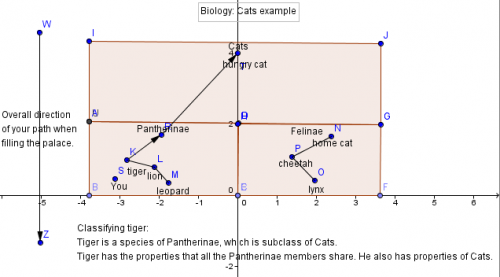
We have superclass : Cats. Its subclasses: Pantherinae and Felinae. Pantherinae members: lion, tiger, leopard etc (here super- and subclasses are actually Family and Subfamily if to speak in terms of taxonomy).
Felinae members: home cat, cheetah, lynxes etc. I place my cat (it symbolyses class Cats) into the living room (which is most behind), Pantherinae and Felinae go to kitchen and dining room respectively (kitchen and dining room are in front of living room, dining room right of the kitchen). Kitchen: I let a lion prepare a cake, tiger serves it and leopard cleans up afterwards. Dining room : my white kitten sits on a chair and eats the cake, cheetah runs circles around the table and begs some leftovers, lynx climbs on the table and steals the cake (this is called linking).
To remember the properties (the thing that all members of a class share) I use the members of the class. Cats: all its members look like a cat, they can protract claws out and are carnivores. My brother sits on armchair watching football. Hungry cat sticks her claws out and starts clawing the sofa, demanding brother’s attention. Brother doesn’t notice, so the cat attacks my brother, bites a collop out and fills her hunger.
These properties expand to subclasses’ Pantherinae and Felinae members too, I can visualize e.g. how a random member, e.g. the tiger walks into the living room, replaces the cat and starts eating my brother.
Properties of Pantherinae: they roar. Lion preparing the cake starts roaring. Felinae: they are usually smaller. My kitten becomes even smaller and gets lost into the cake it’s eating. -
Physics - elementary particles.
Elementary particles can be divided into fermions and bosons. Fermions can be divided into quarks and leptons. Each class has its own properties (quantity of spin, existence of mass, electrical charge quantity). -
Math - differential equations
There are first order equations, 2nd order and so on. 2nd order can be linear (subclass of second order), linear homogenous with constant coefficents (sc of 2nd order linear), linear nonhomogenous with constant coeffeicents (sc of 2nd order linear homogenous with const coefs). When we solve the last one we need first to know how to solve an equation from its super class (a homogenous with const coefs). We place the method for solving its super class equation behind and the extra technique (e.g. variation of parameters) that is necessary to solve the nonhomogenous equation in front. To solve the nonhomogenous eq we first take the method from behind (we always see that), solve its homogenous equation and then use the result to solve it’s nonhomogenous part (using the variation of parameters technique). Voila! Equation solved!
This kind of placement system has proved really effective for me (especially when I compare my new palaces with to the older ones, where I used not to divide my palaces into linear journeys and walked forward, not back). My later subjects in maths and physics just become subclasses of the previous ones and I can see how exactly they are derived from their previous ones. And as I already said, there is no point of memorizing without understanding.
Calm down, if it was too much to grasp at once:
Note that classes and subclasses are just more technical words for grouping, which we do ALL THE TIME. For example: your facebook friends, a part of them is your family, a fraction of them are your best friends. Or clothes - jeans, shirts,…; cars; computers… Almost every word can be thought as a group, that has its distinguishing feature. Our whole thinking bases on grouping similar thoughts together. Sadly it’s where a lot of misunderstandings come from (racism, prejudicism…), and that’s what makes individuals different - each one has its own way of grouping his/her thoughts. Grouping is also what leads to great discoveries - can you think outside of box, say that “no, it works actually like these things, it shares a similarity with them, they belong in the same group…”
Good luck applying the ideas mentioned here:)